Use this guide for
Match a Civic year and configuration to the problem patterns that actually apply.
Boundary: Use the years-to-avoid page for purchase-year ranking, or troubleshooting when you already have a symptom.
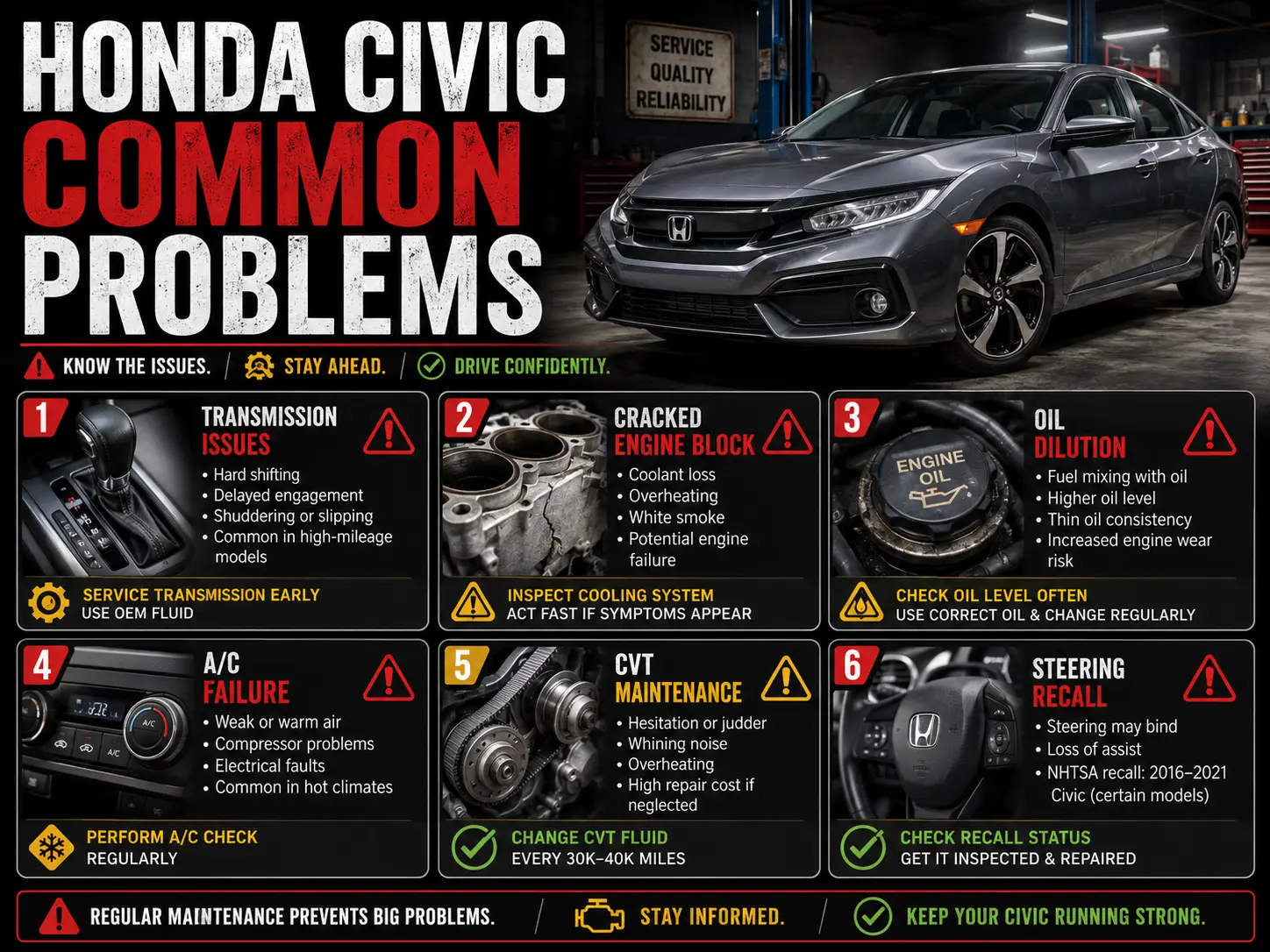
Honda Civic common problems are not one uniform list. The useful question is: which problem can actually apply to this Civic’s year, engine and transmission? The table below is the fastest route from configuration to the failure pattern worth checking.
Match the Civic to the problem first
| Years/configuration | Problem pattern | What the driver may notice | Use this next |
|---|---|---|---|
| 2001–2005 automatic | Automatic-transmission wear or failure | Delayed engagement, slipping, flare between gears, loss of drive | Transmission problem map |
| 2006–2008 and some early 2009 1.8L cars | Engine-block coolant leakage | Repeated coolant loss, overheating, dried coolant residue | Cooling-system inspection before parts guessing |
| 2014–2015 CVT | Drive-pulley recall context | Warning lights, abnormal operation, possible acceleration loss | Civic CVT guide |
| 2016–2018 1.5T | Fuel dilution of engine oil | Oil level rising, fuel odor, cold-running concerns | Oil-dilution evidence guide |
| 2016–2021 | A/C condenser or related refrigerant leakage | Weak A/C, cooling that fades after recharge | A/C diagnosis and coverage |
| Recall-eligible later Civics | Fuel-pump impeller failure | Hard starting, hesitation, stalling or no-start | Fuel-pump recall and VIN check |
| Recall-eligible newer Civics | Steering gearbox concern | Sticky, notchy or increased steering effort | Recall workflow |
This page owns problem applicability, not year rankings
Use this guide when you want to know what can go wrong and whether it applies to your configuration. If the question is which years are the riskiest to buy, use Honda Civic years to avoid. If the question is overall long-term dependability, use Honda Civic reliability. Keeping those jobs separate prevents a broad “problems” page from competing with every other Civic page.
Early-2000s automatic transmission trouble
On seventh-generation automatic Civics, the transmission deserves its own warm-road-test decision. A car can feel acceptable immediately after startup and begin slipping, flaring or delaying engagement after the fluid is hot. Fresh fluid is not proof of a healthy unit, and fluid service does not repair an already slipping transmission.
For a 2001 specifically, use the 2001 Civic transmission guide, which narrows the diagnosis further.
Coolant loss from the block on some 2006–2009 1.8L Civics
Honda acknowledged coolant leakage from the engine block on certain 2006–2008 and early-production 2009 cars through a warranty extension. In a used car today, the evidence that matters is whether there is unexplained coolant loss, prior overheating or a documented block replacement.
If the seller says the car “uses a little coolant,” do not jump straight to a hose or radiator assumption. A cooling-system pressure test and inspection for dried residue are better next steps.
2014–2015 CVT: a different transmission question
The later CVT should not be lumped together with the early-2000s conventional automatic. Certain 2014–2015 Civics were recalled for a drive-pulley problem. That makes VIN status and campaign completion part of the diagnosis, alongside fluid history, warning lights, shudder, abnormal noise and inconsistent acceleration.
Early 1.5T oil dilution
For early turbocharged Civics, the useful evidence is the operating pattern and oil history. Repeated short trips in cold conditions can make dilution concerns more relevant. Check the oil level before driving, note a strong gasoline odor, review change intervals and ask how the vehicle was typically used. None of those observations alone proves a mechanical failure; together they help decide whether deeper inspection is justified.
A/C that goes cold after a recharge and then fades again
Repeated refrigerant loss is a symptom, not a repair plan. Certain tenth-generation Civics received extended coverage for condenser leakage, with separate compressor shaft-seal coverage in some cases. The exact diagnosis matters because not every A/C fault is covered by the same program.
Fuel-pump and steering recalls: VIN beats model-year guessing
Fuel-pump and newer steering campaigns illustrate why recall problems belong to a VIN-based workflow. A model year may contain affected and unaffected cars, and a completed remedy changes the purchase evidence. Use the recall page to identify campaign status before treating a drivability or steering symptom as proof of the recalled condition.
What to do when the symptom does not fit the table
Do not force an unfamiliar noise, warning light or leak into a “common Civic problem” simply because the car is a Civic. Start with the actual symptom. The Civic troubleshooting guide routes symptoms to the most relevant system before a part or failure mode is assumed.
Before buying a Civic with one of these warning signs
Confirm the exact engine and transmission, run the VIN, inspect the car cold and fully warm, scan stored and pending codes, and require repair invoices for major work. A documented repair can make a supposedly risky year a better buy than a neglected “safe year.” The used Civic inspection checklist puts those checks in order.
Evidence boundary
A recall, technical document or recurring owner-report pattern identifies an inspection priority; it does not prove that every Civic in the year range has the defect. Individual condition and service history remain part of the answer.







