If you’re shopping for a used Honda Odyssey and someone tells you “the transmission” like it’s one thing, they’re skipping the most useful part of the story. This van has gone through six different automatic transmissions since 1999, and the failure pattern resets almost every time one of them changes. Some years are genuinely dangerous to buy without checking a recall number first. Others get a bad reputation they don’t really deserve, dragged down by association with the year next to them. The worst offender, by a wide margin, is 2002 — the year Honda swapped in a brand-new 5-speed automatic and it promptly started overheating its own second gear badly enough to trigger a federal recall. If you remember nothing else from this page, remember that: 2002–2004 is the era to be careful about, and everything else here is detail in service of that one decision.
The Short Version, If You’re Standing in a Driveway Right Now
2002 through 2004 is the era to be most careful about — that’s NHTSA recall 04V176000, a genuine safety recall covering roughly a million Honda and Acura vehicles for a second gear that could overheat and fail outright. 1999 through 2001 has its own, separate problem: an earlier 4-speed automatic with a bearing that wore out early enough that Honda extended the warranty on its own, then got sued into extending it again. Everything from 2005 through 2017 is comparatively quiet, with one real but minor exception — a torque-converter judder on 2011–2017 vans that Honda diagnosed as a fluid problem and fixed with a software update and a flush, documented in the company’s own technical bulletins. And the current generation, 2018 onward, splits into two different transmissions by trim: a 10-speed on Touring and Touring Elite that has a real recall for shifting itself into Park while you’re driving, and a 9-speed on everything below that which hasn’t been recalled but has generated enough shudder complaints to end up in active class-action litigation. None of that means every Odyssey with a bad transmission year is a lost cause, and none of it means every Odyssey outside those years is safe by default — it just means the risk isn’t evenly spread, and now you know where it actually sits.
Honda Odyssey Transmission Problems by Year
| Years | Transmission | The actual problem | Documented by |
|---|---|---|---|
| 1999–2001 | 4-speed (B7XA/B7TA) | Early bearing wear, metal debris through the case | Voluntary Honda warranty extension; 2006 class-action settlement |
| 2002–2004 | 5-speed (BYBA), all-new for ’02 | Second gear overheats, can chip or fracture — the worst year in the lineup | NHTSA recall 04V176000 |
| 2003–2004 | Same 5-speed, unrelated part | Ignition interlock lever can deform, key removable out of Park | NHTSA recall 12V573000 |
| 2005–2010 | Revised 5-speed | No broad recall found — the quietest stretch in the model’s history | — |
| 2011–2013 | 6-speed (Touring/Elite) or 5-speed (others) | Torque-converter judder from degraded fluid; also early surge/hesitation complaints | Honda TSB 12-064; 17-052/18-017 |
| 2014–2017 | 6-speed, now standard across trims | Same judder pattern, all trims; separate lawsuit over broader shift quality | Honda TSB 17-043 |
| 2018–2019 | 9-speed (LX–EX-L) or 10-speed (Touring/Elite) | 10-speed can reboot and shift to Park while moving; 9-speed draws shudder complaints | NHTSA recall 19V299000; ongoing litigation |
| 2020–2024 | Same 9-speed/10-speed split | No new broad recall found, but less mileage on record so far | — |
1999–2004: The Second-Generation Odyssey Learned Its Lesson Twice
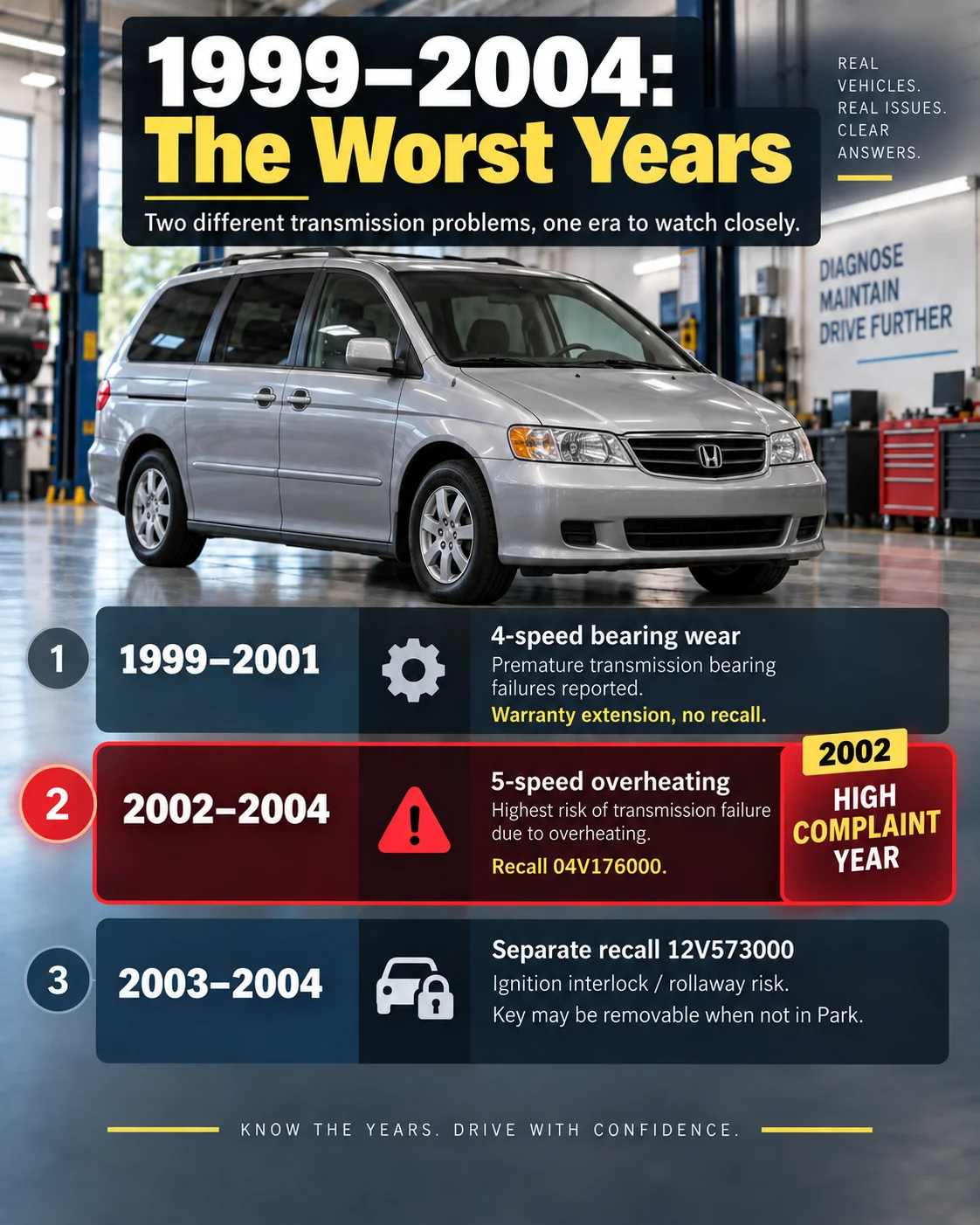
The Odyssey that launched for 1999 was, by most accounts, a genuinely good minivan — roomier than its predecessor, better to drive, finally a real competitor to the Chrysler minivans that had owned the segment for a decade. The transmission didn’t get the memo. A specific bearing inside the 4-speed automatic wore out earlier than it should have, and when it did, it didn’t fail quietly — it shed metal through the transmission’s internal oil passages, the kind of failure that tends to take the rest of the unit down with it. Honda never filed a formal recall over it, which tells you something about how NHTSA’s recall threshold works: enough people had transmissions fail that Honda extended the factory warranty to 7 years or 100,000 miles on its own, and that still wasn’t the end of it. A 2006 class-action settlement pushed coverage even further for affected owners, to 93 months or 109,000 miles. If you’re looking at a 1999–2001 Odyssey today, every one of those windows has long since closed by mileage or by calendar, so what you’re really buying is a van with a documented history of early transmission failure and no coverage left to fall back on. Ask for records. If there aren’t any, budget accordingly.
Then 2002 happened, and things got worse before they got better. Honda replaced the troublesome 4-speed with an all-new 5-speed automatic — internally, the BYBA — and the new unit turned out to have its own, more serious problem: under certain driving conditions, heat built up between two of its internal gears badly enough to chip the gear teeth or break them outright. This is the one that actually became a federal recall. NHTSA opened campaign 04V176000 in April 2004, and it wasn’t small — it covered roughly a million Odyssey, Pilot, MDX, Accord, TL and CL vehicles built with the same transmission family. The agency’s language about what could go wrong is about as direct as these things get: gear failure could lock up the transmission, and that could cause a crash. Vans with low mileage at the time got a revised oil cooler line; vans with more miles got inspected for the telltale overheating discoloration and had the whole transmission swapped if it was there. Separately — not part of the recall, just a known weak spot — a lot of these same 5-speeds also wore out their third-gear clutch pack early, which is where a lot of the “slips and hunts for gears” complaints from Odyssey forums of that era actually come from.
Every complaint tracker that breaks Odyssey data down by model year — CarComplaints, Car Talk, several others — lands on the same conclusion: 2002 is the single worst year this van ever had for transmission trouble, with an average repair bill hovering around $3,400 and failures showing up well under 115,000 miles in a lot of reported cases. If there’s one VIN check on this entire page that actually matters, it’s confirming recall 04V176000 was completed on any 2002–2004 Odyssey you’re considering.
One more thing worth knowing about 2003–2004 specifically, because it’s easy to confuse with the recall above: NHTSA campaign 12V573000 covers a completely unrelated defect on some of these same vans (and the related Acura MDX), where the ignition switch’s interlock lever can deform enough to let the key come out without the shifter actually being in Park. It’s a rollaway risk if the parking brake isn’t set, and it has nothing to do with the transmission’s internal gears — check both recalls separately.
2005–2017: The Quiet Decade, and the Fluid That Wasn’t Quite Right
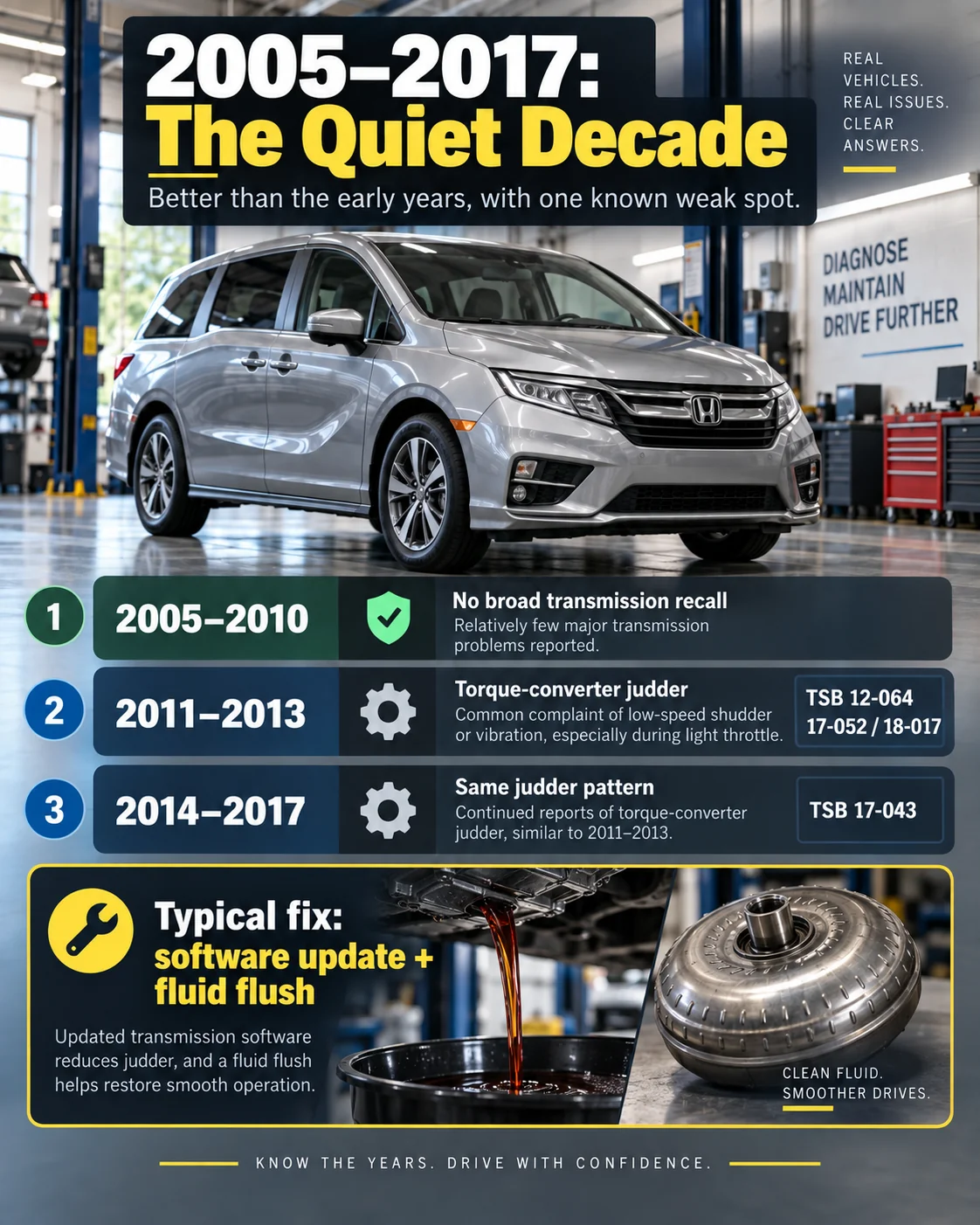
Whatever Honda learned from the 2002–2004 debacle, it applied it. The third-generation Odyssey (2005–2010) kept a 5-speed automatic but a revised one, and the complaint volume drops off noticeably — no broad NHTSA transmission recall turned up in the records reviewed for this guide. That’s not a guarantee on any individual van this age, but it’s a genuinely different risk profile than what came before it.
The fourth generation (2011–2017) introduced a real but much smaller issue: a torque-converter judder, felt as a shudder somewhere between about 20 and 60 mph. Honda documented it themselves, across a series of technical service bulletins — 12-064 for early 2011–2012 Touring and Elite models complaining of surge and hesitation on upshifts, then 17-052 and its follow-up 18-017 for 2012–2013 Touring/Elite vans with the judder specifically, and finally 17-043, which extended the same diagnosis to every 2014–2017 Odyssey once the 6-speed became standard across the whole lineup. What’s notable here is what Honda’s engineers actually found: not a bad torque converter, but transmission fluid that broke down faster than expected under sustained high-heat driving. The fix, in every one of those bulletins, is a software update followed by a full fluid flush — not a transmission replacement. Owners have also brought a broader class-action claim covering 2011–2016 Odysseys alleging shift and acceleration problems beyond just the judder; that’s litigation, not an adjudicated defect, and worth knowing about rather than worrying about. If you’re looking at a 2011–2017 Odyssey and the seller can show you paperwork for this exact service, that’s a good sign — it means a known issue was actually addressed instead of ignored.
2018 and Newer: One Recalled Transmission, One That’s Still Being Argued About
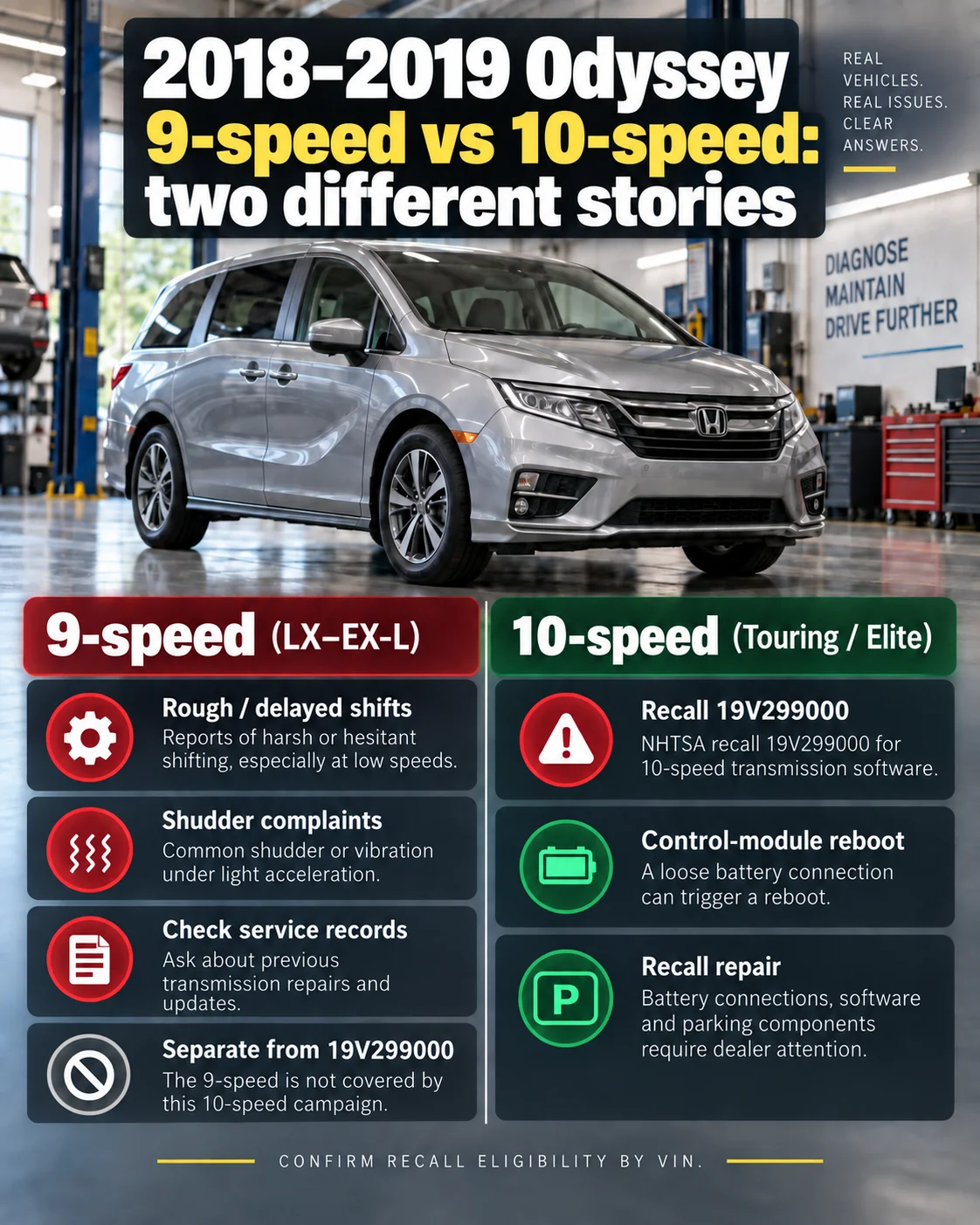
The current-generation Odyssey splits its automatic by trim — a 9-speed on LX, EX and EX-L, a 10-speed on Touring and Touring Elite — and the two units have completely different reputations.
The 10-speed has an actual, confirmed federal recall. NHTSA campaign 19V299000 covers about 50,000 of the 2018–2019 Touring and Touring Elite vans: a weak or loosely connected 12-volt battery can reboot the transmission’s control computer mid-drive, and on rebooting, the computer can shift the van into Park while it’s still moving — which can damage the parking rod and, if the electronic parking brake isn’t separately engaged, let the van roll. Dealers fix it for free: secure the battery terminals, update the control software, inspect and if needed replace the transmission and parking rod. It only applies to Touring and Touring Elite; the 9-speed on lower trims isn’t part of this campaign at all.
The 9-speed’s story is murkier, and it’s worth being honest about that instead of pretending it’s settled. Owners have reported rough, delayed and harsh shifting, and enough of them have that it’s become the basis of ongoing class-action litigation against American Honda. No NHTSA recall currently covers this specific shudder pattern. That’s a meaningful distinction — litigation documents a pattern worth taking seriously, but it isn’t the same evidentiary bar as a completed federal recall determination. If you’re looking at an 2018–2019 Odyssey with the 9-speed, the most useful thing you can do is drive it yourself, cold and then again once it’s fully warmed up, specifically watching for shudder at light, steady throttle in the 25–45 mph range. A quiet test drive doesn’t prove the transmission is fine, but a shuddering one tells you everything you need to know before you sign anything.
Model years 2020 and later carry the same 9-speed/10-speed pairing forward, and no new broad recall has surfaced for them in this review — though it’s worth remembering that also just means there’s less real-world mileage behind those model years than behind the ones discussed above.
What It Actually Costs to Fix
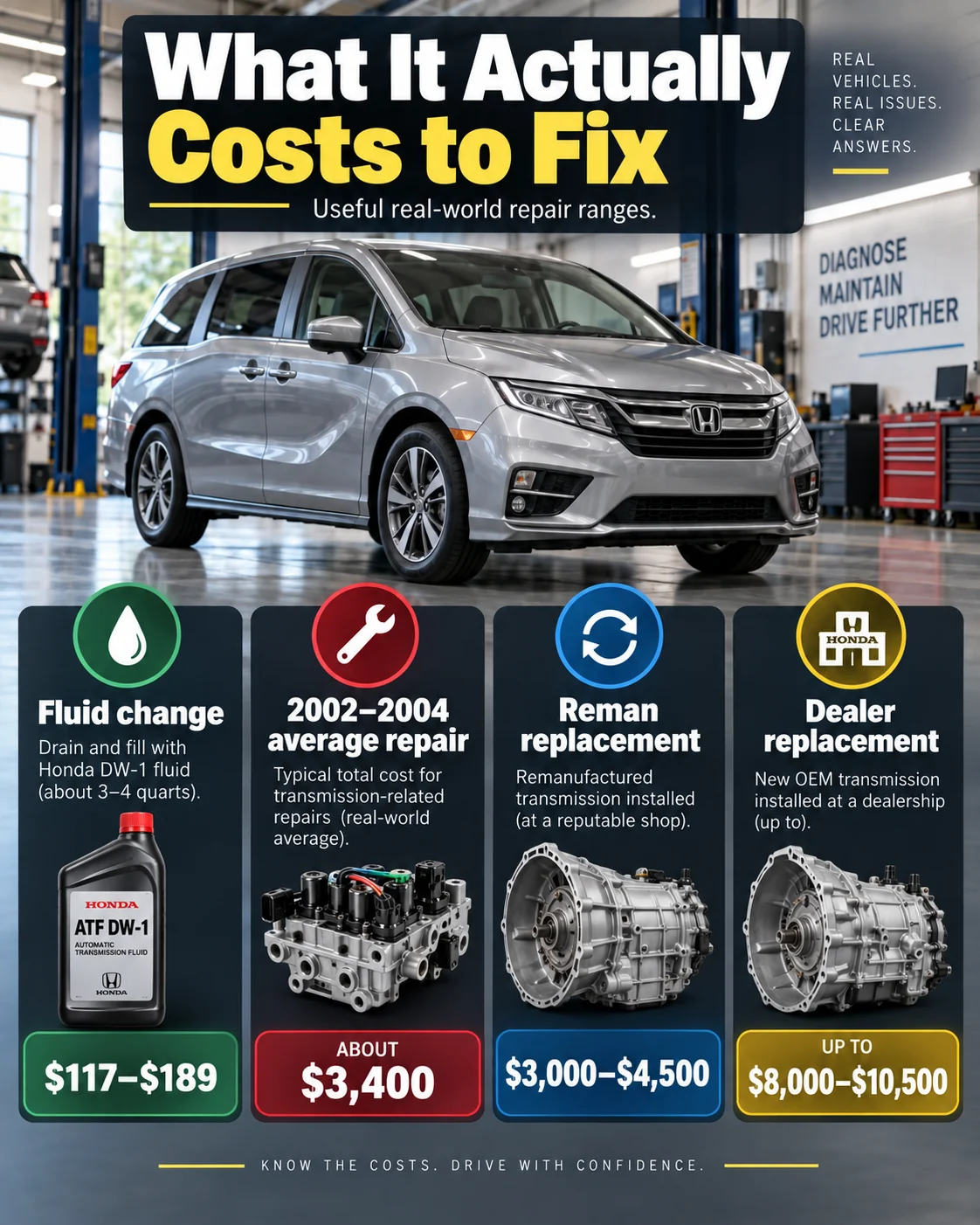
None of these numbers are a quote for your specific van — your ZIP code, your shop, and whether you go new, remanufactured or used will all move the total. But they’re a genuinely useful sanity check. A straight fluid change runs somewhere in the $117–$189 range depending on model year, and it’s the right first move on anything that looks like judder rather than outright failure. Owners with a full 2002–2004-era transmission failure report an average repair cost around $3,400–$3,442, according to the complaint trackers that publish this kind of data. A remanufactured replacement at an independent shop typically lands between $3,000 and $4,500; the same job at a dealer, especially with an extended warranty attached, can run considerably higher — into the $8,000–$10,500 range in some reported cases. Get two quotes, minimum, one from each kind of shop, and get in writing exactly what you’re paying for — new, remanufactured, or used, and what happens if it fails again.
Before You Hand Over a Check
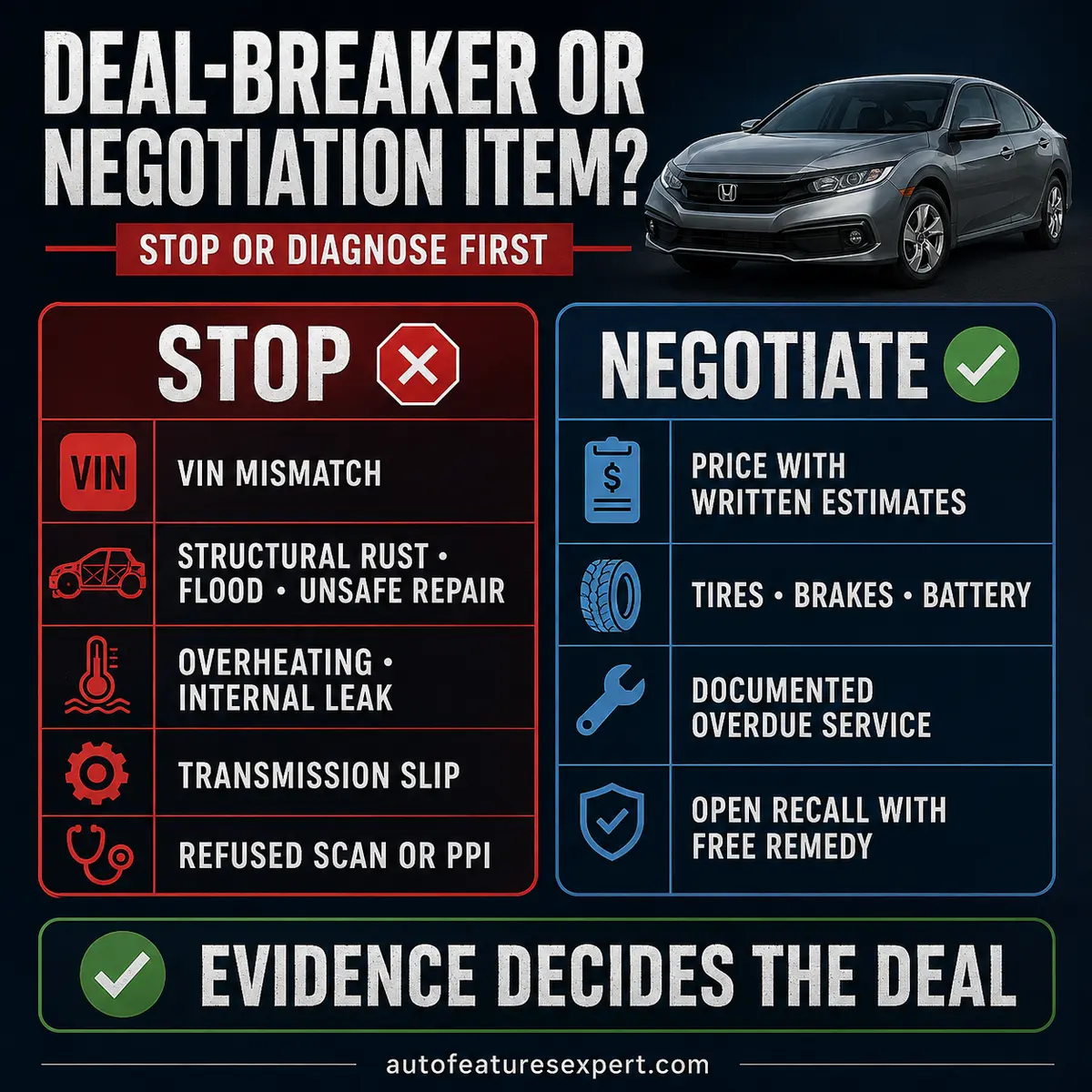
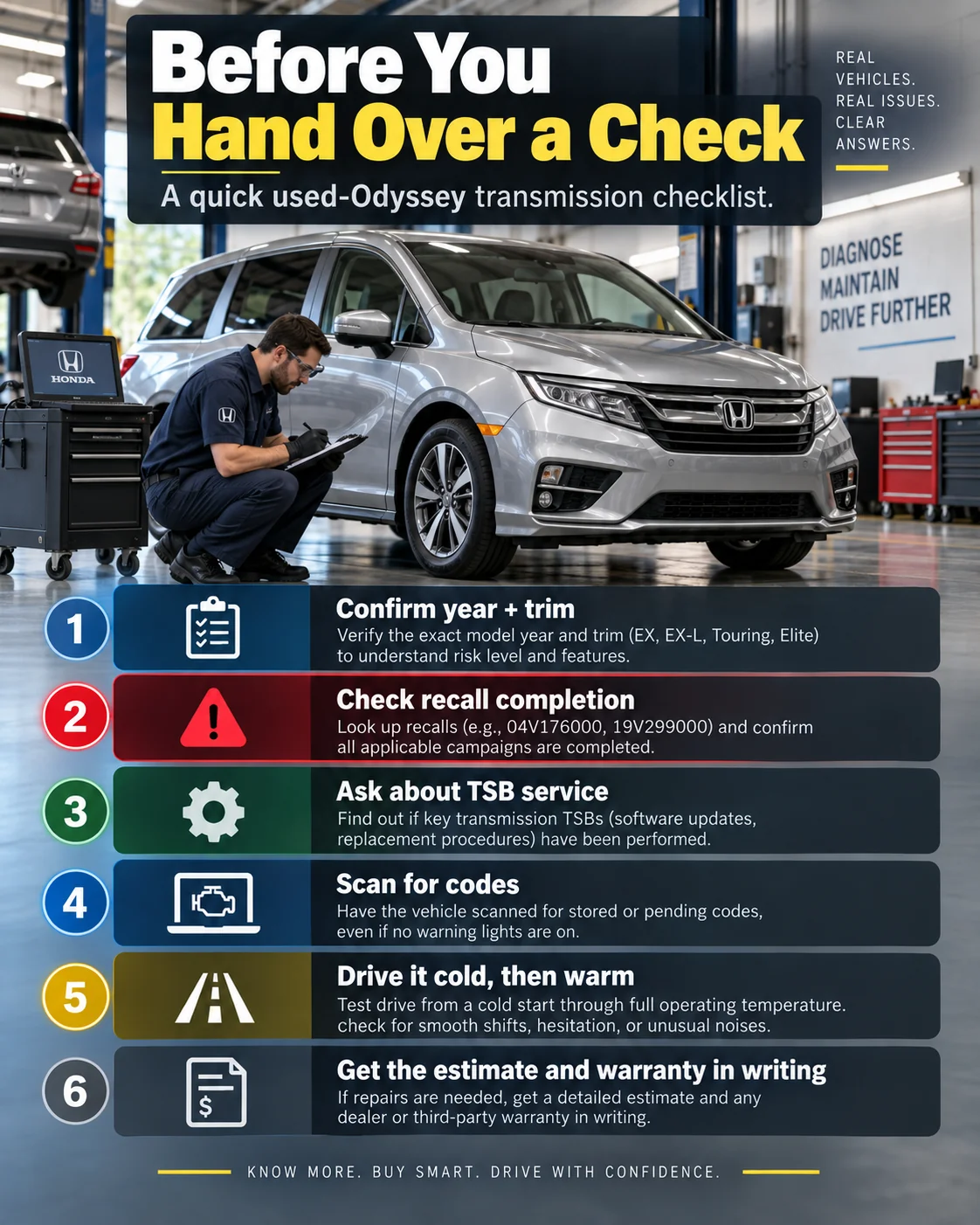
Confirm the exact transmission first — year and trim both matter, since a 2012 Touring and a 2012 LX don’t share a gearbox. Run the VIN through NHTSA separately for every recall that could apply; a 2003–2004 van can legitimately carry two unrelated ones. On an 2011–2017 van, ask specifically whether the judder-related service bulletin was performed and whether the fluid was actually flushed, not just the software updated — those are two different levels of “fixed.” Scan for codes before anyone clears anything, since pending codes and freeze-frame data often say more than a warning light does. Drive it cold, then drive it again once it’s fully warmed up, since judder and hesitation both tend to hide until the transmission’s at operating temperature. And whatever a shop tells you needs replacing, get the actual failed component, the supporting codes, and the warranty terms in writing before you agree to anything.
A Few Things People Ask Directly
What year Honda Odyssey has the most transmission problems? 2002, specifically, with 2003 and 2004 close behind it — all three share the 5-speed covered by recall 04V176000, and every independent tracker that breaks Odyssey complaints down by year agrees on this one.
Is the 9-speed transmission in the 2018–2019 Odyssey reliable? It’s not recalled, but it’s not clean either — expect rough or delayed shifting complaints and ongoing litigation, and treat it as a real pattern worth test-driving for rather than a settled non-issue.
Does the 2018 Odyssey have transmission problems? Depends on the trim. Touring and Touring Elite (10-speed) have a real recall for shifting into Park while driving. LX through EX-L (9-speed) aren’t part of that recall but have their own separate shudder complaints.
Will a fluid flush fix the judder on a 2012–2017 Odyssey? Often, yes — Honda’s own bulletins for this exact symptom point to degraded fluid as the cause, and specify a software update plus a full flush as the fix, not a torque-converter or transmission swap.
Related Honda Research
- Honda Odyssey Reliability by Generation: The Smartest Used-Buy Years
- Honda Civic Transmission Problems by Generation
- Honda Accord CVT Problems: Shudder, Fluid Service and Failure Signs
Sources
- NHTSA: VIN Recall Lookup
- NHTSA Campaign 04V176000: Official Recall Record (2002–2004 Odyssey, Pilot, MDX)
- Consumer Reports: Honda Odyssey Recalled for Rollaway Risk (NHTSA 19V299000)
- Honda Technical Service Bulletin 17-052/18-017: 2012–13 Odyssey Torque Converter Judder
- Honda Technical Service Bulletin 17-043: 2014–17 Odyssey Torque Converter Judder
- CarComplaints.com: Honda Odyssey Complaints by Model Year
- Car Talk: Used Honda Odyssey Year-by-Year Transmission Complaint Data
- RepairPal: Transmission Replacement Cost (general benchmark)
Written and source-verified by Alex Fric, Automotive Research Editor, September 16, 2026, from NHTSA recall records, Honda’s own technical service bulletins, and independently published complaint data. This guide can’t diagnose your specific van — VIN, build date, service history and a real inspection still matter more than any model-year generalization.