Use this guide for
Distinguish Civic A/C failure symptoms, likely leak locations and applicable warranty-extension questions.
Boundary: Repeated refrigerant loss is a symptom; a recharge alone does not identify the failed component.
On a 2016–2021 Honda Civic, warm air is a symptom, not a warranty diagnosis. The coverage question is narrower: does Honda show the VIN as eligible, and did testing identify either the condenser condition in bulletin 19-091 (or Type R bulletin 21-014) or the compressor shaft-seal condition in bulletin 23-039? This Civic-specific guide follows those three bulletins, separates covered components from look-alike failures and shows what evidence to request before authorizing a customer-paid repair.
Key Takeaways
- Two extensions, not blanket coverage: eligible condenser and compressor shaft-seal failures are handled under separate Honda programs.
- VIN status is essential: model year alone cannot confirm coverage; an authorized Honda dealer must check the vehicle record.
- Type R has separate condenser guidance: Honda covers the 2017–2021 Type R condenser under bulletin 21-014 rather than 19-091.
- Leak source changes the answer: an evaporator leak, road-debris damage or an unrelated compressor failure is not automatically covered.
- Prior repair costs may be reimbursable: Honda’s customer letters say some owners who already paid for qualifying condenser or compressor/shaft-seal work may be eligible.
Civic A/C Coverage Decision: Six Checks
- Confirm the VIN and original purchase date. Ask an authorized Honda dealer to run the iN VIN status; model year alone does not establish eligibility.
- Identify the body and powertrain. The standard two-/four-door, five-door and Type R condenser programs are not routed through the same bulletin, while bulletin 23-039 identifies 1.5T, 2.0L and Type R 2.0T applications.
- Document the complaint before adding parts. Record vent temperature, compressor operation and recovered refrigerant quantity. A recharge that restores cooling does not identify the leak.
- Prove the exact leak location. The repair order should distinguish condenser tube-wall leakage, compressor shaft-seal leakage, evaporator leakage, an O-ring/line leak or physical condenser damage.
- Match both part and cause to the bulletin. A qualifying manufacturing-related condenser leak is different from foreign-object tube damage; a shaft-seal leak is different from an unrelated complete-compressor failure.
- Get the decision in writing. Request the bulletin number, VIN eligibility result, diagnosed leak source, covered and non-covered charges, and, if you paid previously, the reimbursement instructions that apply to the documented repair.
This sequence produces one of three useful outcomes: a bulletin-matched covered repair, a diagnosed non-covered repair, or an incomplete diagnosis that needs more evidence. It prevents the phrase “A/C warranty” from being treated as approval for every component in the system.
Does Honda Cover Honda Civic A/C Problems?
Honda issued two separate warranty extensions for the tenth-generation Civic. One addresses factory-defective condensers; the other addresses refrigerant leakage from the compressor shaft seal. These programs are related to the A/C system, but they do not make every warm-air complaint a free repair.
| A/C component | Vehicles identified by Honda | Extended coverage | Important limitation |
|---|---|---|---|
| Condenser | 2016–2020 Civic two- and four-door models; 2017–2021 five-door models except Type R | 10 years from original purchase, unlimited miles | Covers qualifying manufacturing-related condenser leaks, not tube damage caused by a foreign object |
| Compressor shaft seal | 2016–2021 Civic 1.5T and 2.0; 2017–2021 Civic Type R 2.0T | 10 years from original purchase, unlimited miles | Covers the shaft seal condition identified in Honda’s bulletin, not every internal compressor failure |
| Type R condenser | 2017–2021 Civic Type R | Addressed under a separate Honda bulletin | VIN and campaign eligibility still need confirmation |
| Evaporator, hoses, valves and electrical parts | Depends on the diagnosed failure | Not included in these two extensions | Other warranties, prior repairs or dealer goodwill may apply, but coverage should not be assumed |
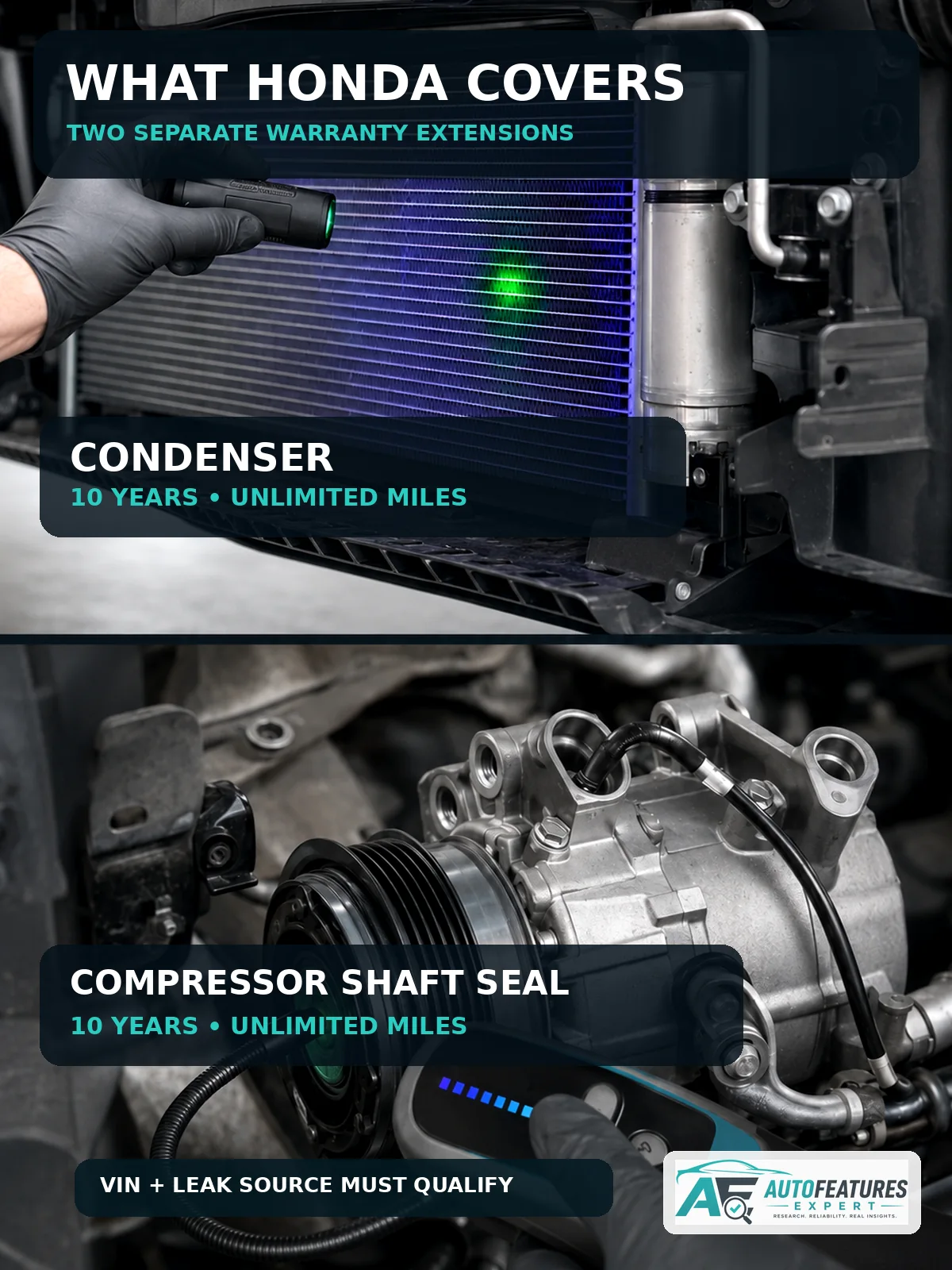
Honda instructs dealers to check the vehicle’s internal VIN status before applying either extension. Age alone is not enough. A 2018 Civic can be within the time period and still require a diagnosis showing that the failed part and failure mode qualify.
Why the 2016–2021 Civic Can Lose Cold Air
Several failures can produce the same complaint: the fan works, but the air becomes weakly cool or completely warm. The difference matters because only specific condenser and compressor-seal conditions receive the extended coverage described above.
Tiny condenser leaks can release refrigerant
The condenser sits near the front of the car, where it releases heat from the high-pressure refrigerant. Honda’s condenser bulletin says some units were not manufactured to specification. Corrosion can create tiny holes in the condenser tube walls, allowing refrigerant to escape.
This failure often develops gradually. Cooling may weaken over weeks or months, improve temporarily after a recharge and then fade again. A shop may need fluorescent dye, an electronic detector or an ultrasonic leak test to identify the exact source.
The location of the leak is only part of the decision. Honda’s extension covers a qualifying factory defect; it does not cover a condenser tube punctured by road debris. The bulletin tells technicians to distinguish a manufacturing-related leak from foreign-object damage before submitting the repair under warranty.
The compressor shaft seal has its own extension
Honda’s current compressor bulletin, 23-039 Version 5, covers an identified shaft-seal leak on specified 2016–2021 Civic powertrains. Honda explains that the refrigerant and oil combination can swell the seal, leading to abnormal wear and a larger gap around the compressor shaft. Refrigerant can then escape.
This is not the same as a warranty on the entire compressor. A leaking shaft seal may qualify; a seized compressor, internal contamination, clutch or electrical failure may not. Before approving a full compressor replacement, ask the dealer to identify the failed component and explain whether the shaft-seal extension applies to the VIN.
Evaporator and other leaks can look identical from the driver’s seat
The evaporator is inside the climate-control housing behind the dashboard. A leaking evaporator can also cause low refrigerant and warm vent temperatures, but it is not included in the condenser or shaft-seal extensions.
Expansion valves, refrigerant lines, service-port seals, pressure sensors, fuses, relays and control faults can produce similar symptoms. Weak airflow can also come from a clogged cabin filter or blower problem rather than a refrigerant leak.
That overlap explains why “the A/C is warm” is not a sufficient diagnosis. The repair decision should be based on a documented leak or electrical test, not on symptoms alone.
What Your Civic’s Symptoms Can and Cannot Tell You
| What you notice | Possible explanation | Best next check |
|---|---|---|
| A/C gradually becomes warmer over several weeks | Slow refrigerant leak from the condenser, shaft seal, evaporator or another connection | Request a complete leak-source diagnosis |
| Cooling improves after a recharge but fades again | The system was low, but the underlying leak remains | Do not approve repeated recharges without locating the leak |
| One side feels warmer than the other | Low refrigerant charge, air-mix door issue or another distribution fault | Compare vent temperatures and test system pressures |
| Airflow is weak at every temperature setting | Cabin filter, blower or evaporator-airflow restriction | Inspect the filter and blower operation before assuming a refrigerant failure |
| A/C is cold initially, then turns warm | Pressure, sensor, compressor-control or icing problem; a leak is also possible | Record when the change occurs and request pressure/temperature testing |
| Grinding, rattling or belt noise appears with A/C on | Possible compressor, pulley or belt-drive fault | Switch the A/C off and have the drive system inspected promptly |
These signs help a technician reproduce the problem, but none proves that a specific warranty extension applies. A photograph of visible dye, the written leak location and the dealer’s VIN-status result are more useful than a verbal statement that “the compressor is bad.”
What the 10-Year Warranty Actually Means
The coverage period starts from the vehicle’s original purchase or in-service date, not from the date a later owner bought the car. It has no mileage limitation, but the calendar limit still applies.
For example, a Civic first placed in service in September 2017 would generally reach the end of a 10-year extension in September 2027. The exact date and eligibility must be verified from the vehicle record.
The warranty extension is also different from a safety recall. A recall addresses a safety defect and normally appears in official recall searches. A warranty extension expands coverage for an identified component condition. Owners should use the VIN when speaking with an authorized Honda dealer and should not rely only on a general year-and-model recall page.
Condenser coverage
Honda bulletin 19-091 Version 5 identifies:
- 2016–2020 Civic two- and four-door models;
- 2017–2021 Civic five-door models, excluding Type R;
- separate condenser guidance for the 2017–2021 Type R.
The qualifying condenser repair includes leak inspection and, when the bulletin’s criteria are met, condenser replacement, refrigerant evacuation and recharge. The bulletin specifically excludes a leaking condenser damaged by a foreign object.
Compressor shaft-seal coverage
Honda bulletin 23-039 Version 5 identifies:
- 2016–2021 Civic models with the 1.5-liter turbo engine;
- 2016–2021 Civic models with the 2.0-liter engine;
- 2017–2021 Civic Type R models with the 2.0-liter turbo engine.
The corrective action is to inspect the system and replace the compressor shaft seal when directed by Honda’s procedure. The bulletin also excludes vehicles declared a total loss, sold for salvage or carrying a branded or similar title.
Already Paid? Ask Honda About Reimbursement
Honda’s condenser and compressor/shaft-seal customer letters say an owner who previously paid for a qualifying repair may be eligible for reimbursement, even if the vehicle has since been sold. That language is conditional: reimbursement is not automatic, and Honda must confirm the vehicle, component and repair meet the program rules.
Keep the VIN, dated repair order, proof of payment and any leak-test findings. If the invoice says only “A/C repair” or “compressor,” ask the repairing shop for the exact failed component. Contact Honda or an authorized dealer for the current claim process before assuming an old bill qualifies; deadlines and documentation requirements should be verified directly.
How Should a Warm-Air Civic Be Diagnosed?
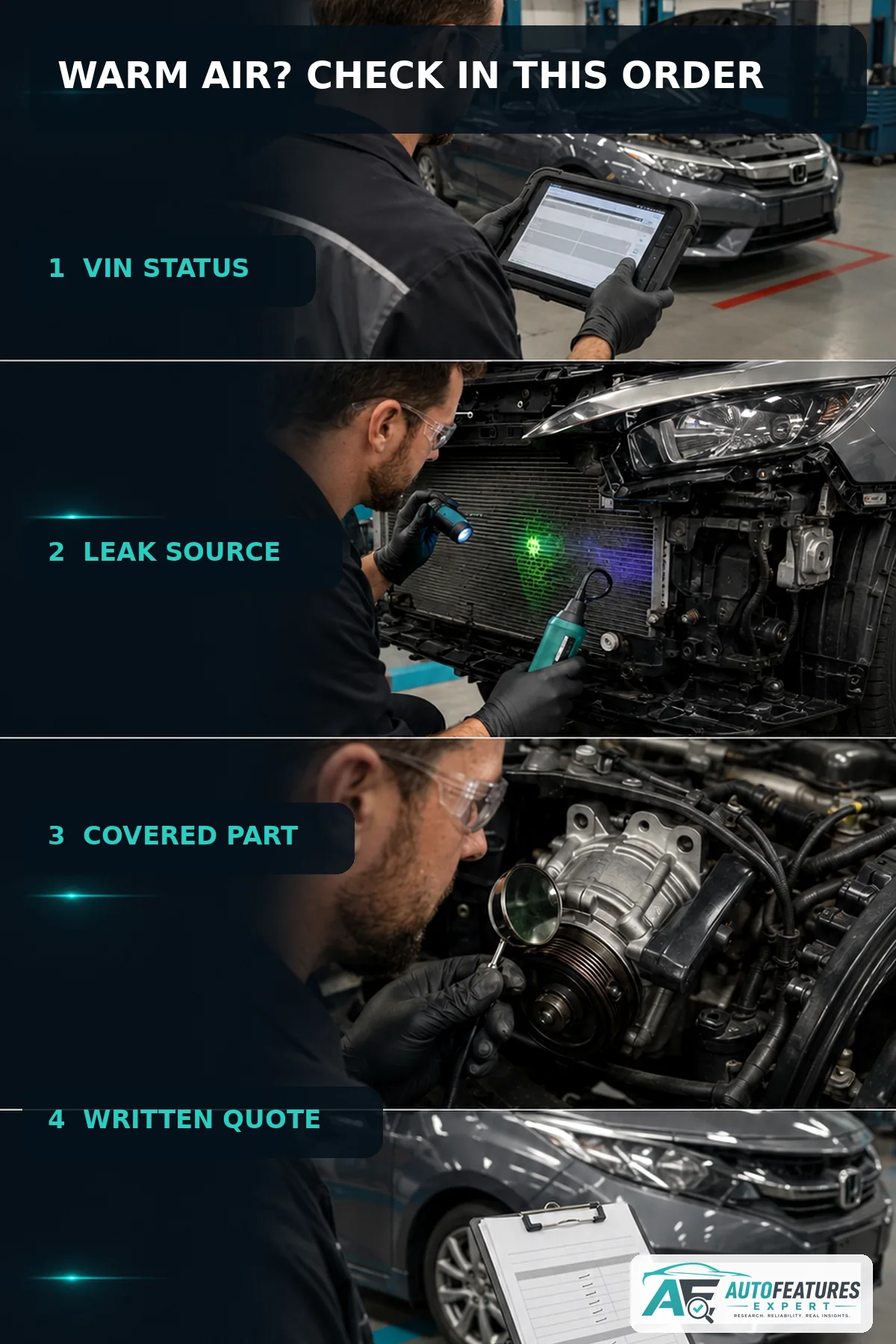
The best diagnostic order separates eligibility from the mechanical cause. It also reduces the chance of paying for a recharge or complete compressor when the covered repair is narrower.
- Verify the configuration and VIN. Record model year, body style, engine and original in-service date. Ask the dealer to check the VIN against condenser bulletins 19-091 or 21-014 and compressor shaft-seal bulletin 23-039.
- Recover and measure the refrigerant. A trained shop should use equipment appropriate for the Civic’s refrigerant system. A low charge confirms refrigerant is missing, but not where it escaped.
- Locate the exact leak. Depending on the evidence and equipment, the shop may use fluorescent dye, an electronic detector, an ultrasonic detector and visual inspection. The written result should name the component and leak point.
- Classify condenser damage. If the condenser leaks, determine whether the tube shows the manufacturing/corrosion pattern covered by Honda or an impact from road debris, which the condenser program excludes.
- Inspect the compressor shaft seal under Honda’s procedure. A qualifying seal leak is different from a seized or internally damaged compressor. If the seal condition is not present, diagnosis must continue instead of assuming the whole compressor is covered.
- Test the remaining system. The evaporator, O-rings, service ports, hoses, expansion valve, pressure readings, fans, fuses, controls and air-mix doors may need evaluation when the two covered components do not explain the complaint.
- Get findings and coverage in writing. Before authorizing work, request the VIN-status result, leak source, covered and customer-pay line items, diagnostic-fee policy and final estimate.
What Owners Report vs. What Honda Confirms
Owner discussions commonly describe repeat warm-air visits, temporary improvement after a recharge and repair estimates that mention more than one possible leak. Those reports are useful for building questions for a dealer, but they cannot establish a failure rate, prove that every tenth-generation Civic is affected or determine coverage for a specific VIN.
Honda’s documents confirm something narrower and more actionable: defined 2016–2021 Civic configurations can receive extended coverage for a qualifying condenser defect or compressor shaft-seal leak. They do not create a blanket evaporator warranty or make every compressor replacement free. Treat forums as symptom context; use Honda’s bulletins, VIN status and a documented diagnosis for the repair decision.
Five Questions to Ask Before Paying for a Repair
1. Is my VIN eligible for bulletin 19-091 or 23-039?
Ask the dealer to check both programs. A condenser extension does not answer whether the compressor seal is covered, and vice versa.
2. Where is the refrigerant leaking?
Request the component name and leak location in writing. “Low refrigerant” describes the system’s condition, not the cause.
3. If the condenser is leaking, is the tube damaged?
Foreign-object damage can take the repair outside Honda’s condenser extension. Ask what physical evidence supports that conclusion and request a photograph when possible.
4. Does “compressor failure” mean the shaft seal or the complete compressor?
The shaft-seal extension is narrower than a full compressor warranty. If a full assembly is recommended, ask which internal test or contamination finding makes seal replacement insufficient.
5. What happens to the diagnostic charge if the repair qualifies?
Diagnostic-fee policies can vary by dealer and by the final cause. Ask for the amount and refund or waiver terms before authorizing work. Keep the repair order, test results and invoice even when the covered repair has no customer charge.
Honda Civic A/C Repair Costs When Coverage Does Not Apply
Published prices are budgeting benchmarks, not quotes. Labor rates, refrigerant quantity, model year, engine, body style, location and contamination can change the total. RepairPal’s Honda Civic estimates below were updated July 25, 2026; taxes, fees and related repairs are generally outside the displayed ranges.
| Service | Current U.S. benchmark | Decision note |
|---|---|---|
| A/C recharge | $255–$342 | Can restore cooling, but does not repair the leak that caused a low charge. |
| Condenser replacement | $583–$715 | Confirm VIN and failure-mode eligibility before paying; impact damage is different from a covered defect. |
| Compressor replacement | $1,014–$1,518 model-wide average; some 2016–2021 year estimates are higher | Do not confuse a complete compressor quote with the narrower shaft-seal extension. |
| Evaporator replacement | $842–$1,185 | The evaporator is not included in the two extensions discussed in this guide. |
Kelley Blue Book’s broader U.S. A/C guide lists different general-market ranges, which is a useful reminder that estimator methodology matters. Do not average unrelated estimates into a supposedly precise price. A useful quote separates diagnosis, refrigerant, parts, labor, taxes and Honda-covered work.
Repeated recharges deserve special caution. If cooling returns and then fades, another recharge without locating the leak can delay the repair and raise the total cost.
Should You Avoid a 2016–2021 Civic Because of the A/C?
An A/C history alone is not a reason to reject every tenth-generation Civic. The better decision depends on the current cooling performance, the documented repair history and whether the vehicle remains eligible for the two extensions.
A used Civic is easier to justify when:
- the A/C reaches a stable cold vent temperature during an extended test;
- prior condenser or shaft-seal work is documented;
- the dealer confirms remaining VIN eligibility;
- no repeated recharge pattern appears in the service history;
- a pre-purchase inspection finds no evaporator or collision-related condenser leak.
Be more cautious when the seller says the system “only needs a recharge,” one side blows warm, the A/C stops cooling after 15–20 minutes, or several repairs were performed without a recorded leak source. Those signs do not prove a major failure, but they justify diagnosis before purchase, not after.
For an otherwise clean Civic, an eligible condenser or shaft-seal repair can be manageable. An uncovered evaporator leak, damaged condenser and internal compressor failure on the same vehicle can change the economics quickly. The inspection should determine which situation you are buying.
Frequently Asked Questions
Which Honda Civic years have the A/C warranty extension?
Honda’s condenser bulletin covers specified 2016–2020 two- and four-door Civics and 2017–2021 five-door Civics, with separate guidance for the 2017–2021 Type R. The compressor shaft-seal extension identifies 2016–2021 Civics with 1.5T or 2.0 engines and 2017–2021 Type R models. VIN eligibility still needs confirmation.
Does Honda’s extension cover the whole A/C compressor?
No. Bulletin 23-039 extends coverage for the compressor shaft seal condition it describes. It does not state that every compressor failure or complete compressor replacement is covered. Ask the dealer to identify whether the leak comes from the shaft seal or whether another internal failure is being diagnosed.
Is the Honda Civic A/C warranty extension a recall?
No. It is an extended warranty program for specified component defects, not a safety recall. Recall-search results alone may not provide the complete campaign status. An authorized Honda dealer can check the VIN against the condenser and compressor-seal extensions.
Will recharging the A/C fix a Honda Civic refrigerant leak?
A recharge can restore cooling temporarily, but it does not seal the leak that allowed refrigerant to escape. If cooling weakens again, request leak detection before paying for repeated recharges. The leak source determines whether Honda coverage or a customer-paid repair applies.
Is an evaporator leak included in the 10-year extension?
The condenser and compressor shaft-seal bulletins reviewed for this article do not extend coverage to the evaporator. Another warranty, prior repair warranty or case-specific assistance could still apply, but the evaporator should not be presented as automatically covered by these programs.
Can I diagnose or recharge the R-1234yf system myself?
Basic checks such as confirming blower operation or inspecting the cabin filter are reasonable. Refrigerant recovery, leak testing and charging require appropriate equipment and handling procedures. Honda’s bulletins state that the repair procedures are intended for trained technicians, not do-it-yourself work.
Related Honda Civic Guides
- Honda Civic Common Problems by Year
- Honda Civic Reliability
- Honda Civic Years to Avoid
- Honda Civic Generations and Buying Guide
- Honda Civic Transmission Problems
- Honda Civic CVT Problems
- 2020 Honda Civic Oil Dilution
References
- American Honda Motor Co., Service Bulletin 19-091 Version 5: 2016–2021 Civic A/C Condenser Warranty Extension, May 28, 2021.
- American Honda Motor Co., Service Bulletin 21-014: 2017–2021 Civic Type R A/C Condenser Warranty Extension, May 28, 2021.
- American Honda Motor Co., Service Bulletin 23-039 Version 5: 2016–2021 Civic A/C Compressor Shaft Seal Leak, June 19, 2024.
- American Honda Motor Co., Civic A/C Condenser Warranty Extension Customer Letter, including conditional reimbursement information.
- American Honda Motor Co., Civic A/C Compressor Shaft Seal Warranty Extension Customer Letter, including conditional reimbursement information.
- Honda Owners, Honda Recall Lookup, accessed July 31, 2026.
- RepairPal, Honda Civic A/C Recharge Cost, updated July 25, 2026.
- RepairPal, Honda Civic A/C Condenser Replacement Cost, updated July 25, 2026.
- RepairPal, Honda Civic A/C Compressor Replacement Cost, updated July 25, 2026.
- RepairPal, Honda Civic A/C Evaporator Replacement Cost, updated July 25, 2026.
- Kelley Blue Book, Car A/C Repair Costs, accessed July 31, 2026.
- CivicX owner discussion: A/C issues, used only as owner-experience context; accessed July 31, 2026.
About This Article
Author: Alex Fric, Automotive Research Editor
Draft prepared: July 26, 2026
Last verified: August 30, 2026
Article type: Single-problem analysis, warranty guide and used-buyer decision support
Research scope: U.S.-market 2016–2021 Honda Civic condenser and compressor shaft-seal warranty extensions, Type R guidance, non-covered failures, diagnosis, reimbursement and current repair-cost benchmarks
Primary sources checked: American Honda bulletins 19-091 Version 5, 21-014 and 23-039 Version 5; Honda customer letters and VIN resources
Reviewed by: Alex Fric, source verification and editorial review; no independent mechanical inspection was performed
AI use: AI-assisted tools supported source comparison, editing and original visual production. They were not used as factual evidence; material claims were checked against the linked sources.
Correction/update history: First research draft prepared July 26, 2026. Coverage scope, reimbursement language, Type R guidance, diagnosis sequence, current costs, visual assets and FAQ schema reverified July 31, 2026. Honda bulletins 19-091 Version 5, 21-014 and 23-039 Version 5 were rechecked and the six-step coverage decision was added August 30, 2026.
Editorial limitation: This article cannot determine whether a specific vehicle or repair is covered. Eligibility and diagnosis depend on the VIN, original in-service date, title history and inspected failure source.







