
Use this guide for
Evaluate 2020 Civic 1.5T oil-dilution concern using oil level, fuel odor, use pattern and service evidence.
Boundary: Oil dilution is not the same diagnosis as coolant loss or head-gasket failure.
The 2020 Honda Civic can show oil-dilution symptoms, but it should not be treated as if every 2020 Civic has a confirmed factory defect. The concern is most relevant to cars with the 1.5-liter turbocharged, direct-injected engine—especially those used for repeated short trips in cold weather. Honda’s best-documented Civic oil-dilution product update and related warranty extension covered certain 2016–2018 1.5T cars, not the 2020 model year. That distinction matters: a gasoline smell or a rising dipstick level on a 2020 deserves a proper inspection, but an internet post about an older Civic does not diagnose your car.
Quick Answer
The 2020 Honda Civic can experience oil dilution only with the 1.5L turbo engine. Honda built 2019-and-newer cars with updated warm-up programming, so the 2020 model is not included in the special 2016–2018 oil-dilution warranty extension. Most cases are manageable, but cold-weather short-trip drivers should monitor oil level and fuel smell.
- Affected engine: 1.5L turbo
- Not affected in the same way: naturally aspirated 2.0L
- Main signs: rising oil level, gasoline smell and rough cold starts
- Best prevention: regular longer drives and timely oil changes
This guide separates the official campaign history from the questions a 2020 owner actually needs answered. It explains which engines are relevant, what changes at the dipstick are meaningful, when to stop driving, what a shop should check, and how to evaluate a used Civic without turning one symptom into a worst-case conclusion.
Does the 2020 Honda Civic Have an Oil-Dilution Problem?
A careful answer is: some 2020 Civic 1.5T owners may encounter fuel contamination of the engine oil, but the evidence and official treatment are not the same as they were for certain 2016–2018 Civics. Honda’s earlier service material described a cold-weather operating pattern in which fuel could mix with the oil and, on affected vehicles, contribute to drivability symptoms or diagnostic trouble codes. The company issued software and climate-control updates for eligible older cars and later extended warranty coverage for specific damage on certain 2016–2018 1.5-liter turbo Civics.
The 2020 Civic came after those campaigns. It is therefore inaccurate to copy the 2016–2018 coverage language onto a 2020 car or promise that a dealer must perform the same update for free. It is also inaccurate to claim that a 2020 is immune simply because its model year is not listed in the older bulletin. Fuel can enter the crankcase in any direct-injected gasoline engine under some operating conditions. The practical question is whether the amount is temporary and controlled or persistent enough to raise the oil level, alter viscosity, trigger a warning light, or affect how the engine runs.
Owners should make decisions from repeatable observations rather than smell alone. A brief fuel odor from used oil is not automatically proof of excessive dilution. A dipstick level that repeatedly climbs above the maximum mark, a strong fuel smell accompanied by rough running, or a malfunction indicator light is a much stronger reason to arrange diagnosis.
Which 2020 Civic Engines and Trims Are Relevant?
The phrase “2020 Civic oil dilution” is too broad because the model was sold with several engines. The concern most people are discussing centers on Honda’s 1.5-liter turbocharged direct-injected engine. A naturally aspirated 2.0-liter Civic is not part of the same 1.5T-specific campaign history, while the Civic Type R uses a different 2.0-liter turbocharged powertrain and should not be lumped into the 1.5T discussion either.
| 2020 Civic version | Engine situation | How this guide applies |
|---|---|---|
| Sedan | Available with a naturally aspirated 2.0L or a turbocharged 1.5L, depending on trim | The 1.5T discussion applies only to turbo-equipped cars; verify the actual engine |
| Coupe | Engine varies by trim, including 2.0L and 1.5T applications | Do not decide from body style alone; confirm the engine before judging risk |
| Hatchback | U.S.-market hatchbacks use versions of the 1.5L turbo engine | Short-trip and cold-weather operating history deserves closer attention |
| Si | Performance-tuned 1.5L turbo engine | Relevant to the general dilution mechanism, but tuning and use history also matter |
| Type R | 2.0L turbo engine | Do not apply 1.5T Civic campaign claims to it without Type R-specific evidence |
The quickest confirmation is the emissions label under the hood, the original window sticker, a VIN-specific build record, or the owner’s documentation. Do not rely on an online listing that merely says “four-cylinder.” If you are shopping for a car, ask the seller for a clear photo of the under-hood label and the VIN before traveling.
Engine identification changes the buying conversation. A 2.0-liter naturally aspirated Civic can have its own maintenance or repair needs, but a seller should not discount it because of headlines aimed at the 1.5T. Conversely, a clean-looking 1.5T should not be rejected automatically. Its cold-start behavior, service records, oil level, driving history, and diagnostic scan are more useful than a blanket reputation.
What Oil Dilution Means Inside the Engine
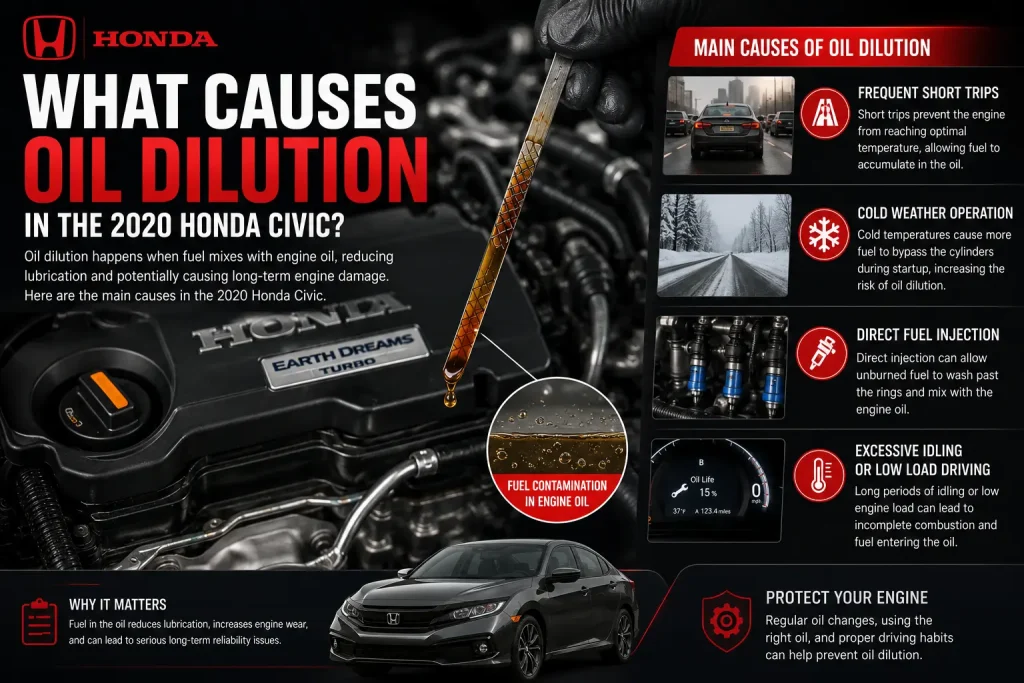
Engine oil is designed to maintain a protective film between moving surfaces, carry heat, suspend contaminants, and support components such as the turbocharger. Oil dilution occurs when unburned gasoline reaches the crankcase and mixes with that oil. A small amount can occur during normal cold operation and may evaporate once the engine and oil remain fully warm. The concern begins when fuel enters faster than it can leave or when the vehicle rarely stays hot long enough for evaporation.
A cold gasoline engine deliberately uses a richer mixture than a fully warmed engine. Some fuel can remain on the cylinder wall instead of burning completely. Direct injection places fuel directly in the combustion chamber, and repeated cold starts create more opportunities for a portion of that fuel to pass the piston rings. This passage is often called blow-by. It does not by itself mean the rings have failed; every piston engine has some blow-by, and the crankcase ventilation system is designed around that reality.
The pattern becomes less favorable when a driver starts the Civic, travels a few miles, shuts it off, and repeats the cycle without a sustained fully warm drive. Cold ambient temperatures lengthen warm-up. Cabin-heat demand can also influence how quickly an engine reaches and holds temperature. Over time, persistent fuel contamination can lower the oil’s effective viscosity and make the oil level appear to rise because the crankcase now contains oil plus fuel.
That is why an oil change alone may improve the immediate condition but fail to answer the cause. Fresh oil resets the mixture. It does not reveal whether the car’s use pattern, thermostat behavior, injectors, software state, crankcase ventilation, or another mechanical issue is contributing. A useful diagnosis looks at the whole pattern rather than treating every case as the same defect.
What Honda Officially Documented—and What It Did Not
The official paper trail is important because many summaries blur several model years together. Honda service bulletin 18-137 described a product update for certain 2016–2018 Civic vehicles equipped with the 1.5-liter turbo engine. The procedure included software-related work and, depending on the car and revision, climate-control changes and an engine-oil service. Honda’s accompanying dealer communication tied the expansion to 21 cold-weather states and instructed dealers to confirm eligibility through the vehicle identification number.
Honda later issued warranty extension bulletin 19-038 for certain 2016–2018 1.5T Civics. That document addressed eligible engine damage associated with specific diagnostic trouble codes—P0300 through P0304 or P0172—or a described abnormal noise, subject to diagnosis, VIN eligibility, and exclusions. It extended the applicable powertrain coverage from five years/60,000 miles to six years with unlimited mileage for the covered condition.
Those details are useful context, but they are not a transferable coupon for a 2020 Civic. The listed model years matter. A 2020 owner should use Honda’s VIN-specific lookup and ask a dealer to check the complete campaign and software history for that individual car. A generic year/make/model search cannot prove that a particular VIN has an open action, and the absence of the old 2016–2018 campaign does not replace diagnosis of a current symptom.
It is also important to distinguish a product update or warranty extension from a safety recall. The older oil-dilution materials were service and coverage actions; they should not be described as a universal 2020 recall. If a listing, forum post, or repair shop uses the word “recall,” ask for the campaign number and VIN result. Precise language protects buyers from both needless alarm and unsupported promises.
Symptoms Worth Checking on a 2020 Civic 1.5T
No single symptom confirms excessive oil dilution. The most useful evidence is a combination that repeats under controlled checks. Start with what you can observe safely, then let a qualified technician determine whether the observations point to fuel contamination or another problem.
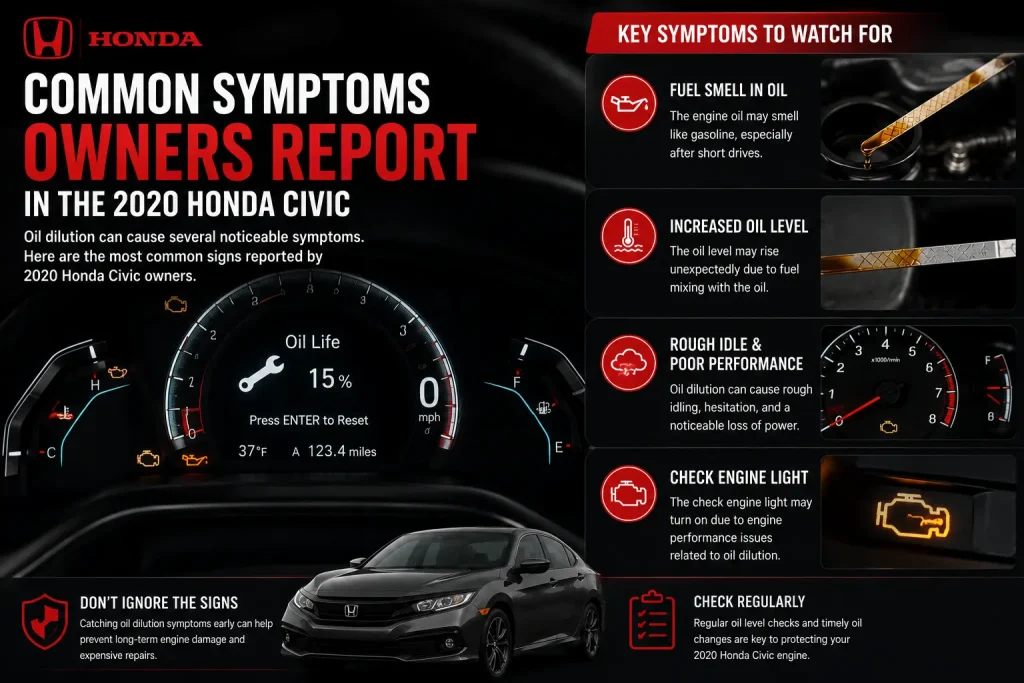
A rising oil level on the dipstick
A level that moves above the full mark after being correctly set is one of the more meaningful owner observations. The check must be consistent: level ground, the same warm-or-cold procedure, enough time for oil to drain back, and a clean dipstick read. Comparing a rushed gas-station check with a cold overnight check can create a false trend. Photograph the dipstick with the date and mileage if you are monitoring a suspected change.
A strong gasoline odor from the oil
Used oil can have a petroleum or fuel-like odor, so smell is subjective. A strong gasoline smell becomes more relevant when it appears with a rising oil level or a change in engine behavior. Avoid repeatedly inhaling crankcase vapors, and do not attempt a flame or evaporation test. If confirmation matters, a laboratory used-oil analysis can quantify fuel contamination more reliably than a nose test, although sampling technique and recent oil changes affect the result.
Rough cold starts, misfires, or a warning light
Honda’s older warranty bulletin referenced misfire codes P0300, P0301, P0302, P0303 and P0304, plus the rich-condition code P0172, in its specific diagnostic pathway. Those codes do not automatically prove oil dilution on a 2020. Misfires can come from spark plugs, ignition coils, injectors, compression, air leaks, fuel quality, or other causes. They do mean the car needs a scan and diagnosis rather than another month of observation.
Oil-pressure warning, abnormal noise, or severe drivability change
An oil-pressure warning, loud mechanical noise, flashing malfunction indicator light, severe loss of power, or persistent shaking changes the urgency. Safely stop driving and arrange professional assistance. Continuing to drive a badly misfiring engine can overheat the catalytic converter, while continuing with a true oil-pressure problem can damage the engine quickly. Do not assume the cause is dilution; respond to the warning first.
How to Check the Oil Level Without Creating a False Alarm
Owners often get conflicting dipstick readings because the conditions change. Use the procedure in the 2020 Civic owner’s manual for your body style and engine. If you are creating a short monitoring record before a service appointment, consistency matters more than checking ten times in ten different places.
- Park on genuinely level ground. A sloped driveway can move the indicated level enough to confuse the comparison.
- Use the manual’s timing procedure. Do not compare an immediate post-shutdown reading with an overnight cold reading and call the difference fuel.
- Remove, wipe, fully reinsert, and reread the dipstick. On some engines one side smears; use the clearer boundary and repeat once.
- Record date, mileage, outside temperature, and recent use. Five two-mile trips tell a different story from a 200-mile highway day.
- Do not drain oil or add a random amount to “correct” an uncertain reading. If the level appears substantially high, confirm the procedure and contact a shop.
- Save warning-light information before it is cleared. A scan report with stored and pending codes is more useful than a seller’s statement that the light “just needed a reset.”
If the oil has just been changed, note the invoice mileage and ask how much was installed. An overfill can mimic the high-level symptom that owners associate with dilution. A leaking fuel injector, repeated failed start attempts, or other rich-running fault can also put fuel into the oil. Diagnosis should rule out these alternatives.
A used-oil analysis can add evidence when the concern is persistent but the engine runs normally. Use a reputable laboratory, follow its sampling instructions, and tell it the oil brand, viscosity, miles on the oil, engine miles, and whether makeup oil was added. One sample is a snapshot. A trend across comparable intervals is more informative, but most owners do not need an ongoing laboratory program if the level remains stable and the car has no symptoms.
Driving Patterns That Can Increase or Reduce the Concern
The highest-attention pattern is a 1.5T Civic used for frequent cold starts followed by short, low-load trips. Examples include moving the car between parking spots, a two-mile winter commute, repeated school runs, or long idling sessions intended to warm the cabin. The engine may produce heat, but idling is not the same as bringing the oil fully to operating temperature under normal driving.
Cold weather does not make every 1.5T a bad purchase. It changes the questions to ask. Has the car spent most of its life on short local trips? Did the owner follow the Maintenance Minder and keep invoices? Was the oil level ever documented as rising? Does the car reach normal operating temperature? Are there stored misfire or rich-condition codes? A northern highway commuter may have a less concerning use pattern than a warm-climate car driven only three minutes at a time.
Owners can reduce repeated cold cycling by combining errands when practical and allowing the vehicle to complete a normal drive rather than extended driveway idling. This is not an instruction to speed, hold high rpm, or take an unnecessary trip solely to “burn off” gasoline. Drive normally and follow the owner’s manual. If the level is already above the maximum mark or the engine is showing serious symptoms, a longer drive is not a repair strategy.
Oil-change timing should follow Honda’s Maintenance Minder and the correct manual guidance for the car. A concerned owner may choose to discuss a shorter interval with a qualified technician based on severe short-trip use, but more frequent oil changes should not be presented as proof that the engine is fixed. Keep receipts and record the level at service; documentation is useful for troubleshooting and any warranty discussion.
What a Competent Shop Should Check
A useful service visit begins with specifics: “The level moved from here to here in 800 miles, checked on the same level surface,” is better than “these engines all dilute oil.” Bring photographs, dates, invoices, and any scan results. Ask the service adviser to write the observed complaint on the repair order even if the car is currently running normally.
The diagnostic path depends on symptoms, but it can include:
- Confirming the oil level and condition, and checking whether the crankcase was overfilled at the last service
- Scanning for current, pending, and history codes rather than looking only for an illuminated warning light
- Reviewing freeze-frame data, fuel trims, misfire counters, coolant-temperature behavior, and warm-up performance
- Checking the VIN for applicable campaigns, software updates, warranty status, and prior dealer work
- Evaluating ignition, injector operation, compression, crankcase ventilation, and other causes if the engine runs poorly
- Changing the oil and filter when appropriate, then establishing a documented baseline for a measured follow-up
Ask for findings, not just a conclusion. If the shop says the condition is normal, request the measured level, codes checked, software status, and the basis for that assessment on the invoice. If it recommends a major repair, ask which test identified the failed component. This approach is firm without assuming the technician is hiding something.
For a car still within an applicable warranty period or covered by an extended service contract, authorization rules matter. A non-dealer shop may be excellent at diagnosis, but the warranty administrator may require dealer inspection or prior approval. The 2020 Honda warranty booklet also emphasizes owner responsibility for required maintenance and preserving service records. Read the actual coverage terms for the vehicle rather than relying on a forum estimate.
Repair Options and Realistic Cost Expectations
There is no honest single “oil dilution repair price” because oil dilution describes a condition, not one failed part. The low end may be diagnosis, an oil-and-filter service, a software-status check, and monitoring. A separate fault such as an injector, thermostat-related warm-up issue, ignition problem, or crankcase ventilation problem changes the repair. Confirmed internal engine damage is a different category again.
A shop should not jump straight from fuel odor to engine replacement. It also should not repeatedly change the oil while ignoring a fast-rising level, codes, or drivability symptoms. The right response is proportional:
- Stable level, no warning lights, normal operation: follow the manual and Maintenance Minder, document the baseline, and recheck consistently.
- Suspected increase but uncertain procedure: have the level professionally set and recorded, then monitor over a defined mileage interval.
- Rising level or strong odor with codes/rough running: diagnose promptly; do not treat an oil change as the complete answer.
- Oil-pressure warning, flashing light, severe noise, or severe misfire: stop driving safely and arrange assistance.
When comparing estimates, make sure they address the same diagnosis. One quote may cover only fluid service; another may include injector testing, software verification, and follow-up. Written test results make the comparison meaningful. National cost averages are often too broad to be useful because labor rates, diagnostic time, parts choice, and warranty participation vary by location.
Can Oil Dilution Damage the 2020 Civic Engine?
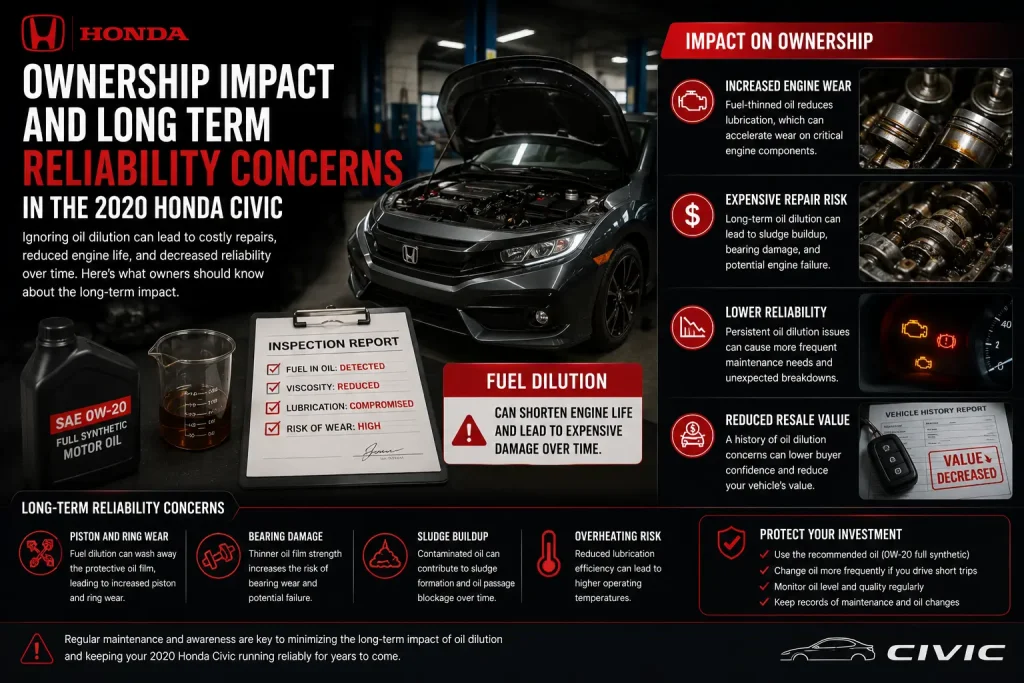
Excessive, persistent fuel contamination can reduce oil viscosity and weaken the lubricating film, so it should not be ignored. Bearings, cylinder surfaces, timing components, and the turbocharger all depend on suitable lubrication. That mechanical principle is real. It does not follow that every 1.5T with a faint fuel smell is approaching engine failure.
Risk depends on concentration, duration, temperature, load, oil condition, and whether another fault is present. A car with a stable level, normal operation, clean diagnostic history, and documented service is not equivalent to one that repeatedly rises above the full mark and stores misfire codes. Treating both cars as identical produces bad buying advice.
Long-term ownership decisions should also include the rest of the vehicle. Our broader Honda Civic reliability guide covers the model’s ownership picture beyond this one concern. For generation-level shopping, compare the patterns in our Honda Civic years to avoid analysis and the diagnostic context in our Honda Civic common problems guide. No single issue should replace a complete pre-purchase inspection.
Used 2020 Honda Civic 1.5T Buying Checklist
A pre-purchase inspection is the best place to turn a vague reputation into car-specific evidence. Arrange it with a shop that works for you, not only the seller. Ideally the engine should be cold when first inspected; a seller who warms the car before every viewing can hide a difficult cold start.
Before seeing the car
- Obtain the VIN and verify the exact engine and trim.
- Use Honda’s VIN lookup and the NHTSA vehicle search for open safety recalls and available campaign information.
- Ask for oil-change invoices, not a verbal claim that maintenance was “always on time.”
- Look for repeated very short oil intervals without explanation; they may reflect careful severe-use maintenance or an unresolved concern.
- Ask whether the oil level has ever risen, whether the warning light has appeared, and whether software or injector work was performed.
During the inspection
- Check the oil on level ground using the proper procedure before the test drive.
- Observe the cold start for extended cranking, roughness, smoke, warning lights, or abnormal mechanical noise.
- Scan for pending and history codes; a recently cleared monitor status deserves explanation.
- Confirm that the engine reaches and maintains normal temperature during a reasonable drive.
- Inspect for unrelated leaks, coolant condition, turbo plumbing issues, accident repair, tire mismatch, and neglected brakes.
- Recheck the car after the drive as the inspector recommends, without comparing incompatible hot and cold readings.
A good 1.5T with records and a clean inspection can be a reasonable purchase. A seller’s refusal to provide the VIN, allow a cold start, permit a scan, or approve an independent inspection is a stronger reason to walk away than an unsourced claim that every 2020 engine is defective.
Should You Keep, Buy, or Avoid One?
Keep it if your 2020 Civic runs normally, the oil level remains stable when checked correctly, maintenance is documented, and no diagnostic evidence points to a problem. Continue normal observation rather than repeatedly disturbing the oil or paying for speculative repairs.
Buy it if the price and condition are competitive, the exact engine is understood, records make sense, the VIN check is complete, and an independent inspection finds no rising level, unresolved codes, poor cold-start behavior, or other major concern. Negotiate from the individual car’s evidence.
Pause or walk away if the oil is substantially overfull without a credible explanation, the engine misfires, the warning light has been recently cleared, the seller blocks an inspection, or the service history shows repeated complaints without diagnosis. There are enough Civics on the market that you do not need to inherit an unanswered mechanical question.
Arrange prompt service if a car you already own shows a repeatable level increase, persistent gasoline odor plus drivability symptoms, or a warning light. The goal is not to win an argument about whether all 2020 Civics are affected. The goal is to document and correct what is happening in your engine.
Frequently Asked Questions
Is there a 2020 Honda Civic oil-dilution recall?
Do not assume there is a universal 2020 recall based on the older Civic campaign. Honda’s widely cited oil-dilution product update and related warranty extension applied to certain 2016–2018 1.5T Civics and required VIN confirmation. Check the individual 2020 VIN through Honda and NHTSA for current open actions.
Does the 2020 Civic 2.0 engine have the same issue?
The official Civic materials most commonly discussed for oil dilution centered on the 1.5-liter turbo engine. The naturally aspirated 2.0-liter Civic is outside that specific 1.5T campaign history. Any engine can have fuel-contaminated oil because of a separate fault or operating condition, so diagnose actual symptoms rather than transferring the 1.5T label.
Does a gasoline smell on the dipstick prove oil dilution?
No. Smell is subjective, and used oil can have a fuel-like odor. A repeatable rise in level, laboratory oil analysis, rich-running or misfire data, and a technician’s findings provide better evidence. Strong odor combined with rough running or a warning light deserves faster attention.
Will a longer highway drive fix diluted oil?
Normal sustained operation may help evaporate a small amount of fuel that accumulated during cold short trips, but a highway drive is not a repair for oil that is substantially overfull or an engine with codes, noise, or severe symptoms. Diagnose the cause and change contaminated oil when a qualified technician recommends it.
Should I change the oil more often on a 2020 Civic 1.5T?
Follow the 2020 owner’s manual and Maintenance Minder. If the car experiences unusually severe short-trip use or a documented level increase, discuss an appropriate interval with a qualified technician. Shorter intervals may limit time on contaminated oil, but they do not correct an injector, software, warm-up, or mechanical fault.
Can Honda’s 2016–2018 warranty extension cover my 2020 Civic?
The published extension described certain 2016–2018 1.5T Civics, not a blanket 2020 entitlement. Coverage depends on the VIN, in-service date, diagnosis, current warranty terms, and any additional applicable program. Ask a Honda dealer to document the VIN-specific result rather than relying on a general online summary.
What is the most important check when buying a used 2020 1.5T?
There is no single magic test, but an independent cold-start inspection that includes a correct oil-level check, a full diagnostic scan, maintenance-record review, and VIN campaign lookup gives the strongest practical picture. A stable, well-documented car should be judged differently from one with an overfull crankcase and recently cleared codes.
References and Source Notes
- Honda News: 2020 Civic Sedan Specifications & Features — official engine and trim specification context.
- Honda News: 2020 Civic Hatchback Specifications & Features — official hatchback powertrain context.
- Honda Service Bulletin 18-137 — product-update procedure and affected 2016–2018 Civic scope.
- Honda Service Bulletin 19-038 — warranty-extension conditions for certain 2016–2018 Civic 1.5T vehicles.
- 2020 Honda Civic Sedan Owner’s Manual — official operating, oil-check, warning, and maintenance guidance.
- Honda VIN Recall and Product Update Lookup — vehicle-specific campaign checking.
About This Article
This guide was written for U.S.-market 2020 Honda Civic owners and used-car shoppers. It distinguishes Honda’s official 2016–2018 1.5T service campaign and warranty documents from the evidence applicable to a 2020 vehicle, then combines the 2020 engine specifications, owner’s-manual guidance, and practical diagnostic decision points. It does not assume that an owner report diagnoses every car. Service programs and VIN eligibility can change, so confirm current information with Honda and use a qualified technician for vehicle-specific findings.







