Use this guide for
Screen higher-risk Civic production groups and compare safer starting points.
Boundary: This is not a diagnosis page and it does not mean every VIN in a listed year is defective.
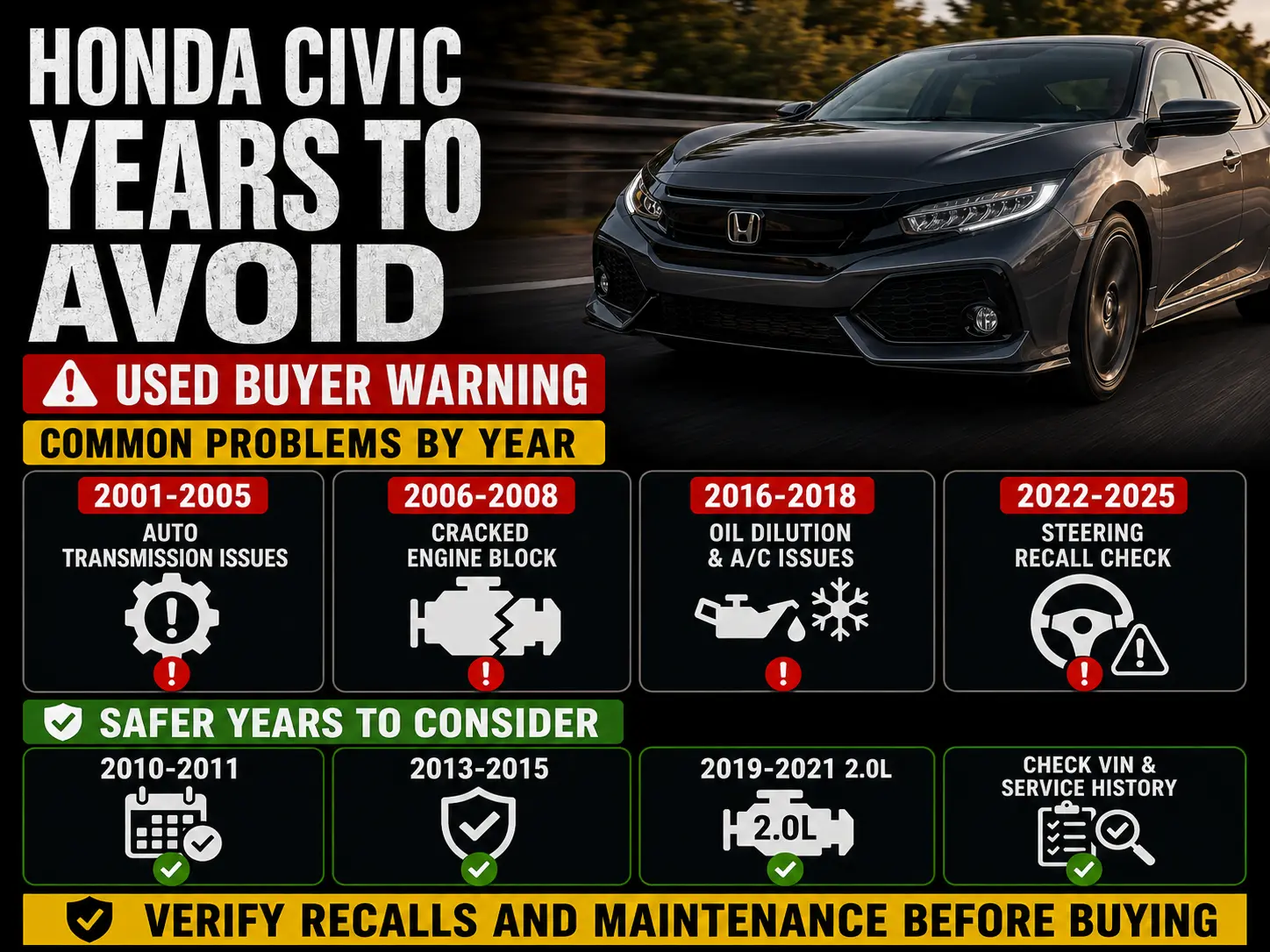
For a used Honda Civic, start with the 2001–2005 automatics and the 2006–2008 or early-production 2009 cars affected by Honda’s engine-block coolant-leak bulletin. These are the clearest mechanical caution groups. A 2016–2018 1.5T needs a closer look at its oil and use history; a 2012 is more of a condition-and-price decision. Check the engine, transmission, VIN and repair records before ruling out any individual car.
Which Civic years need the closest look?
- 2001–2005 automatic: test for delayed engagement and slipping after the transmission warms up.
- 2006–2008 and early 2009: inspect for cylinder-block coolant leakage or documented block replacement. Honda’s service bulletin 10-048 identifies the affected production group and calls for a VIN eligibility check.
- 2016–2018 1.5T: evaluate oil-change records, operating conditions and the actual engine fitted.
A clean 2012 belongs in a price and condition comparison, not an automatic rejection list. For easier starting points, compare maintained 2010–2011, 2013–2015 and 2019–2021 2.0L examples. None is exempt from a VIN check and inspection.
Start here: match the Civic to the risk that actually applies
| Configuration | Primary risk to verify | Evidence that changes the decision | Next research step |
|---|---|---|---|
| 2001–2005 automatic | Transmission slip, delayed engagement or heat-related loss of drive | Warm road test, repair invoices, consistent engagement in Drive and Reverse | Transmission overview; for 2001, use the model-year transmission guide |
| 2006–2008 and some early 2009 1.8L cars | Engine-block coolant leakage and overheating history | Documented block replacement, stable coolant level, clean pressure test | Common-problem map |
| 2012 | More a refinement/value question than a defining catastrophic defect | Condition, price and comparison with updated 2013–2015 cars | 2012 Civic problems |
| 2016–2018 1.5T | Oil-dilution history and short-trip/cold-weather use | Oil-change records, oil level, fuel odor, operating history | Oil-dilution evidence guide |
| 2016–2021 with weak A/C | Condenser/compressor-related fault and prior repair history | Actual diagnosis, repair invoice and applicable warranty coverage | A/C diagnosis and coverage |
| 2022–2025 and other recall-eligible newer cars | Steering recall completion and steering feel | VIN-based remedy status and a normal road test | Recall and VIN workflow |
If the car already has a fault, identify the symptom before using a model-year list. The Civic reliability guide compares generations and powertrains; the checks below focus on the individual car you may buy.
2001–2005 automatics: the strongest mechanical caution group
The seventh-generation automatic is the clearest place where the transmission can dominate the buying decision. Delayed Drive or Reverse engagement, engine-speed flare without matching acceleration, slipping when warm or loss of drive can turn a cheap Civic into an uneconomic repair.
Do not judge one of these cars from a five-minute cold drive. Get the transmission fully warm and test every engagement. A manual-transmission car, or an automatic with documented professional repair and normal hot behavior, is a materially different proposition from an unknown original automatic.
2006–2008 and early 2009 1.8L cars: cooling evidence matters
Honda’s engine-block bulletin 10-048 describes coolant leakage and overheating on some 2006–2008 and early-production 2009 Civics. It extended coverage to 10 years from the original purchase date, with VIN eligibility checks. That old coverage should not be mistaken for a current free repair. Ask for a block-replacement invoice or have unexplained coolant loss diagnosed before buying.
A replacement invoice and a stable cooling-system test improve the evidence. Repeated coolant loss with no identified external leak is a reason to stop and diagnose before buying.
2012: separate reputation from actual failure risk
The 2012 redesign was criticized for refinement, interior quality and road noise, but that is different from a concentrated catastrophic powertrain pattern. If a 2012 and a 2013–2015 car are similarly priced and similarly maintained, the updated later cars are easier starting points. A clean 2012 should still be judged on its own condition and recall history.
2016–2018 1.5T: use pattern changes the answer
Early 1.5L turbo Civics deserve a closer look at oil history, especially where repeated short trips and cold-weather use were common. Check the dipstick before the test drive, look for an abnormal fuel smell in the oil, ask how the car was used and compare the answer with service records.
The naturally aspirated 2.0L is the simpler alternative for a buyer prioritizing mechanical simplicity. Before applying either reputation broadly, confirm the engine in the Civic engine and powertrain map.
A/C and recall concerns: expensive or inconvenient does not always mean “avoid the year”
A weak A/C system on a tenth-generation Civic can be costly, but it is a diagnosis and repair-history question rather than proof that every car from the year should be rejected. The same principle applies to newer recall-eligible Civics: an open campaign requires action, while completed remedy documentation changes the evidence.
Safer starting points
| Starting point | Why it can be easier to buy | Still verify |
|---|---|---|
| 2010–2011 | Outside the main early R18 block concern window | Age, cooling, A/C, suspension and recall status |
| 2013–2015 | Relatively simple ownership profile | Normal wear, transmission service, accident history |
| 2019–2021 2.0L | Simpler engine choice within the tenth generation | CVT service, A/C history and recalls |
| Newer cars with completed recalls | Lower age-related wear and documented campaign completion | Current steering behavior and service history |
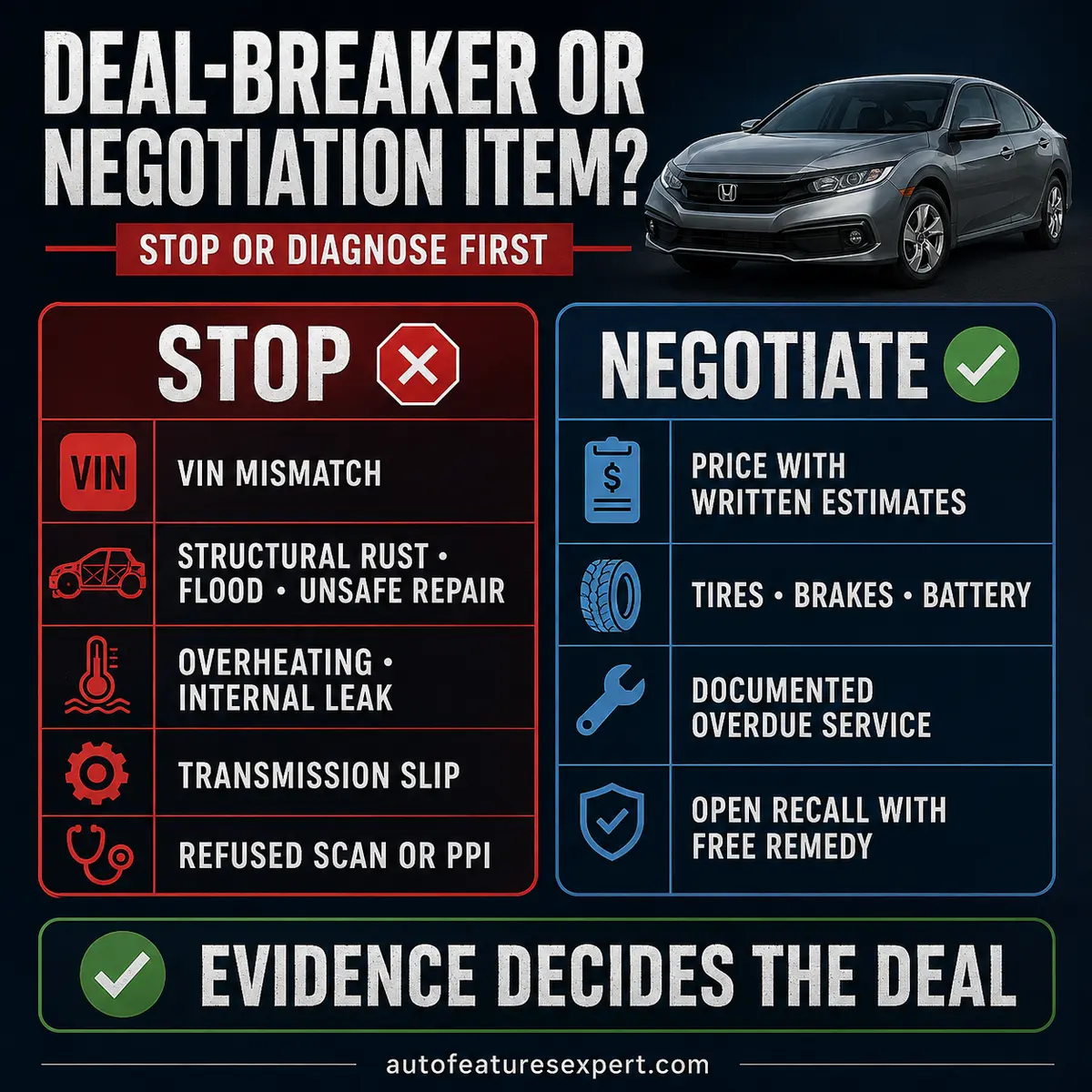
Use an avoid list as a filter, not a verdict
- Identify the exact year, engine, transmission and trim.
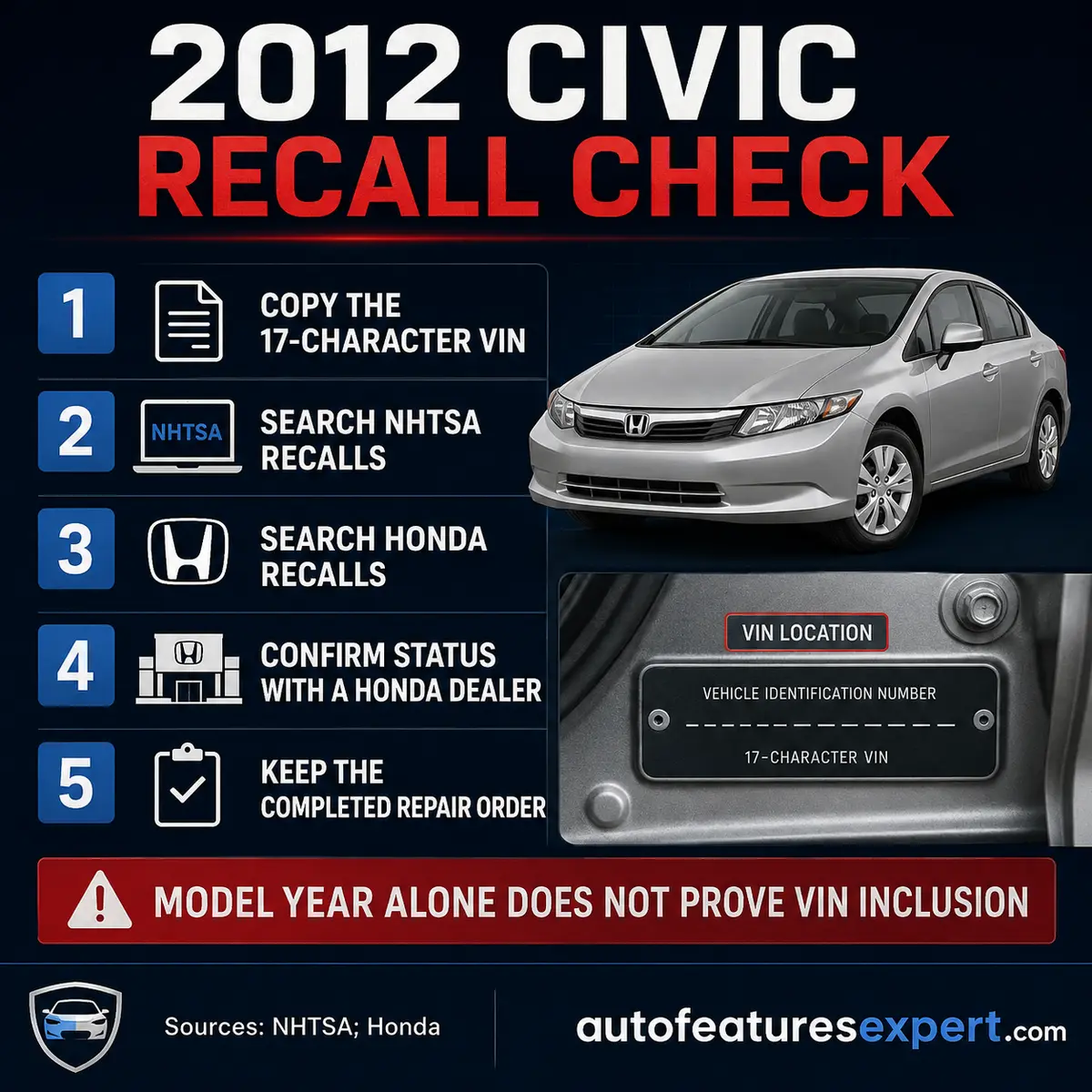
- Run the VIN for current recalls and completed remedies.
- Open the focused problem page only for the risk that applies.
- Require invoices for major repairs instead of relying on seller memory.
- Test the vehicle from cold start through full operating temperature.
- Use scan data and an independent lift inspection before a final purchase decision.
For the complete buying sequence, continue to the used Honda Civic buying guide.
How this guide was checked
This U.S.-market buyer guide separates a documented Honda service bulletin from broader model-year buying judgments. Honda bulletin 10-048 supports the 2006–2008 and early 2009 block concern; transmission behavior, oil history and vehicle condition still require an inspection of the actual car. Recall eligibility is VIN-specific. The groups above are screening priorities, not failure rates or a measured reliability score.