Use this guide for
Separate Civic CVT service history, recall context, shudder/noise and actual failure evidence.
Boundary: A CVT symptom should not be mixed with the early conventional-automatic problem pattern.
Honda Civic CVT problems are most clearly documented in certain 2014–2015 cars recalled under NHTSA campaign 15V-574. Honda also issued narrower information for a TCM fault and brief hot-restart noise on specified 2016–2017 cars, plus a blocked-vent condition on 2016–2018 CVTs. These issues have different causes and repairs; they do not prove that every Civic CVT is defective.
This guide focuses on the modern belt-type CVT used in U.S.-market gasoline Civics from 2014 onward. Earlier Civic HX and Civic Hybrid CVTs use different designs, while the 2025–2026 Civic Hybrid’s two-motor drive is not a traditional belt CVT. For automatic, manual and hybrid-drive coverage across all generations, use the broader Honda Civic transmission problems guide.
Are Honda Civic CVT Transmissions Reliable?
Most Honda Civic CVTs are not covered by a generation-wide transmission-failure recall. Reliability should be judged by the exact VIN, recall completion, correct HCF-2 service, current symptoms and inspection. The table below separates a confirmed safety recall from condition-specific bulletins and from a 2016 parking-brake recall that is often incorrectly described online as an internal CVT defect.
| Model years or configuration | What the official evidence shows | Priority check |
|---|---|---|
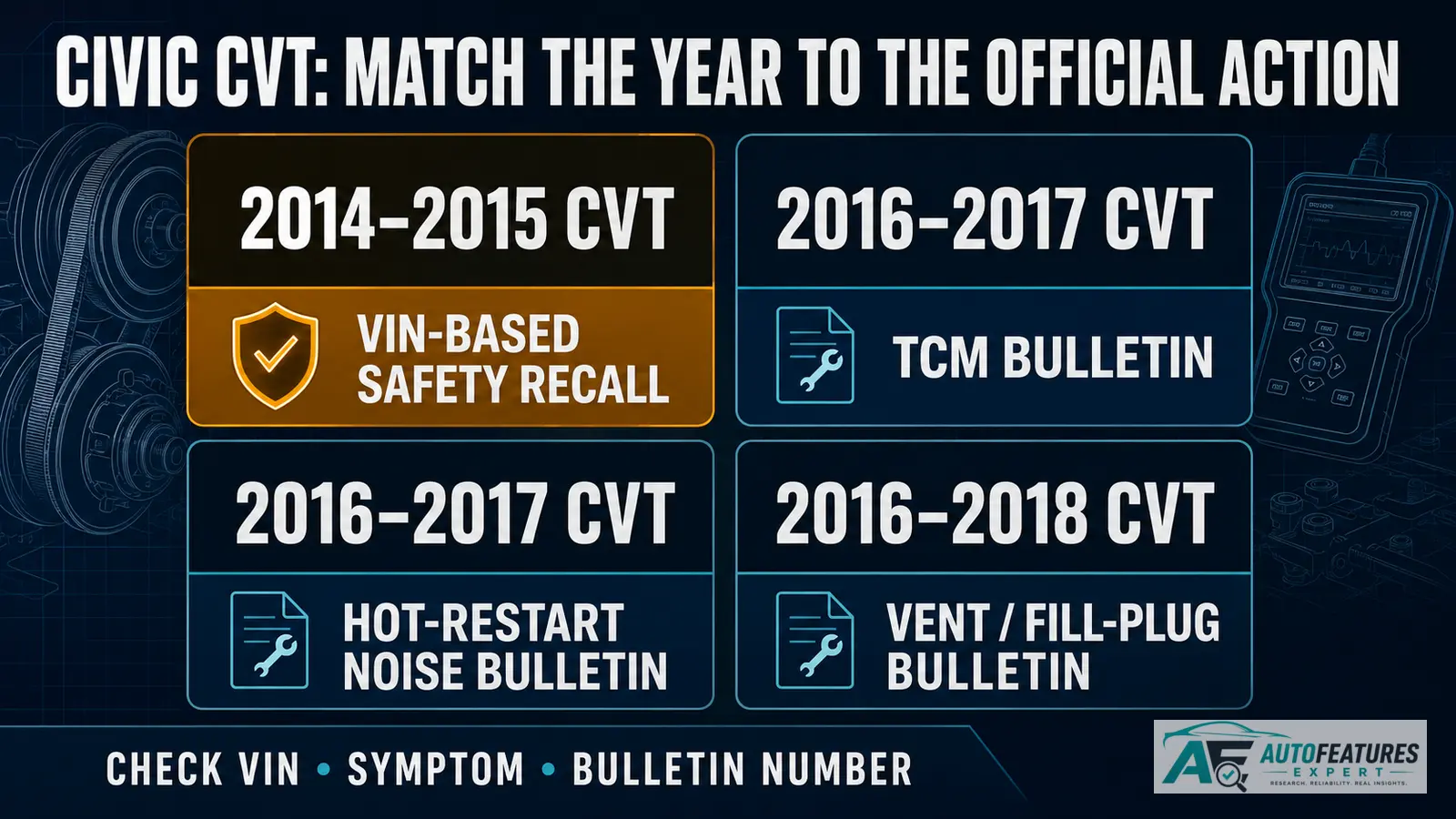
| Certain 2014–2015 Civic CVTs | NHTSA recall 15V-574 documents software settings that could damage the transmission drive-pulley shaft. | Run the VIN through Honda and NHTSA and confirm the recall remedy on a repair order. |
| Certain 2016 Civics | NHTSA recall 16V-725 concerns electric-parking-brake software and possible rollaway. It is not a finding that the CVT belt or pulleys failed. | Check recall completion and distinguish an EPB warning from an internal transmission complaint. |
| 2016 Civic CVT and specified 2017 VIN ranges | Honda Service Bulletin 17-012 covers a TCM malfunction that can prevent the car leaving Park or starting. | Scan for U0038 and U0101 and verify bulletin applicability before blaming the internal CVT. |
| Specified 2016–2017 Civic CVTs | Honda Service Bulletin 17-003 describes a grinding or pump-like noise for about two seconds after a hot restart. Honda states that the noise does not affect function or reliability. | Reproduce the exact hot-restart condition instead of treating every grinding description as internal failure. |
| 2016–2018 Civic with CVT | Honda ServiceNews A19090B says a blocked vent can build pressure and displace the CVT fill plug. | Inspect the plug, vent and fluid level and determine whether fluid loss occurred. |
| 2019–2026 gasoline Civic CVT | The primary official sources reviewed did not identify a broad Civic CVT safety recall defining these years. | Use the individual VIN, service history, scan results and road test; absence of a recall is not a durability guarantee. |
| 2025–2026 Civic Hybrid | Honda’s two-motor hybrid system does not use the gasoline model’s traditional belt CVT for propulsion. | Do not apply gasoline-CVT belt, pulley or HCF-2 advice to the hybrid drive unit. |
Which Honda Civic CVT Years Should You Watch?
Certain 2014–2015 Civics deserve the highest-priority VIN check because they are the only group in this guide tied to a confirmed drive-pulley-shaft safety recall. Later documents describe narrower symptoms: a 2016–2017 TCM communication fault, a brief hot-restart valve-body noise and a 2016–2018 vent/fill-plug condition. Treating all four as “CVT failure” hides the repair path.
Certain 2014–2015 Civics: Check Recall 15V-574 First
The strongest documented reason to pause before buying a 2014 or 2015 Civic CVT is NHTSA campaign 15V-574. It covers certain 2014–2015 Civic vehicles manufactured from January 16, 2014, through November 6, 2014, plus certain 2015 Fits. NHTSA lists 143,676 potentially affected vehicles across the combined recall population.
Honda reported that the transmission-control software could place damaging loads on the drive-pulley shaft. If the shaft broke, the car could lose acceleration or the front wheels could lock while driving. The recall remedy was a free transmission software update.
“2014 Civic” or “2015 Civic” does not by itself prove that a vehicle is included. Check the full 17-digit VIN through the Honda recall lookup and NHTSA recall lookup. If the seller says the update was completed, ask for the repair order identifying campaign JU2. A generic software-update invoice is not the same evidence.
2016 Civic Rollaway Recall: EPB Software, Not Internal CVT Damage
Search results about Civics that rolled while parked can be mistaken for a CVT belt, pulley or Park-mechanism failure. NHTSA campaign 16V-725 covers certain 2016 Civic coupes and sedans because the electric parking brake might not engage when applied immediately after the ignition was switched off. The remedy was a VSA software update.
This recall matters to used buyers, but its official component is the parking brake—not an internal CVT failure. Check the VIN and repair record, note any blinking BRAKE indicator, and avoid using lawsuit allegations or a rollaway headline as proof that the belt-type CVT itself is defective.
2016–2017 Civics: A No-Start or Park Complaint May Be the TCM
Honda Service Bulletin 17-012 Version 3 covers all listed 2016 Civic 1.5-liter and 2.0-liter CVT applications and specified 2017 VIN ranges. The documented symptoms are unusually specific: the car will not come out of Park, may not crank or start, several indicators illuminate, and DTC U0038 and sometimes U0101 are stored.
Honda identifies an internal transmission control module malfunction. The repair is TCM replacement, with a PCM update to match on 2016 models. This distinction matters because a TCM communication failure does not automatically mean the CVT belt, pulleys or bearings have failed. Battery voltage, network faults and brake-shift interlock inputs can also produce overlapping symptoms, so the stored codes and applicable VIN range must be documented.
2016–2017 Civics: A Brief Hot-Restart Grind May Be Bulletin 17-003
Honda Service Bulletin 17-003 addresses specified 2016–2017 Civic CVT applications that may produce a grinding or pump-like noise for about two seconds after a hot restart. Some drivers describe it as a starter noise. Honda traces the sound to a vibrating pressure-control valve in the lower valve body.
The bulletin explicitly states that this brief noise does not affect transmission function or reliability. Honda’s corrective action is an updated lower valve body when the verification sequence reproduces the condition. A continuing grind while driving, RPM flare or loss of propulsion is a different symptom and should not be dismissed under this bulletin.
2016–2018 Civics: Check the Vent When the Fill Plug Leaks or Pops Out
Honda ServiceNews article A19090B applies to all 2016–2018 Civics equipped with a CVT. Honda says debris can block the CVT vent cap, allowing pressure to build at the fill plug. The plug may pop out or appear to leak.
Honda’s repair direction is to remove and clean the vent cap, reinstall it in the correct orientation, replace a loose or displaced fill plug and top up with Honda Genuine HCF-2 fluid if necessary. The document does not call this an internal CVT failure. However, fluid loss is still important: operating with an incorrect level can cause poor performance and damage. The leak source, remaining fluid level and any debris or diagnostic codes should be checked before the car is driven further.
2019–2026 Civics: Do Not Invent a “Worst Year” Without VIN-Level Evidence
Current search results often label long ranges such as 2015–2021 or 2016–2022 as universally bad, usually by combining forum reports, unrelated Honda-model bulletins and ordinary CVT behavior. The official Honda and NHTSA sources reviewed on July 31, 2026 did not establish a single broad Civic CVT safety campaign covering 2019–2024 or the newer gasoline cars.
That does not prove every newer unit will last a particular mileage. It means the evidence should remain vehicle-specific. Check the VIN, verify Maintenance Minder service, scan all modules and test the car under repeatable conditions. Newer model years also have less long-term exposure than a 2014 or 2016 Civic, so confident lifetime claims are premature.
Normal Civic CVT Behavior vs. a Real Warning Sign
A CVT does not shift through fixed gears like a traditional automatic. During acceleration, it can hold the engine at a steady or elevated rpm while vehicle speed continues to rise. Some Civics simulate stepped shifts under certain throttle inputs, but a smooth “rubber-band” sensation or steady engine note is not automatically slip.
| What you notice | Could be normal? | When it becomes concerning |
|---|---|---|
| Engine holds one rpm during acceleration | Yes. A CVT continuously changes ratio instead of making fixed shifts. | Road speed stops increasing, the engine flares suddenly, or the symptom is accompanied by warning lights. |
| Mild drone under heavy throttle | Yes, especially when the engine stays near its power peak. | The sound changes to a new whine, grind or bearing-like growl that follows load or vehicle speed. |
| Slight hesitation from a stop | Throttle mapping, turbo response or traction control can influence takeoff. | The delay becomes repeatable, the car shudders, or Drive engages late after selecting the gear. |
| Simulated stepped shifts | Yes. Some programming creates the feel of conventional shifts. | There is a harsh impact, repeated hunting or loss of propulsion. |
| Fluid near the fill plug | No visible leak should be dismissed. | The plug is displaced, fluid is spreading underneath the car, or the level is low. |
Honda Civic CVT Warning Signs That Need Prompt Diagnosis
- RPM flare without matching acceleration: The engine speed rises abruptly while road speed stalls or increases slowly.
- Repeated shudder under light or moderate load: The vibration returns under the same conditions after the engine and transmission are warm.
- Delayed Drive or Reverse engagement: The car pauses noticeably before moving after the selector is changed.
- Flashing transmission indicator or reduced power: Save the codes and freeze-frame data before anyone clears them.
- New whine, grind or growl: Note whether it follows engine rpm, vehicle speed, steering input or only CVT load; wheel bearings and accessories can imitate transmission noise.
- Fluid leakage: Identify the fill plug, axle seal, case joint or another source and measure the level correctly.
- No-start with multiple warnings: On applicable 2016–2017 cars, scan for the TCM communication condition in Honda bulletin 17-012.
- Loss of drive: Stop driving and arrange a tow if the vehicle cannot accelerate predictably or repeatedly falls out of propulsion.
A Better Honda Civic CVT Diagnosis Sequence
A useful diagnosis should move from identification and free recall checks to codes, fluid condition and a repeatable road test before anyone recommends a complete CVT. This order protects the owner from paying for internal work when the actual cause is a TCM, voltage, vent, engine or driveline problem.
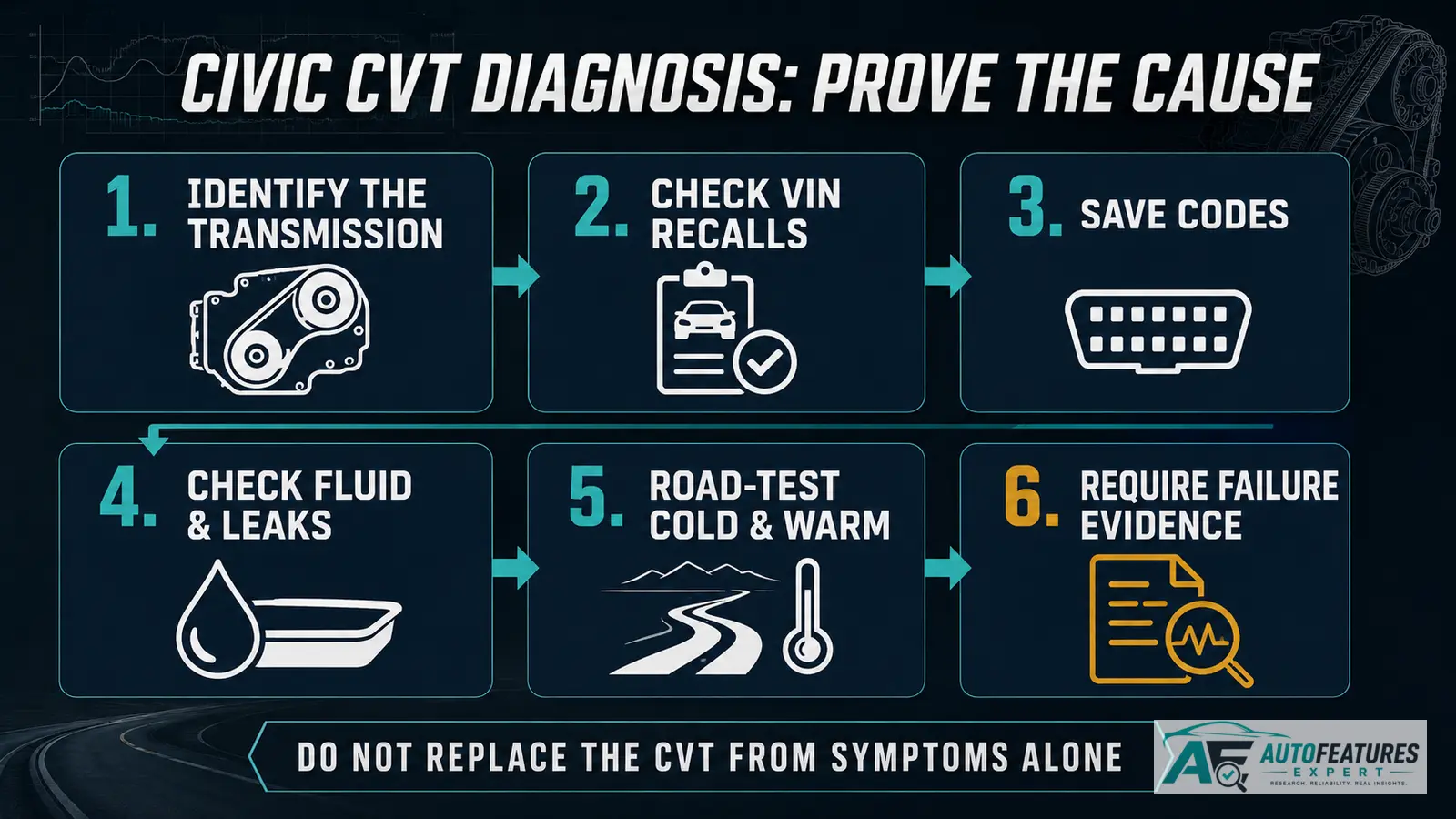
- Confirm that the car actually has the belt-type CVT. Record the VIN, year, trim and engine. Do not treat a manual Civic, older Hybrid CVT or 2025–2026 two-motor hybrid as the same system.
- Check open recalls before paid diagnosis. A VIN included in campaign 15V-574 should receive the recall remedy through Honda; a 2016 car should also be checked for the separate EPB campaign.
- Scan every relevant control module. Save current, pending and history codes plus freeze-frame data. Network codes may point toward a TCM or voltage issue rather than mechanical slip.
- Inspect the correct fluid at the correct level. Look for contamination, metal debris and leaks. A fill-plug leak on a 2016–2018 Civic should trigger a vent-cap inspection.
- Road-test cold and fully warm. Record throttle opening, engine rpm, road speed and whether the symptom occurs on launch, steady cruise, hill climbing, hot restart or deceleration.
- Exclude common look-alikes. Engine misfire, turbo response, weak battery voltage, worn mounts, axle vibration, wheel bearings and traction-control intervention can be mistaken for CVT trouble.
- Demand a failure basis before replacement. The written estimate should identify the failed component, test results, codes, fluid findings, replacement-unit source, programming and warranty.
How Should Honda Civic CVT Fluid Be Serviced?
Honda specifies HCF-2 fluid for the modern gasoline Civic CVT and warns against mixing it with other transmission fluids. The exact service decision should follow the owner’s manual and Maintenance Minder for the specific year. Honda uses Maintenance Minder subcode 3 for transmission-fluid service on applicable vehicles; severe low-speed driving in mountainous conditions can require more frequent service than the normal Minder request, so the owner’s manual must be checked rather than applying a universal internet interval.
A routine drain-and-fill and a machine flush are not interchangeable. Follow the Honda procedure for the exact CVT, use the specified fluid and set the level under the required conditions. Avoid “universal CVT fluid” claims unless the product is explicitly approved for the required Honda specification, and do not use an aggressive flush as a promised cure for existing slip or metal contamination.
The 2025–2026 Civic Hybrid is a separate case. Its two-motor drive uses Honda HEVF-Type 1 fluid, not HCF-2. A shop estimate that labels both the gasoline Civic and Civic Hybrid as the same CVT service should be clarified before work begins.
Can a Fluid Change Fix Civic CVT Shudder or Slipping?
A correct fluid service may improve behavior caused by low, incorrect or degraded fluid when no permanent damage has occurred. It cannot repair a cracked pulley shaft, restore damaged belt or pulley surfaces, replace failed bearings, or correct a defective TCM. If the car has true rpm flare, loss of drive, ratio-related codes or significant debris, document those findings before changing the fluid so evidence is not lost.
Be cautious with two opposite promises: “fresh fluid will definitely fix it” and “never change old CVT fluid.” Neither is a diagnosis. The decision should account for the symptom, fluid level and type, debris, service history and Honda’s procedure for that VIN.
What Does Civic CVT Service, Diagnosis or Replacement Cost?
Costs should be separated by the work actually being performed. A drain-and-fill, electrical diagnosis, lower-valve-body repair and complete CVT replacement are not interchangeable estimates. National figures are useful for a reasonableness check, but the VIN, local labor rate, fluid quantity, failed component and warranty coverage determine the real quote.
| Service or repair path | Current cost context | What the written quote should show |
|---|---|---|
| Honda Civic transmission-fluid service | RepairPal’s June 18, 2026 Civic estimate lists $179–$207 across the model line and $215–$244 for a 2024 Civic. | Correct Honda HCF-2 fluid, quantity, sealing washers, labor and leak inspection. |
| 2016 Civic example from Kelley Blue Book | KBB displays a $221–$390 fluid-service range for its Des Moines-area example, with separate dealer and independent-shop figures. | ZIP code, shop type and whether the price is service only or includes diagnosis. |
| TCM, lower valve body or vent/fill-plug repair | No single national price applies. Warranty, bulletin applicability, programming and required parts materially change the total. | Codes, verification procedure, part numbers, programming, fluid replacement and coverage decision. |
| Complete CVT replacement | Replacement generally moves from hundreds to thousands of dollars; national transmission estimates are not a Civic-specific quote. | New, remanufactured or used unit; installation; programming; cooler or line work; fluid; taxes and warranty terms. |
If a shop recommends complete replacement, obtain a second diagnosis unless the vehicle has lost drive or the evidence is already conclusive. Compare the replacement-unit source, mileage, programming, labor, excluded items and parts-and-labor warranty. A low headline price can become expensive when fluid, calibration, shipping or warranty labor is omitted.
Used Honda Civic CVT Test-Drive Checklist
- Run the VIN through Honda and NHTSA before the test drive.
- Start with the car fully cold; recently warmed fluid can hide an engagement or noise complaint.
- Check Drive and Reverse engagement on level ground without using extra throttle.
- Accelerate lightly, then moderately, watching whether road speed follows engine rpm smoothly.
- Repeat the test after the powertrain is fully warm and include a safe uphill load if possible.
- Listen for a new whine or growl, but rule out wheel bearings and engine accessories.
- Inspect beneath the car and around the CVT fill-plug area for fresh fluid.
- Scan for current, pending and history codes even if the dashboard is clear.
- Review invoices for HCF-2 service, recall JU2, TCM replacement or prior CVT work.
- Arrange an independent pre-purchase inspection if the seller recently cleared codes, serviced the fluid immediately before sale or cannot explain a symptom.
Honda Civic CVT Problems: Frequently Asked Questions
What year did the regular Honda Civic get a CVT?
The modern belt-type CVT used across regular U.S.-market gasoline Civic trims arrived for the 2014 model year. Transmission availability can still vary by trim, and some earlier specialty or hybrid Civics used different CVT designs that are outside this article’s main scope. The 2025–2026 Civic Hybrid is another separate case because its two-motor drive is not the gasoline model’s belt CVT. Before using a fluid specification, bulletin or reliability claim, decode the VIN and confirm the engine, trim and installed transmission instead of assuming every Civic from a model year has identical hardware.
What are the worst Honda Civic CVT years?
The evidence supports a targeted warning rather than a blanket worst-years list. Certain 2014–2015 Civics deserve the highest-priority check because NHTSA recall 15V-574 documents possible drive-pulley-shaft damage. Specified 2016–2017 cars have separate TCM and brief hot-restart-noise bulletins, while 2016–2018 CVTs have a vent/fill-plug service article. Those later documents do not establish a generation-wide internal failure rate. Use the VIN, recall status, correct HCF-2 service history, scan data and a cold-and-warm road test to judge the individual car.
How long does a Honda Civic CVT last?
Honda and NHTSA do not provide one guaranteed lifespan for every Civic CVT, and the available official documents do not support a universal 100,000- or 200,000-mile promise. Heat, correct HCF-2 service, driving conditions, leaks, software history and prior damage all matter. A higher-mileage car with documented maintenance, no ratio or pressure codes and smooth cold-and-warm operation may be safer than a lower-mileage car with fluid loss or RPM flare. Evaluate the exact vehicle and treat precise lifespan claims as estimates unless they are tied to a defined, transparent data set.
Is a whining sound normal in a Civic CVT?
A light, consistent operating sound can be normal, but a new, rapidly increasing or load-sensitive whine needs diagnosis. Note whether the sound follows engine rpm, vehicle speed, steering input, hot restart or only CVT load. Low fluid, internal bearings, pulleys, wheel bearings and engine-driven accessories can produce similar noises. Honda Bulletin 17-003 describes a very specific two-second grinding or pump-like noise after a hot restart on listed 2016–2017 applications and states that it does not affect reliability. A continuous driving noise should not automatically be classified under that bulletin.
Does a Honda CVT service bulletin mean the repair is free?
No. A service bulletin gives technicians diagnostic or repair instructions for a defined condition; it is not automatically a safety recall, warranty extension or free-repair program. Coverage depends on the original warranty, any applicable extension, VIN, mileage, repair history and Honda’s current policy. A safety recall such as 15V-574 is different and an open recall remedy should be completed without charge at an authorized dealer. Ask the dealer to identify the bulletin or campaign number, confirm VIN applicability and state in writing whether parts, labor, programming and fluid are covered.
Can a Honda Civic CVT be repaired, or must it be replaced?
The answer depends on the failure. A TCM, pressure-control valve, blocked vent, displaced fill plug, leak or software issue may have a targeted repair path. Internal belt, pulley, bearing or case damage may lead a dealer or specialist to recommend replacement because parts availability, tooling and warranty policy vary. Before approving a complete unit, request the codes, fluid and debris findings, road-test results and the specific failed component. Compare repair, remanufactured and used-unit options, programming requirements and warranty coverage; obtain a second diagnosis when the evidence does not clearly justify replacement.
Related Honda Civic Research
- Honda Civic Transmission Problems by Generation
- Honda Civic Common Problems by Year
- Honda Civic Reliability: Best Years, Problems and Lifespan
- Honda Civic Years to Avoid and Safer Picks
- Honda Civic Generations and Used-Buyer Guide
- 2020 Honda Civic Oil Dilution Guide
Sources
- NHTSA Campaign 15V-574: Transmission Software May Result in Pulley Damage
- Honda Owners: VIN Recall Lookup
- NHTSA: VIN Recall Lookup
- NHTSA Campaign 16V-725: 2016 Civic Electric Parking Brake Software
- American Honda Service Bulletin 17-012 Version 3: Civic TCM Malfunction
- American Honda Service Bulletin 17-003: Brief CVT Noise After a Hot Restart
- American Honda ServiceNews A19090B: CVT Fill Plug Pops Out or Leaks
- American Honda 2014 Civic New-Model Service Information: HCF-2 CVT Fluid
- Honda 2022 Civic Owner’s Manual: CVT Fluid Specification
- Honda 2024 Civic Owner’s Manual: CVT Fluid Specification and Capacity
- American Honda: 2026 Civic Two-Motor Hybrid System
- Honda 2025 Civic Hybrid Owner’s Manual: HEVF-Type 1 Fluid
- RepairPal: Honda Civic Transmission Fluid Change Cost
- RepairPal: 2024 Honda Civic Transmission Fluid Change Cost
- Kelley Blue Book: 2016 Honda Civic Transmission Fluid Change Cost
- RepairPal: Transmission Replacement Cost
About This Article
Author and scope: Alex Fric, Automotive Research Editor. This U.S.-market guide covers modern gasoline Honda Civic belt-type CVTs from 2014–2026, including recall scope, condition-specific service information, normal behavior, warning signs, fluid decisions, cost context and used-car checks. Earlier hybrid CVTs and the 2025–2026 two-motor hybrid drive are separated where their hardware or fluid requirements differ.
Research and review: Source-verified July 31, 2026 using NHTSA recall records, American Honda service information, Honda owner manuals, VIN-lookup resources and current U.S. cost references. Alex Fric performed source verification and editorial review; no independent mechanical inspection of a specific vehicle was performed.
Limitations and updates: This article cannot diagnose an individual transmission or establish a failure rate. Recall eligibility, service-bulletin applicability and repair decisions depend on the VIN, build date, service history, scan data, fluid findings and physical inspection. Recall status, bulletin versions, owner-manual instructions and cost references should be rechecked during future updates.







