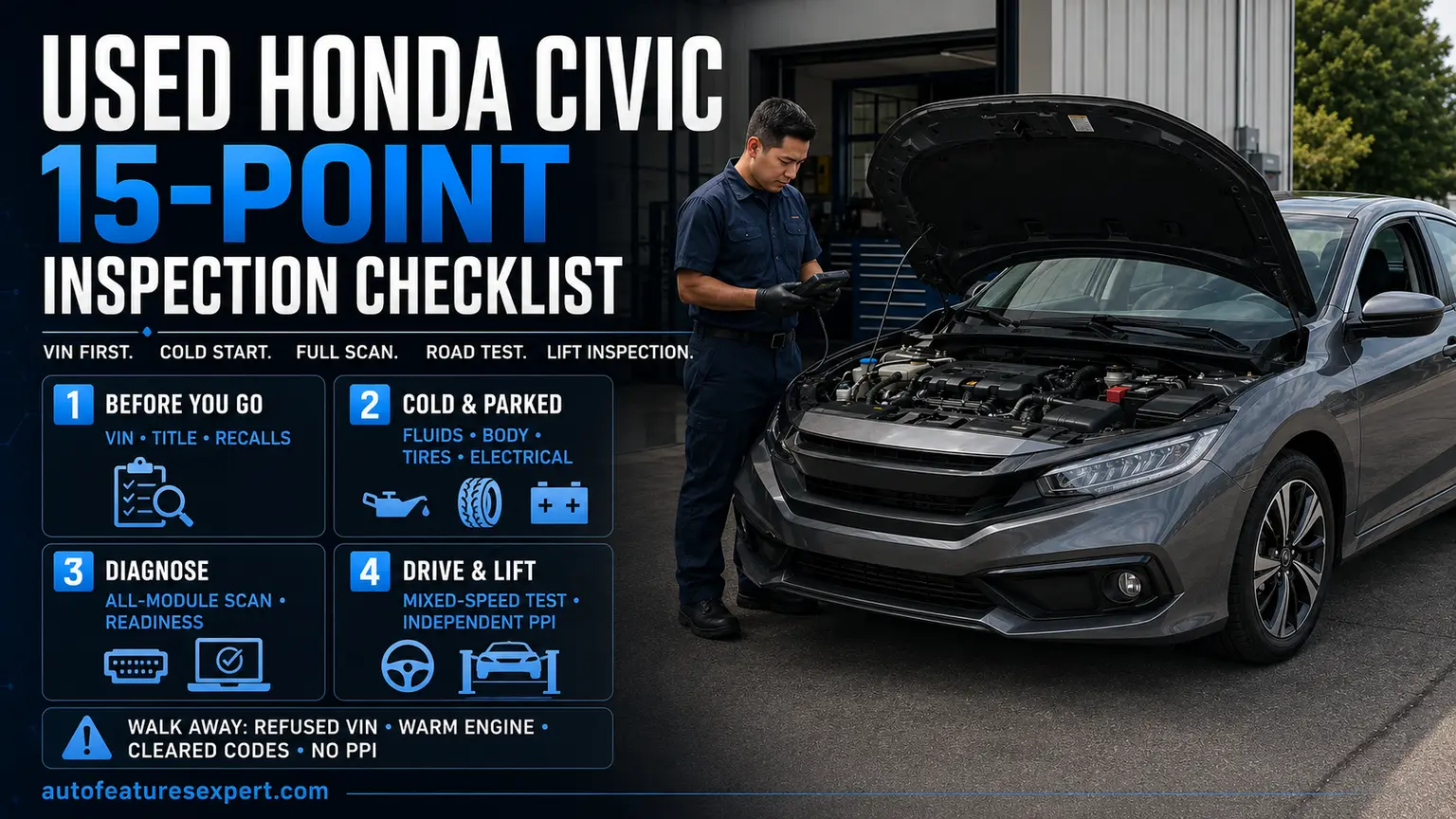
Use this guide for
Run a used Civic inspection in a useful order: VIN, cold start, scan, road test, fluids and lift inspection.
Boundary: The checklist does not replace a specific diagnostic page when the car fails a check.
A used Honda Civic inspection checklist should start with the 17-character VIN, title history, open recalls and a true cold start. Then inspect fluids, leaks, crash or flood evidence, tires, brakes, A/C and electronics; scan every available module; complete a mixed-speed road test; and finish with an independent lift inspection. A seller who refuses the VIN, cold start, scan or pre-purchase inspection is giving you a reason to leave.
The Civic can be an economical long-term car, but its reputation does not erase neglect, collision damage or powertrain-specific problems. This U.S.-focused 15-point checklist is designed to help you screen a car yourself, brief the mechanic correctly and separate a normal maintenance expense from a risk that should stop the purchase.
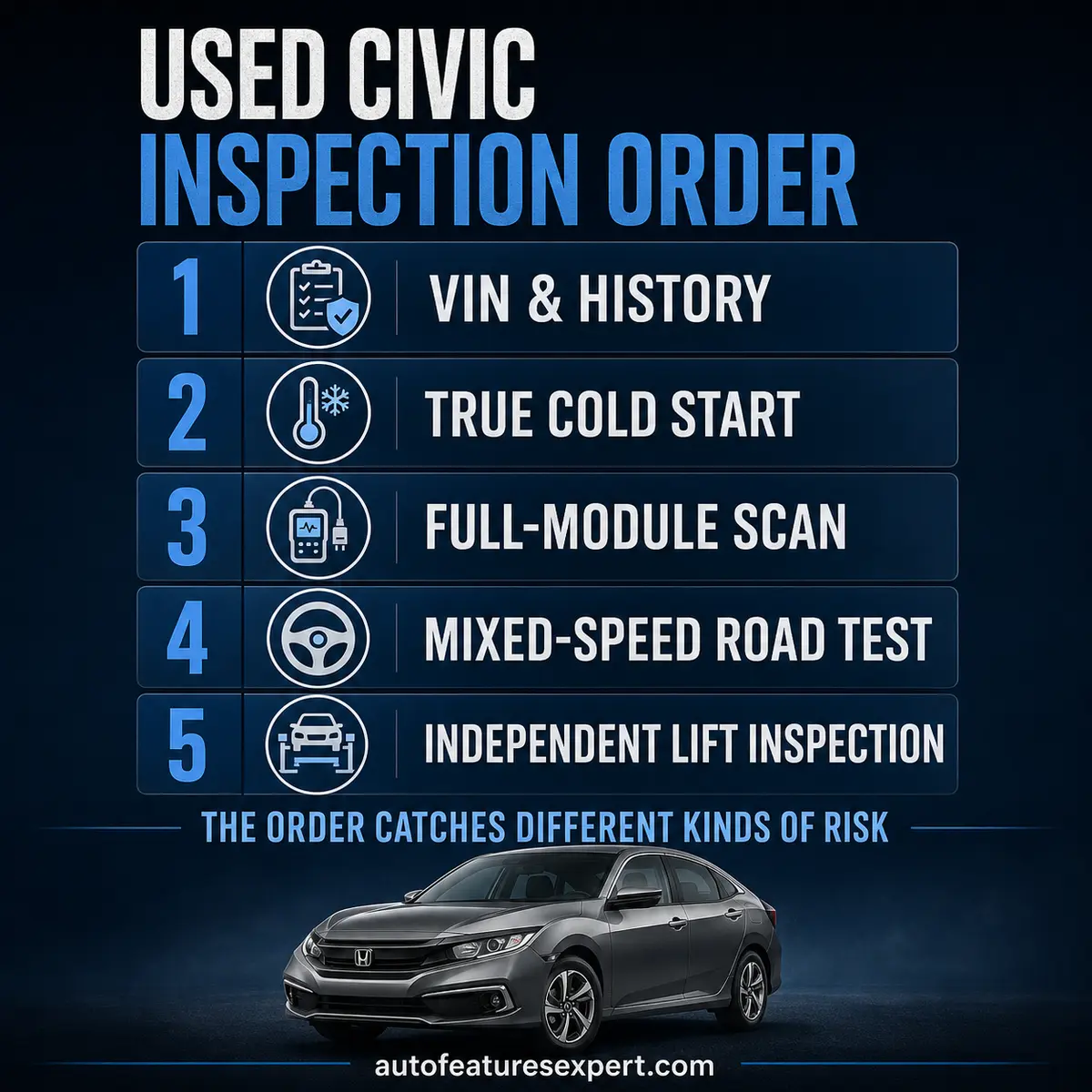
The inspection order matters more than the number of checks
Start by proving the car’s identity and history, then inspect it cold, scan it, drive it until fully warm and finish underneath on a professional lift. That order catches different kinds of risk. A clean history report cannot rule out a mechanical fault, and a pleasant five-minute drive cannot reveal structural damage hidden below the car.
The exact Civic also changes the inspection. A turbocharged 1.5-liter car, a naturally aspirated 2.0-liter model, a hybrid, an Si, a Type R and an older timing-belt Civic do not share the same powertrain checks. Service records and the VIN should decide which risks deserve extra testing.
What should you inspect before buying a used Honda Civic?
Use the same sequence on every candidate: identity and history, cold parked inspection, diagnostic scan, road test and professional lift inspection. This order prevents a glossy listing or pleasant five-minute drive from distracting you from the expensive questions. It also gives the mechanic a concise list of observations to confirm.
The Federal Trade Commission’s used-car guidance says a vehicle-history report usually does not identify mechanical problems and is not a substitute for an independent inspection. That remains true when a car is advertised as certified or sold with a warranty. The goal of your walkaround is to decide whether the Civic deserves a paid pre-purchase inspection, not to certify the car in a parking lot.
What to bring to the inspection
You do not need a rolling toolbox, but a few inexpensive items make the inspection more repeatable. Bring a flashlight, paper towels, a tire-pressure gauge, a tread-depth gauge, a small mirror, gloves and a phone for photos. A paint-thickness gauge can help identify refinished panels when you understand how to compare readings, while a capable OBD-II scanner is useful only if it can read the modules fitted to that Civic.
Also bring the listing, VIN report, seller’s service records and a blank page for four columns: finding, evidence, who diagnoses it and estimated cost. Do not erase codes, disconnect the battery, open a hot cooling system, crawl beneath a car supported only by a jack or dismantle a seller’s vehicle. Anything requiring a lift, pressure, compression, refrigerant or electrical testing belongs to the professional inspection.
Before you see the car
1. Decode the VIN and confirm the exact configuration
Ask for the complete VIN before traveling. Enter it in the official NHTSA VIN decoder, then compare the result with the listing. Confirm model year, body style, engine, transmission and assembly information. When you reach the car, compare the VIN at the windshield, driver-door certification label, title and registration.
This step prevents a common research error: applying advice for a turbocharged 1.5T, hybrid, Si or Type R to a different Civic. It also catches listing mistakes and identity inconsistencies before money changes hands. Stop if VINs do not match, a plate appears altered, the door label is missing without a documented repair explanation or the seller refuses to provide the number.
2. Check title, theft, salvage and odometer history
Order a report from an approved National Motor Vehicle Title Information System provider. NMVTIS is the U.S. Department of Justice system intended to help consumers identify title brands, theft data, salvage or total-loss history and the latest reported odometer information. Compare the report with the physical title, seller identity, current mileage and other available records.
A “clean” report does not prove the Civic was never damaged. A privately paid repair, recent collision, poor maintenance or mechanical fault may not appear. Use the report to direct the physical inspection. A rebuilt-title car needs a structural specialist, confirmation that it can be insured and financed, complete repair documentation and a price that reflects its permanent title history. For most buyers seeking ordinary transportation, an unexplained title problem is a reason to choose another Civic.
3. Run both Honda and NHTSA recall checks
Enter the VIN in the Honda recall lookup and NHTSA recall tool. Ask an authorized Honda dealer to check the VIN for open safety recalls, product updates and applicable warranty extensions. Save or print the results because model-year recall lists do not prove whether one specific vehicle is included or whether a remedy was completed.
Open safety recalls are generally repaired without charge by an authorized dealer, but parts availability and campaign status can affect timing. Confirm whether any open work can be completed before purchase. Civics span multiple recall populations, including older air-bag campaigns and more recent fuel-pump or steering actions, so the VIN, not a seller’s memory, decides coverage. Our Honda Civic fuel-pump recall guide explains why the affected population and the symptom path must not be guessed from model name alone.
4. Audit maintenance records, ownership use and modifications
Arrange invoices by date and mileage. Look for regular engine-oil service, the correct transmission-fluid service, coolant and brake-fluid work, spark plugs, filters, tires, brakes, battery replacement and age- or mileage-specific items. Match the work to the owner’s manual and Honda Maintenance Minder information for the exact year and powertrain. A dashboard maintenance reset proves only that the display was reset.
Ask how the car was used: repeated short cold trips, long highway commuting, ride-share work, long storage, track use and snow-belt operation create different wear patterns. Compare the answer with seat, steering-wheel, pedal and tire wear. A low odometer with severe cabin wear, long record gaps or repeated auction transfers deserves more investigation.
Record every modification: tune, intake, exhaust, removed emissions equipment, lowering springs, coilovers, wheel spacers, oversized wheels, wiring, remote starter or audio system. A modified Civic is not automatically defective, but unknown software, improvised wiring and poorly chosen suspension geometry can create drivability, emissions, alignment, insurance and warranty problems. Ask whether the factory parts and tuning access are included.
Inspect the parked Civic before it is started
5. Demand a true cold start and verify the warning-light check
Tell the seller in advance not to start the car. Carefully feel the hood and use scan data to compare engine-coolant or intake-air temperature with ambient conditions. Before starting, switch the ignition on and confirm that the check-engine, air-bag, ABS and other warning lamps illuminate for their normal self-test. A lamp that never appears may have been disabled or may indicate a cluster fault.
Start without pressing the accelerator. Listen for prolonged cranking, heavy knocking, timing or accessory noise, belt squeal and uneven idle. Watch for persistent warning lights, smoke and a cold misfire that fades as the engine warms. Note how quickly the idle stabilizes. A pre-warmed engine is not proof of deception, but it removes one of the most valuable tests; reschedule the inspection rather than accepting an explanation.
6. Inspect oil, coolant, visible leaks and recent cleaning
With the Civic level and cold, check oil level and condition using the owner’s-manual procedure. Oil below the minimum suggests consumption, leakage or neglect. Oil above the maximum, especially if it smells strongly of fuel on some turbo cars, needs diagnosis. A small amount of light residue under an oil cap can result from short-trip condensation, but coolant loss, contaminated oil, overheating history or repeated cold-start misfire is a more serious pattern.
Inspect the coolant reservoir, hoses, radiator area, water-pump region, valve-cover perimeter, timing cover, oil pan, transmission case and the ground where the car was parked. Look for fresh wetness, dried coolant residue, spray patterns and a just-washed engine bay that prevents you from seeing the leak history. Never remove a hot radiator or expansion-tank cap. On a 1.5T, unexplained coolant loss plus a cold misfire justifies a cold pressure test and evidence-based internal-leak diagnosis; our Civic 1.5T head-gasket guide lays out that diagnostic sequence.
7. Check body structure, paint, glass, corrosion and flood clues
Inspect a clean, dry car in daylight. Stand at each corner and compare reflections, paint color and texture. Look for overspray on seals, inconsistent panel gaps, disturbed hinge or fender fasteners, replacement lamps, weld changes and dates on glass. Open the hood, trunk and every door. Inspect the radiator support, trunk floor, spare-tire well, rocker panels, pinch welds, subframes and suspension mounting points.
Cosmetic surface corrosion and structural scaling are not equivalent. Heavy corrosion around a subframe, control-arm mount, brake line or jacking point can make an inexpensive Civic unsafe or uneconomical. Inside, lift mats and inspect carpet edges, seat hardware and the trunk for silt, moisture, musty odor, water lines, electrical corrosion or mismatched trim. Suspected flood or structural repair requires specialist evaluation, not a price concession based on appearance.
8. Read the tires, wheels, brakes and suspension
Record tire brand, model, size, date code, pressure and tread depth. Check all four tires across the full tread width; inside-edge wear can hide behind a healthy-looking outside shoulder. Mismatched tires may signal minimum-cost maintenance, while cupping or rapid inner wear can point to alignment, bushing, bearing, ride-height or collision-related geometry problems. Inspect wheels for cracks, bends, corrosion and poor repairs.
Look through the wheels for visible pad thickness, rotor scoring and a large wear lip. Push down only gently on the body to note obvious damping differences; do not treat a parking-lot bounce test as a suspension diagnosis. The lift inspection should measure pads and rotors and check brake hoses, calipers, wheel bearings, ball joints, tie rods, struts, shocks, control-arm bushings, engine mounts and CV boots. Four tires, four damaged wheels and worn suspension components can turn a competitive asking price into a poor total cost.
9. Test the cabin, A/C, cameras and every electrical feature
Operate every window, lock, mirror, exterior light, wiper, washer, horn, seat adjustment, seat heater, sunroof, camera, audio input, USB port and steering-wheel control. Pair a phone if connectivity matters to you. Confirm that both keys start the car and that keyless access works. Check seat belts, air-bag warning behavior and the condition of child-seat anchors.
Run the air conditioner at idle and again during the road test. Airflow should remain cold and consistent without a sudden cycling loss. Certain 2016–2021 Civics received extended coverage for specific A/C condenser and compressor-shaft-seal conditions, but eligibility and the actual leak source must be confirmed by VIN and diagnosis. “It only needs a recharge” is not a repair estimate: refrigerant loss has a cause, and other components may not be covered.
Match the inspection to the Civic generation and powertrain
There is no single mechanical problem list for every Civic. Use the VIN and records to identify the engine and transmission, then give the technician the correct concerns. The following matrix is a research starting point, not a diagnosis.
| Civic configuration | Inspection emphasis | Evidence to request |
|---|---|---|
| Older high-mileage Civic | Rust, fluid leaks, cooling stability, mounts, suspension, prior timing-belt service where applicable | Long-term invoices, belt-related service proof for the exact engine, corrosion photos from the lift |
| 2016–2021 2.0L naturally aspirated | CVT service and behavior, A/C performance, crash repair, recalls, normal wear | Correct fluid-service records, VIN campaign check, A/C diagnosis if weak |
| 2016-on 1.5L turbo | Oil level and odor, coolant stability, cold-start misfire, modifications, CVT or manual condition | Oil and coolant history, software or tune documentation, symptom-driven pressure/compression testing |
| Si or Type R | Clutch and synchros, tires and brakes, underbody contact, tune, track or launch evidence | Factory parts, alignment data, modification invoices, brake and tire measurements |
| Hybrid Civic | Hybrid warnings, battery state and cooling, 12-volt system, brake blending, complete scan | Hybrid-capable diagnostic report and service history from a qualified shop |
10. Inspect the engine that is actually installed
Older Civic engines may have a timing belt, while later engines use different valve-train and maintenance strategies. Do not accept “all Civics have a chain” or a generic mileage rule. Check the owner’s manual and service information for the VIN. On older cars, missing proof of required belt-related work should be priced as overdue service, not treated as completed because the engine currently runs.
For a turbo Civic, examine oil level, fuel odor, cold-start behavior, coolant stability and modification history together. Frequent short trips can matter when evaluating fuel dilution, while persistent coolant loss or misfire needs separate diagnosis. The 2020 Honda Civic oil-dilution guide explains that oil condition and usage pattern need context. On any engine, authorize compression, leak-down, borescope or cooling-system testing only when symptoms, records or initial findings justify it.
11. Test the exact transmission, not just “automatic”
Depending on year and trim, a Civic may use a conventional automatic, continuously variable transmission or manual gearbox. Verify the unit before researching service requirements. Require evidence of the correct fluid and procedure rather than accepting a generic “transmission service” line item. Add aftermarket additives, universal fluid or repeated flushes without diagnosis to the mechanic’s question list.
During the road test, include gentle takeoff, moderate acceleration, reverse engagement, low-speed maneuvering, a hill and a fully warm drive. CVT engine speed can behave differently from a stepped automatic, but pronounced shudder, loss of drive, abnormal flare, delayed engagement or a burning odor is not dismissed as “normal CVT behavior.” On a manual, check clutch take-up, high-gear load response, gear engagement, synchro operation and signs of launch or track abuse. Use our Honda Civic CVT problems guide for a diagnostic, not rumor-based, comparison.
12. Scan every available module and inspect readiness status
Scan before and after the road test. Read stored, pending and permanent powertrain codes, then access ABS, air-bag, electronic power steering, body, driver-assistance and other modules supported by the car and tool. Save code numbers, descriptions and freeze-frame data. Do not let the seller clear anything “to see if it comes back.”
Review emissions-readiness monitors. Several “not ready” results may follow a battery disconnect or code clearing and can temporarily hide a recurring fault. Compare the reported VIN and mileage data where the module exposes them. A clear dashboard with incomplete monitors is not the same as a documented fault-free drive cycle. Module communication faults, mismatched VIN data or a cluster that does not complete its bulb check deserve professional investigation.
13. Verify cooling stability from cold start to heat soak
Watch live coolant temperature from cold start through the test drive and several minutes of warm idle with the A/C operating. The engine should warm predictably and remain stable without a warning, coolant odor, reservoir bubbling or a heater-temperature swing. Confirm fan operation when conditions call for it. The dashboard gauge is useful, but live data and a pressure test give the mechanic more evidence when coolant loss is suspected.
After the drive, look again for fresh residue, smoke or drips. An overheating history needs repair invoices and a successful diagnosis; a replaced thermostat alone does not prove that the original cause or resulting damage was resolved. If coolant is low without an external leak, do not approve the car on a seller’s promise that it “just needs a cap.”
Road-test and professional inspection
14. Complete a mixed-speed road test
Drive with the radio off on city streets and, where legal and safe, at highway speed. Include light and moderate acceleration, steady cruise, deceleration, turns in both directions, rough pavement and controlled braking. The Civic should track predictably without steering pull, wheel shake, clunks, bearing hum, brake pulsation or a warning. Do not perform aggressive emergency maneuvers in an unfamiliar vehicle.
Observe engine temperature, transmission behavior and, where fitted, driver-assistance warnings. Test adaptive cruise, lane-support features and the camera only in safe conditions. A misaligned windshield camera, collision repair or electrical fault can create warning messages that require calibration or diagnosis. After the drive, allow a warm idle with the A/C on, then repeat the leak, odor, fan and scan checks. A five-minute loop selected by the seller is not a useful road test.
15. Pay for an independent pre-purchase inspection
Choose and pay the shop yourself. Ask for a written report with photos, measurements, scan results and repair priorities. The technician should raise the Civic, inspect structural points and corrosion, check leaks, measure tires and brakes, evaluate steering and suspension, test the battery and charging system, assess fluids, reproduce your symptoms and confirm the engine and transmission fitted.
Tell the technician what you found in steps 1–14. Request symptom-driven tests: a cooling-system pressure test for unexplained coolant loss, A/C leak diagnosis for weak cooling, compression or leak-down testing for combustion concerns, alignment measurement for abnormal tire wear or a body-shop assessment for suspected structural repair. If buying a Honda Certified Pre-Owned vehicle, review the downloadable inspection report and coverage, but keep the independent inspection: Honda currently describes multi-point inspections by certification tier, while the FTC still recommends an independent mechanic even for a certified car.

Deal-breaker or negotiation item?
Do not negotiate before the expensive uncertainty is resolved. A diagnosis turns a symptom into a repair scope; without it, the “discount” is only a guess. Use the inspection report to classify each finding.
| Finding | Best response |
|---|---|
| Altered or mismatched VIN, unresolved ownership or lien problem | Stop until identity and title are independently resolved; usually walk away |
| Structural corrosion, unsafe crash repair or flood evidence | Specialist evaluation is mandatory; most ordinary buyers should choose another car |
| Overheating, internal coolant leak, severe misfire or transmission slip | Diagnose before any offer; do not price an engine or transmission problem from a seller’s guess |
| Recently cleared codes with several incomplete monitors | Delay the purchase, complete the required drive cycle and rescan |
| Worn tires, brakes, battery or documented overdue maintenance | Use written parts-and-labor estimates to adjust the offer if the car is otherwise sound |
| Open recall with remedy available | Arrange the free authorized-dealer remedy and keep the completed repair order |
| Seller refuses VIN, scan, adequate road test or independent PPI | Leave; access is part of verifying the asset |
Build your offer from the asking price plus immediate safety work, overdue maintenance and near-term repairs. Then add tax, registration, financing cost and insurance. Compare that total with Civics of the same generation, trim, mileage and title condition. Our Honda Civic reliability guide, Civic years-to-avoid analysis and Honda Civic common-problems overview can provide population context only after the individual car passes inspection.
Dealer paperwork to verify before signing
At a U.S. dealer, read the FTC Buyers Guide displayed on the used vehicle and keep the final copy. Confirm whether the Civic is sold “as is” or with a warranty, which systems and repair percentages are covered, and whether negotiated promises appear in writing. Spoken assurances about repairs, return periods, certification or included equipment should be reflected in the signed documents.
Compare the purchase order, financing contract and add-on disclosures line by line. An auto service contract is a separate product, not the same thing as a manufacturer warranty, and its exclusions, administrator and claim authorization rules matter. Check your state’s consumer-protection and inspection requirements because used-car warranty and return rules are not uniform nationwide. Do not let the end-of-day paperwork rush replace the inspection decision.

Questions to settle before you commit
What should be checked before buying a used Honda Civic?
Verify the 17-character VIN against the car and title, order an NMVTIS-based history report, check Honda and NHTSA recall status, and review dated service invoices. Inspect a genuinely cold engine, oil and coolant, leaks, crash or flood evidence, corrosion, tires, brakes, suspension, A/C and electronics. Scan every available module without clearing codes, review emissions-readiness status, complete a cold-to-hot mixed-speed road test and pay for a buyer-selected lift inspection. Match the mechanical checks to the exact engine, transmission, trim and generation rather than using one generic Civic problem list.
How much should a Honda Civic pre-purchase inspection cost?
There is no reliable national flat price because labor rates, region, vehicle age and inspection depth vary. Compare scope before comparing price. Ask whether the quoted service includes a lift inspection, full-module scan, road test, tire and brake measurements, structural and corrosion checks, photos and a written repair-priority report. Cooling-system pressure, A/C leak, compression, leak-down, alignment or body measurements may cost extra and should be requested when symptoms justify them. A cheap visual walkaround is not equivalent to a comprehensive pre-purchase inspection, and the fee is small compared with an uncertain engine, transmission or structural repair.
Why is a cold start important when inspecting a used Civic?
A cold start can expose prolonged cranking, timing or accessory noise, smoke, uneven idle, warning-light behavior and a misfire that fades as the engine warms. It also lets you compare oil and coolant condition before heat and pressure change the evidence. Ask the seller not to start the car before you arrive, then compare scan-tool coolant or intake temperature with ambient conditions. A warm engine does not prove dishonesty, but it removes an important test. Reschedule rather than assuming that a quiet hot idle proves the engine is healthy.
Can a Honda dealer perform the pre-purchase inspection?
Yes, provided the Honda dealer is independent of the sale, allows enough time and gives you a written report rather than a quick courtesy check. A dealer can also run the VIN for open campaigns, product updates and applicable warranty extensions. An experienced independent Honda specialist may offer more flexible diagnostic time or lower labor rates. Whichever you choose, hire the shop yourself, describe the exact symptoms and request measurements, photos and scan results. If the selling dealer is also inspecting its own inventory, treat that report as seller information and consider a separate buyer-selected assessment.
Is a Honda Certified Pre-Owned Civic already inspected?
Honda certification includes a multi-point inspection and specified warranty or benefit terms that vary by certification tier, and buyers should obtain the downloadable vehicle inspection report. Certification is useful evidence, but it does not make a second opinion pointless. The FTC recommends an independent inspection even when a used car has been certified or is sold with warranty coverage. Confirm that the certification is Honda’s program rather than a dealer-created label, read the exclusions and in-service dates, verify that promised work was completed, and let an independent technician evaluate any condition or symptom that matters to your purchase.
What if the seller will not allow a scan, road test or lift inspection?
Decline the purchase unless the access problem is temporary and a new appointment is arranged. A seller may have a legitimate insurance or scheduling restriction, but the buyer still needs a safe way to verify an expensive asset. Mobile inspectors can sometimes work at the seller’s location, and some dealers will permit a nearby shop or supervised inspection. Do not substitute a history report, clean dashboard, short test drive or seller’s mechanic for the evidence you requested. If independent access remains blocked, another Civic with records and inspection access is the lower-risk choice.
Should you buy a modified Honda Civic?
Only after the exact modifications, installer, software, emissions legality, insurance effect and resulting wear have been documented. A high-quality, reversible modification is different from an unknown tune, removed emissions equipment, improvised wiring, extreme ride-height change or evidence of repeated launches and track use. Scan the car, inspect tire and brake wear, check clutch or CVT behavior, verify alignment and look underneath for contact damage. Price the car on its present condition, not on the seller’s cost of aftermarket parts. For a daily driver, an unmodified Civic with complete records is usually easier to diagnose, insure and resell.
The evidence that should decide the deal
A good used Civic purchase rests on three layers: verified identity and history, a disciplined cold-to-hot inspection, and an independent professional report. The 15 checks work because each layer tests a different kind of risk. A model’s reputation cannot fill a missing title record, explain coolant loss or show what is hidden above an undertray.
Negotiate only after safety, structural, engine and transmission uncertainty is resolved. Normal wear can be measured and priced. An altered VIN, hidden damage, overheating, severe corrosion, recently erased diagnostics or denied inspection access should not be converted into optimism with a round-number discount.
Sources
- Federal Trade Commission: Buying a Used Car From a Dealer
- Federal Trade Commission: Auto Warranties and Auto Service Contracts
- U.S. Department of Justice: Approved NMVTIS Data Providers
- U.S. Department of Justice: Understanding an NMVTIS Vehicle History Report
- NHTSA: VIN Decoder
- NHTSA: Recall Lookup
- Honda: Recall Lookup
- Honda Certified: Certified Pre-Owned Benefits and Inspection Information
- American Honda Service Bulletin 19-091: 2016–2021 Civic A/C Condenser Warranty Extension
- American Honda Service Bulletin 23-039: 2016–2021 Civic A/C Compressor Shaft Seal Warranty Extension
About This Article
This buyer guide was prepared by Alex Fric, Automotive Research Editor, and last source-verified on August 22, 2026. It covers U.S.-market Honda Civics across multiple generations and is designed as a risk-screening and pre-purchase inspection framework rather than a diagnosis of one vehicle.
The research combined Federal Trade Commission used-car and warranty guidance, U.S. Department of Justice NMVTIS resources, NHTSA VIN and recall tools, Honda recall and Certified Pre-Owned information, and American Honda A/C warranty-extension bulletins. Competitor coverage and owner discussions were reviewed to identify unanswered buyer questions, but material factual claims were checked against the primary sources linked above.
No individual Civic was examined for this article. A history report may be incomplete, state purchase rules vary and mechanical or structural conclusions require access to the vehicle and inspection by a qualified independent technician. Recall status, warranty extensions and Honda certification terms should be rechecked by VIN at the time of purchase. Corrections and material source changes will be reflected in this section during future updates.






