Use this guide for
Compare Civic reliability by generation, engine, transmission and ownership condition.
Boundary: Use Years to Avoid for a purchase blacklist question, or a focused problem page for diagnosis.
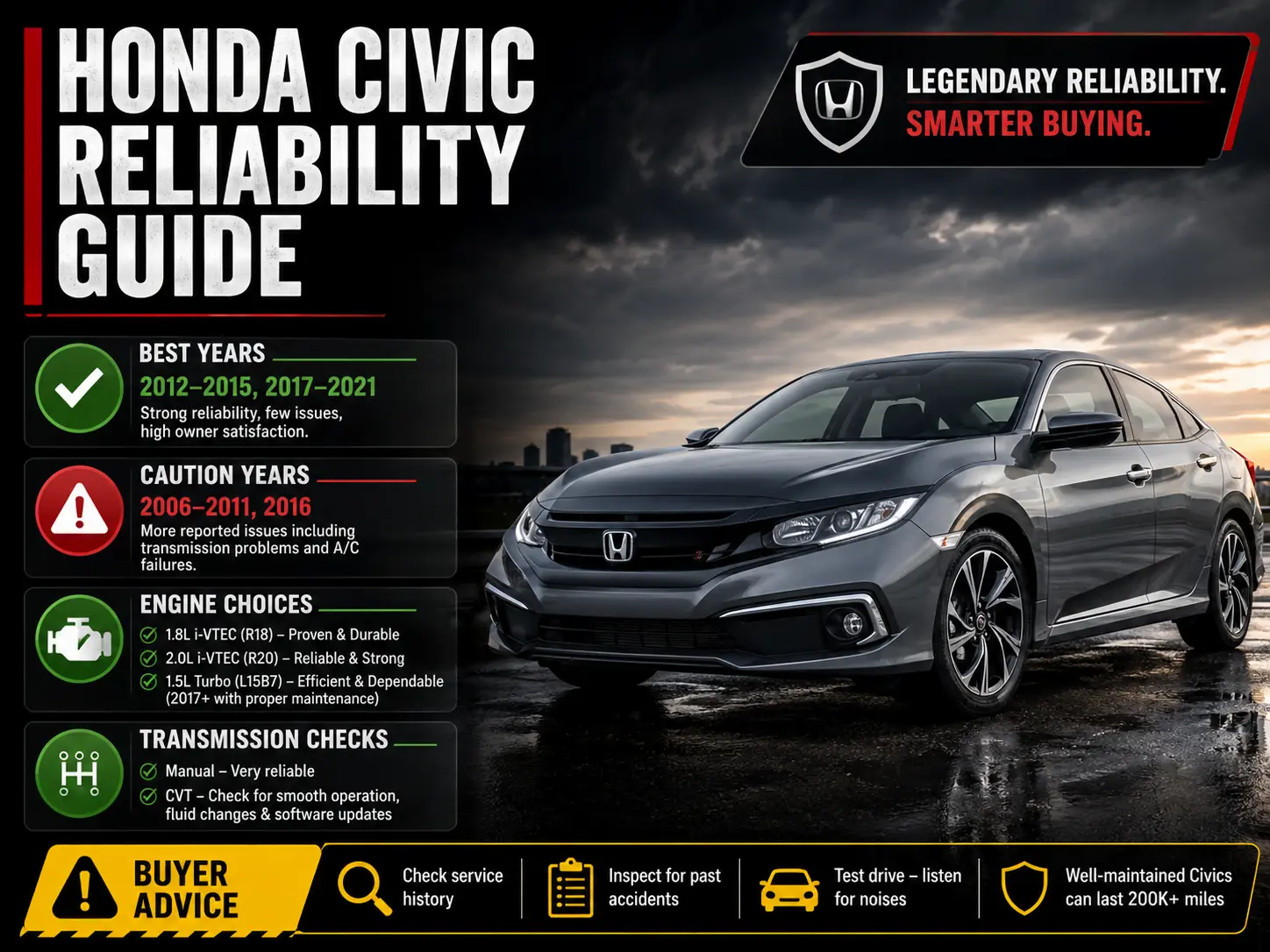
Honda Civic reliability is not one score. A seventh-generation automatic, a ninth-generation 1.8L, an early tenth-generation 1.5T and a newer 2.0L Civic can have very different ownership risks. The useful comparison is generation + powertrain + service history + current vehicle condition.
Reliability by generation: what actually changes the answer
| Generation | Main reliability variable | Where to research next |
|---|---|---|
| 2001–2005 | Automatic-transmission condition, timing-belt history and age | 2001 Civic hub for a model-year example |
| 2006–2011 | Cooling-system and early 1.8L block history, plus age-related wear | Common-problem router |
| 2012–2015 | Generally simpler ownership profile; individual maintenance and condition dominate | Year-risk comparison |
| 2016–2021 | 2.0L vs 1.5T, CVT service, A/C history and use pattern | Powertrain map |
| 2022–present | Recall completion, exact powertrain and still-developing long-term evidence | VIN/recall path |
This page owns the long-term dependability question. It does not rank “bad years” or diagnose every fault. Use Years to Avoid for purchase screening and Common Problems for failure applicability.
2001–2005: transmission type can dominate the whole car
These cars are old enough that maintenance and corrosion now matter as much as original design. The automatic transmission is the largest configuration-specific risk. A manual car with documented maintenance can be a materially different ownership proposition from an automatic that slips or delays engagement after warm-up.
Timing-belt history, cooling condition, rust, suspension, brake lines, seals and electrical operation should be checked on every surviving example.
2006–2011: cooling evidence matters more than reputation
Certain 2006–2008 and early-production 2009 1.8L Civics were covered by Honda action related to engine-block coolant leakage. Today, the buyer question is whether the individual car has stable coolant level, no overheating history and documented repair if applicable. Later cars sit outside the main production window, but they are still old enough for normal cooling and age-related inspection.
2012–2015: one of the cleaner used-buy starting points
The ninth generation avoids the early-2000s automatic concentration and the later turbo oil-dilution discussion. That does not make every car good, but it leaves normal maintenance, brakes, suspension, tires, accident history and individual condition as the main variables on many examples.
2016–2021: split the 2.0L and 1.5T before judging reliability
The tenth generation introduced a meaningful powertrain divide. The naturally aspirated 2.0L is mechanically simpler. The 1.5T adds turbo and direct-injection hardware and deserves closer review of oil history, operating pattern and cooling evidence. A/C condenser/compressor coverage and CVT maintenance can also influence ownership experience.
Use the engine and powertrain map before transferring one engine’s reputation to another.
2022–present: do not overstate long-term certainty
Newer Civics have less high-mileage exposure than older generations. Recall completion and the exact powertrain should be checked, while long-term conclusions should remain more provisional. Newer gasoline, Si/Type R and hybrid configurations should not be collapsed into a single reliability claim.
Evidence that matters more than a reliability score
| Evidence | Why it matters |
|---|---|
| Dated service invoices | Show what was actually maintained and when |
| Cold-start and full-hot road test | Expose temperature-dependent engine/transmission behavior |
| Stored/pending/permanent codes | Reveal faults that may not have a current warning lamp |
| Stable coolant and no overheating history | Supports engine-condition evidence |
| Current VIN recall status | Separates affected, unaffected and already-remedied vehicles |
| Lift/structure inspection | Captures corrosion, leaks, suspension and crash repair that model reputation cannot |
Can a Civic reach 200,000 miles?
Many individual Civics do, but there is no defensible universal mileage promise. A documented high-mileage car can be safer than a neglected low-mileage one. Use mileage as one attribute alongside service history, cooling, transmission behavior, corrosion and previous repairs.
When mileage itself becomes the main buying concern, continue to High-Mileage Honda Civic.
Which Civic is the easier reliability bet?
For a buyer who prioritizes mechanical simplicity, well-maintained ninth-generation cars and later naturally aspirated 2.0L Civics are reasonable research starting points. That is not a guarantee, and a documented 1.5T or older car can still be the better individual vehicle.
Evidence boundary
Reliability patterns help prioritize inspection. They do not establish a failure percentage for every Civic in a generation. The installed powertrain, service history and present condition remain part of the answer.







