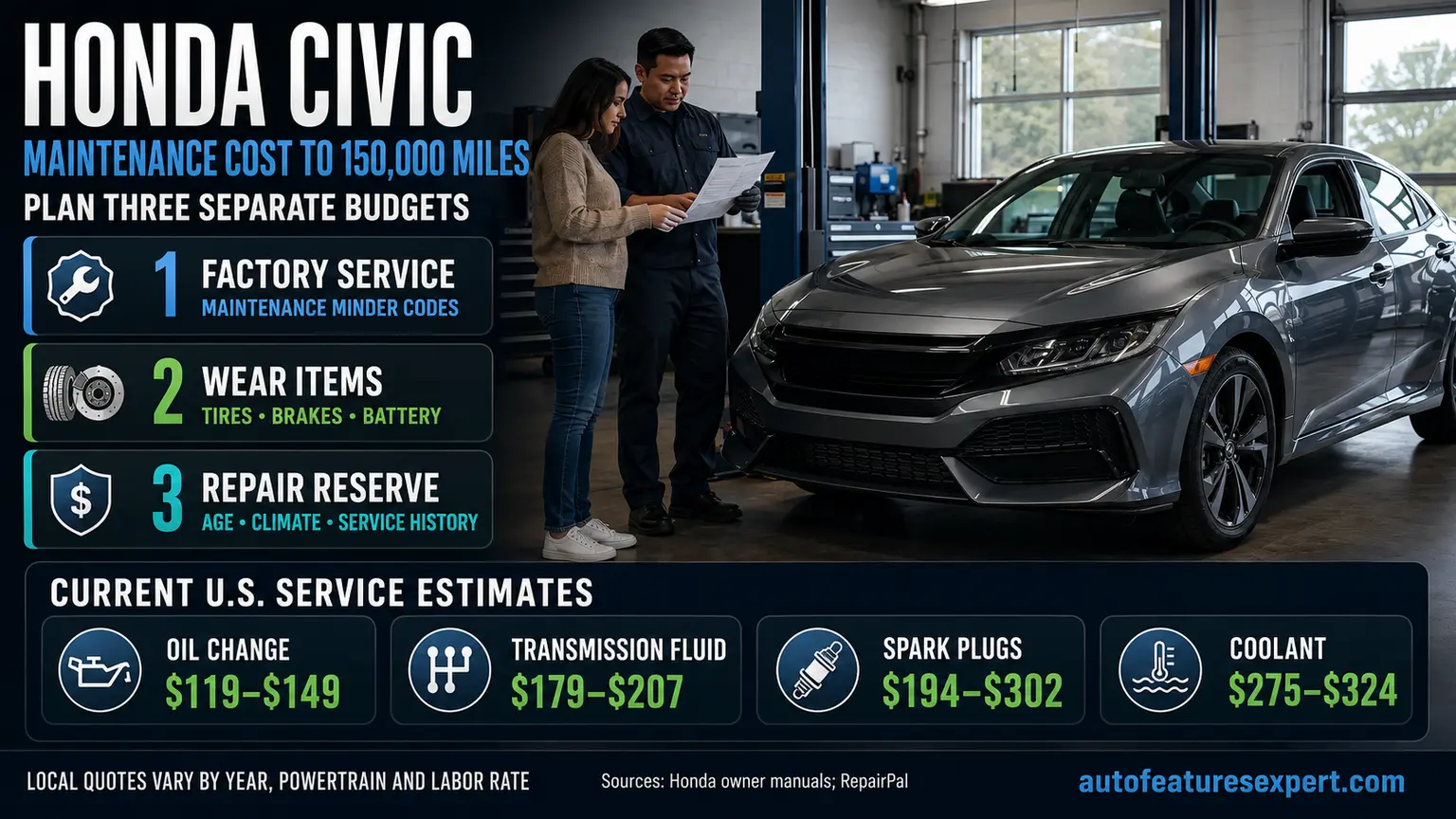
Use this guide for
Separate scheduled Civic maintenance from wear items, deferred service and age-related repair cost.
Boundary: This page estimates ownership workload; it does not diagnose a current fault.
Honda Civic maintenance cost is low by compact-car standards, but there is no honest universal total through 150,000 miles. As of July 2026, RepairPal reports a $368 average annual repair-and-maintenance cost, while CarEdge estimates $5,632 during the first 10 years. Budget separately for Maintenance Minder service, tires and brakes, and unexpected repairs; model year, powertrain, labor market and prior records determine the actual amount.
This guide turns those benchmarks into a usable U.S. ownership plan. It explains what Honda’s Maintenance Minder codes request, where higher-mileage spending tends to concentrate and how to compare quotes without treating a dealer’s mileage package as a factory requirement. Prices are in U.S. dollars and were source-checked on August 22, 2026. Owners in other markets should use the local owner’s manual, service information, taxes and labor rates.
What the published averages actually tell you
RepairPal currently places average annual Honda Civic repair and maintenance spending at $368, while CarEdge estimates $5,632 during the first 10 years. These are useful comparison points, not a prediction for one car. They use different methods and cannot be multiplied into a reliable 150,000-mile total.
A practical budget has three parts: factory-required service, wear that can be measured, and a reserve for faults that cannot be scheduled. The exact Civic matters too. Age, service history, local labor rates, climate, engine and transmission can move the real cost far above or below a model-wide average.
How much does Honda Civic maintenance cost through 150,000 miles?
There is no single defensible national 150,000-mile total. The strongest current model-level anchors answer narrower questions. RepairPal reports $368 as the Civic’s average annual repair and maintenance cost across model years. CarEdge estimates $5,632 for maintenance and repairs during the first 10 years, including $1,786 during the first five years. CarEdge also models a 16.08% chance of a repair costing more than $500 during the first decade.
Those numbers should not be combined or multiplied into a supposed “correct” 150,000-mile bill. RepairPal’s annual figure blends vehicles of different ages and conditions. CarEdge models a new-car ownership curve by year, not the precise service history of your VIN. A Civic may reach 150,000 miles before the tenth birthday or long after it; the slower-mileage car can accumulate more calendar-age batteries, corrosion, rubber deterioration and A/C or electrical work.
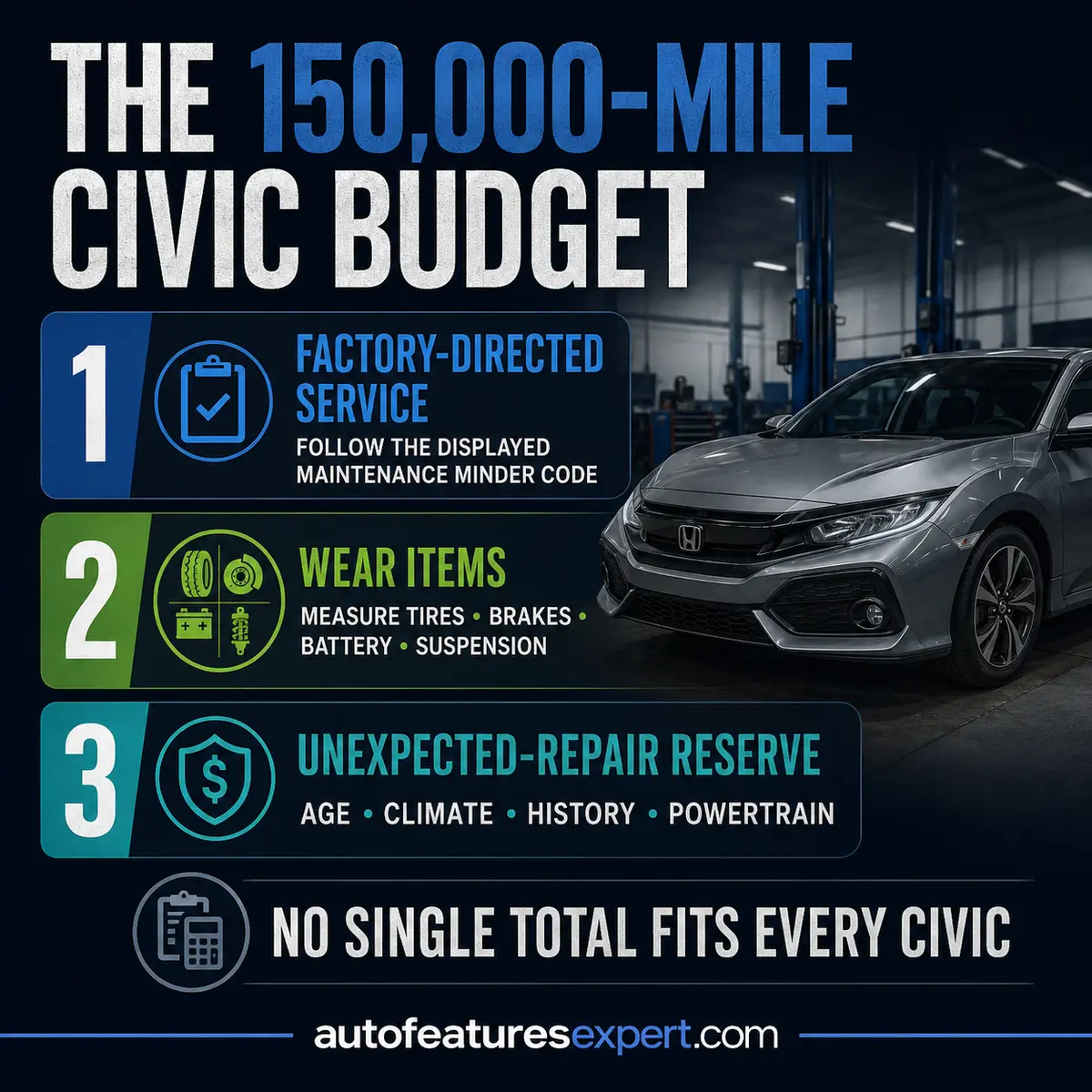
The practical answer is therefore a process: identify what the exact Civic requires, reconstruct what was completed, price the next two years of due service, measure wear items and add a reserve that matches age and condition. That method remains useful when published averages or local labor rates change.
Build the budget in three separate buckets
1. Factory-directed maintenance
This bucket covers the work identified by the owner’s manual and Maintenance Minder: engine oil, oil filter, inspections, tire rotation, air filters, transmission fluid, spark plugs, valve-clearance inspection where specified, coolant and brake fluid. These are not all due at once, and the displayed code should be recorded before it is reset.
Ask the shop to itemize parts, labor, fluid specification, shop supplies, taxes and disposal. A lower quote may exclude inspections or use a different fluid; a higher one may bundle condition-based repairs or optional additives. Compare equal scopes rather than the number at the bottom of two differently structured estimates.
2. Wear and age items
Tires, brake pads and rotors, the 12-volt battery, wiper blades, bulbs and alignment are ordinary ownership costs but are not a fixed mileage schedule. Driving style, climate, tire choice, road damage, storage and alignment can move replacement timing dramatically. Suspension components, engine mounts, wheel bearings, belts and hoses also become condition-based questions as age and mileage rise.
Measure what can be measured. Record tire tread depth and age, brake-pad and rotor measurements, battery test results, fluid condition and any suspension play or leakage. “Recommended soon” is not a measurement. A written inspection lets you decide whether an item belongs in this month’s invoice, the next year’s reserve or neither.
3. Unexpected repairs
A repair reserve covers faults rather than maintenance: an A/C leak, starter, alternator, sensor, damaged wheel, failed mount, cooling-system leak or larger powertrain diagnosis. The correct reserve depends on warranty coverage, vehicle age, title and collision history, climate, modifications and the quality of prior work. A newly warranted Civic and a 15-year-old 150,000-mile Civic should not carry the same contingency.
A useful monthly formula is:
(Known maintenance due in the next 24 months + measured wear expected in that period + repair contingency) ÷ 24.
For example, if documented estimates show $400 of due fluids and filters, $1,000 for tires, $600 for brakes and you choose a $1,000 repair contingency, the two-year total is $3,000, or $125 per month. That is a budgeting example, not a prediction for every Civic. Replace each input with written local estimates and the actual inspection findings.
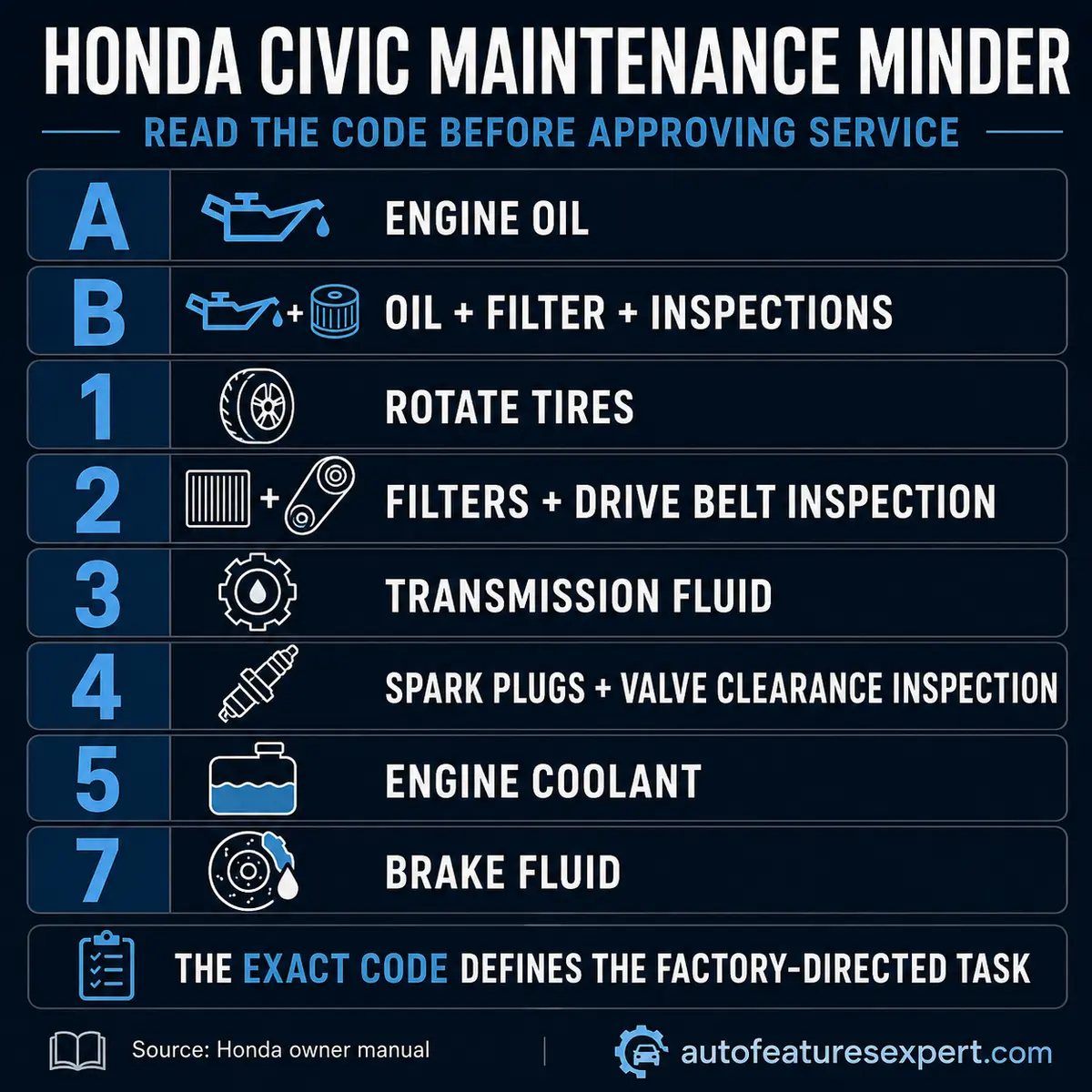
Honda uses Maintenance Minder codes, not one universal mileage schedule
Current U.S.-market Civics use an oil-life calculation and service codes rather than one fixed national mileage chart. The system evaluates operating conditions and displays a main item plus applicable sub-items as service approaches. The owner’s manual for the exact year remains controlling; code definitions and powertrain coverage can differ by model and market.
| Honda code | Service identified in current U.S. Civic manuals | What to verify on the quote |
|---|---|---|
| A | Replace engine oil | Correct viscosity and specification; whether a filter is included should be itemized |
| B | Replace engine oil and oil filter; perform listed vehicle inspections | Inspection scope and any separately priced findings |
| 1 | Rotate tires | Tread, pressure and wear pattern; whether rotation is included with tire purchase or another visit |
| 2 | Replace engine air cleaner and cabin dust-and-pollen filter; inspect drive belt | An inspection is not automatic belt replacement; confirm filter part and fit |
| 3 | Replace transmission fluid | Fluid and procedure must match the installed CVT, automatic, manual or hybrid drive unit |
| 4 | Replace spark plugs and inspect valve clearance | Plug specification; distinguish valve inspection from adjustment labor |
| 5 | Replace engine coolant | Correct coolant, system bleeding and whether a leak or repair is a separate job |
| 7 | Replace brake fluid | Clarify fluid replacement or bleed scope; pads, rotors and calipers are separate |
Oil service also has a time limit. Current Honda manuals instruct owners to change the engine oil at least annually if the Maintenance Minder does not call for it within 12 months. Check oil level between services and investigate leakage, consumption, fuel odor, contamination or warnings instead of waiting for a percentage to diagnose a problem.
Do not reset a code until the associated work is complete. If only part of the displayed service is performed, the record should say which item remains due. Save the code in the invoice, because a later buyer cannot reconstruct the service history from the reset display alone.
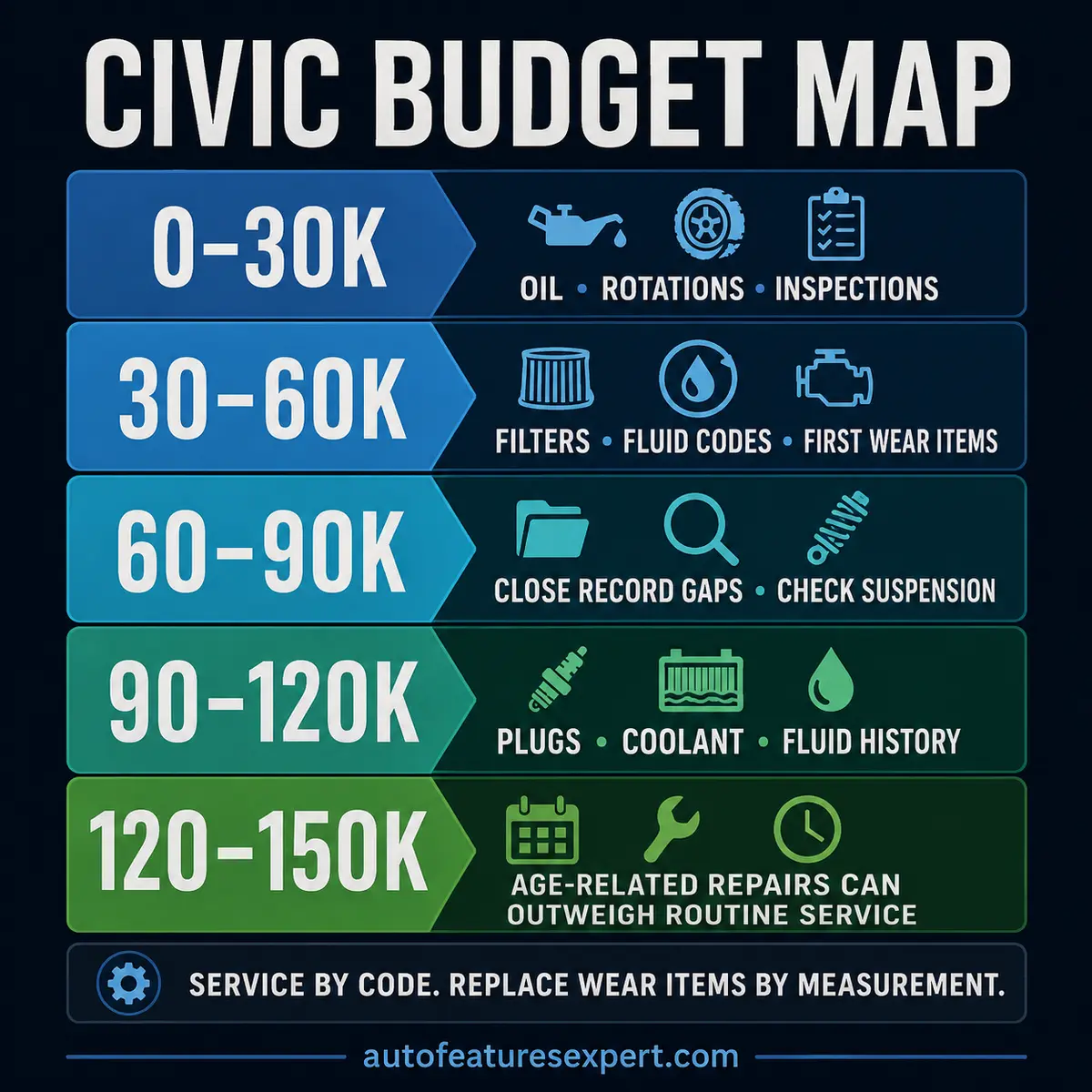
A realistic 0-to-150,000-mile budgeting map
The ranges below organize likely decision points; they are not automatic replacement commands. A code may appear earlier or later, and age can make a low-mileage car need work before a high-mileage commuter.
| Mileage stage | Factory-directed work to track | Wear and repair budget questions |
|---|---|---|
| 0–30,000 miles | Oil service, rotations and B-code inspections as displayed | Road-hazard tire damage, alignment, wipers and an unusual early battery failure are possible, not scheduled certainties |
| 30,000–60,000 miles | Repeat oil/tire service; filter, transmission-fluid or brake-fluid codes may appear according to use and time | First tire set, brake wear and battery replacement become more plausible; measure before replacing |
| 60,000–90,000 miles | Continue code-driven fluids, filters and inspections; close any service-record gaps | Review shocks, struts, bushings, mounts, wheel bearings and a second wear-item cycle by condition |
| 90,000–120,000 miles | Spark-plug/valve-clearance, coolant and transmission-fluid work can concentrate in this period if displayed or overdue | Cooling stability, leaks, belt condition, brakes, tires and charging system deserve documented inspection |
| 120,000–150,000 miles | Repeat due oil, filter, tire and fluid service; verify that earlier major codes were not skipped | Age-related suspension, mounts, A/C, starting/charging and cooling repairs can outweigh routine service; maintain a repair reserve |
The most expensive “100,000-mile service” is often not one factory package. It is a collision of overdue or newly due codes, a tire or brake cycle and work discovered during inspection. Two Civics at 100,000 miles can therefore need very different invoices. One may have recent coolant, transmission fluid, plugs and tires; the other may have no records and several incomplete services.
Current Honda Civic service cost references
The following RepairPal model-level estimates were checked August 22, 2026. They exclude taxes and fees, do not account for your ZIP code and may not represent a specific model year. Related repairs can increase the invoice. Use the exact year, engine, transmission and location tool before authorizing work.
| Service | Current Civic estimate | Important qualification |
|---|---|---|
| Engine oil change | $119–$149 | Oil quantity, specification, filter, shop and local labor affect the total |
| Tire rotation | $49–$72 | May be included with another service or tire-purchase plan |
| Engine air filter | $66–$87 | Installed price includes labor; check the exact filter and air-box fit |
| Cabin air filter | $60–$74 | Owner-replaceable on many Civics; install in the correct airflow direction |
| Transmission fluid change | $179–$207 | Recent year-specific estimates can be higher; require the correct Honda fluid and procedure |
| Spark-plug replacement | $194–$302 | Recent model-year estimates can exceed the model range; valve-clearance work is separate |
| Engine coolant change | $275–$324 | A leak, thermostat, water pump or cooling-system repair is not included |
| Brake bleed | $90–$131 | A brake-fluid replacement quote can have a different scope; friction parts are separate |
| 12-volt battery replacement | $247–$269 | Recent models and battery types may cost more; this is not hybrid high-voltage battery service |
These estimates demonstrate why a service name alone is insufficient. RepairPal’s model-level transmission-fluid range is $179–$207, while its current 2024 Civic estimate is $215–$244. The model-level spark-plug range is $194–$302, yet several recent model-year estimates are higher. Always select the year and location before using a web figure in a negotiation or budget.
The costs a maintenance schedule usually leaves out
Tires, alignment and road damage
Tires can be one of the largest predictable Civic expenses, but wheel size, speed rating, climate and brand make a national dollar figure misleading. An economical sedan tire and a performance tire for an Si or Type R do not belong in the same estimate. Include mounting, balancing, disposal, valve-service needs and alignment diagnosis when wear is uneven. A pothole-damaged wheel or tire is a repair event, not scheduled maintenance.
Brake friction parts
Maintenance Minder code 7 concerns brake fluid, not automatic pad or rotor replacement. Pads, rotors and calipers are inspected and measured. Highway driving can produce long life; stop-and-go use, corrosion, performance driving and seized hardware can shorten it. Hybrid regenerative braking can reduce friction wear but does not eliminate corrosion or inspection.
Diagnostic time and related repairs
An oil change estimate does not include tracing a low-oil warning. A coolant service does not include finding a leak. An A/C recharge does not explain why refrigerant escaped. Budget diagnostic labor before a repair when the cause is unknown; replacing the part suggested by a symptom is not the same as diagnosis.
Deferred maintenance from a previous owner
A used Civic can appear inexpensive until the first inspection exposes four years of skipped fluids, worn tires, weak battery, brake work and a cooling leak. Do not call that entire invoice “normal annual Civic maintenance.” It is the cost of catching up one specific car. Our used Honda Civic inspection checklist shows how to identify those gaps before purchase.
How the Civic version changes the budget
Older timing-belt engines
Some older Civic engines use a timing belt and have a separate age/mileage replacement schedule that can include related components. Later Civics generally use different valve-train designs. Never apply “all Civics have a chain” or “all Civics need a belt at 100K” to the entire model history. Identify the engine and use the correct manual or service information. Missing proof should be priced as overdue work, not assumed complete.
CVT, conventional automatic and manual transmissions
The code may simply say transmission fluid, but fluid type, quantity and procedure are transmission-specific. CVT fluid, conventional automatic fluid and manual gear oil are not interchangeable. Avoid universal fluid or an aggressive flush sold without reference to the installed unit. Keep the product and service procedure on the invoice. For symptom context, see our Honda Civic CVT problems guide.
Turbocharged Civics
A 1.5-liter turbo does not automatically carry a dramatically higher routine schedule, but oil level and condition, correct specification, coolant stability, driving pattern and modification history deserve attention. Frequent short trips can affect oil condition; a tune can alter risk and warranty context. Our Civic oil-dilution analysis explains why usage pattern matters more than a generic internet interval.
Hybrid, Si and Type R models
A hybrid adds high-voltage systems, power electronics, battery cooling and model-specific fluids or inspections; a generic gasoline-Civic budget cannot estimate a high-voltage repair. Si and Type R ownership can involve costlier tires, brakes and performance-use wear. Modifications and track use change the inspection and reserve. Verify warranty coverage and use technicians equipped for the exact system.
How to price a used Civic before you buy
Start with invoices, not the seller’s maintenance display. Build a timeline of oil service, transmission fluid, brake fluid, coolant, plugs, filters, tires, brakes and battery work. Match the dates and mileage to the correct owner’s manual and codes. A line saying “60K service” is weak evidence if it does not identify the fluid, parts and work performed.
Then obtain a buyer-selected pre-purchase inspection. Ask for tire depth and age, brake measurements, battery test, fluid and leak findings, scan results, cooling-system behavior and suspension condition. Separate the report into:
- Safety or active faults: diagnose or repair before purchase.
- Overdue factory maintenance: price from the exact service and fluid specification.
- Measured near-term wear: include in the next 12–24 months.
- Optional or cosmetic work: decide whether it matters to your ownership goal.
Subtracting an arbitrary amount from the asking price is not budgeting. Add the verified catch-up work, wear items, tax, registration and insurance to the purchase price, then compare that all-in number with another Civic of the same generation and condition. Use our Honda Civic reliability guide, years-to-avoid analysis and common-problems overview for model-level context after the individual car is inspected.
How to avoid paying for the wrong service
Ask the service advisor to divide the estimate into three labels: factory code due, condition-based repair and optional service. Request the displayed code and the owner’s-manual basis for the first category, measurements or diagnosis for the second, and the claimed benefit for the third.
Common quote traps include a “lifetime” additive, universal transmission fluid, automatic belt replacement when the code requests an inspection, bundled filters with high labor, a coolant exchange that does not address an active leak and repeated work that was recently documented. A shop may have a valid reason to recommend more than the displayed code, but the reason should be evidence, not the name of a mileage package.
Dealer service is not automatically unnecessary, and independent service is not automatically cheaper after scope and equipment are matched. Authorized Honda dealers are the correct path for recall work and VIN-specific campaigns. An experienced independent Honda specialist can be an excellent option for maintenance and diagnosis. Competence, documentation, correct materials and an itemized estimate matter more than the sign outside.
Questions that change the budget
Is a Honda Civic expensive to maintain?
No, current model-level benchmarks place the Civic on the lower-cost side of compact-car ownership, but the condition of one vehicle can matter more than the average. RepairPal reports a $368 average annual repair-and-maintenance cost, and CarEdge estimates $5,632 during the first 10 years. Those figures do not include every owner’s tires, taxes, local labor or deferred work in the same way. A well-documented Civic can be predictable; an inexpensive used Civic with overdue fluids, worn brakes and an undiagnosed fault can create a large first-year bill.
How much should be budgeted for a Honda Civic each year?
Use the $368 RepairPal average only as a comparison point, then build a personal annual budget from the actual car. Add the factory maintenance expected in the next year, the annualized share of measured tires, brakes and battery needs, and a repair contingency appropriate for age and warranty. A two-year worksheet divided by 24 months is more useful than multiplying an average by ownership years. Newer warrantied cars may need mainly routine and wear-item funds, while an older high-mileage Civic should carry a larger contingency for diagnosis and age-related repairs.
What maintenance does a Honda Civic need at 100,000 miles?
There is no universal Honda “100K package” for every Civic. Around that mileage, spark plugs and valve-clearance inspection, coolant, transmission fluid and recurring oil, filters, tires or brake-fluid service may be due, already completed or not yet displayed. Modern U.S.-market Civics use Maintenance Minder codes, while older engines and other markets can follow different schedules. Check the VIN-specific manual, current code and invoices. Price only the missing items; do not repeat documented work simply because a dealer menu uses a round mileage number.
What should be replaced by 150,000 miles?
No single list applies to every Civic. By 150,000 miles, the record should show the required oil, filters, transmission fluid, brake fluid, coolant, spark plugs and inspections for that powertrain. Tires, pads, rotors, battery, suspension, mounts, belts and cooling components are replaced by age, measurements or diagnosis rather than the odometer alone. Some older engines have a separate timing-belt schedule; current hybrids add system-specific requirements. Missing history should trigger inspection and catch-up planning, not blind replacement of every item on a generic list.
How often should a Honda Civic get an oil change?
Follow the oil-life display and instructions in the owner’s manual for the exact model year and market. Current U.S. Civic manuals use Maintenance Minder and also require an engine-oil change at least annually if the system does not call for one within 12 months. Check level between services and act sooner for leakage, abnormal consumption, contamination, warning lights or a diagnosed operating issue. A fixed internet interval may be more conservative, but it should not replace the specified oil, filter, inspection and documentation requirements.
Does Honda Maintenance Minder include transmission fluid?
Yes. In current U.S. Civic manuals, sub-item 3 identifies transmission-fluid replacement. The code does not make every transmission or fluid interchangeable. Verify whether the Civic has a CVT, conventional automatic, manual transmission or hybrid drive unit, then require the correct Honda-specified fluid and procedure. Keep the product and code on the invoice. A universal fluid, power flush or additive should not be accepted solely because a shop says it works in all vehicles.
Should a Civic be serviced at a Honda dealer or independent shop?
Either can perform competent maintenance if the shop follows the correct Honda information, uses appropriate fluids and parts, has the required diagnostic equipment and documents the work. Compare itemized scopes rather than assuming one is always cheaper. A Honda specialist may offer efficient model knowledge, while a dealer can check VIN-specific campaigns and is the proper channel for recall remedies. Choose based on evidence, qualifications and communication. For a hybrid, advanced driver-assistance fault or unusual powertrain diagnosis, confirm the shop has training and equipment for that exact system.
The budget that keeps a 150,000-mile Civic predictable
The most useful maintenance number is not a universal lifetime total. It is the amount required for the next known services, measured wear and a realistic contingency on the Civic you own or plan to buy. Maintenance Minder gives the factory-directed work; invoices prove what was done; inspection shows what condition-based spending is approaching.
Update the worksheet after every service. Remove completed items, add new measurements and keep unexpected repairs separate from routine maintenance. That prevents one large tire or A/C invoice from distorting the Civic’s normal service cost, and prevents an attractive average from hiding a neglected individual car.
Sources
- American Honda: Maintenance Minder overview
- American Honda: 2026 Civic Hybrid Maintenance Minder information
- Honda Owners: Owner’s Manuals and Vehicle-Specific Resources
- CarEdge: Honda Civic Maintenance Costs and Repair Probability
- RepairPal: Honda Civic Repair and Maintenance Cost
- RepairPal: Honda Civic Maintenance Schedule and Local Estimate Tools
- RepairPal: Honda Civic Oil Change Cost
- RepairPal: Honda Civic Transmission Fluid Change Cost
- RepairPal: Honda Civic Spark Plug Replacement Cost
- RepairPal: Honda Civic Coolant Change Cost
About This Article
This maintenance-cost guide was prepared by Alex Fric, Automotive Research Editor, and last source-verified on August 22, 2026. It is intended for U.S.-market Honda Civic budgeting through 150,000 miles, with explicit notes where model year, powertrain, age and market change the recommendation.
The analysis combines current American Honda owner-manual information, CarEdge model-level ownership estimates and RepairPal’s Civic average and service-specific estimate pages. Live search results and competing guides were reviewed to identify missing questions, but service definitions were anchored to Honda material and all dollar figures are labeled as third-party estimates rather than factory prices.
No individual Civic or service invoice was inspected. Prices exclude location-specific taxes, fees and related repairs unless a cited source states otherwise. Always verify the owner’s manual, displayed Maintenance Minder code, warranty and VIN-specific campaigns, then obtain an itemized local estimate. Cost figures and code coverage should be rechecked during future updates.







