
Use this guide for
Decide whether 100K, 150K or 200K miles changes the risk enough to reject a used Civic.
Boundary: Mileage alone does not own the reliability verdict; records and configuration can outweigh the odometer.
A high-mileage Honda Civic is not automatically a poor buy at 100,000 miles. A well-maintained Civic at 150,000 miles can still be worth buying, while a neglected 90,000-mile car may be riskier. At 200,000 miles, service records, cooling and transmission health, structural condition and expected repair costs matter more than the badge or odometer.
The mileage checkpoints below show what to verify at 100K, how the risk changes at 150K and when a 200K Civic is still a sensible purchase.
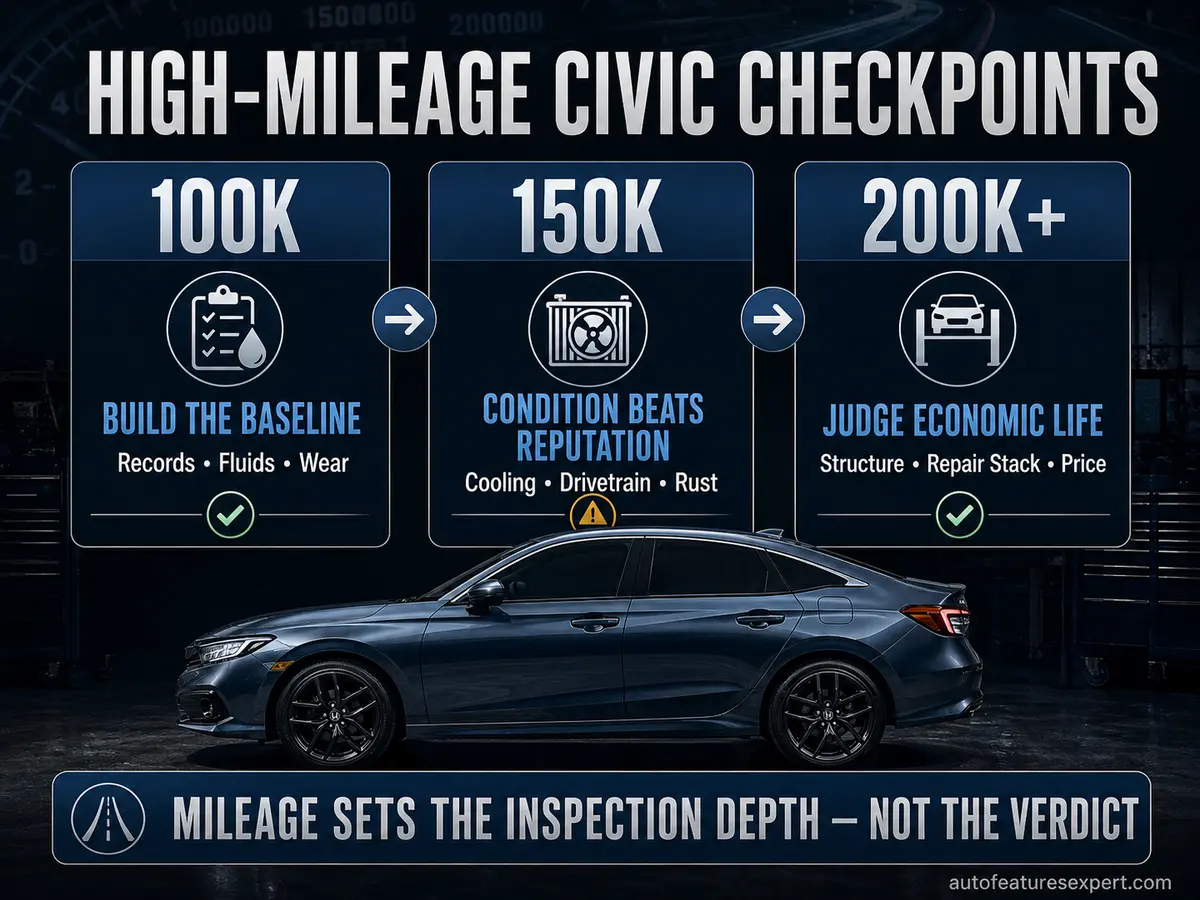
What Should You Check at 100K, 150K and 200K Miles?
| Odometer | What it usually means | What to check | When it makes sense |
|---|---|---|---|
| Around 100K | The car is entering a stage where maintenance history matters more, not automatically the end of useful life | Service invoices, fluid history, dashboard warning lights, recall status, tires, brakes and a basic inspection | Reasonable when maintenance is documented and no major system is already showing trouble |
| Around 150K | The condition of the individual car matters more than the Civic nameplate | Cold and hot drivetrain behavior, cooling stability, leaks, suspension, bearings, mounts, A/C and corrosion | The price should leave room for normal wear and any overdue work |
| 200K and above | What the car needs next matters more than the mileage number itself | Qualified pre-purchase inspection, scan results, structural condition, oil use, transmission health and recent major repairs | Buy only if the engine, transmission, cooling system and structure check out and the price leaves room for repairs |
Is 100,000 Miles High for a Honda Civic?
At 100,000 miles, a Honda Civic is entering a stage where maintenance matters more, but mileage alone does not make it a poor buy. Check dated service records, the exact engine and transmission, recall completion, fluid condition, warning lights, tires and brakes. A clean inspection matters more than reaching 100,000 miles.
Start with the service records. Review dated invoices rather than relying on a dashboard reminder or a seller’s memory. Match the records to the exact model year, engine and transmission. Confirm that warning lights illuminate during the ignition check and then go out normally. Look for recently cleared diagnostic monitors, unexplained recent fluid refills, mismatched tires, uneven wear and repairs that appear to have been performed only to prepare the car for sale.
On older Civics that use a timing belt, the service history deserves special attention. Do not assume the belt was replaced because the odometer passed a familiar interval; verify the correct schedule for the exact engine and market in the owner documentation, then ask for a dated invoice. Later Civics use owner information specific to each model and Maintenance Minder codes rather than one universal mileage schedule.
What Changes Around 150,000 Miles?
At 150,000 miles, a Honda Civic can still be a sensible purchase, but the individual car now matters more than the model’s reputation. A proper test drive should confirm stable cooling, normal cold and hot transmission behavior, clean engine operation, manageable suspension wear and no structural corrosion.
Evaluate the vehicle from cold start through full operating temperature. A few minutes around a parking lot tells you very little. Listen for prolonged cranking, abnormal mechanical noise and uneven idle. Watch temperature behavior. Test acceleration, deceleration, maneuvering at low speed and cruising at a steady speed. Repeat transmission checks after the drivetrain is fully warm; some slipping, flare, shudder or engagement problems are more obvious then.
Normal wear does not automatically make a 150,000-mile Civic a bad purchase. Tires, brakes, struts, bushings, mounts and wheel bearings are serviceable items. The problem is when several of those jobs are due at the same time and the car also has an uncertain transmission or cooling issue. That is how a cheap Civic can become an expensive one.
At this mileage, pay for the condition you can verify rather than the Civic’s general reputation. Clean records, stable cooling, consistent transmission behavior and a solid body are all good signs. The badge and the number on the odometer cannot tell you those things.
Is a 200,000-Mile Honda Civic Still Worth Buying?
A 200,000-mile Honda Civic can still be worth buying when an independent inspection confirms stable cooling, a healthy engine and transmission, safe structure and no pileup of overdue repairs. Complete records and recent replacement of normal wear parts help, but the price must leave enough room for work that comes with age.
Ask five separate questions:
- Engine: Does it start cleanly, run evenly and show acceptable oil use without smoke, persistent misfire or contaminated fluids?
- Cooling system: Is the coolant level stable, the temperature controlled and the repair history free of repeated overheating?
- Transmission: Does it engage and operate consistently both cold and hot, without slip, flare, harsh delay, shudder, abnormal noise or loss of drive?
- Structure: Are the unibody, subframes, mounting points, brake lines and fuel lines safe rather than cosmetically disguised?
- Upcoming repairs: Are tires, brakes, suspension, A/C, charging system and other age-related items already handled, or are several bills about to arrive at once?
A 210,000-mile Civic with records and recently renewed wear components may be more predictable than a 110,000-mile car with a slipping transmission and evidence of overheating. Every 200,000-mile Civic still needs its own inspection. Judge the mileage together with the car’s condition, history and price.
How Much Does Mileage Really Tell You?
Mileage figures are easy to misuse. There are really three different questions: how long Civics tend to stay on the road, how far an unusually well-kept example can go and whether the specific car in front of you is still worth maintaining.
- Typical lifespan: what the available data suggests across a large group of Civics.
- High-mileage potential: how far a well-maintained individual car may go under favorable conditions.
- Worth keeping: whether the next round of repairs still makes sense compared with the car’s value and replacement cost.
For 2026, iSeeCars reports a proprietary model estimate of 165,978 miles, about 13.8 years, for the Civic and a 29.4% estimated chance of reaching at least 200,000 miles. The company says its survival model draws on more than 300 million vehicle data points. That is useful background, but it is not a Honda warranty, a mechanical limit or a prediction for the car you are inspecting.
Dealer articles often talk about 200,000 to 300,000 miles as if every Civic should get there. Some do. Others are lost earlier to crashes, rust, neglect, overheating or a repair bill that no longer makes sense for the value of the car.
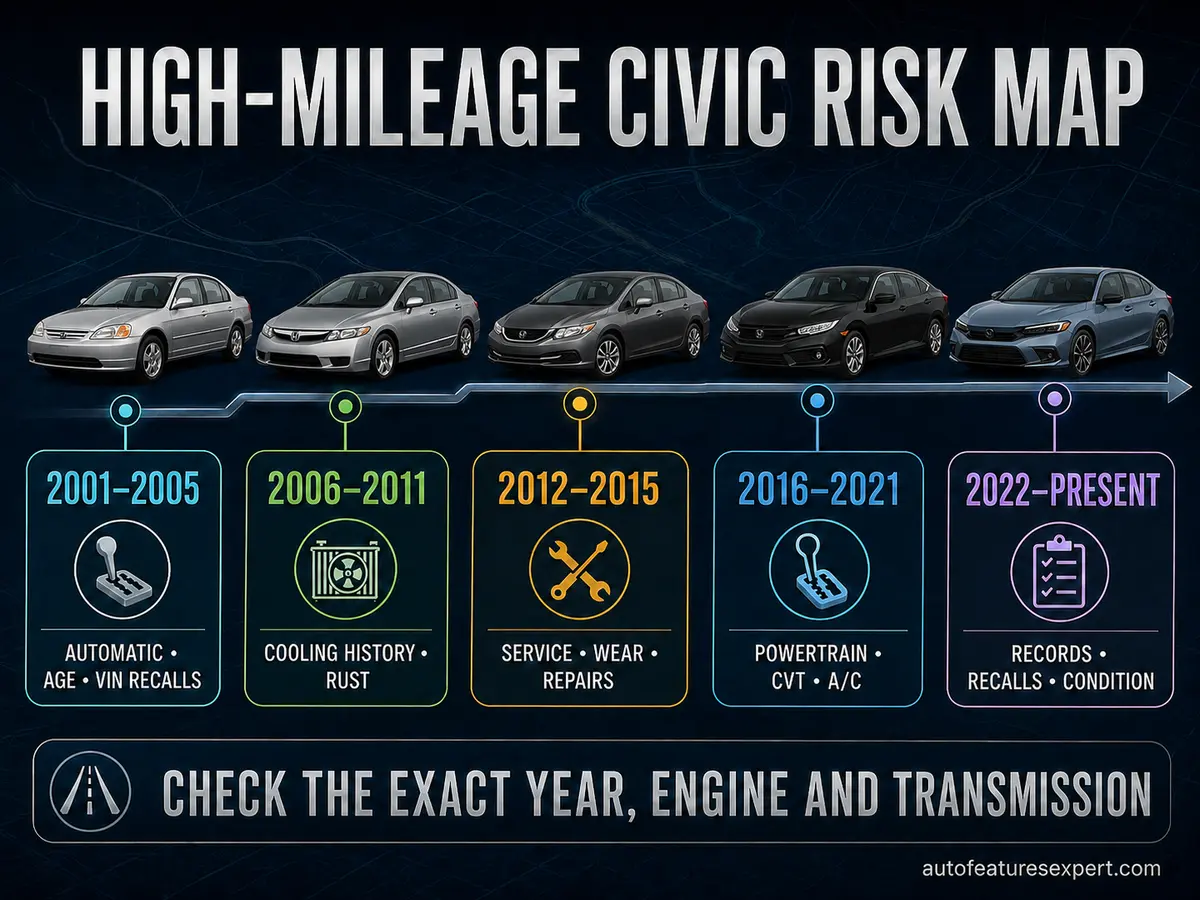
High-Mileage Risks by Honda Civic Generation
This inspection map focuses on mileage. For the broader model verdict, use our Honda Civic reliability by generation guide.
2001–2005: Transmission, Age and Safety History
On seventh generation cars, a healthy engine does not cancel a weak conventional automatic transmission. Test Drive and Reverse engagement from cold, repeat the test when warm and treat any slip, flare, delayed movement or loss of drive as a fault that needs diagnosis. Age never excuses abnormal behavior.
Age now matters as much as mileage. Verify timing belt history for the exact engine, cooling condition, structural corrosion, brake and fuel lines, suspension, seals and electrical operation. NHTSA’s Takata recall information includes older Civics, so complete a recall check by VIN rather than assuming that an airbag repair was completed. For a detailed example for a specific model year, see our 2001 Honda Civic reliability guide and 2001 Civic transmission guide.
2006–2011: Cooling History Matters
American Honda extended warranty coverage for some 2006–2008 Civics and 2009 Civics built early in the model run after identifying engine block coolant leakage that could lead to overheating. The coverage window is historical for most vehicles now, but the repair history still matters. A car with paperwork for a replacement block is a very different purchase from one that keeps losing coolant with no clear explanation.
Later eighth generation examples avoid the main production window described in that communication, but they are old enough for corrosion, suspension wear, mounts, seals, A/C faults and neglected cooling service to influence the decision. Unexplained overheating history is more important than whether the odometer reads 120,000 or 180,000 miles.
2012–2015: A Cleaner Starting Point Still Needs Proof
The ninth generation avoids several of the headline patterns attached to the preceding and following generations. That makes it a useful place to start when shopping for a high-mileage Civic, but the individual car still needs an inspection. Confirm maintenance records, transmission behavior, leaks, engine mounts, suspension, wheel bearings, A/C operation, tires, brakes and accident repair.
Complaints about interior refinement do not prove mechanical failure, and a favorable generation reputation cannot replace an inspection.
2016–2021: Engine Choice, CVT History and A/C
On tenth generation Civics, identify the actual powertrain before judging mileage. The naturally aspirated 2.0L avoids the oil dilution product update for the turbo engine, while certain 2016–2018 1.5T cars in specified states with cold climates were covered by an American Honda product update. On a used 1.5T, review oil history, previous climate and driving pattern, behavior at startup, oil level and campaign completion without assuming every engine is affected in the same way.
Transmission fluid history and current CVT behavior matter on cars with a CVT. A/C repair history matters as well: American Honda extended condenser coverage on eligible 2016–2021 Civics for a specified manufacturing defect. Use our Honda Civic CVT guide, Honda Civic A/C guide and Civic oil-dilution guide when those systems become the deciding issue.
2022–Present: Too New for a Full Ownership Record
The eleventh generation has not been around long enough to tell the same 15- or 20-year ownership story as older Civics. Early data, recalls and individual high-mileage cars can show what deserves attention, but they cannot tell us how the whole generation will age. Check the VIN for open campaigns and judge the individual car rather than assuming a few early high-mileage examples mean every one will reach 300,000 miles.
What Usually Makes a High-Mileage Civic Not Worth Fixing?
A Civic usually stops making financial sense when several expensive or structural problems show up together. There is no secret odometer number where the car suddenly becomes finished.
Repeated Overheating
One overheating event does not tell the whole story, but repeated coolant loss, pressure problems, contaminated fluids or a history of driving while hot can turn a manageable cooling repair into major engine work. Get a clear diagnosis before buying.
Transmission Failure
A transmission that slips, loses drive, delays engagement or behaves abnormally when warm can quickly exceed the value of an older car. A short test drive cannot identify the cause, and a fluid change cannot reverse internal damage.
Structural Corrosion or Poor Collision Repair
Surface rust and cosmetic wear are not the same as corrosion affecting structural mounting points, subframes or brake and fuel lines. Likewise, a repaired body panel is not automatically unsafe, but distorted structure, poor welds, water intrusion or uneven crash repair requires professional assessment.
Repairs Piling Up
A worn suspension alone may be manageable. Tires alone may be manageable. A/C work alone may be manageable. But when tires, suspension and A/C are all due and the car also has an uncertain engine or transmission, the total repair bill can be more than the car is worth.
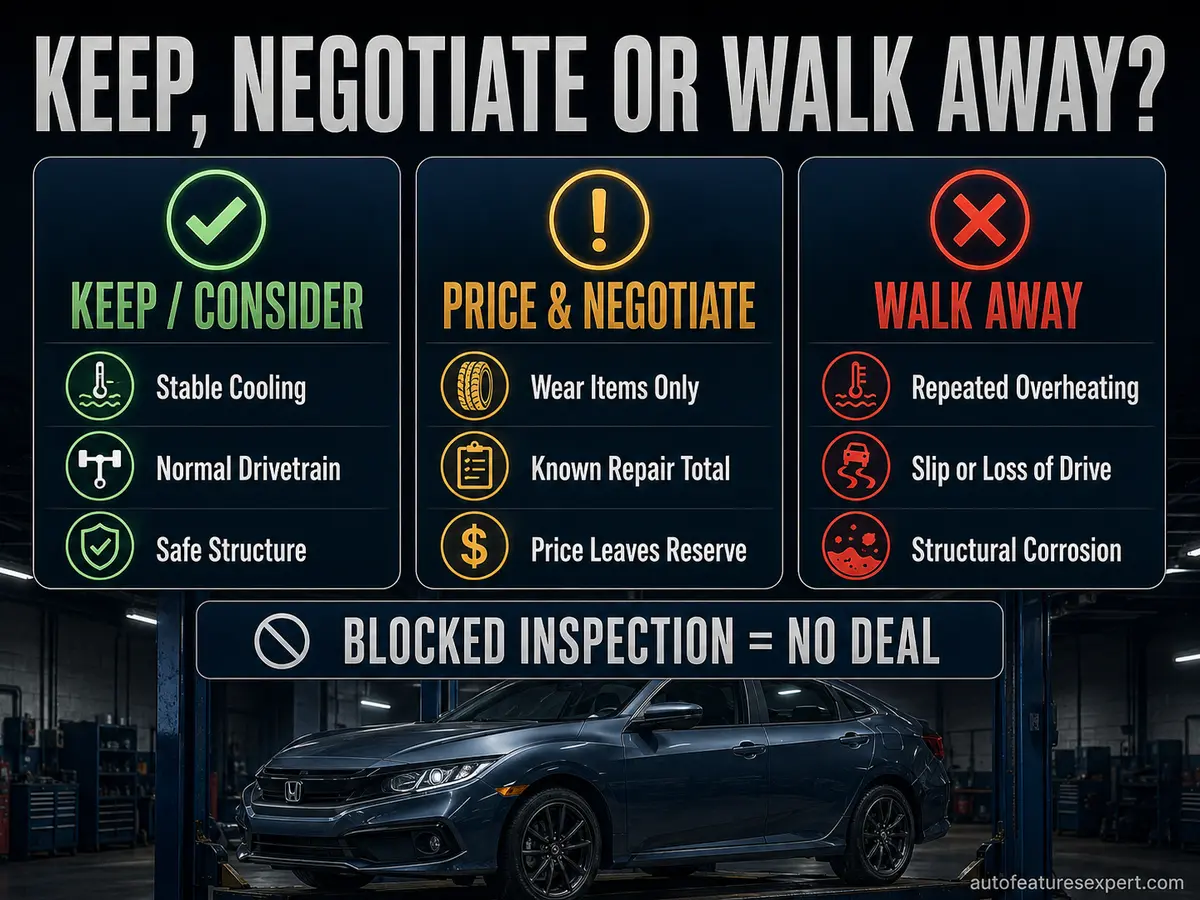
Repair, Keep or Walk Away?
| What you find | What to do | Why |
|---|---|---|
| Stable cooling, normal drivetrain, safe structure, useful records and manageable wear | Keep or consider buying | The major systems are working and the next costs are easier to plan |
| Normal drivetrain but overdue tires, brakes, mounts, suspension or A/C | Inspect, price and negotiate | Wear items can be reasonable when the purchase price reflects them |
| Unclear service history with no current symptoms | Get a deeper inspection | Missing records add uncertainty, but they do not prove the car is bad or good |
| Repeated overheating, slipping or loss of drive, structural corrosion, flood evidence or blocked independent inspection | Walk away | The risk is too high for an ordinary used-car purchase |
| Several major systems need work at once | Compare the repair total with replacement cost | The car may still run, but the numbers may no longer make sense |
High-Mileage Honda Civic Buyer Checks
This is the shortlist for these mileage points. For a complete purchase workflow, the car should still receive a pre-purchase inspection chosen by the buyer.
- Confirm the VIN, title status, odometer history and exact engine/transmission configuration.
- Run both Honda and NHTSA recall checks; save the results with the purchase records.
- Request a true cold start and observe the dashboard warning light check at startup.
- Scan available modules and review readiness status without clearing codes first.
- Inspect oil, coolant, visible leaks and signs that the engine bay was recently cleaned.
- Test cooling and drivetrain behavior from cold start through full operating temperature.
- Inspect structural areas, subframes, brake and fuel lines, corrosion and collision repairs on a lift.
- Measure tire and brake condition and identify suspension or bearing noise.
- Verify that every major electrical and heating and air conditioning function works.
- Price known work before deciding whether the high-mileage discount is real.
What a 248,740-Mile 2022 Civic Actually Proves
Car and Driver documented a 2022 Civic that accumulated 248,740 miles in roughly its first year and a half. The previous owner reportedly used it as a medical courier vehicle between Texas cities, and the service history showed dealer oil changes about every two weeks.
That example shows a Civic can rack up huge mileage quickly when most of its life is highway driving and maintenance is frequent. It does not mean an average 2022 Civic will reach the same mileage without major work. Time, cold starts, short trips, road salt, neglected fluids and long repair delays can age a car with fewer miles in very different ways.
Other High-Mileage Civic Questions
What is considered high mileage for a Honda Civic?
For shopping for a used car, 100,000 miles is the point to demand a clear maintenance history. At 150,000 miles, drivetrain, cooling, suspension and corrosion condition deserve closer inspection. A Civic with 200,000 miles needs a price-and-condition decision based on structural safety, what it needs now and what repairs are likely to come next.
Can a Honda Civic last 200,000 miles?
Yes, individual Honda Civics can reach and exceed 200,000 miles, but the odometer does not predict the remaining life of a specific car. Maintenance history, overheating, transmission condition, corrosion, crashes and accumulated repair costs determine whether reaching that mileage is realistic and whether the car is still worth keeping.
Do highway miles make a high-mileage Civic safer to buy?
Highway use may involve fewer cold starts and less city traffic per mile, but a seller’s “highway miles” claim does not prove good condition. Verify it through service and odometer history, then inspect the engine, cooling system, transmission, structure and wear items as carefully as on any other high-mileage car.
Sources
- iSeeCars: Honda Civic Reliability and Lifespan Methodology (2026)
- NHTSA: VIN Recall Lookup
- NHTSA: Takata Air Bag Recall Spotlight
- American Honda / NHTSA: Civic Engine Block Warranty Extension
- American Honda / NHTSA: 2016–2018 Civic 1.5T Product Update
- American Honda / NHTSA: 2016–2021 Civic A/C Condenser Warranty Extension
- Car and Driver: 248,740-Mile 2022 Honda Civic
- American Honda: Recall and Product Update Lookup
About This Article
- Author: Alex Fric
- Role: Automotive Research Editor
- Editorial review: Auto Features Expert Editorial Team
- Last verified: August 22, 2026
- Primary market: United States; global English readers should verify local engines, recalls and maintenance documentation
- Vehicle scope: Used Honda Civic mileage decisions, primarily 2001–present U.S.-market generations
- Sources checked: Manufacturer and NHTSA documents for technical campaigns; attributed secondary data for population estimates
- Limitations: No mileage figure guarantees the remaining life of an individual vehicle
- We update this guide when: Honda releases a new campaign, NHTSA takes relevant action, longevity data changes materially or Civic powertrains change
- Before buying: Verify the VIN and hire a qualified, buyer-selected inspector







