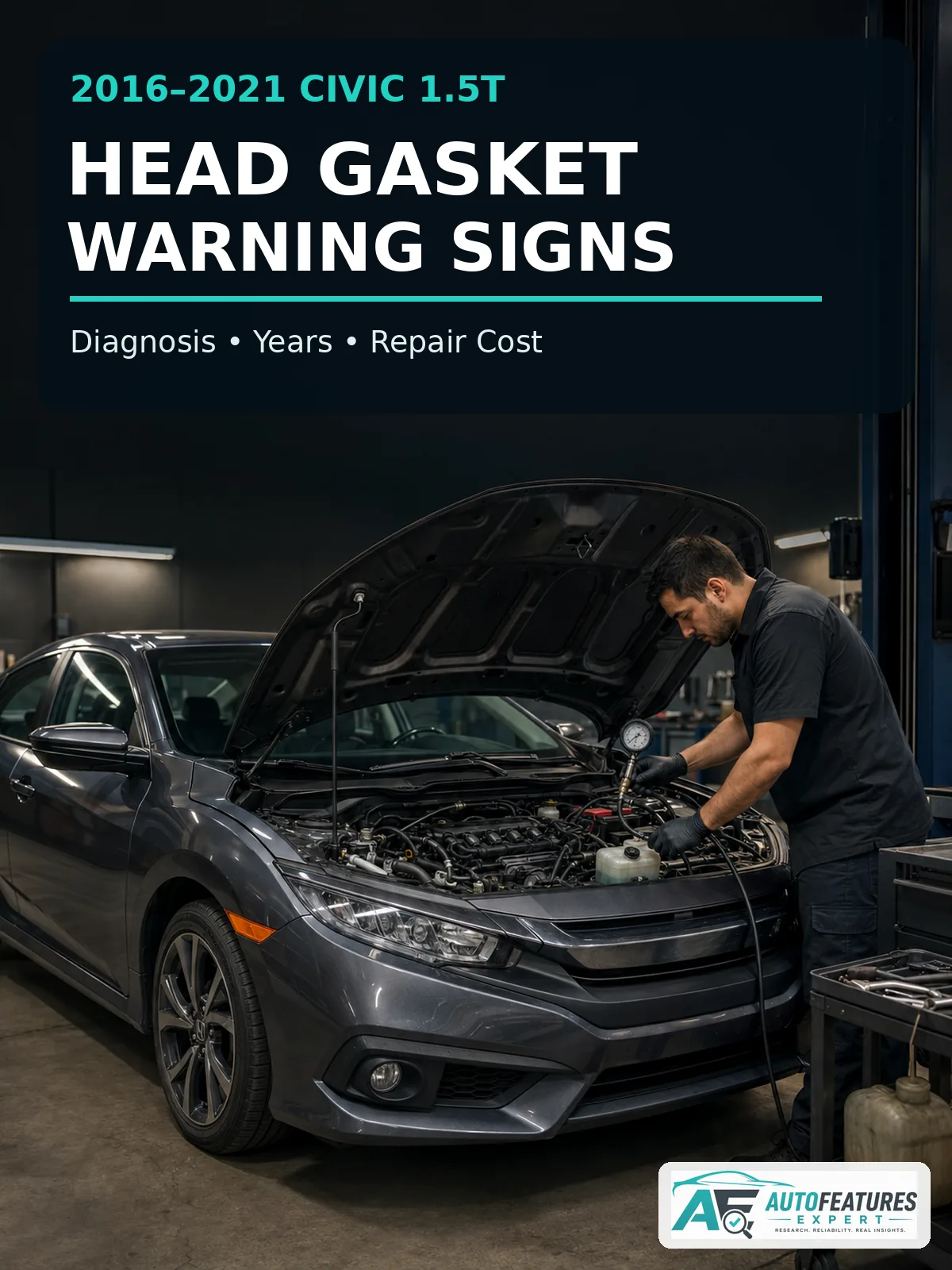
Use this guide for
Evaluate evidence for a Civic 1.5T head-gasket or combustion-to-cooling-system concern.
Boundary: Do not treat oil dilution, an ordinary coolant leak and a head-gasket failure as the same condition.
Honda Civic 1.5T head gasket failure can cause repeated coolant loss and a brief cold-start misfire, but no single symptom or P0300–P0304 code proves the gasket has failed. The strongest case combines falling coolant with no visible external leak, cylinder-specific cold-start evidence and confirmation from pressure testing or borescope inspection. There is no broad U.S. Civic 1.5T head-gasket recall.
Key Takeaways
- Coolant loss plus a repeatable cold-start misfire is the key warning pattern; either symptom alone has several other causes.
- Do not rank Civic model years by forum volume. No standardized public dataset establishes a Civic 1.5T head-gasket failure rate.
- Misfire codes identify the affected cylinder—not the failed part. Spark plugs, coils, injectors, valve sealing and oil-dilution-related drivability issues must be separated from an internal coolant leak.
- Current Civic replacement estimates start around $2,254–$3,068, while 2016–2020 year estimates are about $2,525–$3,420 before related damage.
- Stop driving if the engine overheats, loses coolant rapidly, misfires severely or may be hydrolocked.
This guide covers U.S.-market Civics with the 1.5-liter turbo engine. It explains which model years used that engine, what evidence does—and does not—show about failure patterns, how a shop should confirm the problem and what a complete repair may cost. The 2.0-liter Civic engines, hybrids and the 2.0T Type R are outside this article’s scope.
Is head gasket failure common on the Honda Civic 1.5T?
Head gasket failure is a documented owner concern on some Honda Civic 1.5T cars, but there is no reliable public failure-rate dataset proving that every year or trim is broadly defective. Treat unexplained coolant loss plus a repeatable cold-start misfire as a reason for prompt testing—not as proof that the gasket has failed.
That distinction matters because online discussions often combine Civic, Accord and CR-V cases simply because the vehicles use related 1.5-liter turbo engines. Engine family alone does not establish that a service bulletin, warranty extension or failure pattern applies to a Civic. A bulletin’s model, year, trim and VIN range control its scope.
As of July 31, 2026, our review of Honda owner resources and NHTSA-hosted manufacturer communications did not find a broad U.S. safety recall specifically for a Civic 1.5T head gasket. That is not a promise that a particular VIN has no open campaign, nor does it rule out later updates. Check the VIN through Honda and NHTSA before authorizing a repair.
For model-wide longevity, ownership-cost and generation context beyond this single failure mode, read our Honda Civic reliability analysis.
Which Honda Civic years have the 1.5-liter turbo?
Honda says its 1.5-liter turbo engine debuted in the United States in the 2016 Civic. The engine then appeared in multiple tenth- and eleventh-generation Civic configurations. It was not installed in every Civic, so model year alone is not enough to identify the engine.
| U.S. model years | Where the 1.5T appeared | How to interpret the period |
|---|---|---|
| 2016 | Selected sedan and coupe trims, including higher turbo-equipped trims | First U.S. Civic model year for the 1.5T |
| 2017–2021 | Various sedan, coupe and hatchback trims; Civic Si for 2017–2020 | Broadest tenth-generation use, but equipment varies by body style and trim |
| 2022–2024 | Selected sedan and hatchback trims, plus Civic Si | Eleventh-generation 1.5T applications |
| 2025–2026 | Civic Si in the U.S. lineup | Mainstream sedan and hatchback powertrains changed; do not assume a non-Si has the 1.5T |
Confirm the engine using the VIN, underhood emissions label or Honda build information. A turbocharger visible at the engine does not tell you whether a repair campaign applies, and “Civic turbo” should not be confused with the 2.0-liter turbo Type R.
Which years are most at risk?
There is not enough standardized public data to rank Civic 1.5T head gasket failure by model year. Forums produce a useful list of symptoms to investigate, but their posts are self-selected: they do not reveal how many unaffected cars exist, whether diagnoses were independently confirmed or how vehicle modifications and prior overheating influenced the outcome.
Older 2016–2021 cars have simply had more time and mileage to develop cooling-system or sealing problems. That exposure is not the same as proof of a model-year defect. For a used-car decision, service history, coolant stability, cold-start behavior and a pre-purchase inspection are more defensible indicators than an unsupported “avoid year” list. For the broader ownership picture, see our Honda Civic years to avoid analysis.
Early signs that deserve attention
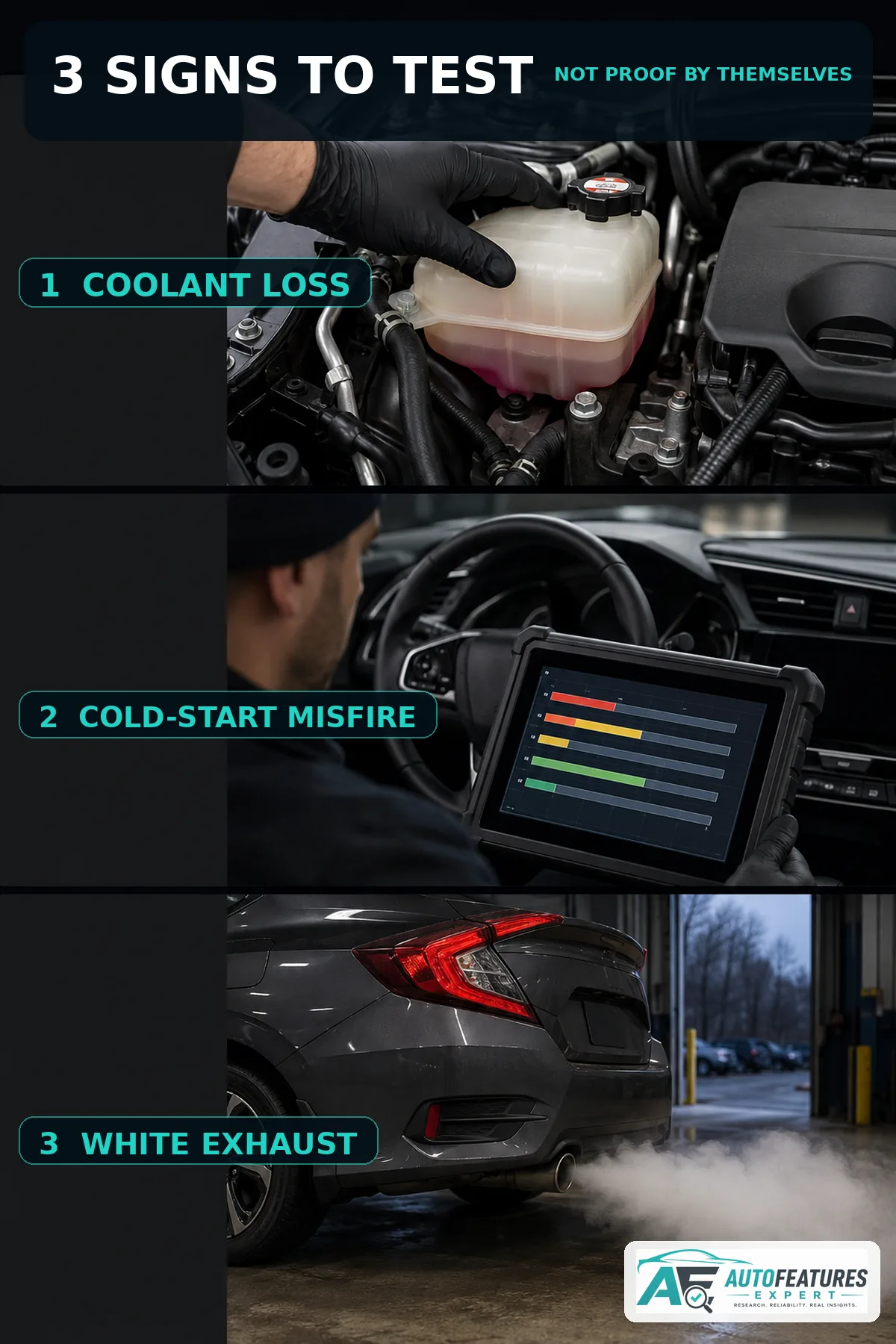
No single symptom below confirms a failed gasket. The strongest case comes from a pattern—especially coolant loss with no visible external leak, a repeatable misfire after the engine sits and evidence of coolant entering a cylinder.
- Coolant level keeps dropping. Check only when the engine is completely cold and parked on level ground. A one-time change after recent cooling-system service may be trapped air leaving the system. Repeated loss after the level has stabilized needs investigation.
- Rough cold start that clears quickly. A small internal leak can allow coolant to enter a cylinder while the car sits. The engine may stumble for several seconds on the next start, set P0300 or a cylinder-specific P0301–P0304 code, and then smooth out.
- Persistent white exhaust with a sweet smell. Ordinary water vapor on a cold morning should fade as the exhaust warms. Dense vapor that continues from a warm engine, particularly with coolant loss, is more concerning.
- Cooling-system pressure or reservoir bubbling. Combustion gas can pressurize the cooling system. Do not open a hot radiator or reservoir cap; hot coolant can cause severe burns.
- Temperature warning or overheating. Shut the engine down safely. Continuing to drive can warp the cylinder head, damage the turbocharger, contaminate the oil or turn a repairable leak into an engine replacement.
- A wet or unusually clean spark plug. After an overnight sit, a borescope may reveal liquid or an abnormally steam-cleaned piston in the affected cylinder. This is useful evidence when combined with pressure testing.
Milky oil is widely associated with head gasket failure, but its absence does not clear the engine. A leak can run from a coolant passage into a combustion chamber without mixing enough coolant into the crankcase to create a visible emulsion. Conversely, beige residue limited to the oil cap can result from condensation during repeated short trips.
When should you stop driving?
Arrange a tow if the temperature warning appears, the gauge rises abnormally, coolant loss is rapid, the engine misfires severely, dense white exhaust persists after warm-up or the starter cannot turn the engine normally. A cylinder partly filled with coolant can hydrolock; forcing it to crank risks internal damage.
If the car runs normally and the only clue is a small, unconfirmed coolant change, let the engine cool fully, document the reservoir level and schedule an inspection. Do not keep topping it up indefinitely. Use only the coolant specification listed by Honda, and never add a stop-leak product before diagnosis. Sealers can complicate testing and obstruct small cooling-system passages.
How a shop should confirm the failure
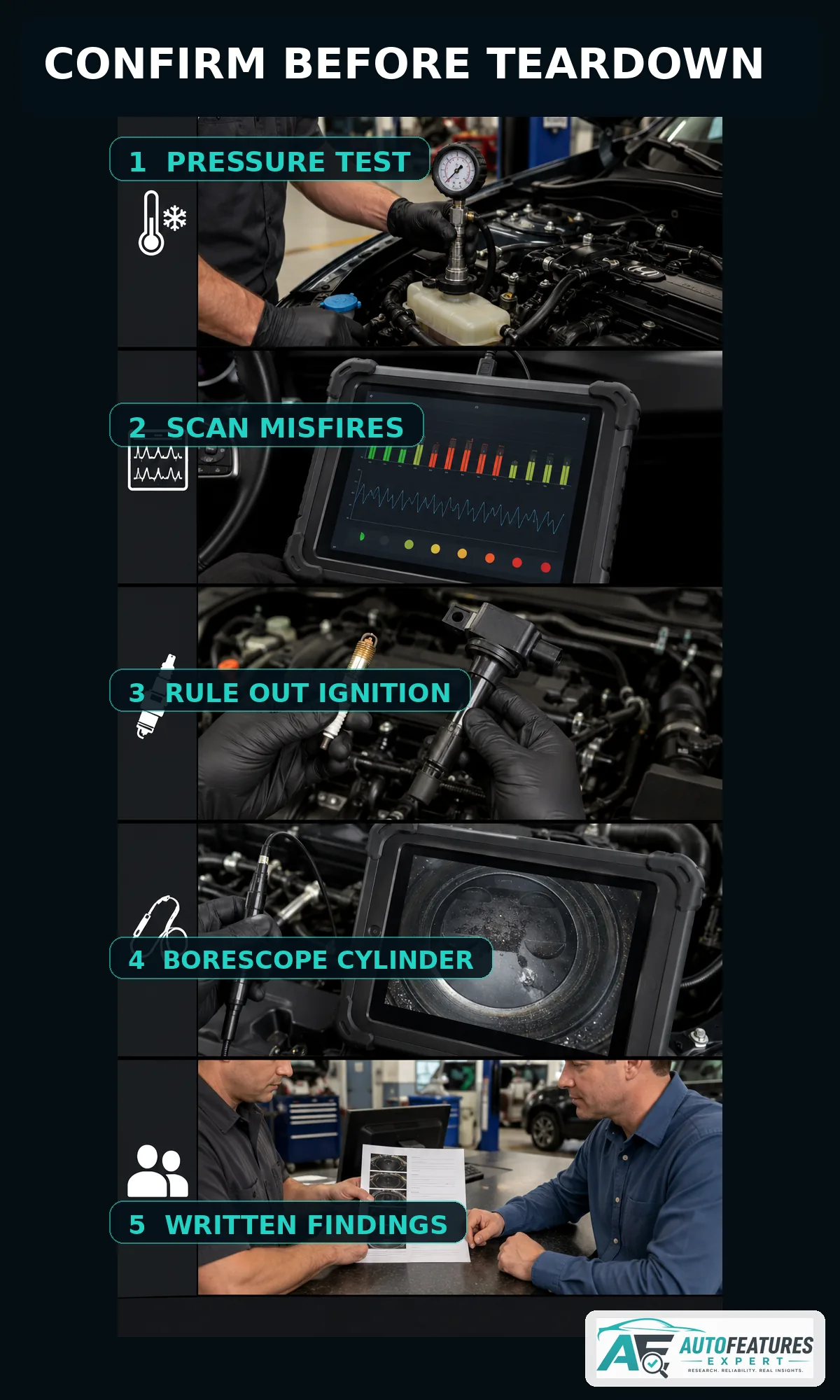
A proper diagnosis separates an internal sealing failure from more common and less expensive causes. Ask for the test results, not only the conclusion “it needs a head gasket.” A sensible sequence is:
- Document the complaint. Record when the misfire occurs, how much coolant is being added, recent repairs, overheating events, diagnostic codes and whether the engine or tune is stock.
- Inspect for external leaks. Check the reservoir, cap, hoses, radiator, thermostat housing, water pump area, heater circuit and underbody evidence. Dried coolant residue can remain after liquid evaporates.
- Pressure-test the cooling system cold. The system should hold the specified pressure. An overnight hold can expose a slow leak that a short test misses.
- Scan cold-start data. Misfire counters and freeze-frame information can identify the cylinder and operating conditions. Clearing codes before recording them destroys useful evidence.
- Check ignition and fuel causes. Inspect plugs and coils and evaluate injector operation. A P0301–P0304 code identifies a misfiring cylinder; it does not identify the gasket as the cause.
- Inspect the cylinders. With appropriate safety precautions, a borescope inspection after the car sits under cooling-system pressure may show coolant intrusion or an unusually clean piston crown.
- Test for combustion gas. A chemical block test or gas analyzer can detect combustion products in the cooling system. A negative result on a small, intermittent leak is not always conclusive.
- Use compression and leak-down tests in context. These can reveal sealing problems, but an intermittent coolant leak may still produce acceptable readings when the engine is warm and dry.
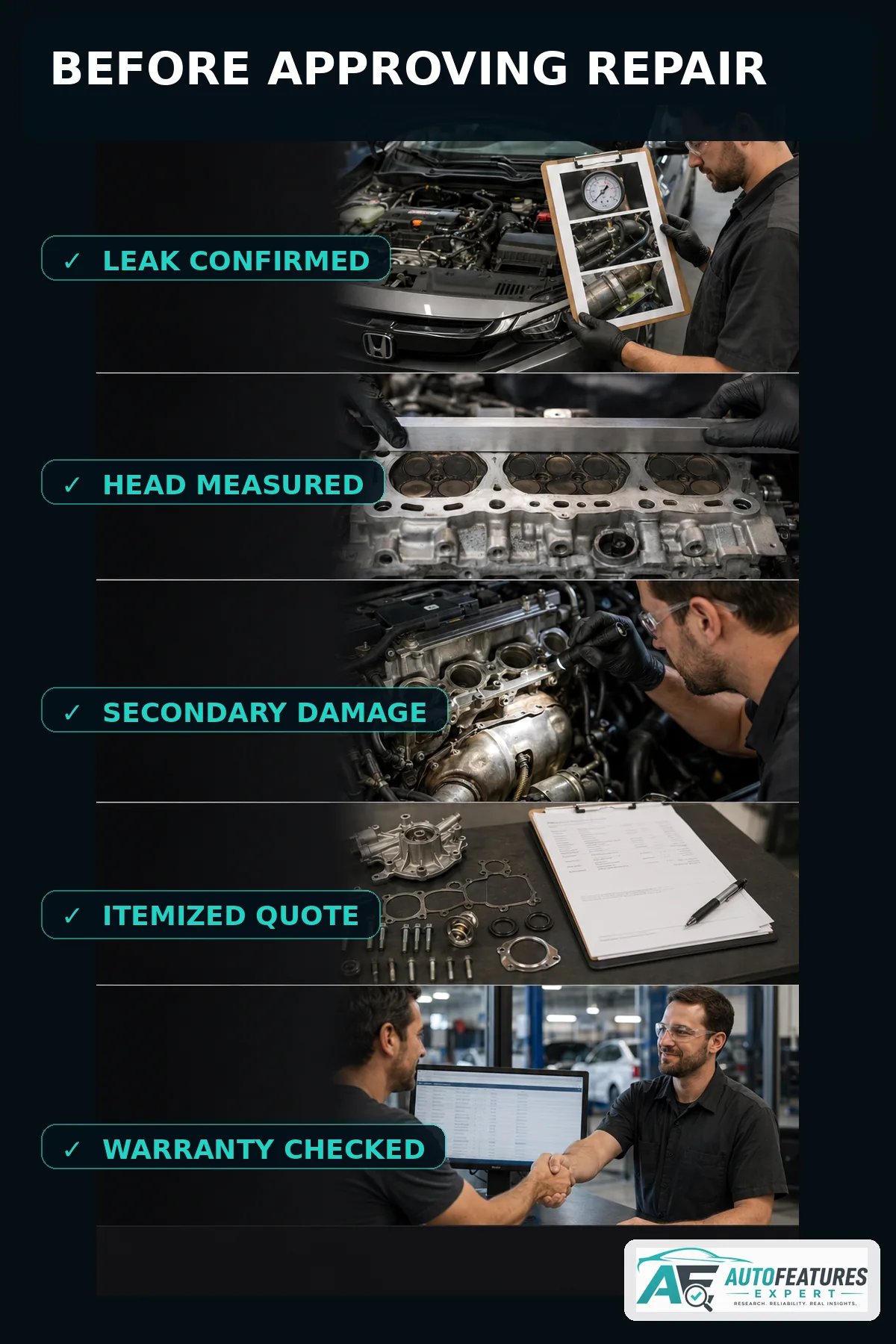
If the head is removed, the shop should inspect the gasket’s failure path and measure the cylinder head and block sealing surfaces against Honda specifications. Replacing a gasket without determining whether the head is warped, cracked or improperly finished can lead to a repeat failure.
Problems that can look similar
| Symptom | Possible non-gasket causes | Useful next check |
|---|---|---|
| Cold-start misfire | Spark plug, ignition coil, injector, wiring or valve deposit issue | Misfire counters, plug/coil swap and fuel-system testing |
| Coolant loss | Hose, radiator, cap, water pump, thermostat housing or heater-core leak | Cold pressure test and external dye inspection if appropriate |
| White exhaust at startup | Normal condensation in cool or humid weather | Determine whether vapor persists warm and tracks with coolant loss |
| Overheating | Low coolant, fan fault, thermostat, blocked radiator or water-pump problem | Cooling-system flow, fan operation and leak checks |
Honda issued a 2019 warranty extension addressing oil-dilution-related drivability concerns on certain 2016–2018 Civics. That communication includes misfire codes, but its stated coverage concerns software and certain valvetrain components—not a blanket head gasket extension. This is exactly why a code should be matched to the VIN and diagnostic procedure rather than to an internet headline. Read more in our focused guide to Honda Civic oil dilution.
What each diagnostic test proves—and what it does not
| Test | Useful finding | Important limitation |
|---|---|---|
| Cold cooling-system pressure test | Shows whether the sealed system loses pressure; an overnight hold can expose a slow leak | A pressure drop does not identify the leak path by itself |
| Cold-start scan data | Identifies when and where misfire counts rise | P0300–P0304 codes do not name the failed component |
| Plug and coil inspection or swap | Can expose a cheaper ignition fault when the misfire follows the moved part | A misfire that stays on one cylinder still needs fuel, mechanical and coolant checks |
| Borescope after a pressure hold | May reveal liquid or an unusually steam-cleaned piston in one cylinder | The image should be interpreted with coolant history and other test results |
| Combustion-gas test | Can find combustion products in the cooling system | A negative result may miss a small or intermittent leak |
| Compression or leak-down test | Can identify a mechanical sealing problem and help compare cylinders | A small coolant-path leak can exist with acceptable compression |
A diagnosis becomes persuasive when independent findings point to the same cylinder and leak path. A short pressure test, a single misfire code or one negative block test should not be presented as definitive on its own.
Honda Civic 1.5T head gasket repair cost
RepairPal’s U.S. Honda Civic estimate, updated July 25, 2026, is $2,254–$3,068 before taxes, fees, location adjustments and related repairs. Its year-specific estimates are more useful for the turbo-era Civic: $2,525–$3,420 for 2016–2020 and $2,933–$3,915 for 2021. These figures are budgeting references, not a diagnosis or guaranteed quote.
| Quoted work | Why it belongs in the estimate | Question to ask |
|---|---|---|
| Diagnosis and teardown authorization | Defines what you owe if testing or inspection does not confirm the gasket | Which results justify removing the cylinder head? |
| Gasket set and one-time-use hardware | The gasket is only one part of a complete repair | Which bolts, seals and fuel-system parts cannot be reused? |
| Cylinder-head inspection and machine work | Checks flatness, cracks and surface condition before reassembly | Is machine-shop work included or billed separately? |
| Oil, filter, coolant and bleeding | Contaminated fluids must be replaced and air removed from the cooling system | Are all fluids and the final pressure test itemized? |
| Secondary-damage inspection | Overheating or coolant intrusion can affect the cylinder head, catalytic converter, turbocharger or short block | What evidence supports replacing anything beyond the gasket repair? |
| Parts-and-labor warranty | Defines protection if leakage or workmanship problems return | How long is the complete repair covered? |
A much higher quote can be reasonable when the cylinder head is cracked or warped, the engine has been overheated, or the shop finds cylinder damage. For context, RepairPal’s current model-wide estimate for a complete Honda Civic cylinder-head replacement is $4,811–$5,745. Compare at least two written quotes with the same scope; a lower price that omits head inspection, machine work or required hardware is not directly comparable.
Repair the head gasket or replace the engine?
Repair is easier to justify when the leak is confirmed early, the cylinder head can be restored within specification, the cylinders are undamaged and the car’s maintenance history and value support the expense. A replacement engine becomes more relevant after severe overheating, hydrolock, cylinder-wall damage, a cracked head or repair costs approaching the value of a verified replacement assembly and installation. Ask for measurements and photographs instead of making the decision from mileage alone.
Does Honda Bulletin 19-038 cover a Civic head gasket?
No—not automatically. Honda Service Bulletin 19-038 Version 3 applies to eligible 2016–2018 Civics with the 1.5-liter engine and addresses specified drivability concerns, P0300–P0304 or P0172 codes, and a whirling noise. It extended certain powertrain coverage to six years with unlimited mileage for engine components damaged by the condition described in that bulletin. It is not written as a blanket Civic head-gasket warranty.
The distinction matters because a head-gasket leak and the bulletin’s drivability path can produce overlapping misfire codes. Honda’s procedure tells dealers to verify VIN status and follow the applicable software and mechanical diagnostic steps. A dealer should not approve or reject a head-gasket repair from the code alone.
Honda also issued an April 2023 dealer request involving confirmed head-gasket coolant leaks on certain 2018–2019 Accord 1.5L vehicles. That document is useful evidence that Honda required borescope or pressure-test confirmation, but it names the Accord—not the Civic—and does not create Civic warranty coverage.
Recall, warranty and goodwill questions
A head gasket may be covered when the vehicle remains within an applicable powertrain or service-contract term, but coverage depends on the contract, in-service date, mileage, maintenance documentation, diagnosis and modifications. A technical service bulletin is not automatically a recall, and a bulletin for another Honda model does not create Civic coverage.
Before paying:
- Enter the VIN in the Honda recall lookup and the NHTSA recall lookup.
- Ask a Honda dealer to check the VIN for open recalls, product updates, warranty extensions and other campaigns.
- Request the diagnosis and coverage decision in writing.
- Keep maintenance invoices, coolant purchase records, scan reports and photos of the coolant level or warning display.
- If the vehicle is just outside coverage, ask Honda customer service whether case-by-case assistance is available. Assistance is discretionary, so do not treat it as guaranteed reimbursement.
Can maintenance prevent the problem?
Maintenance cannot guarantee that a gasket will never fail, but it can reduce avoidable heat and contamination risks. Correct coolant concentration, a leak-free sealed system, prompt response to temperature warnings and engine oil maintained to Honda’s requirements all matter. Never mix unknown coolants or open the system hot.
Performance tuning adds another variable. More cylinder pressure, altered fueling and repeated high-load operation can complicate both root-cause analysis and warranty consideration. Online claims that one specific design feature—head bolts, boost pressure, fuel octane or gasket material—explains every Civic failure are not supported by a Civic-wide Honda finding located for this review. Modified-car advice should come from a builder who can measure the engine, not from a universal parts recipe.
Used Civic 1.5T inspection checklist
- Inspect the coolant level only with the engine cold; look for staining or residue around the system.
- Request a true cold start after the car has sat overnight. A pre-warmed engine can hide a brief startup misfire.
- Scan for stored, pending and permanent codes, plus readiness monitors. Recently reset monitors deserve an explanation.
- Watch the exhaust after warm-up and verify stable operating temperature during the road test.
- Review service records for coolant work, overheating, misfire diagnosis, cylinder-head repair and repeated top-offs.
- Have an independent shop perform a pre-purchase inspection; add cooling-system or borescope testing when symptoms justify it.
Do not reject an otherwise sound car only because it has a 1.5T, and do not buy one only because it starts smoothly once. Evidence from the specific vehicle is more useful than a broad reputation. See our Honda Civic generations guide to identify the platform and body-style changes, or start with the overview of common Honda Civic problems.
Frequently Asked Questions
Can a Honda Civic 1.5T have a bad head gasket without overheating?
Yes. A small leak may first show as gradual coolant loss or a brief cold-start misfire while the cooling system still contains enough coolant to maintain normal temperature. Repeated coolant loss should be tested before an overheating event occurs.
Does P0301, P0302, P0303 or P0304 confirm a head gasket failure?
No. These codes identify detected misfire activity in a cylinder. Ignition, injector, wiring, compression, valve and internal coolant-leak faults can all cause a cylinder-specific misfire. The leak requires supporting cooling-system and cylinder evidence.
Will a compression test always find a Civic 1.5T head-gasket leak?
No. A small coolant-path leak may seal differently as the engine warms, and compression can remain acceptable. An overnight pressure hold, borescope inspection, combustion-gas test, leak-down test and cold-start scan data may need to be combined.
Is there a Honda Civic 1.5T head-gasket recall?
Our review found no broad U.S. safety recall specifically for the Civic 1.5T head gasket as of July 31, 2026. Honda Bulletin 19-038 covers a separate defined drivability and warranty-extension path. Check the VIN with Honda and NHTSA because campaign status can change.
How much does a Honda Civic head-gasket replacement cost?
RepairPal’s current model-wide Honda Civic estimate is $2,254–$3,068. Its 2016–2020 estimates are $2,525–$3,420, while 2021 is $2,933–$3,915, before taxes, fees, location adjustments and related damage.
Should I use head-gasket sealer in a Civic 1.5T?
Not before a professional diagnosis. A sealer does not restore the clamping surfaces and can contaminate the cooling system, restrict small passages and complicate later testing or repair.
Is a 2016–2018 Civic misfire automatically the oil-dilution issue?
No. Honda’s oil-dilution-related communication shows that eligible misfire complaints may follow another diagnostic and coverage path, but it does not explain every misfire. The VIN, coolant behavior, cold-start pattern and physical test results determine the correct path.
Approve a Head-Gasket Repair Only When the Evidence Aligns
The useful warning pattern is not “all Civic 1.5Ts fail.” It is repeated coolant loss, a repeatable cold-start misfire and physical evidence that coolant or combustion pressure is crossing the seal.
- Confirm the vehicle actually has the 1.5-liter turbo engine.
- Document coolant loss and cold-start behavior before codes are cleared.
- Rule out visible leaks and less expensive ignition or fuel causes.
- Require pressure-test, borescope or equivalent physical evidence tied to the affected cylinder.
- Verify VIN-specific recall, bulletin, warranty and goodwill status.
- Compare itemized repair and replacement options using the same scope.
Stop driving if the engine overheats, loses coolant rapidly, misfires severely or may be hydrolocked. Otherwise, arrange structured testing before authorizing major teardown.
Sources
- Honda Newsroom, Honda 1.5-Liter Turbo Engine applications, May 16, 2024.
- Honda Newsroom, 2016 Honda Civic Sedan Press Kit, October 18, 2015.
- Honda Newsroom, 2026 Honda Civic Si Pricing and EPA Ratings, January 6, 2026.
- American Honda Motor Co., Service Bulletin 19-038 Version 3: 2016–2018 Civic 1.5L Drivability Concerns, October 2, 2019.
- Honda Owners recall lookup and NHTSA VIN recall lookup, accessed July 31, 2026.
- RepairPal, Honda Civic Head Gasket Replacement Cost, updated July 25, 2026; and Honda Civic Cylinder Head Replacement Cost, accessed July 31, 2026.
- CivicX owner/technician discussion: diagnosing 2016–2021 Civic 1.5T misfires, used only as owner-experience context; accessed July 31, 2026.
About This Article
Author: Alex Fric, Automotive Research Editor
Draft prepared: July 26, 2026
Last verified: July 31, 2026
Article type: Single-system failure analysis, diagnostic guide and repair-cost decision support
Research scope: U.S.-market Honda Civic 1.5-liter turbo applications, symptoms, competing misfire causes, confirmation tests, Honda bulletin scope, repair-versus-replacement decisions and current costs
Primary sources checked: Honda engine/application information, American Honda Service Bulletin 19-038 Version 3, Honda and NHTSA VIN tools and current RepairPal Civic estimates
Owner-experience use: Forum reports were used to identify questions and symptom patterns, not to calculate a failure rate or declare every Civic 1.5T defective.
Reviewed by: Alex Fric — source verification and editorial review; no vehicle was examined and no independent mechanical inspection was performed
AI use: AI-assisted tools supported SERP comparison, source organization, editing and original visual production. They were not used as factual evidence; material claims were checked against the linked sources.
Correction/update history: First research draft prepared July 26, 2026. Engine applications, bulletin scope, diagnostic limitations, cost benchmarks, FAQ schema and visual assets reverified July 31, 2026.
Editorial limitation: No reliable public dataset establishes a Civic 1.5T head-gasket failure rate. Diagnosis and coverage depend on the VIN, service history, cooling-system evidence, scan data and physical testing by a qualified technician.







