
Use this guide for
Separate Civic transmission problems by conventional automatic, CVT and manual gearbox.
Boundary: Do not apply one generation's transmission failure pattern to every Civic.
Honda Civic transmission problems are most concentrated in owner reports for 2001–2003 automatic models. Affected 2006–2008 Civic Si manuals also have a documented third-gear issue, while certain 2014–2015 CVTs were recalled for possible drive-pulley-shaft damage. Later Civics have narrower TCM, vent and clutch bulletins, so the exact transmission, VIN and symptoms matter more than the generation alone.
This page is the broad guide to Civic automatics, manuals, CVTs and hybrid drive systems. If you are researching only a belt-type CVT car, use the dedicated Honda Civic CVT problems guide for deeper service, warning-sign and model-year detail. In every case, confirm the installed powertrain, check open recalls by VIN and review the fluid and repair history before drawing a conclusion.
Which Honda Civic Years Have the Most Transmission Problems?
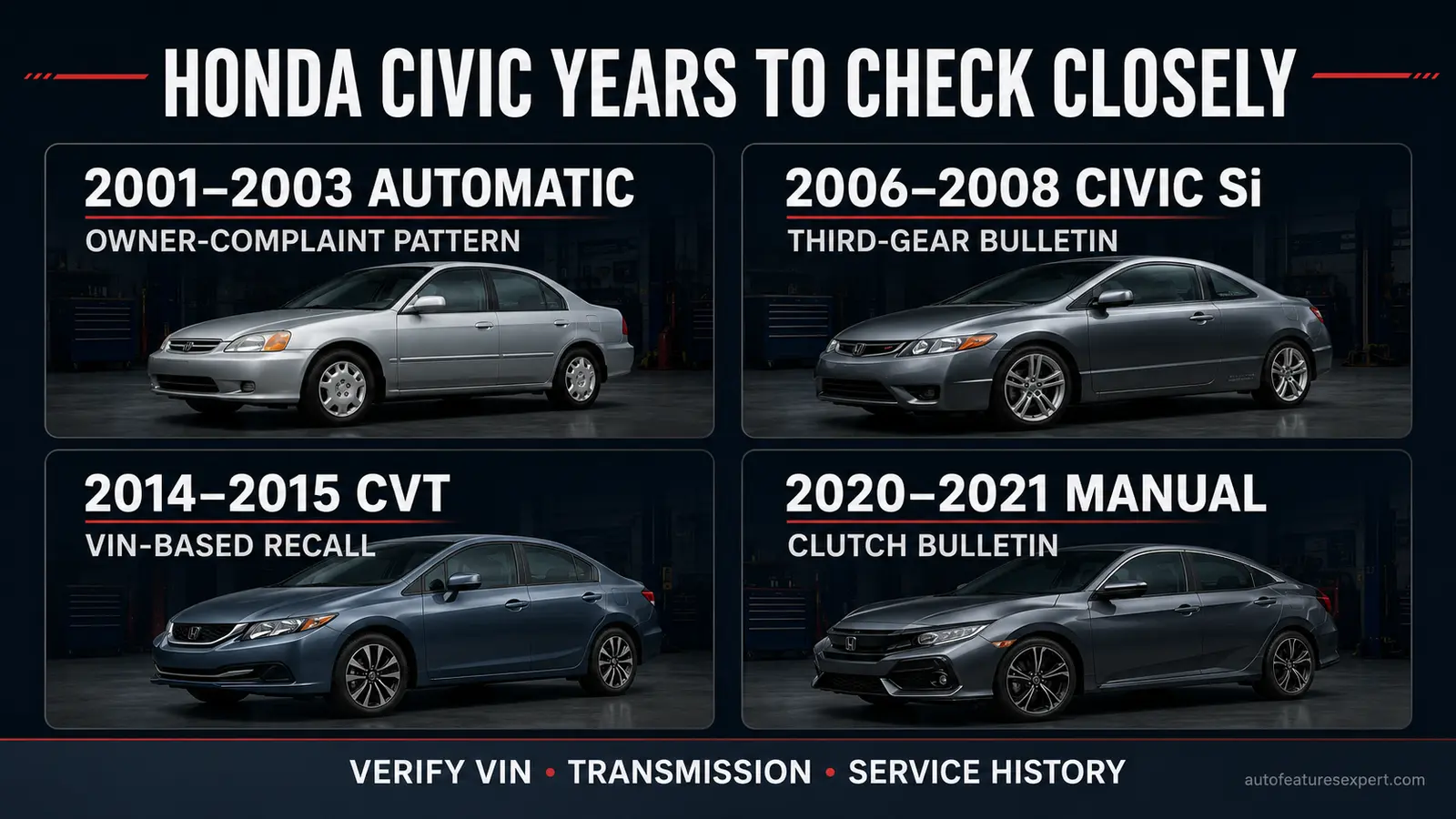
The strongest caution pattern is the 2001–2003 gasoline Civic automatic, especially 2001 owner reports describing slipping, delayed engagement or loss of drive. Separate documented checks apply to affected 2006–2008 Civic Si manuals, certain recalled 2014–2015 CVTs and 2020–2021 manual cars covered by a clutch bulletin. These groups do not share one failure mode, so use the evidence column below to decide what to inspect.
| Model years and transmission | Evidence-backed concern or distinction | What a buyer should do |
|---|---|---|
| 2001–2003 gasoline Civic automatic | Owner complaints—most visibly for 2001—describe delayed engagement, slipping, ratio errors and loss of drive. This is a complaint pattern, not a Civic transmission recall or a measured failure rate. | Test the car cold and fully warm, scan for transmission codes and require a credible fluid and repair history. |
| 2003–2005 Civic Hybrid CVT | The first Civic Hybrid used a separate CVT integrated with Honda’s IMA hybrid system. It should not be evaluated as if it has the gasoline model’s four-speed automatic. | Confirm hybrid-specific CVT service history, fluid specification and smooth launch behavior. |
| Affected 2006–2008 Civic Si six-speed manual | Honda Service Bulletin 08-020 addresses grinding, difficulty entering third gear or popping out of third because of the synchronizer or 3–4 shift sleeve. | Confirm the applicable VIN range, test repeated second-to-third shifts without forcing the lever and ask whether the third-gear set was replaced. |
| 2012–2013 gasoline Civic automatic | These cars retained a conventional five-speed automatic rather than the later gasoline-model CVT. No single transmission campaign defines the whole range. | Judge the individual car by shift quality, leaks, diagnostic codes and maintenance records. |
| Certain 2014–2015 Civic CVTs | NHTSA recall 15V-574 says incorrect software settings could damage the drive-pulley shaft, potentially causing lost acceleration or front-wheel lockup. | Run the VIN through Honda and NHTSA recall tools and obtain proof that the recall remedy was completed. |
| Selected 2016–2018 Civic CVTs | Honda documents separate TCM, hot-restart noise and blocked-vent/fill-plug conditions on specific applications. The bulletins do not declare every tenth-generation CVT defective. | Match the symptom, engine, trim and VIN to the correct bulletin before approving internal transmission work. |
| Selected 2020–2021 Civic manuals | Honda Service Bulletin 22-017 addresses premature clutch friction-disc wear that may cause slipping, difficulty shifting or no vehicle movement. | Check clutch engagement, repair history and the bulletin’s exact model/application range. |
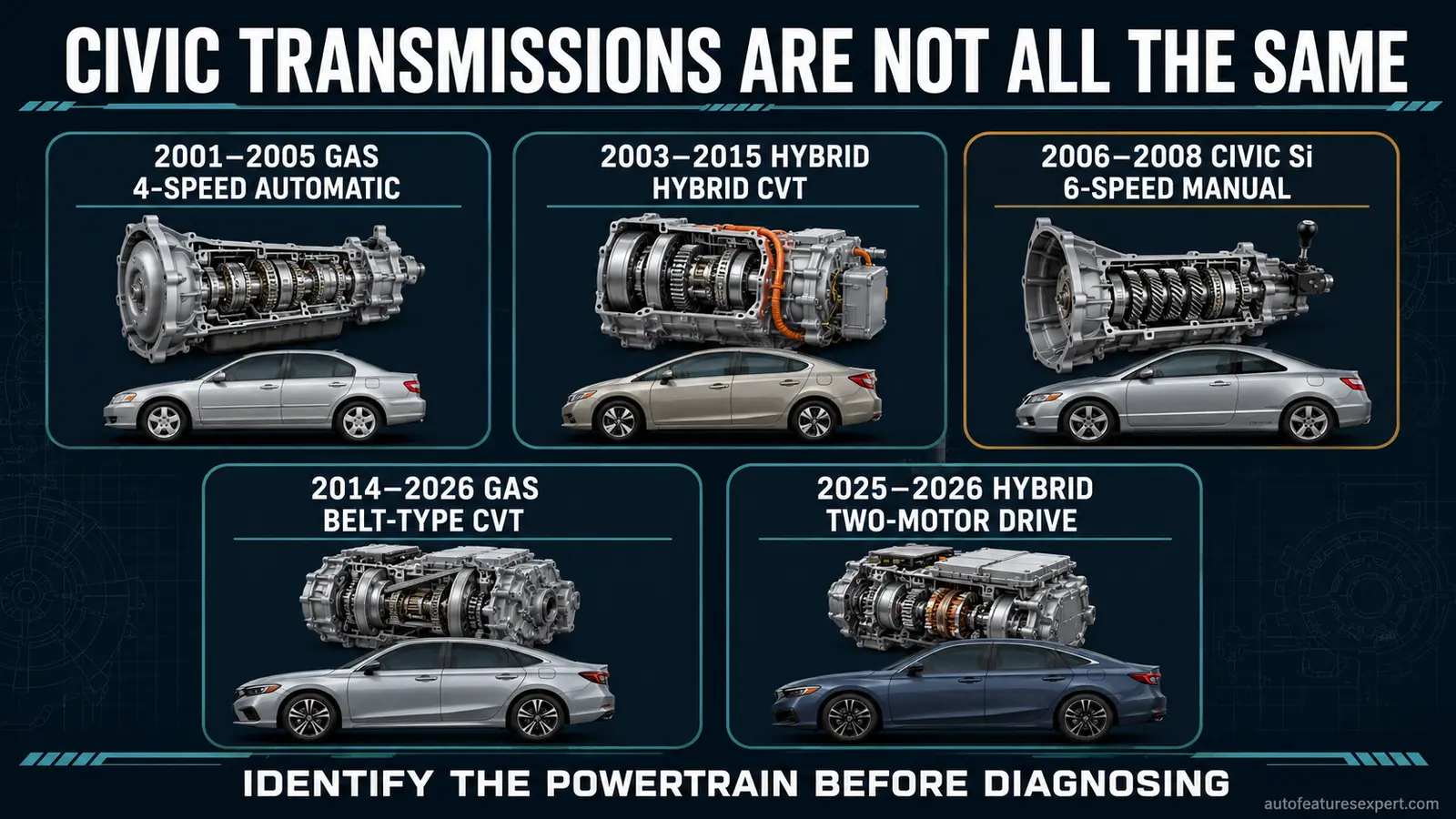
| 2022–2026 Civic | Gas models may use a belt-type CVT, Si and Type R use manuals, and the 2025–2026 Civic Hybrid uses a two-motor drive rather than the gasoline model’s belt CVT. | Identify the powertrain first and check the VIN for current campaigns rather than applying older conclusions broadly. |
Honda Civic Transmission Problems by Generation
The Civic name spans several mechanically different drivetrains: four- and five-speed automatics, performance manuals, hybrid CVTs, gasoline belt-type CVTs and a newer two-motor hybrid drive. A symptom can point in different directions depending on which unit is installed. Decode the VIN and confirm the trim before applying a bulletin, fluid specification or failure pattern to a specific car.
2001–2005 Civic: Separate the Gas Automatic From the Hybrid CVT
Seventh-generation Civics are now old enough that wear, prior repairs and maintenance quality can matter as much as model-year reputation. Even with that limitation, the 2001 gasoline-model automatic deserves extra attention. The NHTSA 2001 Civic owner-complaint record contains reports of slipping, loss of drive and early transmission replacement. Complaints are unverified owner submissions and cannot establish a defect rate, but they are useful for identifying what to test on a specific used car.
Warning signs include a long pause before Drive or Reverse engages, engine speed rising without matching acceleration, harsh shifts after the car warms up, repeated incorrect-ratio codes, or a vehicle that stops pulling despite the engine continuing to run. A single rough shift does not prove the unit needs replacement: fluid level, electrical inputs, shift solenoids and engine-performance faults can change shift behavior. Persistent slipping or ratio errors after basic checks are more concerning because they may indicate internal clutch or hydraulic wear.
Do not confuse this Civic complaint pattern with Honda recall 04V-176. That second-gear lubrication recall covered other Honda and Acura models; its official application documents do not list the Civic. A repair shop or seller should identify a Civic-specific campaign or bulletin by number and VIN rather than referring vaguely to an “old Honda transmission recall.”
The 2003 Civic Hybrid used a different continuously variable transmission designed for Honda’s Integrated Motor Assist system, as described in Honda’s 2003 Civic Hybrid powertrain information. Hybrid Civics through 2015 therefore need hybrid-CVT service records and the correct fluid specification; the gasoline automatic’s complaint pattern should not be transferred to them without model-specific evidence.
2006–2011 Civic: The Best-Documented Issue Is the Si Third-Gear Problem
The conventional automatic used in most eighth-generation Civics is different from both the earlier four-speed automatic and the CVT introduced later. The clearest transmission document for this generation concerns the Civic Si manual rather than every Civic automatic.
American Honda Service Bulletin 08-020 covers all 2006–2007 Civic Si coupes, all 2007 Civic Si sedans and specified early-production 2008 Si coupes and sedans. It describes a transmission that grinds when shifting into third, is hard to shift into third or pops out of third. Honda identifies a faulty third-gear synchronizer or 3–4 shift sleeve and directs technicians to replace the third-gear set.
Some notchiness is not the same as a gear that repeatedly grinds or disengages. During a pre-purchase test, shift normally through second and third after the fluid is warm; do not force the lever or use an aggressive shift to manufacture a symptom. If the car is within the affected range, ask for a repair order showing whether the updated third-gear set was installed.
2012–2015 Civic: Know When the CVT Arrived and Check Recall 15V-574
Gasoline Civics used a conventional five-speed automatic for 2012–2013. The redesigned gasoline-model CVT arrived for 2014, so advice written for a 2014 or 2015 CVT should not automatically be applied to a 2012 automatic.
The major confirmed safety action is NHTSA recall 15V-574. It covers certain 2014–2015 Civics manufactured from January 16, 2014, through November 6, 2014, along with certain 2015 Fits. NHTSA lists 143,676 potentially affected vehicles across the recall population. The control software could place damaging loads on the transmission drive-pulley shaft; if the shaft broke, the vehicle could lose acceleration or the front wheels could lock.
Honda’s recall remedy was a transmission software update. The year alone does not confirm inclusion or completion, and “the software was updated once” is not enough documentation unless the repair order identifies the campaign. Run the 17-digit VIN through both the Honda recall lookup and NHTSA recall lookup. An open safety recall should be repaired free of charge through an authorized dealer.
2016–2021 Civic: Separate TCM, CVT Noise, Vent and Manual-Clutch Issues
Tenth-generation Civic search results often group every warning light, noise, leak and hesitation under “CVT failure.” Honda’s own documents show why diagnosis needs to be more specific—and why manual-transmission cars need a separate branch of the decision tree.
Honda Service Bulletin 17-012 applies to listed 2016 and 2017 Civic 1.5-liter and 2.0-liter CVT configurations and VIN ranges. The documented symptom is a vehicle that will not come out of Park and may not crank or start, with multiple indicators and communication codes U0038 and sometimes U0101. Honda identifies an internal TCM malfunction; the correction is TCM replacement, with a matching PCM update on 2016 models. That is an electronic-control problem, not evidence that the CVT belt has broken.
Honda Service Bulletin 17-003 covers listed 2016–2017 Civic CVT applications that may make a grinding or pump-like noise for about two seconds after a hot restart. Honda traces the sound to the pressure-control valve in the lower valve body and states that it does not affect transmission function or reliability. That distinction matters: a documented brief restart noise is not the same as slip, ratio errors or loss of drive.
A separate Honda ServiceNews article A19090B covers 2016–2018 Civics with a CVT when the fill plug pops out or appears to leak. Honda says pressure can build when debris blocks the vent cap. The instructed fix is to clean the vent, replace a loose or displaced plug and top up with Honda Genuine HCF-2 fluid if needed. An external fill-plug leak still needs prompt attention because low fluid can damage a CVT, but the plug condition itself does not prove internal belt or pulley failure.
Manual-transmission owners have a different documented issue. Honda Service Bulletin 22-017 addresses premature clutch friction-disc wear on listed 2020–2021 Civic manual applications. Reported symptoms may include clutch slip, difficulty shifting or a car that will not move. The presence of a bulletin does not confirm every clutch is defective, but it gives the technician a model-specific path that should be checked before treating the complaint as a generic manual-transmission failure.
For a car that shudders, surges or flares under acceleration, the shop should document fluid level and condition, scan results, road-test behavior and any metal debris before condemning the entire unit. A powertrain-specific diagnosis is more useful than a generic statement that “all CVTs do that” or “all Civic transmissions fail.”
2022–2026 Civic: Separate the Gasoline CVT, Manuals and Hybrid Drive
The eleventh-generation lineup does not use one transmission design. Regular gasoline trims use a belt-type CVT, while the Civic Si and Type R use manual gearboxes. Beginning with the 2025 model year, U.S.-market Civic Hybrid trims use Honda’s two-motor hybrid system. Honda states that this system does not require a traditional transmission or CVT for driving and generating power. It should not be judged as if it contains the same belt-and-pulley CVT used by a non-hybrid Civic.
As of the July 31, 2026 source review, the official records checked for this article did not show a broad Civic transmission safety recall defining the 2022–2026 generation. That is not a lifetime-reliability guarantee: newer cars have less long-term exposure, service documents can be revised, and a VIN may have campaigns unrelated to the transmission. Check the current VIN record before purchase or service.
For the engine and hybrid-drive side of these configurations, compare the Honda Civic engines and powertrains guide.
Honda Civic Transmission Warning Signs That Need Diagnosis
Stop driving and arrange diagnosis if the car loses propulsion, will not engage a gear, displays a transmission warning with severe behavior, leaks fluid rapidly or makes repeated grinding sounds. Less dramatic symptoms—such as a brief hot-restart noise, mild hesitation or a displaced fill plug—still require inspection, but Honda’s bulletins show that they do not all mean the complete transmission has failed.

| Symptom | Possible direction | Why it is not a diagnosis by itself |
|---|---|---|
| RPM rises but road speed does not | Automatic clutch slip, CVT belt/pulley slip, low fluid or control-pressure problem | Engine and traction-control faults can also limit acceleration; scan data and a road test are required. |
| Long delay engaging Drive or Reverse | Low fluid, hydraulic pressure loss, valve-body or internal wear | Cold-only and hot-only behavior can point in different directions. |
| Grinding or popping out of third in an Si | Third-gear synchronizer or 3–4 shift sleeve on an affected 2006–2008 Si | Clutch-release, linkage and driver-input issues should still be checked. |
| Will not leave Park; no-start; several warning lights | TCM communication fault on certain 2016–2017 CVT cars | Battery voltage, brake-switch and network faults can produce overlapping symptoms. |
| CVT fill plug displaced or fluid around the plug | Blocked vent cap on documented 2016–2018 applications | The fluid level and exact leak source must still be verified. |
| Whine, judder or vibration under load | Fluid, mount, axle, wheel-bearing, CVT or engine-related issue | Noise location and operating conditions matter; replacing a transmission based on sound alone is risky. |
The Honda Civic troubleshooting guide helps separate transmission behavior from overlapping engine, electrical, brake-switch, axle and wheel-bearing symptoms.
Is It Safe to Drive a Civic With Transmission Symptoms?
Stop driving and arrange a tow if the Civic unexpectedly loses drive, cannot maintain speed, repeatedly drops into Neutral, leaks enough fluid to leave a growing puddle, produces a burning smell with abnormal shifting, or shows a flashing transmission indicator with reduced propulsion. Continuing to drive can turn a controllable leak or control fault into internal damage, and sudden loss of acceleration can be dangerous in traffic.
A mild, repeatable shift-quality complaint may allow a short trip to a repair facility, but only after checking for an active recall and obvious fluid loss. A scan should be performed before codes are cleared or the battery is disconnected because stored codes and freeze-frame data can shorten the diagnosis.
Diagnose the Problem Before Authorizing a Transmission Replacement
- Identify the exact powertrain. Record the year, trim, engine, automatic/CVT/manual/hybrid drive and VIN. “Honda Civic transmission” is not a single part across 26 model years.
- Check open recalls by VIN. Recall 15V-574 is manufacturing-date and VIN dependent; a model-year match is not enough.
- Scan every relevant module. Save powertrain and network codes, pending codes and freeze-frame data before clearing anything.
- Verify fluid type, level and leak source. A tenth-generation CVT with fluid near its fill plug may need the vent checked before anyone assumes the case or internal belt failed.
- Road-test cold and warm. Record whether the symptom occurs on initial engagement, light acceleration, highway load, deceleration or a specific manual shift.
- Match the symptom to the document. A TSB can guide diagnosis, but it is not a recall and does not automatically create free coverage.
- Request findings in writing. A replacement estimate should identify the failed component, supporting codes/tests, fluid condition, parts source, warranty and whether software programming is included.
What Does Honda Civic Transmission Service or Replacement Cost?
Current U.S. estimates show why diagnosis should come before replacement. Prices vary by model year, transmission, ZIP code, labor rate, parts source and related damage; the figures below are comparison points, not quotes for a specific car.
| Service | Current U.S. benchmark | How to interpret it |
|---|---|---|
| Civic transmission fluid change | RepairPal lists $179–$207; Kelley Blue Book lists $221–$390 for a 2021 Civic in its displayed ZIP-based example. | Fluid type, model year, local labor and whether additional inspection is included change the total. |
| 2021 Civic transmission replacement | Kelley Blue Book displays $5,537–$5,965 for dealer replacement in its Des Moines-area example. | This is a year- and location-specific estimate, not a universal Civic price. |
| Transmission replacement across vehicles | RepairPal’s current general estimate is $6,003–$6,525. | Use it only as a broad cross-check; a used, rebuilt, remanufactured or new unit can produce very different quotes. |
Ask whether a replacement is new, remanufactured or used, what programming and fluid are included, and how long both parts and labor are covered. On a low-value older Civic, compare the complete installed cost with the car’s condition and replacement value rather than approving a transmission based on a verbal diagnosis.
Transmission Fluid Matters, but It Cannot Reverse Internal Wear
Honda introduced HCF-2 fluid with the later gasoline Civic CVT and warns that the correct fluid and level matter. Follow the owner’s manual and Maintenance Minder for the exact year and powertrain instead of imposing one universal mileage interval on every Civic. The 2025–2026 hybrid drive uses Honda HEVF-Type 1 fluid, which is another reason not to treat every Civic “CVT service” as the same procedure.
A correct drain-and-fill can address overdue maintenance or fluid-related shift quality, but fresh fluid cannot rebuild worn clutches, repair a damaged pulley shaft or replace a failed synchronizer. Avoid using a fluid service as a promise that established slipping will disappear. If significant debris, a ratio code or repeat loss of drive is present, document it before deciding on the next repair.
Use the Honda Civic maintenance schedule as the broader service reference, then confirm the exact fluid and procedure in the owner documentation for that VIN and powertrain.
Used Honda Civic Transmission Checklist
- Decode the VIN and confirm the exact transmission, engine and build date.
- Run both Honda and NHTSA recall checks; save proof of completed campaigns.
- Start the car cold and repeat the drive after it reaches operating temperature.
- Check Drive and Reverse engagement on level ground without using excessive throttle.
- Accelerate lightly and then under moderate load while watching for flare, shudder or delayed response.
- On an affected Civic Si, test normal second-to-third shifts and watch for grinding or disengagement.
- Inspect for fluid near the CVT fill plug, axle seals and underbody, then verify the actual source.
- Scan for current, pending and history codes even if no warning light is illuminated.
- Review invoices for fluid type, recall completion and any prior transmission, TCM, clutch or synchronizer work.
- Have an independent pre-purchase inspection performed before buying a car with an unexplained symptom or recently cleared codes.
Before purchase, verify campaigns with the Honda Civic recall guide and use the Honda Civic buying guide to combine the transmission findings with engine, maintenance, body and ownership evidence.
Honda Civic Transmission Problems: Frequently Asked Questions
What is the worst Honda Civic year for transmission problems?
The 2001 gasoline Civic automatic is the strongest older-model caution flag in the owner-complaint record reviewed for this guide, with reports describing slipping, delayed engagement and loss of drive. That does not produce a verified failure rate, and age, prior repairs and maintenance now heavily influence each car. Certain 2014–2015 CVTs present a different, more clearly documented concern because NHTSA recall 15V-574 addresses possible drive-pulley-shaft damage. Use the VIN, transmission type, service history and a cold-and-hot road test rather than rejecting or approving a Civic by model year alone.
Does the Honda Civic CVT have problems?
Some Civic CVTs have documented recalls, bulletins or service conditions, but they are not one universal defect. Certain 2014–2015 cars were recalled for software settings that could damage the drive-pulley shaft. Selected 2016–2017 applications have TCM or brief hot-restart-noise bulletins, and some 2016–2018 cars can develop a displaced fill plug when the vent is blocked. Each condition has a different diagnosis and remedy. For CVT-only research, see our dedicated Honda Civic CVT guide; for a specific car, match its VIN, engine, trim, codes and symptoms to current Honda information.
How long does a Honda Civic transmission last?
There is no defensible single lifespan for every Civic transmission. Honda has used four- and five-speed automatics, belt-type CVTs, hybrid CVTs, several manuals and a two-motor hybrid drive, and each responds differently to heat, fluid condition, driving style and prior repair quality. Mileage alone is therefore a weak predictor. A higher-mileage Civic with documented correct-fluid service, clean scan results and smooth cold-and-hot operation may be a safer purchase than a lower-mileage car with delayed engagement, slipping or an unknown history. Inspect the exact powertrain rather than relying on an unsupported mileage promise.
Will changing the fluid fix a slipping Civic transmission?
A correct fluid service may improve operation when the cause is low, degraded or incorrect fluid and internal damage has not occurred. It cannot rebuild worn automatic clutch packs, repair a damaged CVT belt or pulley, restore a failed manual synchronizer or replace a worn clutch friction disc. Before authorizing a flush or replacement, the shop should identify the transmission, check fluid level and condition using the proper procedure, scan for codes, inspect for leaks and road-test the symptom. Treat fluid service as maintenance or one diagnostic step—not as a guaranteed cure for established slipping.
Which Honda Civic Si years have the third-gear problem?
Honda Service Bulletin 08-020 covers all 2006–2007 Civic Si coupes, all 2007 Civic Si sedans and specified early-production 2008 Si coupes and sedans. The documented symptoms are grinding when shifting into third, difficulty selecting third or the transmission popping out of third. Honda identifies the third-gear synchronizer or 3–4 shift sleeve and directs technicians to replace the third-gear set on applicable cars. Not every Si in those years will show the problem, so confirm the VIN range, test normal second-to-third shifts after warm-up and ask for a repair order if the seller says the update was completed.
Is a Honda transmission service bulletin the same as a recall?
No. A safety recall addresses a safety-related defect or noncompliance and is tied to a defined VIN population; an authorized dealer normally performs an open recall remedy without charge. A service bulletin gives technicians diagnostic or repair instructions for a known condition, but it does not by itself mean every listed vehicle is defective or that the repair is free outside warranty or another coverage program. Check recalls through Honda and NHTSA using the 17-digit VIN. For a bulletin, confirm the exact model, engine, transmission, production range, symptoms and any warranty or goodwill eligibility with a Honda dealer.
Related Honda Civic Research
- Honda Civic CVT Problems: Warning Signs, Service and Years to Watch
- Honda Civic Common Problems by Year
- Honda Civic Reliability: Best Years, Problems and Lifespan
- Honda Civic Years to Avoid and Safer Picks
- Honda Civic Generations and Used-Buyer Guide
- 2020 Honda Civic Oil Dilution Guide
Sources
- NHTSA Campaign 15V-574: Transmission Software May Result in Pulley Damage
- Honda Owners: VIN Recall Lookup
- NHTSA: VIN Recall Lookup
- NHTSA: 2001 Honda Civic Safety and Owner-Complaint Record
- American Honda Service Bulletin 08-020: Third-Gear Shift Complaint (archived copy)
- American Honda Service Bulletin 17-012: Civic TCM Malfunction
- American Honda Service Bulletin 17-003: Brief CVT Noise After a Hot Restart
- American Honda ServiceNews A19090B: CVT Fill Plug Pops Out or Leaks
- American Honda Service Bulletin 22-017: 2020–2021 Civic Manual Clutch Wear
- American Honda 2014 Civic New-Model Service Information: HCF-2 CVT Fluid
- American Honda: 2003 Civic Hybrid Powertrain, IMA and CVT
- American Honda: 2026 Civic Two-Motor Hybrid System
- Honda 2025 Civic Hybrid Owner’s Manual: Transmission Fluid
- RepairPal: Honda Civic Transmission Fluid Change Cost
- RepairPal: Transmission Replacement Cost
- Kelley Blue Book: 2021 Honda Civic Transmission Fluid Change Cost
- Kelley Blue Book: 2021 Honda Civic Transmission Replacement Cost
About This Article
Author and scope: Alex Fric, Automotive Research Editor. This U.S.-market guide compares Honda Civic automatic, CVT, manual and hybrid-drive concerns for model years 2001–2026, with emphasis on recall scope, condition-specific service bulletins, diagnostic decisions, repair-cost context and used-car checks.
Research and review: Source-verified July 31, 2026 using NHTSA recall and complaint records, American Honda service information, Honda owner resources, current repair-cost references and cross-generation powertrain documentation. Alex Fric performed source verification and editorial review; no independent mechanical inspection of a specific vehicle was performed.
Limitations and updates: Owner complaints do not establish failure rates, and this article cannot diagnose an individual car. Recall eligibility, transmission type and repair decisions depend on the VIN, build date, service history, scan results and physical inspection. Recall status, bulletin applicability, newer-generation evidence and cost benchmarks should be rechecked during future updates.







