Use this guide for
Translate a Civic model year into its generation, major powertrain choices and ownership changes.
Boundary: This page maps the platform; it does not own detailed reliability rankings or fault diagnosis.
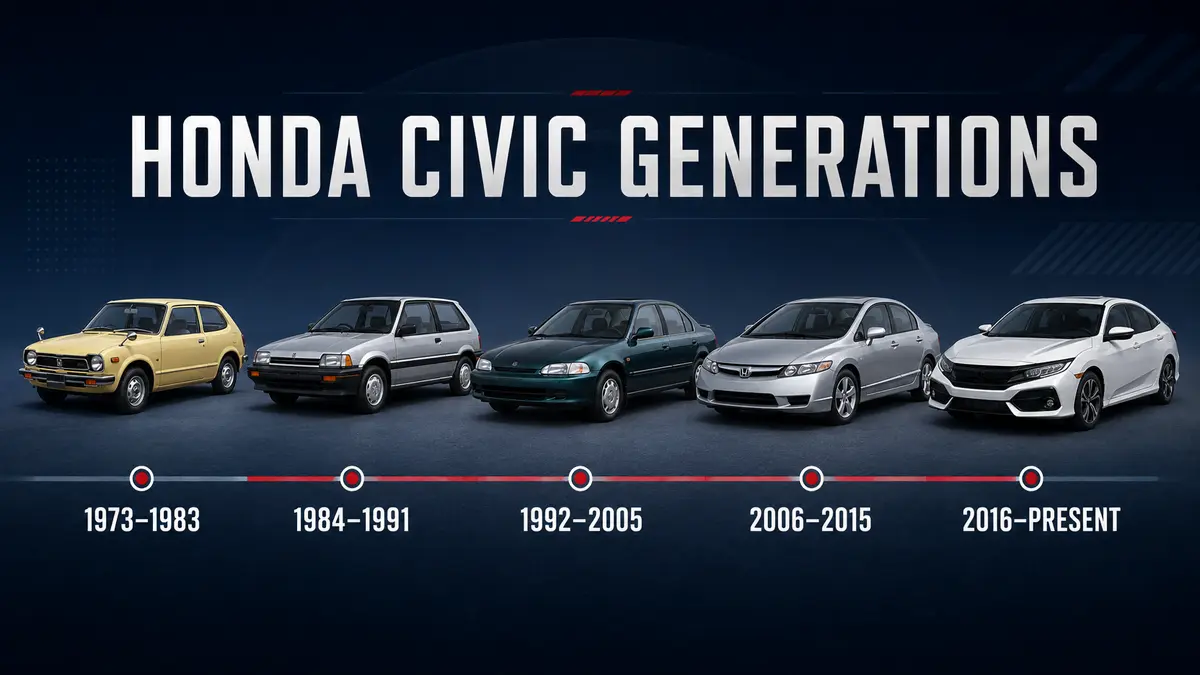
Honda Civic generations tell the story of how a small, economical hatchback became one of the most familiar compact cars in North America. Since the Civic went on sale in the United States in early 1973, it has grown through 11 generations, adding larger bodies, new engine families, stronger safety structures, hybrids, turbocharged engines and increasingly advanced driver-assistance technology.
Quick Answer
There are 11 Honda Civic generations. In the U.S., the first generation covers 1973–1979, while the current 11th generation began with the 2022 model year. For used buyers, the 2013–2015 ninth-generation Civic is one of the safest all-around choices, while some 2001–2009 and early 1.5T models need closer inspection.
- 1st generation: 1973–1979
- 2nd generation: 1980–1983
- 3rd generation: 1984–1987
- 4th generation: 1988–1991
- 5th generation: 1992–1995
- 6th generation: 1996–2000
- 7th generation: 2001–2005
- 8th generation: 2006–2011
- 9th generation: 2012–2015
- 10th generation: 2016–2021
- 11th generation: 2022–present
That history also makes used-Civic shopping more complicated than it first appears. A 2003 Civic automatic, a 2014 Civic sedan, a 2018 Civic 1.5T and a 2023 Civic may share the same badge, but they have very different strengths, maintenance needs and known problem areas.
This guide maps every Civic generation by year and explains the changes that matter to an owner or used-car buyer. For deeper ownership research, compare our Honda Civic reliability guide, common problems by year and Civic years to avoid.
Honda Civic Generations at a Glance
| Generation | U.S. Model Years | What Changed | Used-Buyer View |
|---|---|---|---|
| 1st | 1973-1979 | Small hatchback, CVCC era, economy focus | Collector territory; rust and parts condition dominate |
| 2nd | 1980-1983 | Larger body, more refinement and body choices | Rare; inspect corrosion and prior repairs |
| 3rd | 1984-1987 | New angular design, CRX and Si performance identity | Enthusiast interest; originality matters |
| 4th | 1988-1991 | Double-wishbone suspension and fuel-injected performance | Engaging but now very old; modifications are common |
| 5th | 1992-1995 | Rounded design, broader safety equipment, strong aftermarket | Simple and desirable when unmodified |
| 6th | 1996-2000 | More space, refinement and trim variety | One of the last simple Civics; condition is decisive |
| 7th | 2001-2005 | Flat rear floor, new cabin packaging, hybrid introduced | Automatic transmission risk needs close inspection |
| 8th | 2006-2011 | Futuristic cabin, new 1.8L engine, stronger Si | Later years are generally preferable to early 1.8L cars |
| 9th | 2012-2015 | Efficiency focus, rapid updates after 2012 launch | 2013-2015 are strong low-stress used choices |
| 10th | 2016-2021 | 2.0L and 1.5T engines, hatchback return, advanced safety | Great all-rounder; engine choice and A/C history matter |
| 11th | 2022-present | Cleaner design, stiffer body, improved technology and hybrid return | Promising; verify current recall work and steering feel |
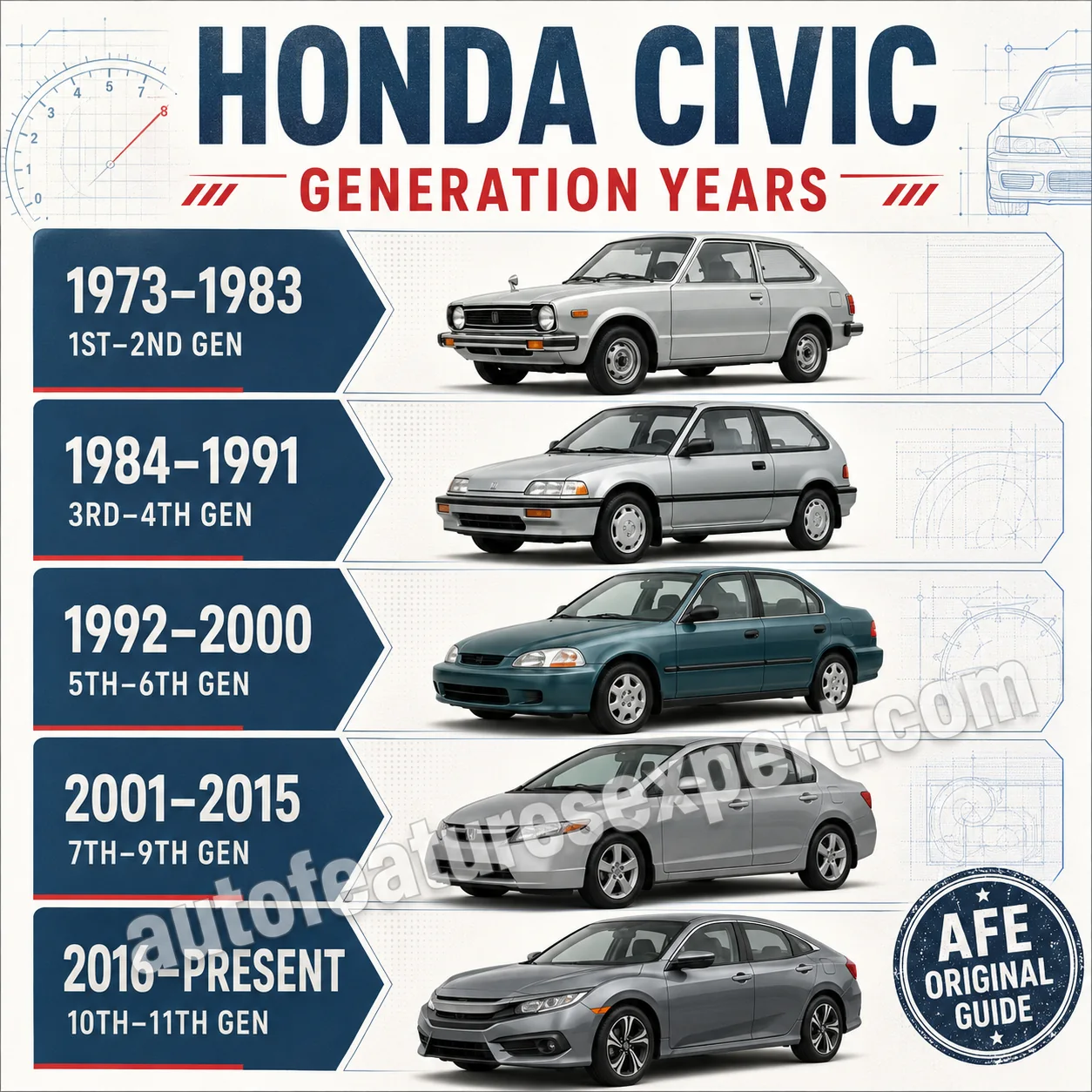
Generation dates can vary outside the United States, and body styles do not always change in the same model year. The ranges above follow the mainstream U.S.-market Civic.
First Generation: 1973-1979
The first Civic arrived as fuel prices and emissions rules were reshaping the car market. Its compact dimensions, front-wheel-drive layout and efficient engines made it practical in a way many larger cars were not. Honda’s CVCC combustion technology helped the Civic meet emissions requirements without relying on the same approach as many competitors.
Today, a first-generation Civic is not a normal budget commuter. Rust, previous restoration quality, parts availability and originality matter more than an ordinary reliability score. A complete, structurally sound car is far more valuable than a cheap example with hidden corrosion.
Second Generation: 1980-1983
The second Civic grew in size and refinement while keeping the light, economical character of the original. Honda offered multiple body styles and continued developing the CVCC engine family. These cars are now uncommon enough that purchase decisions should be based on body integrity, mechanical completeness and repair quality.
Look closely at floor pans, suspension mounting points, weather seals, cooling-system condition and evidence of improvised wiring. Age is the main risk.
Third Generation: 1984-1987
The third generation gave the Civic a sharper, more modern identity. It also produced the CRX and helped establish the Civic Si as an attainable enthusiast car. Packaging remained clever, while performance versions showed that an economy car could also be light and entertaining.
Surviving examples often have modifications. A stock car with service history is usually safer than one with unknown engine swaps, cut springs or unfinished electrical work.
Fourth Generation: 1988-1991
The fourth-generation Civic is remembered for its low weight, double-wishbone suspension and responsive handling. Fuel-injected engines became more important across the range, and the platform earned a large following among tuners.
That popularity creates the main used-buyer challenge. Check for accident repairs, rust, mismatched engine or transmission components, poor-quality suspension changes and missing emissions equipment. An original car may cost more but is usually easier to evaluate.
Fifth Generation: 1992-1995
The fifth generation introduced the rounded shape many drivers still associate with a classic 1990s Civic. It balanced efficiency, interior space and simple mechanical design, while performance trims and the aftermarket kept enthusiast interest high.
These Civics can last well, but they are now old enough for timing-belt history, cooling-system care, oil leaks, suspension wear and rust to matter more than mileage alone. Heavily modified examples deserve a careful inspection.
Sixth Generation: 1996-2000
The sixth-generation Civic added refinement without becoming overly complicated. For buyers who want an older, mechanically straightforward Civic, a clean 1996-2000 car can still be appealing. Parts knowledge is widespread and routine service is familiar to many independent shops.
The problem is finding an unmodified, well-maintained example. Inspect for rust, overheating history, oil leaks, worn engine mounts, tired suspension bushings and previous collision repair. Theft history and missing original components can also affect value.
Seventh Generation: 2001-2005
The seventh generation brought a roomier cabin and a flat rear floor, and it introduced the Civic Hybrid to the U.S. lineup. It is also the generation that requires the clearest transmission warning.
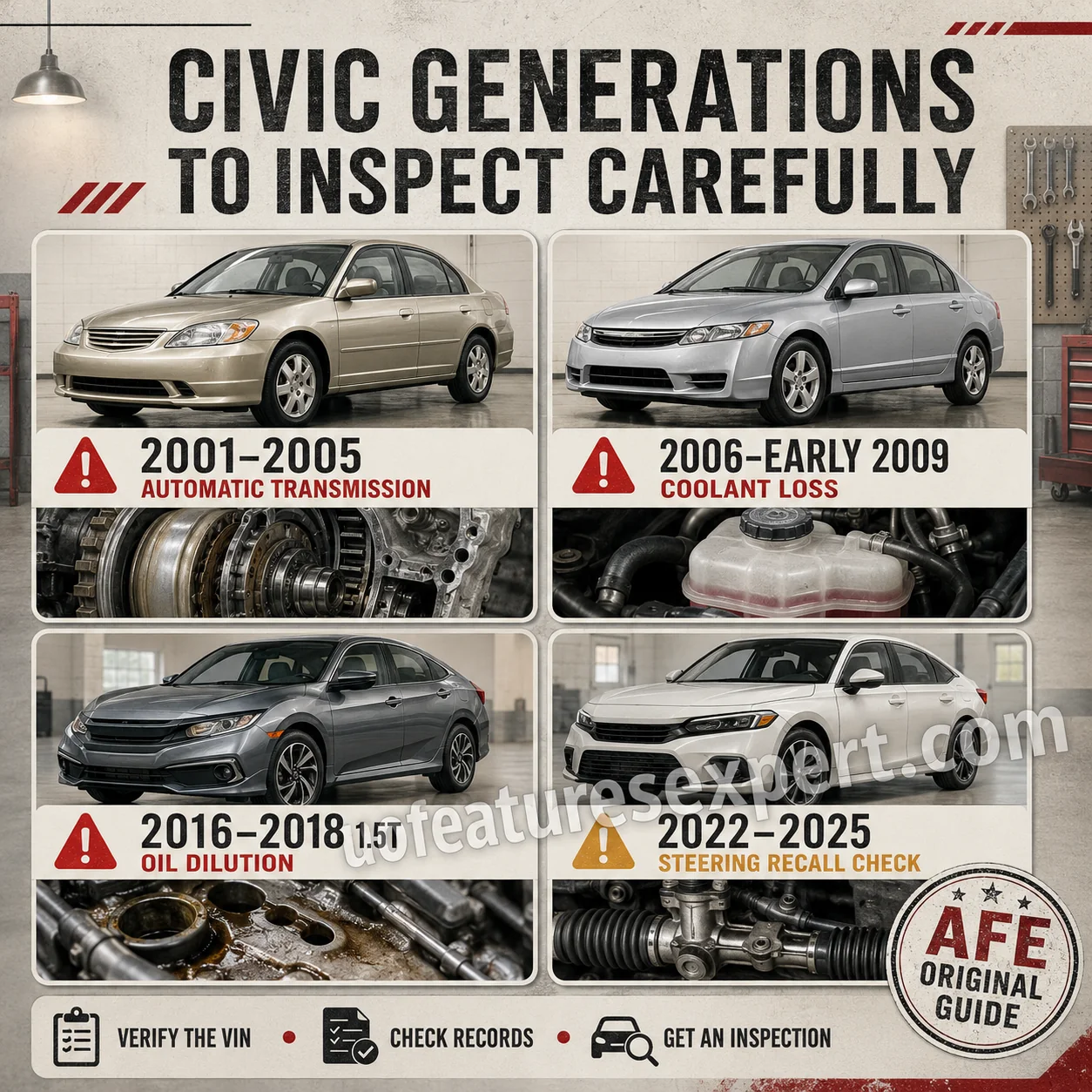
Some automatic-equipped 2001-2005 Civics developed slipping, delayed engagement, harsh shifting or complete transmission failure. Manual-transmission examples are generally more attractive, although clutch and synchro wear still need inspection. On an automatic car, test the transmission both cold and fully warm and ask for fluid-service records.
Our Honda Civic years to avoid guide explains why early cars from this generation deserve more caution.
Eighth Generation: 2006-2011
The eighth-generation Civic was a major visual and technical change. Its two-tier dashboard, more aerodynamic body and 1.8-liter engine made it feel much newer than the car it replaced. The Si gained a high-revving 2.0-liter engine and a stronger performance identity.
The central ownership concern is coolant leakage from the engine block on some 2006-2008 and early-production 2009 Civics with the 1.8-liter engine. Honda issued a warranty extension for affected vehicles, but those cars are now beyond the original extension period. Inspect coolant level, overheating history and proof of any engine-block replacement. Later 2010-2011 examples are often easier to recommend.
Ninth Generation: 2012-2015
The ninth generation arrived for 2012 with a strong efficiency focus, but criticism of the interior and overall refinement led Honda to update the car quickly. The 2013 model received meaningful improvements, and later cars became more polished.
For many used buyers, 2013-2015 is the Civic sweet spot. These cars avoid the older automatic-transmission pattern, the early eighth-generation block concern and the later turbo oil-dilution discussion. They still need normal checks for CVT or automatic service, brakes, suspension, tires, air conditioning and accident history.
Tenth Generation: 2016-2021
The tenth generation transformed the Civic again. It introduced a more dramatic fastback-like sedan shape, brought the hatchback back to the U.S. lineup and offered two very different mainstream engines: a naturally aspirated 2.0-liter and a turbocharged 1.5-liter.
The 2.0-liter engine is usually the simpler choice for a buyer focused on long-term ownership. The 1.5T delivers stronger torque and excellent fuel economy, but oil dilution deserves attention, especially on cars used for repeated short trips in cold weather. Check the oil level, fuel smell, service records and previous driving pattern.
Air-conditioning history also matters. Certain 2016-2021 Civics received extended warranty coverage for A/C condenser concerns, and Honda later addressed some compressor shaft-seal issues. Test the system at idle and on the road. For a year-specific example, see our 2020 Honda Civic oil dilution guide.
For the exact coverage boundaries and diagnosis questions, see our Honda Civic A/C problems and warranty guide.
Eleventh Generation: 2022-Present
The eleventh-generation Civic adopted a cleaner design, a more rigid body structure and a less visually complex cabin. Honda continued the sedan, hatchback and Si, while the Type R remained the performance flagship. Hybrid power returned to the U.S. Civic range for the 2025 model year.
Long-term high-mileage evidence is still developing. Used buyers should verify recall completion by VIN and pay attention to steering feel. Certain newer Civics were included in a large steering-gearbox recall; owners may describe the symptom as sticky or notchy steering after the car has been driven for a while.
Which Honda Civic Generation Is Most Reliable?
No generation is uniformly perfect, but the ninth-generation 2013-2015 Civic is one of the easiest ranges to recommend for simple used-car ownership. It combines modern safety and economy with relatively straightforward mechanical hardware.
Later eighth-generation 2010-2011 cars can work well for smaller budgets. Buyers wanting newer technology may prefer a 2019-2021 tenth-generation Civic with the 2.0-liter engine. An eleventh-generation car can also be a strong choice after maintenance and recall status are confirmed.
Reliability ultimately follows the specific car. A documented 1.5T can be safer than a neglected 2.0-liter car, and a higher-mileage Civic with complete records can be a better purchase than a low-mileage example with overheating or collision history.

Best Civic Generation by Buyer Type
- Lowest-stress used purchase: 2013-2015 Civic
- Affordable older commuter: 2010-2011 Civic with clean cooling-system history
- Newer car with simpler engine: 2019-2021 Civic 2.0L
- Enthusiast classic: clean, minimally modified fourth-, fifth- or sixth-generation car
- Modern technology: eleventh-generation Civic with completed recalls
- Performance focus: Si or Type R, evaluated separately from mainstream trims
Used Honda Civic Generation Checklist
- Confirm the exact model year, engine, transmission and trim.
- Run the VIN through Honda and NHTSA recall lookups.
- Review oil, coolant and transmission-fluid service records.
- Test the transmission cold and warm.
- Check for coolant loss or overheating history on early eighth-generation cars.
- Inspect oil level and fuel smell on 1.5T models.
- Test A/C performance on tenth-generation cars.
- Check steering feel on newer Civics.
- Look for rust, collision repairs and low-quality modifications on older generations.
- Arrange an independent pre-purchase inspection.

FAQ
How many Honda Civic generations are there?
There are 11 Honda Civic generations through the current model line. The Civic first went on sale in the United States in early 1973, while the eleventh generation began with the 2022 model year.
What years are the ninth-generation Honda Civic?
The ninth-generation U.S.-market Honda Civic covers model years 2012 through 2015. Many used buyers prefer 2013-2015 because Honda improved the car after the 2012 launch.
What years are the tenth-generation Honda Civic?
The tenth-generation Civic covers 2016 through 2021 in the United States. It offered 2.0-liter naturally aspirated and 1.5-liter turbocharged engines, depending on trim and body style.
Which Civic generation is best for reliability?
The 2013-2015 ninth-generation Civic is one of the strongest all-around choices for reliability-focused used buyers. Later eighth-generation cars and 2019-2021 2.0-liter Civics can also be good options with proper maintenance.
Which Honda Civic generation should buyers avoid?
Buyers do not need to reject an entire generation, but 2001-2005 automatic cars, early 2006-2009 1.8-liter cars and some early 1.5T tenth-generation cars need closer inspection for known problem patterns.
When did the Honda Civic get a turbo engine?
The mainstream U.S. Civic added a 1.5-liter turbocharged engine with the tenth generation for the 2016 model year. Availability depended on trim and body style.
Is the newest Honda Civic generation reliable?
The eleventh-generation Civic has a promising ownership outlook, but long-term data is still developing. Buyers should verify maintenance and recall completion and check for abnormal steering feel.
References
- Honda: 50 Years and 11 Generations of Civic
- Honda: 11th-Generation Civic Introduction
- Honda Recall Lookup
- NHTSA Recall Lookup
- Honda Civic Engine Block Warranty Extension Bulletin
About This Article
Author: Alex Fric, Automotive Research Editor
Article Type: Model history, ownership research and used-buyer guide
Research Sources: Honda historical material, manufacturer documentation, public recall records and technical service information.
Scope: U.S.-market Honda Civic generations, major design and powertrain changes, reliability patterns and used-buyer checks.
Disclosure: Auto Features Expert is an independent automotive research publication.







