Use this guide for
Keep 2012 Honda Civic-specific problems, recalls and age-related checks separate from broad Civic reputation.
Boundary: Do not use this page as a substitute for all ninth-generation reliability or every Civic problem.
2012 Honda Civic problems do not center on one universal catastrophic engine or transmission defect. The more useful evidence is a collection of VIN-specific safety recalls, a documented low-battery no-start software condition, several warning-light bulletins and an expired paint warranty extension. Age, trim and previous repair history now determine whether a particular 2012 Civic is an economical commuter or a deferred-maintenance project.
The first model year of the ninth-generation Civic was sold in several very different forms: mainstream 1.8-liter gasoline cars, the manual-transmission Si, the Civic Hybrid and the Civic Natural Gas. Advice that is accurate for one version may be irrelevant to another. The inspection must begin with the VIN and powertrain, not an assumption based on the Civic badge.
This guide uses Honda and NHTSA records to identify what is documented, shows how to test the car in front of you and avoids turning every service bulletin into a claim that every vehicle will fail.
What are the most important 2012 Honda Civic problems?
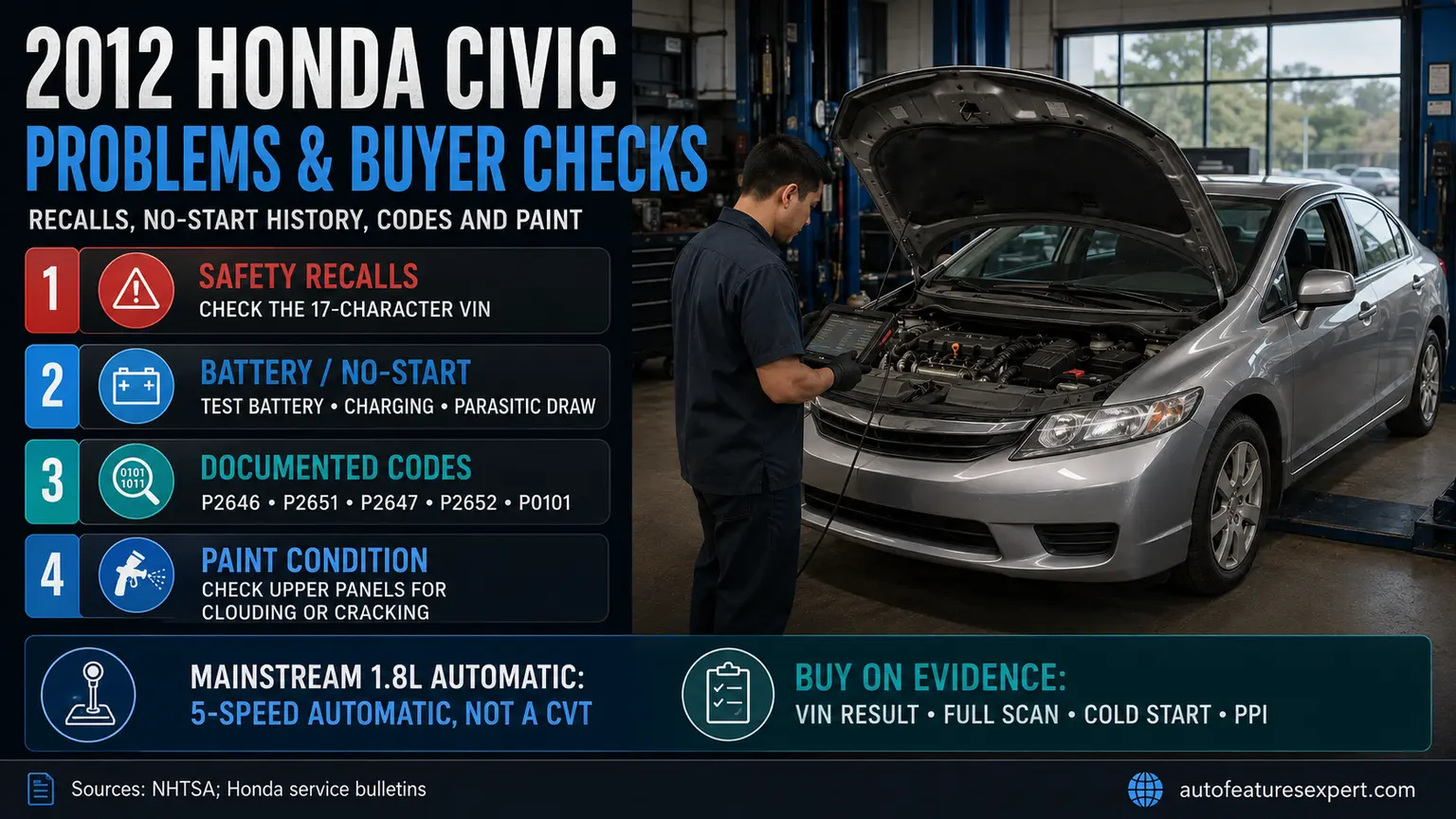
The most important 2012 Honda Civic problems are unrepaired VIN-specific recalls, repeat no-start events caused by an undercharged or failing 12-volt battery system, intermittent oil-pressure-switch fault codes, certain software-related P0101 check-engine lights and deteriorating factory paint. None applies identically to every car, so recall lookup, diagnostic scanning and an independent inspection matter more than a generic problem list.
| Concern | Best evidence | Likely clue | Buyer priority |
|---|---|---|---|
| Open safety recall | Current NHTSA and Honda VIN results | May have no symptom before failure | Check before purchase |
| Low-charge no-start | Honda Service Bulletin 12-041 plus battery/charging test | Weak crank, clicking, jump-start history or recent battery replacement | Diagnose before replacing parts |
| Rocker-arm oil-pressure-switch fault | Honda Service Bulletin 13-021 and stored DTCs | MIL with P2646/P2651 or P2647/P2652 | Confirm exact code and oil condition |
| P0101 software condition | Honda Service Bulletin 14-031 | MIL with MAF range/performance code | Check software before parts swapping |
| Paint cracking or clouding | Honda Service Bulletin 14-034 | Chalky upper panels or cracking near hood/fender edges | Condition and cost issue |
Complaints can help an inspector know where to look, but they cannot establish a failure rate without exposure data and verification. Honda bulletins are stronger evidence that the manufacturer recognized a particular diagnostic pattern; even then, the VIN range, trim, symptoms and codes must match.
Which 2012 Honda Civic recalls matter today?
Every candidate should be checked with its 17-character VIN at both the NHTSA recall lookup and Honda’s recall search. Honda explains that a year/make/model search returns general campaigns that may affect only part of the population, while a VIN search identifies uncompleted recalls for that vehicle.

Important campaigns associated with portions of the 2012 Civic population include:
- NHTSA 11V-288, fuel feed line: Honda recalled 1,156 early 2012 Civics because a misaligned O-ring at a fuel-line connection could permit a small leak and create a fire risk in the presence of an ignition source.
- NHTSA 12V-256, left driveshaft: Honda recalled approximately 50,000 vehicles to inspect and, if needed, replace a left driveshaft that might separate from its outer CV joint. Separation can eliminate drive power and allow rollaway in Park if the parking brake is not set.
- NHTSA 12V-548, steering column: this narrowly targeted campaign involved 157 Civics built over a short October 2012 period. The installed steering column might not have the intended energy-absorbing characteristics in a crash.
- NHTSA 20V-770, salt-related driveshaft corrosion: this later campaign applies to certain 2012 Civic Hybrid vehicles sold or ever registered in specified salt-belt jurisdictions. Honda’s filing explicitly says non-hybrid 2012 Civics are not included in this campaign.
The model-year list is not a substitute for the VIN result, and a seller’s claim that “Honda did all recalls” is not documentation. Save or print the current lookup, then ask a Honda dealer to clarify any open, incomplete or unavailable remedy before money changes hands.
Why the two driveshaft recalls must not be blended together
The 2012 campaign 12V-256 concerned assembly of the left driveshaft on certain Civics. The 2020 campaign 20V-770 concerned protective-coating adhesion, road-salt exposure and corrosion on certain Civic Hybrids. They involve different populations and mechanisms. An invoice for one campaign does not prove that the other is irrelevant; only the VIN and Honda campaign history can do that.
If the car has an open driveshaft recall, follow Honda’s current instructions. Independently of recall status, investigate clicking on turns, vibration under acceleration, torn CV boots, grease thrown around the wheel well or corrosion damage. Those signs can reflect ordinary wear or impact damage on a vehicle this age.
Why can a 2012 Civic have a dead battery or fail to start?

Honda Service Bulletin 12-041 addresses 2012 Civics that may not start because the battery has a low state of charge. Honda said the battery sensor monitors battery condition and the PCM chooses a charging mode; depending on battery sulfation and driving habits, the PCM may not select the correct mode. The specified corrective action was a PGM-FI software update after checking battery condition.
The bulletin is not proof that software causes every dead battery. It explicitly lists other possibilities, including an old or sulfated battery, a faulty alternator, parasitic draw, loose cables and a vehicle that has simply sat too long. In 2026, the original 12-volt battery should be long gone, and even a later replacement may be near the end of its useful life.
How to investigate a no-start history
- Ask for the exact event. “It needed a jump” is incomplete. Find out whether the engine cranked slowly, clicked, cranked normally without firing or had no electrical power.
- Check the battery date and test result. A sticker is not a load or conductance test. Record measured state of charge and health.
- Test the full starting and charging system. Verify battery terminals, grounds, cranking voltage, alternator output and voltage drop under load.
- Measure key-off draw if discharge repeats. A healthy battery that goes flat while parked requires a parasitic-draw diagnosis.
- Confirm software status by VIN. A Honda-capable shop or dealer can determine whether the relevant calibration is already installed.
Do not approve an alternator, starter or control-module replacement solely because the car once required a jump. RepairPal’s current estimate places a 2012 Civic starter replacement at $447–$1,052 and an alternator replacement at $689–$1,477, before taxes, location adjustments and connected repairs. Testing first prevents a cheap battery or cable fault from becoming an expensive parts-swapping exercise.
Which check engine light problems did Honda document?
Two Honda bulletins help narrow common-looking warning-light situations. They do not replace a scan, freeze-frame review or mechanical diagnosis.
P2646, P2651, P2647 or P2652
Service Bulletin 13-021 applies to 2012–2013 Civics except Si and Hybrid. It says the rocker-arm oil-pressure switch may fail intermittently and set one of four circuit-low or circuit-high codes. Honda’s corrective action was replacement of the switch and O-ring after confirming the bulletin applies.
“Oil pressure” in a code description should not be dismissed automatically as a small sensor. Verify the oil level and correct viscosity, inspect for leaks, preserve the stored codes and follow the diagnostic tree. A genuinely low engine-oil-pressure condition can damage the engine and requires different action from an electrical switch fault.
RepairPal’s June 2026 estimate for a 2012 Civic oil-pressure-sensor replacement is $140–$163, excluding taxes, fees, location and related repairs. The estimate is useful only after the fault is identified; it is not a quote for an engine oil-pressure problem.
P0101 mass-airflow range/performance code
Service Bulletin 14-031 covers 2012–2013 mainstream and Natural Gas Civics, excluding Si and Hybrid. Honda said the PCM could misinterpret mass-airflow inputs during constant throttle movement and directed technicians to diagnose the car and, when applicable, update PGM-FI software.
That bulletin is a warning against immediately buying a mass-airflow sensor. An intake leak, contaminated sensor, wiring problem, air-filter issue or another engine condition can also produce relevant data. Check whether the calibration update is already present, review fuel trims and inspect the intake before authorizing parts.
Is paint failure a known 2012 Civic problem?
Yes, for specified vehicles, colors and panels. Honda Service Bulletin 14-034 extended paint coverage to seven years from original purchase, with no mileage limit, for eligible 2006–2013 Civics. It documents cracking, chalking or clouding on areas including the hood, front-fender leading edges, roof, trunk, upper quarter panels and upper doors. Dyno Blue Pearl II was listed specifically for the 2012 model year alongside other covered colors.
That seven-year period has expired for every 2012 Civic. The bulletin remains useful evidence of the condition but no longer supports an assumption of free repainting. It also applied only to factory-applied paint and excluded damage such as chips, scratches, sap and bird droppings.
Inspect a clean car under even lighting. Compare horizontal panels for lost gloss or a milky appearance, check hood and fender edges for cracking, and look for overspray on weatherstrips or hardware. Paint-thickness readings can help distinguish a factory-finish problem from previous collision repair. Obtain a local body-shop estimate because repainting several panels can consume a meaningful share of the car’s value.
What does the 2030 airbag support program cover?
Honda Service Bulletin 18-059 describes a customer support program for manufacturing defects in the replacement front-passenger airbag inflator on eligible 2012 Civics, including Hybrid and GX. The document says this group’s program expires June 30, 2030 and requires a VIN-status inquiry and diagnosis of specified SRS fault codes.
This is not permission to describe every 2012 Civic as having a current Takata recall, nor does it cover an airbag deployment, aftermarket components, salvage vehicles or every SRS warning. Check the VIN for open safety recalls first. If the SRS light stays on, have the system scanned by a qualified technician and let Honda determine whether the support program applies.
A car with an illuminated SRS light should not be treated as “just a sensor” during negotiation. Airbags and pretensioners may not operate as intended, and previous collision repairs can introduce incorrect, used or counterfeit components. The VIN, scan report and physical inspection must agree.
Do all 2012 Civics have the same transmission?
No. Mainstream gasoline 2012 Civics were offered with a five-speed automatic or five-speed manual, while the Si used a six-speed manual and the Hybrid used a CVT. The mainstream Civic did not adopt the later-generation CVT simply because newer Civics use one.
| Version | Powertrain-specific test | Common buying mistake |
|---|---|---|
| 1.8-liter gasoline automatic | Cold and warm shifts, engagement delay, fluid history, mounts and leaks | Calling the five-speed automatic a CVT |
| 1.8-liter gasoline manual | Clutch take-up, synchro behavior, fluid history and axle/CV condition | Ignoring clutch cost because the engine runs well |
| Civic Si | Six-speed shift quality, clutch, modifications, oil level and signs of hard use | Applying mainstream 1.8-liter bulletins without checking exclusions |
| Civic Hybrid | IMA warnings, high-voltage battery condition, CVT operation and specialist scan | Assuming a normal 12-volt test evaluates the hybrid system |
| Civic Natural Gas | Fuel-tank/system status, leaks, specialist access and local fueling | Buying before confirming safe service and practical refueling |
Use the Honda Civic generations guide to place this first ninth-generation year in context, but let the exact trim determine the inspection and repair budget.
Which age related failures should a buyer expect?
A 2012 Civic is now old enough for ordinary wear to outweigh its early service bulletins. A complete used Honda Civic inspection should include:
- Structure and corrosion: inspect unibody rails, subframes, pinch welds, suspension mounts, brake lines and previous body repairs, especially in road-salt regions.
- Engine condition: start cold, verify oil and coolant levels, scan for current/pending/permanent codes, inspect leaks and confirm normal operating temperature.
- Transmission and clutch: test every gear from cold through full temperature, check fluid history and investigate vibration rather than blaming mounts automatically.
- Brakes and tires: measure pads, rotors and tread; read tire date codes; investigate steering-wheel shake, pulling and uneven wear.
- Suspension and steering: check struts, bushings, ball joints, tie rods, wheel bearings, electric power steering warnings and alignment.
- Electrical and HVAC equipment: test the battery/charging system, air conditioning, blower speeds, windows, locks, lights, audio display and every warning lamp.
- Service history: compare invoices with the odometer and Maintenance Minder; repeated batteries, check-engine codes or tire replacements deserve a cause, not another reset.
Request a report with photos, measurements, scan results and repair priorities from a shop independent of the seller. A cleared code monitor that is not ready, a recently disconnected battery or an engine already warm on arrival should lead to more testing, not an automatic rejection or acceptance.
How should repair costs change the offer?
National estimates provide scale, not a VIN-specific budget. As of July 26, 2026, Kelley Blue Book lists estimated private-party values for a 2012 Civic LX sedan at roughly $5,580–$7,330 depending on condition, using the page’s displayed market assumptions. Trim, mileage, ZIP code, title history and actual condition can move the figure substantially.
| Finding | Offer treatment | Proof to obtain |
|---|---|---|
| Open recall with available remedy | Require a plan for free dealer completion and obey safety instructions | Current VIN result and dealer confirmation |
| Single documented sensor fault | Use a written diagnostic quote, not a guessed parts price | Codes, test results and bulletin applicability |
| Repeat dead battery | Budget diagnosis until battery, charging mode, alternator and draw are separated | Battery/charging report and software status |
| Multiple cloudy or cracked panels | Subtract a real body-shop estimate if cosmetic condition matters | Paint readings, collision check and written quote |
| Hybrid warning or weak battery evidence | Do not price as a normal 12-volt battery repair | Honda-capable hybrid scan and battery assessment |
| Inspection refused or major warning lights cleared | Choose another car | No verbal assurance closes the evidence gap |
Compare the total with the Honda Civic maintenance cost outlook and other cars available locally. A low purchase price is not a bargain when immediate tires, brakes, paint, air conditioning and unresolved electrical faults arrive together.
Is the 2012 Honda Civic reliable?
The 2012 Civic can be a reliable used car when the exact vehicle has completed recalls, a healthy 12-volt and charging system, no unresolved warning lights, sound structure and consistent maintenance. Its conventional mainstream powertrain is relatively straightforward, but simplicity cannot compensate for neglected fluids, crash repairs or years of short-trip use.
The model year should not be condemned simply because it appears in bulletins, and it should not be purchased solely on Honda’s reputation. Review the larger Honda Civic reliability evidence, then make the final decision from the VIN-specific inspection.
Questions buyers ask about the 2012 Civic
What is the biggest problem with a 2012 Honda Civic?
The biggest risk depends on the VIN and condition. An open safety recall, an unresolved SRS warning, repeated no-starts or a compromised Hybrid system matters more than cosmetic paint failure. Check recalls first, then scan and inspect the specific car.
Does the 2012 Civic have transmission problems?
There is no basis for calling every 2012 transmission defective. Mainstream cars use a five-speed automatic or manual, the Si uses a six-speed manual and the Hybrid uses a CVT. Test the actual unit cold and hot and review its fluid and repair history.
Why does my 2012 Civic battery keep dying?
Honda documented a charging-mode software condition for listed 2012 Civics, but an aging battery, weak alternator, cable problem, parasitic draw or long storage can produce the same result. Test the system and check calibration status before replacing expensive components.
What do P2646 or P2647 mean on a 2012 Civic?
Honda Bulletin 13-021 says an intermittent rocker-arm oil-pressure switch can set related circuit codes on 2012–2013 Civics other than Si and Hybrid. Verify oil level and real pressure concerns, preserve the code data and diagnose before assuming the switch is the only cause.
Is the 2012 Civic paint warranty still active?
No. The relevant extension lasted seven years from original purchase for eligible factory paint, colors and panels. It has expired for 2012 cars, although the bulletin remains useful when identifying the documented cracking, chalking or clouding pattern.
Does a 2012 Civic use a CVT?
Only the 2012 Civic Hybrid uses a CVT. Mainstream gasoline models have a five-speed automatic or manual, and the Si has a six-speed manual. This distinction changes both the road test and the repair budget.
Is a 2012 Civic a year to avoid?
Not automatically. It is a first model year with VIN-specific campaigns and several documented service patterns, but a completed, inspected car can still be a sound choice. Compare condition and total cost with the Honda Civic years to avoid analysis rather than treating a label as a verdict.
The purchase test that matters
A convincing 2012 Civic has more than a clean dashboard during a short drive. Its VIN shows completed campaigns, all readiness monitors and warning systems behave normally, the battery and charging report is healthy, its paint and structure match the history, and the powertrain-specific test reveals no unresolved fault.
Give extra weight to evidence that is difficult to fake: a cold start, dealer recall printout, independent scan, voltage and draw measurements, paint readings and itemized service invoices. If the seller supplies access and the repair-adjusted price remains competitive, this Civic can be a rational long-term commuter. If the story depends on cleared lights and promised cheap fixes, keep shopping.
Sources
- NHTSA: VIN Recall Lookup
- American Honda: Recall Information for Safety and Defects
- American Honda: 2012 Civic Fuel Feed Line Leak Recall Statement
- NHTSA 12V-256 / Honda S40 Owner Recall Notice
- NHTSA Part 573 Safety Recall Report 20V-770
- American Honda Service Bulletin 12-041: New Software Update, Vehicle Will Not Start
- American Honda Service Bulletin 13-021: Rocker Arm Oil Pressure Switch DTCs
- American Honda Service Bulletin 14-031: P0101 Software Condition
- American Honda Service Bulletin 14-034: Civic Paint Warranty Extension
- American Honda Service Bulletin 18-059: Replacement Passenger Inflator Support Program
- RepairPal: 2012 Honda Civic Oil Pressure Sensor Replacement Cost
- RepairPal: 2012 Honda Civic Starter Replacement Cost
- RepairPal: 2012 Honda Civic Alternator Replacement Cost
- Kelley Blue Book: 2012 Honda Civic LX Sedan Values
About this research
This guide was prepared by Alex Fric, Automotive Research Editor, and last verified on August 22, 2026. It covers U.S.-market 2012 Civic sedan and coupe variants and distinguishes mainstream 1.8-liter cars, the Si, Hybrid and Natural Gas models.
The recall and diagnostic sections were checked against NHTSA campaign records, American Honda recall material and Honda service bulletins. Third-party cost pages were used only as labeled estimates. No individual vehicle was inspected, and a complaint or bulletin does not establish that every 2012 Civic has the condition.
Before buying, confirm the current VIN result, scan all available modules and obtain an independent inspection. The broader used Honda Civic inspection checklist covers the full sequence, while the Honda Civic maintenance cost guide helps price overdue service and measured wear.





