Use this guide for
Check Civic fuel-pump campaign scope, VIN eligibility, symptoms and remedy status.
Boundary: Hard starting or stalling can have causes outside the recall; VIN status and diagnosis both matter.
Honda Civic fuel pump recall coverage can involve two very different defects. Many tenth-generation Civics are covered by an in-tank, low-pressure fuel pump motor recall that can lead to a no-start or an engine stall. Certain 2025 Civics have a separate high-pressure fuel pump recall involving the possibility of a fuel leak. The model year printed on the title is not enough to confirm either one.
This U.S.-market guide explains both campaigns, the affected-year ranges, warning signs, free dealer remedies and the VIN checks that determine whether a specific Civic still needs repair. Recall status can change after a campaign is expanded or a repair is recorded, so use the official lookup links rather than a generic model-year list.
Key Takeaways
- Campaign 23V-858: selected 2016–2021 Civics can have an in-tank pump impeller that deforms and stops fuel delivery; not every Civic in those years is included.
- Campaign 24V-763: selected 2025 Civic and Civic Hybrid sedans have a separate engine-mounted high-pressure pump that can crack and leak fuel.
- The 17-character VIN decides eligibility. A year list is only a screening tool because body style, trim, production record, installed service part and prior repair history matter.
- The warning patterns are different. Hard starting, loss of power and stalling fit the in-tank campaign; a raw-fuel odor while driving or idling is the official warning associated with the 2025 high-pressure campaign.
- An eligible recall remedy is free. Contact a Honda dealer promptly, and ask about towing before driving a Civic that stalls, loses power or smells strongly of fuel.
Which Honda Civic years are affected by fuel pump recalls?
Certain 2016–2021 Civics may be included in NHTSA campaign 23V-858 for an in-tank fuel pump motor, with body style, trim, build origin and VIN determining eligibility. Certain 2025 Civic and Civic Hybrid vehicles may be included in campaign 24V-763 for a high-pressure pump that can leak. Not every Civic from those years is recalled.
The distinction between “certain vehicles” and “every vehicle” is critical. Honda’s dealer bulletins instruct technicians to perform an iN VIN status inquiry. The broad ranges below tell an owner which campaigns are worth checking; they cannot confirm coverage without the 17-character VIN.
| Campaign | Civic screening range | Recalled component | Official warning pattern | Dealer remedy |
|---|---|---|---|---|
| 23V-858 | Selected 2016–2021 coupe, sedan and hatchback populations; separate bulletins cover certain Si, Type R and JHM-built cars | Low-pressure fuel-pump motor inside the tank | MIL, difficult starting, intermittent power loss or stalling | Confirm VIN eligibility and replace the affected pump motor/module with the improved part |
| 24V-763 | Selected 2025 Civic and Civic Hybrid four-door vehicles; VIN and powertrain-specific instructions apply | Engine-mounted high-pressure fuel pump | Fuel odor while driving or idling; possible fuel leakage | Inspect the pump and replace it with an improved unit when the inspection fails |
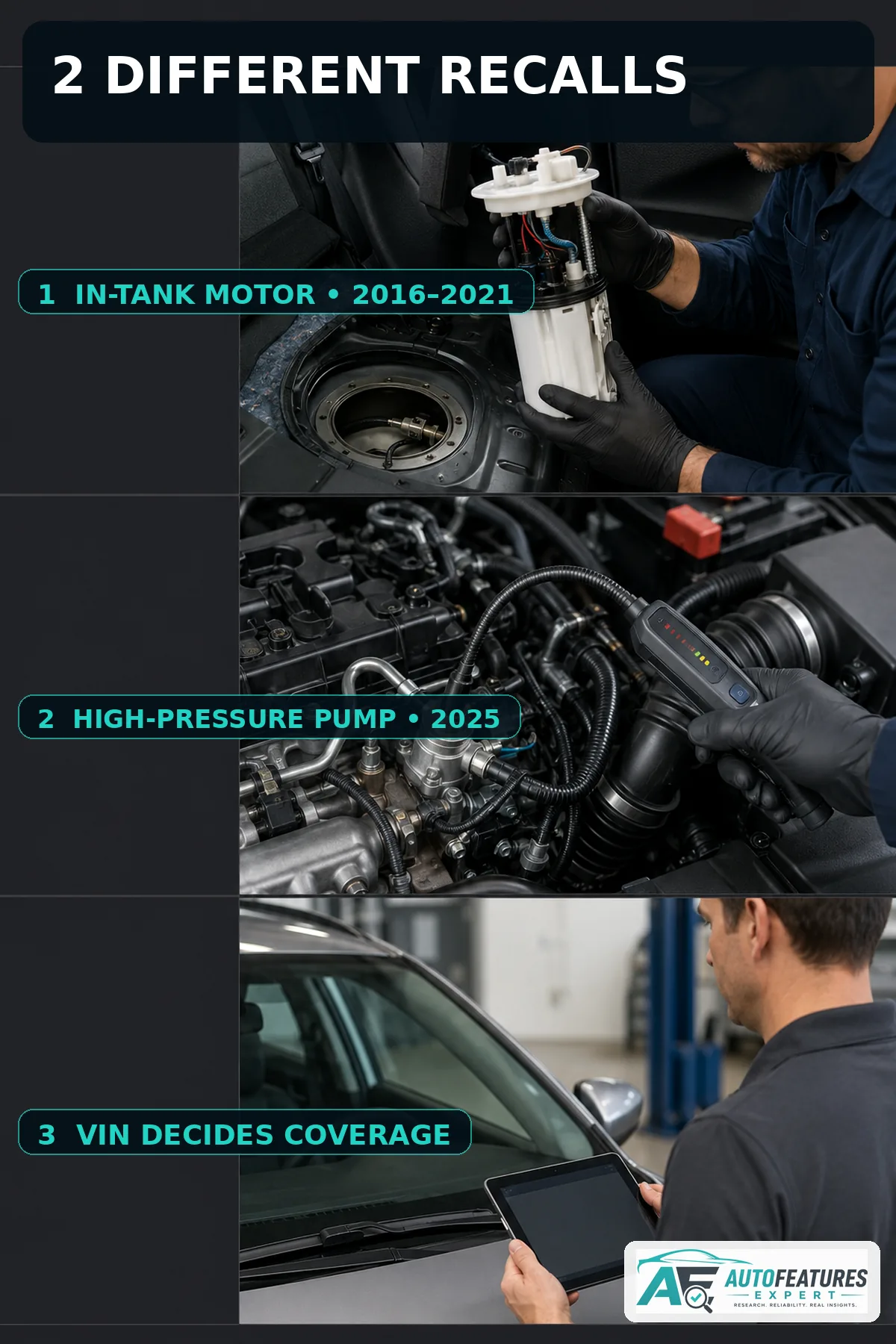
Campaign 23V-858 expanded earlier fuel-pump recalls 20V-314 and 21V-215. That history is why one article or recall notice may say “2018–2020 Civic,” while later Honda service information lists selected Civics as far back as 2016 and as late as 2021. The later bulletins account for additional production populations and vehicles that may have received affected fuel-pump service parts.
Detailed Civic ranges for the in-tank pump recall
Honda’s February 2025 Civic bulletin lists these broad eligibility ranges for vehicles whose VINs do not begin with JHM:
- 2016 and 2018–2020 Civic two-door: all trims except Si, subject to VIN eligibility.
- 2016–2021 Civic four-door: all trims except Si, subject to VIN eligibility.
- 2017–2020 Civic five-door: all trims except Si and Type R, subject to VIN eligibility.
Separate Honda bulletins address certain 2017–2020 Civic Si, 2018–2020 Civic Type R and 2018–2019 four-door Civics with VINs beginning JHM. These overlapping documents make a hand-built VIN range unreliable. Enter the complete VIN in Honda’s recall system or ask a dealer to run the Honda iN inquiry.
A 2017 Civic, for example, is not automatically included simply because later bulletins mention 2017. Body style, trim, installed pump and supplier production information still matter. Likewise, a 2021 sedan may be eligible even though the original December 2023 public summary emphasized 2018–2020 Civics.
What the model year tells you—and what it does not
A model year determines which campaign should be screened first, but it cannot close the decision. Use the following as a quick route to the correct lookup:
- 2016–2021 Civic: check the VIN for 23V-858 and earlier linked fuel-pump campaigns. A 2018–2020 news headline is not the full current Civic service scope.
- 2022–2024 Civic: these model years are not listed as Civic populations in 23V-858 or 24V-763. They can still have other recalls or non-recall fuel-system faults, so use the VIN lookup rather than assuming the car has no campaign.
- 2025 Civic or Civic Hybrid: check for 24V-763. Honda’s Civic-specific non-hybrid bulletin identifies certain 2.0-liter LX and Sport cars, while the federal recall report also lists selected Civic Hybrid sedans.
- Any year with an old pump invoice: check again. Honda expanded the in-tank campaign after identifying additional production populations and affected replacement service parts.
The May 2024 amended Part 573 filing lists the 23V-858 population across Honda and Acura models at 2,490,460 potentially involved vehicles, with an estimated one percent defect rate. That percentage describes the entire filed population, not the probability that an individual Civic will fail. It also does not replace VIN eligibility.
What is wrong with the recalled fuel pumps?
23V-858: in-tank low-pressure pump motor
Honda reported that the fuel-pump impeller could have been improperly molded at low density. The material can absorb fuel, deform and interfere with the pump body. If the impeller binds badly enough, the pump can stop supplying fuel. The engine may then refuse to start or stall while the vehicle is moving, increasing crash risk.
This is the pump motor inside the fuel tank. It should not be confused with the engine-mounted high-pressure pump used by a direct-injection system. Honda’s remedy bulletins tell dealers to replace the affected fuel pump motor and confirm the VIN campaign status before repair.
24V-763: 2025 Civic high-pressure pump
The 2025 campaign involves a different component and failure mode. Honda reported that improper production can allow cracks to form in the high-pressure pump’s solenoid-core component. Fuel can leak while the pump is operating. If leaked fuel reaches an ignition source, the risk of fire, injury or a crash increases.
For certain 2025 non-hybrid Civics, Honda bulletin 24-124 identifies LX and Sport trims with the 2.0-liter engine. Other Honda remedy information covers certain 2025 Civic Hybrid vehicles. Eligibility still depends on the VIN, and the dealer remedy is inspection and replacement as directed by the applicable campaign—not the in-tank motor procedure used for 23V-858.
Honda Civic fuel pump recall symptoms
An open recall does not mean the pump has already failed, and a symptom does not prove that the recall defect caused it. Match the warning pattern to the correct campaign before drawing a conclusion.
| What the driver notices | More consistent with 23V-858 | More consistent with 24V-763 | Immediate next step |
|---|---|---|---|
| Long crank, difficult start or crank/no-start | Yes—loss of low-pressure fuel delivery is possible | Not the defining official warning | Check VIN and call the dealer; do not keep draining the battery with repeated attempts |
| Hesitation, intermittent power loss or stall | Yes—listed in Honda/NHTSA recall materials | Not the defining official warning | Move out of traffic safely and request dealer or roadside guidance |
| MIL/check-engine light or stored P0087 | Possible warning, but not proof of the recalled defect | A warning light alone does not identify a leaking high-pressure pump | Save codes and freeze-frame data; let the dealer follow the VIN-specific bulletin |
| Raw-fuel odor while driving or idling | Not the primary warning pattern for the impeller defect | Yes—the federal report lists fuel odor as a possible warning | Stop in a safe open area, shut the engine off and contact the dealer before driving again |
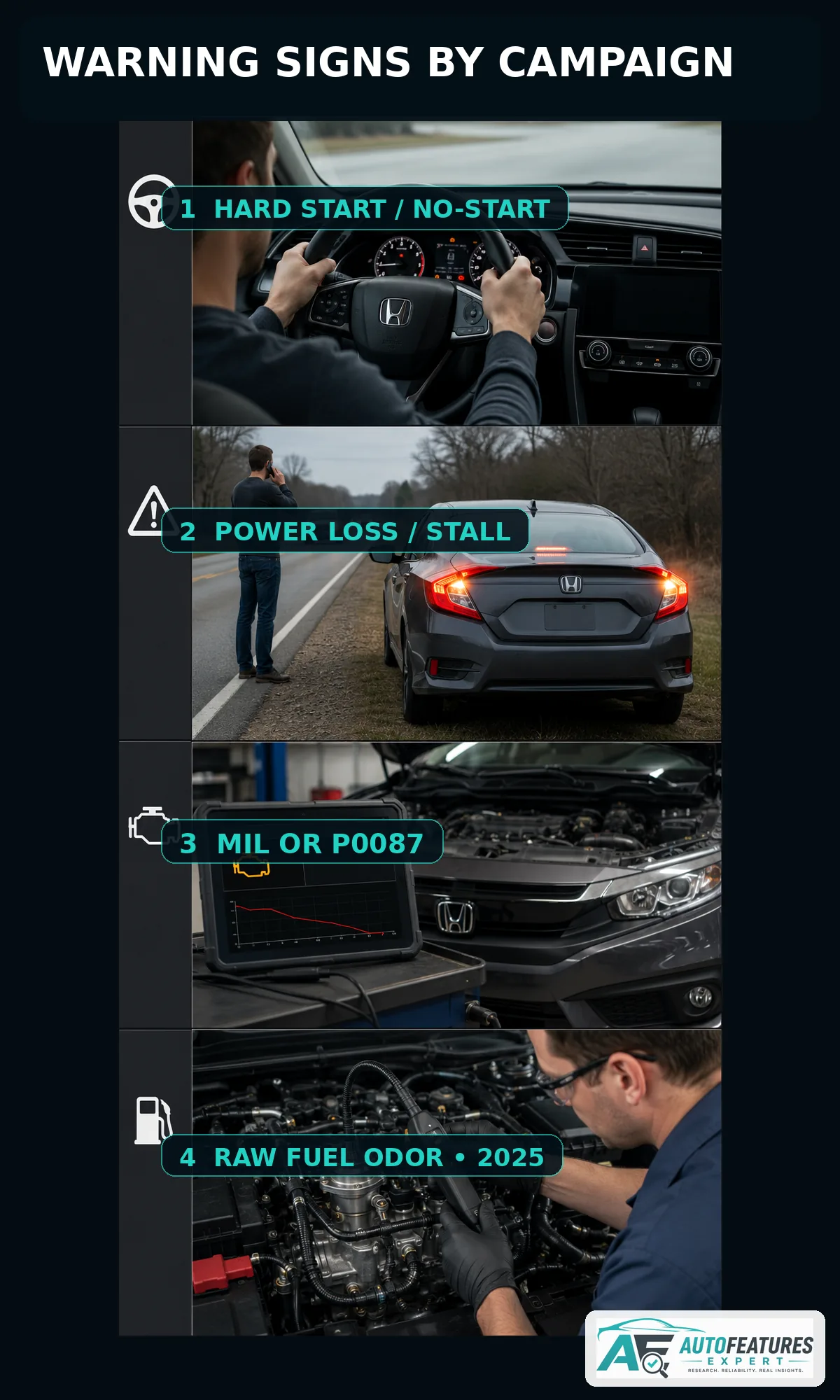
P0087 is not a recall confirmation. Low fuel pressure can have more than one cause. Honda’s 23V-858 bulletin tells dealers to apply the eligible recall procedure before pursuing unrelated repairs when the VIN and listed symptoms align. A failed injector, wiring fault, contaminated fuel, restricted supply or another pump problem requires its own diagnosis.
The 2025 high-pressure campaign has a different warning pattern. The Part 573 report identifies fuel odor while the vehicle is driven or idling. Treat persistent raw-gas odor or visible fuel seriously: shut the vehicle off in a safe open location, keep ignition sources away and ask the dealer whether towing is appropriate. Do not search for a leak with a flame, create sparks or attempt fuel-system work without the required equipment.
Can you drive a Civic with an open fuel pump recall?
A VIN showing an open recall should be scheduled for the free remedy even if the car currently runs normally. Campaign 23V-858 exists because an inoperative pump can stall the engine while driving. Campaign 24V-763 addresses fuel leakage and fire risk. Neither condition is something to postpone indefinitely.
If the Civic hesitates, loses power, stalls, becomes difficult to start, displays P0087 or smells strongly of raw fuel, contact the Honda dealer before driving it again. Ask whether Honda or the dealer will arrange towing. A service department can apply the current VIN-specific instructions and parts-availability rules.
If power is lost in traffic, turn on the hazard lights, keep firm control of the steering and brake pedal, and move out of the travel lane if it is safe to do so. Braking and steering assist may feel different with the engine off. Once stopped in a safe location, do not repeatedly restart a vehicle that smells of fuel or shows evidence of leakage; call roadside assistance.
How to check your Honda Civic VIN
- Find the 17-character VIN. Check the lower driver-side windshield, driver-door jamb, registration or insurance card.
- Use the official Honda recall lookup. Enter the complete VIN rather than searching only by year and model.
- Cross-check the NHTSA recall lookup. A VIN search shows open safety recalls reported to the federal system.
- Call a Honda dealer when the result is unclear. Ask the service department to perform an iN VIN status inquiry and identify the Honda campaign code and remedy bulletin.
- Save the result and repair order. Documentation matters when buying, selling or resolving a delayed status update.
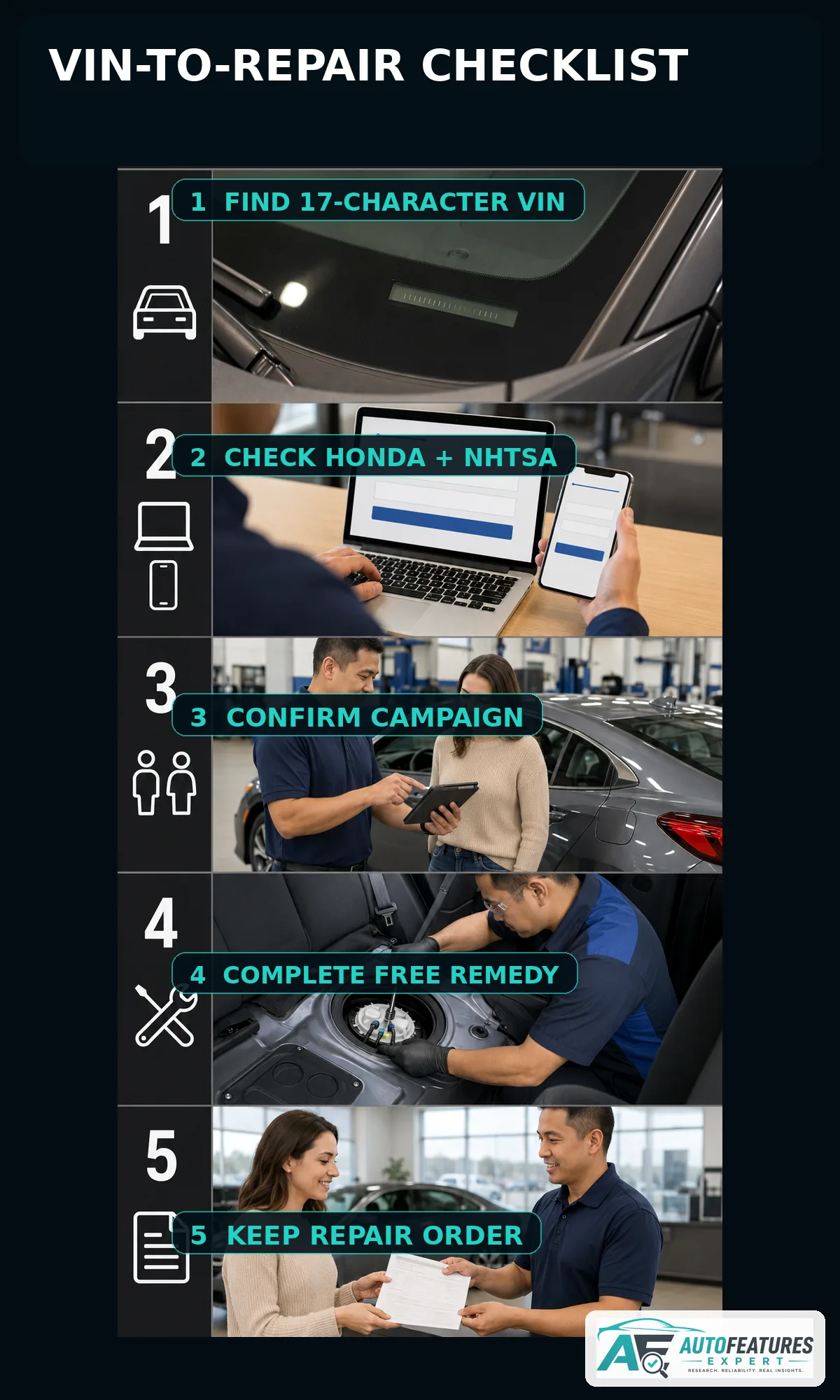
A lookup that shows no open recall can mean the VIN was never included, the remedy was already completed or the database has not yet reflected a recent change. Honda notes that a year/make/model search returns general campaigns that may affect only part of that population. The VIN result is the meaningful one.
How to interpret the recall lookup result
| Lookup result | What it usually means | What to do |
|---|---|---|
| Recall incomplete | The VIN is included and Honda has not recorded the remedy as complete | Call a dealer with the campaign number and schedule the free remedy |
| Remedy not yet available | The VIN is eligible, but the current record or local dealer cannot yet complete the repair | Ask the dealer to document the status, safety guidance, parts plan, towing policy and notification process |
| No unrepaired recalls | The VIN may be outside the population, already repaired or not yet synchronized across systems | Cross-check Honda and NHTSA; request the completed campaign record when purchase history matters |
| Campaign complete | The manufacturer has recorded a remedy for that campaign | Keep the repair order; investigate continuing symptoms as a separate fault rather than assuming the recall repair failed |
Take a screenshot or print the lookup result before the appointment. The service adviser should write the campaign number, inspection outcome, installed part or “no repair required” result on the final repair order. That record is more useful to a future buyer than a seller’s verbal statement that the recall was handled.
What if the car already received an earlier fuel pump repair?
Check again. Honda’s later 23V-858 bulletins explain that some vehicles may have been repaired using a fuel-pump service assembly containing an affected impeller. Do not assume an old invoice permanently clears the vehicle. The current VIN status tells the dealer whether another campaign repair is required.
After completion, keep the final repair order and recheck the VIN after the manufacturer has had time to report the remedy. If the campaign still shows open, contact the repairing dealer with the repair-order number rather than assuming the work failed.
What does the free recall repair include?
For eligible 23V-858 Civics, Honda’s remedy is replacement of the fuel pump motor with a properly manufactured part. The Civic service bulletin lists approximately 1.3 hours of flat-rate labor for two- and four-door vehicles and 1.4 hours for the five-door procedure. That is a warranty labor allowance, not a promise that the visit will take exactly that long; check-in, fuel handling, parts availability and shop scheduling can extend the appointment.
The technician accesses the in-tank module, installs the recall kit, reassembles the unit, pressurizes the system, checks for leaks, clears diagnostic codes and completes related calibration or documentation steps specified for the vehicle. Because the procedure exposes gasoline and requires special tools, it is not a suitable owner repair.
For eligible 24V-763 Civics, the dealer follows the high-pressure pump inspection and replacement instructions for that VIN. Do not accept an explanation that an in-tank recall repair automatically resolves the 2025 high-pressure leak campaign; they involve different parts.
How much does the recall repair cost?
The recall remedy is free at an authorized Honda dealer, regardless of whether the basic factory warranty has expired. A safety recall is tied to the affected vehicle, not only to the first owner. Owners should not be charged for the campaign’s required parts or labor.
If you previously paid to correct the same defect before the recall remedy was available, review the owner letter and ask Honda about reimbursement eligibility. Keep the original paid invoice, proof of payment and description of the replaced part. Reimbursement is fact-specific; an unrelated aftermarket pump repair is not automatically covered.
Parts availability and appointment preparation
Initial 23V-858 notices warned that replacement parts were limited and that symptomatic vehicles would be prioritized. Later Honda bulletins provide complete remedy procedures, but local inventory can still vary. Call with the VIN and ask the dealer to confirm both eligibility and that the correct kit is allocated before leaving the car.
Ask whether the fuel level should be below a stated amount and whether the rear seat or cargo area must be cleared. Honda’s procedure accesses the tank unit from inside the vehicle and includes precautions to reduce fuel spillage. Do not intentionally run a symptomatic car low on fuel merely to prepare for an appointment; request dealer instructions first.
Before pickup, review the repair order for the campaign number and verify that there is no fuel odor, warning light, hard start or abnormal fuel-gauge reading. If any of those symptoms begin immediately after service, stop and contact the dealer so the installation can be inspected.
Questions to ask when scheduling
- Which campaign code is open for this VIN: 23V-858, 24V-763 or an earlier linked campaign?
- Is the appointment for inspection only, a confirmed replacement or both?
- Is the correct VIN-specific kit physically allocated to the appointment?
- Should the fuel level be below a stated amount, and should the rear-seat or cargo area be cleared?
- Does Honda recommend driving, towing or dealer-arranged transport based on the symptoms?
- Will the dealer provide a loaner or alternate transportation if a leaking 2025 pump cannot be returned to service immediately?
- How and when will the completed campaign be reported to Honda’s VIN database?
What to verify after the repair
Start the Civic before leaving the dealer and confirm normal cranking, idle quality and fuel-gauge operation. Walk around the vehicle in an open area and note any fresh raw-fuel odor. The repair order should identify the recall, corrective action, completion date and mileage; for a high-pressure-pump inspection, it should state whether the pump passed or was replaced.
A completed recall does not guarantee that every starting, drivability or warning-light complaint is resolved. If the original symptom remains, return with the repair order and ask for a separate diagnosis. This distinction prevents an unrelated injector, electrical, ignition or fuel-delivery fault from being incorrectly attributed to a campaign that has already been completed.
Used Honda Civic buying checks
A seller’s statement that “the recall was done” is not enough. Check the VIN yourself before purchase and ask for the recall repair order. A history report is helpful, but the Honda and NHTSA systems are the authoritative starting points for open-recall status.
- Run the VIN through both recall tools on the day of inspection.
- Confirm whether the result refers to 23V-858, 24V-763 or another campaign.
- Request a cold start and scan for stored, pending and permanent diagnostic codes.
- Do not dismiss hesitation, a prolonged crank, P0087 or raw-fuel odor.
- Ask a Honda dealer whether an open remedy can be completed before the sale.
- Use an independent pre-purchase inspection to find non-recall fuel-system faults and other problems.
Recall history is only one part of a used-car evaluation. Our Honda Civic common problems guide covers other systems, while the Honda Civic years to avoid analysis explains broader year patterns. For generation and powertrain context, see Honda Civic generations.
Frequently asked questions
Are all 2018–2020 Honda Civics recalled for the fuel pump?
No. The public campaign summary includes 2018–2020 Civics, but Honda’s population was built from manufacturing and supplier records. Some vehicles are included and others are not. Later bulletins also list selected 2016, 2017 and 2021 applications. Only a VIN check confirms an open recall.
Why does my 2016 or 2021 Civic show the recall?
Honda’s later remedy bulletin covers certain 2016–2021 Civics and says some units may have been built with an affected motor or repaired using an affected fuel-pump service part. The current Honda VIN result takes priority over an older news article’s model-year summary.
Is the 2025 Civic recall the same defect?
No. NHTSA campaign 24V-763 concerns a high-pressure pump that may crack and leak. Campaign 23V-858 concerns an in-tank pump impeller that can deform and stop the pump. Both require a VIN check and free dealer remedy, but the components, hazards and repair procedures differ.
Does a check-engine light mean the recalled pump is failing?
Not by itself. Honda identifies the malfunction indicator lamp and P0087 as possible warnings for the in-tank pump issue, but many faults can turn on the light. Save the codes and freeze-frame data, check recall status and let the dealer follow the campaign procedure.
Can a dealer sell a used Civic with an open recall?
Federal stop-sale requirements apply to affected new vehicles in dealer inventory, while used-vehicle rules and practices differ. Regardless of seller type, an open safety recall should be disclosed and resolved as soon as the remedy is available. Confirm the VIN status and get any repair commitment in writing before purchase.
Does the fuel-pump recall depend on the factory warranty?
No. For an eligible VIN, Honda identifies the campaign inspection or replacement as a free recall remedy even when the basic warranty has ended or the current owner did not buy the car new. Ask Honda about reimbursement documentation if the same defect was repaired at the owner’s expense before the recall remedy became available.
How long does the Honda Civic fuel-pump recall repair take?
Honda’s Civic in-tank bulletin lists about 1.3 hours of warranty labor for two- and four-door cars and 1.4 hours for five-door cars. The 24V-763 owner notice says a required high-pressure-pump replacement may take approximately 2 hours 30 minutes. Inspection, check-in, parts allocation and shop workload can make the total appointment longer.
The Recall Result That Determines the Next Step
The headline year range is only a screening tool. Certain 2016–2021 Civics can fall under the in-tank pump campaign, and certain 2025 Civics can fall under a separate high-pressure pump leak campaign. Enter the VIN at Honda and NHTSA, then have a Honda dealer confirm the exact open campaign and repair.
Do not wait for a second stall, repeat hard start or persistent raw-fuel odor. An eligible recall repair is free, and Honda’s service information provides a defined remedy. For the larger ownership picture, compare the recall result with the car’s maintenance history and our Honda Civic reliability guide. If you are evaluating a turbo model, also review the separate Honda Civic oil dilution issue rather than treating every drivability symptom as a fuel-pump failure.
Sources
- NHTSA: Amended Part 573 Safety Recall Report 23V-858 (May 2024)
- Honda Service Bulletin 24-008: 2016–2021 Civic Fuel Pump Motor
- Honda Service Bulletin 24-027: 2017–2020 Civic Si Fuel Pump Motor
- Honda Service Bulletin 23-103: Civic campaign bulletin index
- Honda Service Bulletin 24-077: 2018–2019 JHM Civic Fuel Pump Motor
- NHTSA: Part 573 Safety Recall Report 24V-763
- Honda Service Bulletin 24-124: 2025 Civic High Pressure Fuel Pump Leak
- Honda Official Recall Lookup
- NHTSA VIN Recall Lookup
About This Article
Author: Alex Fric, Automotive Research Editor
Draft prepared: July 26, 2026
Last verified: July 31, 2026
Article type: Safety-recall guide, symptom triage and VIN-based owner decision support
Research scope: U.S.-market Honda Civic in-tank fuel-pump campaign 23V-858 and 2025 high-pressure fuel-pump campaign 24V-763, including affected-year screening, symptoms, dealer remedies, parts questions and used-buyer checks
Primary sources checked: NHTSA Part 573 reports for campaigns 23V-858 and 24V-763, American Honda Service Bulletins 23-103, 24-008, 24-027, 24-077 and 24-124, plus official Honda and NHTSA VIN-lookup resources
Reviewed by: Alex Fric — source verification and editorial review; no vehicle was examined and no dealer campaign record was independently accessed
AI use: AI-assisted tools supported SERP comparison, source organization, outline development and editing. They were not used as factual evidence; material claims were checked against the linked primary sources.
Correction/update history: First research draft prepared July 26, 2026. Reverified July 31, 2026 against the May 2024 amended 23V-858 filing, Honda bulletin 24-008 Version 4, campaign 24V-763 and Honda/NHTSA VIN resources. Added a campaign comparison, symptom triage, VIN-result decision table, appointment questions and recall-specific FAQ. Campaign scope, bulletin revisions, parts availability and VIN status must be rechecked during future updates.
Editorial limitation: Model-year ranges are screening information, not proof that an individual Civic is recalled. Current eligibility and remedy completion depend on the 17-character VIN and the latest Honda or NHTSA campaign record.







