Use this guide for
Differentiate Accord A/C condenser, compressor and refrigerant-loss questions before another recharge.
Boundary: Warm air alone does not identify the failed component or warranty eligibility.
Quick Answer: Honda Accord A/C problems deserve the closest warranty check on 2018–2020 models, because Honda extended eligible factory-defective condensers to 10 years with unlimited miles. That coverage is not a recall and does not automatically pay for a damaged condenser, compressor, evaporator or refrigerant line. Before approving parts, request a documented leak test, pressure readings, vent temperatures and a VIN eligibility inquiry from a Honda dealer.
Key Takeaways
- Priority years: 2018–2020 Accord and Accord Hybrid have the clearest model-specific risk signal because Honda issued condenser warranty extensions for eligible VINs.
- Coverage is narrow: the extension covers a qualifying factory-defective condenser leak—not every cause of warm air and not an automatically covered compressor.
- Diagnosis comes first: low refrigerant confirms that charge was lost; it does not identify where the system leaked.
- Current U.S. cost context: RepairPal estimates $122–$179 for A/C diagnosis, $558–$658 for an Accord condenser and $1,032–$1,549 for a compressor before taxes, location adjustments and related repairs.
- Used-buyer rule: verify the VIN with Honda, test the system after a heat soak and ask for the exact failed component in writing.
Honda Accord A/C Reliability and Risk Snapshot
| Question | Evidence-based answer |
|---|---|
| Highest inspection priority | 2018–2020 Accord and Accord Hybrid |
| Best-documented issue | Manufacturing-related condenser corrosion and refrigerant leakage on eligible vehicles |
| Honda coverage | 10 years from original purchase, unlimited miles, qualifying condenser only |
| Typical severity | Low immediate safety risk, but high comfort impact and potentially four-figure repair exposure |
| First diagnostic question | Is airflow weak, or is airflow strong but warm? |
| Buyer recommendation | Buy on documented diagnosis, VIN eligibility and repair history—not dashboard behavior alone |
This is an inspection-priority assessment, not a failure-rate table. Honda and NHTSA do not publish an Accord A/C survival curve by model year.
Why Accord Air Conditioning Can Blow Warm
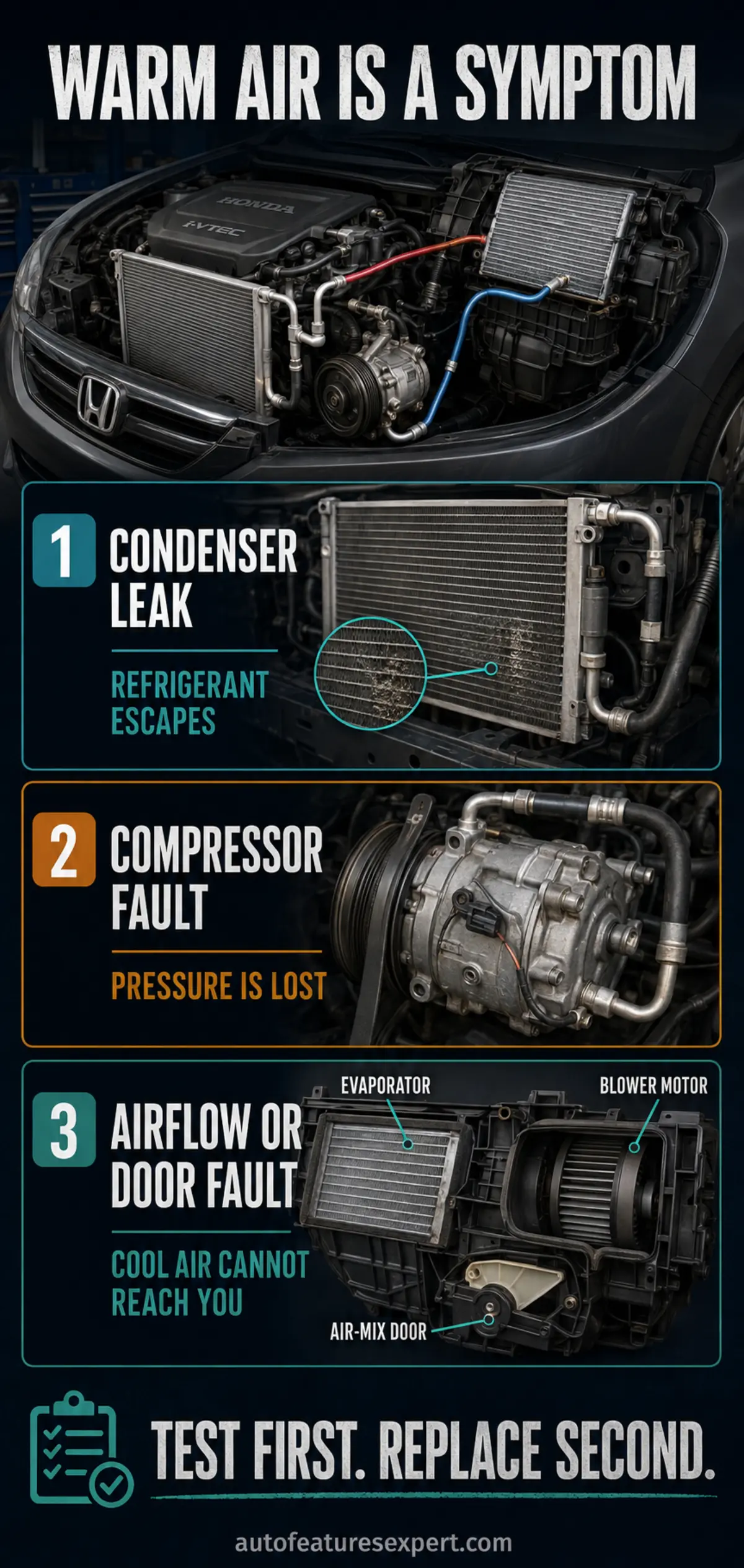
An automotive air conditioner is a sealed heat-transfer system. The compressor circulates refrigerant, the condenser releases heat at the front of the car, the expansion device lowers pressure and the evaporator absorbs cabin heat. Fans, temperature sensors, blend doors and electronic controls determine how that cooling reaches the vents.
Warm air therefore does not name a failed part. A small condenser pinhole, compressor seal leak, damaged line, evaporator leak, weak cooling fan, electrical fault or air-mix door problem can produce similar complaints. Even a clogged cabin air filter can make an otherwise cold system feel ineffective by restricting airflow.
Condenser leak
The condenser sits behind the front grille, where it receives airflow and road exposure. Honda’s 2018–2020 Accord bulletin identifies a specific manufacturing condition: corrosion can create tiny holes in condenser tube walls and release refrigerant. Honda instructs technicians to distinguish that condition from impact damage caused by stones or other foreign objects.
Compressor or compressor-seal problem
The compressor must create the pressure difference that moves heat out of the cabin. Internal wear, an electrical control fault, low refrigerant protection or a leak at the compressor can stop cooling. A noisy compressor, oily residue or abnormal pressure readings may point in this direction, but replacing the whole compressor without confirming the failure mode can turn a wrong diagnosis into a four-figure bill.
Do not import Civic or CR-V coverage into an Accord claim. Honda has issued model-specific compressor shaft-seal programs for certain other vehicles, but the 2018–2020 Accord campaign discussed here is a condenser warranty extension. A dealer must check the Accord’s VIN and failed component.
Evaporator, line or O-ring leak
The evaporator is inside the HVAC housing, so replacement can require substantial interior labor. Refrigerant lines and connection seals can also leak. Honda’s condenser bulletin specifically notes that O-ring or receiver/dryer-cap leaks are not covered by that bulletin. A leak elsewhere can exist at the same time as an eligible car, which is why model year alone cannot authorize a free repair.
Airflow or climate-control problem
If little air comes from the vents at any temperature, investigate the cabin filter, blower motor, resistor or control circuit before assuming a refrigerant problem. If one zone remains warm while another is cold, low charge can cause uneven evaporator cooling, but an air-mix actuator or door fault can create a similar split. Measured vent temperatures and a full system inspection separate these paths.
Which Honda Accord Years Have the Most Important A/C Warning?
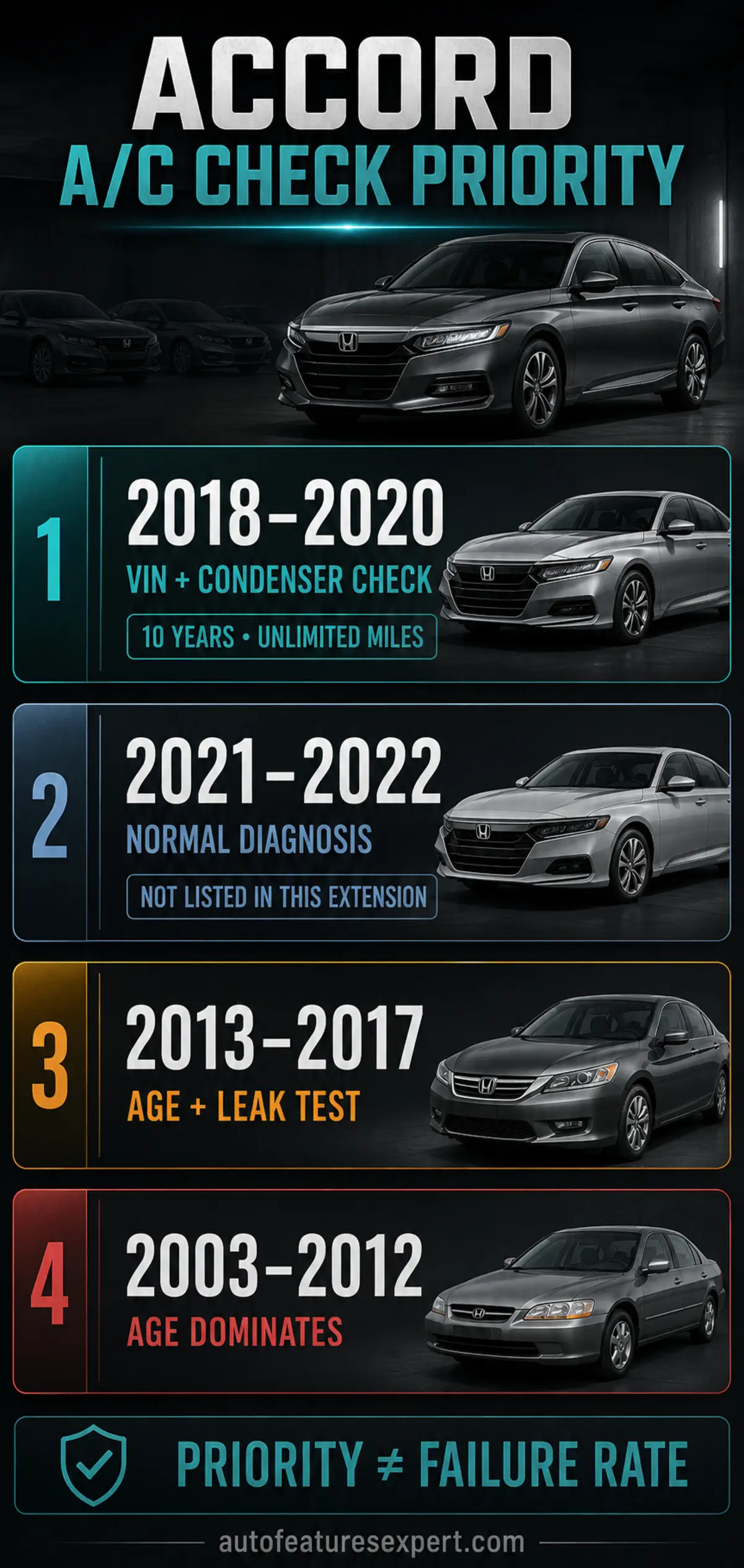
| Model years | What the evidence supports | Used-buyer action |
|---|---|---|
| 2018–2020 | Honda issued separate 10-year/unlimited-mile condenser warranty extensions for Accord and Accord Hybrid, subject to VIN and defect confirmation. | Highest priority: run the VIN, test cooling hot and review any condenser invoice. |
| 2021–2022 | Part of the same Accord generation, but not listed in Honda’s 2018–2020 condenser bulletins. | Inspect normally; do not assume the earlier extension applies. |
| 2013–2017 | No broad Accord condenser extension identified in the reviewed Honda/NHTSA documents. Age-related leaks, compressors and HVAC controls remain possible. | Demand a leak test and repair history; budget for normal out-of-warranty wear. |
| 2008–2012 | Greater component age raises ordinary seal, hose, clutch, relay and compressor exposure, but does not prove a model-year defect rate. | Test every mode and treat a recent “recharge” without a leak repair as unresolved. |
| 2003–2007 and older | Calendar age dominates. One contaminated or internally failed compressor can make system-wide repair more expensive. | Inspect refrigerant condition and ask whether the estimate includes contamination cleanup. |
| 2023–2026 | Lower age-related exposure so far; the reviewed 2018–2020 condenser extension does not apply by model year. | Use the new-vehicle warranty booklet and VIN-specific Honda information. |
The most defensible answer to “which years are worst?” is narrower than many ranking pages suggest. The 2018–2020 group deserves the strongest inspection and coverage attention because Honda documented a condenser manufacturing concern. That does not mean every example will fail, nor does it establish an Accord-wide compressor failure percentage.
Honda Accord A/C Problem Symptoms
- Strong airflow that slowly becomes warm: refrigerant loss, compressor control or freeze-up requires testing.
- Cold while moving, warmer at idle: inspect condenser airflow, cooling fans, refrigerant charge and pressures.
- Driver side warm, passenger side cold: low charge or an air-mix control problem can create uneven vent temperatures.
- Weak airflow at every temperature: check the cabin filter, blower and duct doors before opening the refrigerant circuit.
- Clicking behind the dashboard: an actuator or door mechanism may be hunting or binding.
- Grinding, squealing or rattling near the compressor: stop repeated testing and obtain mechanical diagnosis.
- Oily or fluorescent residue: refrigerant oil or diagnostic dye can help locate a leak, but the source must be confirmed.
- A/C works after recharge, then fades again: the system is probably losing refrigerant; another recharge is not a repair.
How a Proper Diagnosis Should Work
- Confirm the complaint. Record ambient temperature, humidity, vent temperature, fan speed, drive mode and whether the problem appears at idle or on the road.
- Separate weak airflow from warm airflow. This prevents an unnecessary refrigerant repair when the actual issue is a filter, blower or door.
- Scan all relevant modules. Climate-control and powertrain faults may affect compressor operation even when no check-engine light is visible.
- Inspect the complete system. Look for impact damage, oil or dye at the condenser, compressor, lines, joints and service ports.
- Recover and measure refrigerant correctly. Static pressure alone cannot prove the correct charge. A certified shop can recover, weigh and recharge to specification.
- Measure operating pressures and temperatures. High-side and low-side behavior, vent temperatures and condenser fan operation narrow the fault.
- Perform the Honda bulletin procedure when eligible. For a 2018–2020 Accord, the dealer should check iN VIN status and determine whether the condenser leak matches the covered manufacturing condition.
- Document the conclusion. The estimate should identify the leak location or failed circuit and explain why the proposed part solves it.
Expert Tip: Ask the shop to photograph the leak and list the recovered refrigerant amount. “Low refrigerant” is a finding; “condenser corrosion at the covered location” is a diagnosis.
Can you diagnose an Accord A/C system with a recharge can?
No. A retail gauge generally reads only one side of the system and cannot recover, weigh or identify contaminated refrigerant. Overcharging can reduce cooling or damage components, while venting refrigerant is prohibited. EPA rules require paid motor-vehicle A/C service to be performed by Section 609-certified technicians using appropriate recovery equipment.
Diagnostic clues are starting points—not parts orders
| Observed pattern | Systems to test first | What it does not prove |
|---|---|---|
| Cold at speed, warm at idle | Condenser fan operation, condenser airflow, charge level and high-side pressure | It does not automatically prove a bad compressor. |
| Cold for 10–20 minutes, then warm | Evaporator temperature, freeze-up, compressor command, clutch/control behavior and pressures when the fault occurs | A normal reading after the car cools down does not close the diagnosis. |
| One side warmer than the other | Recovered charge, left/right vent temperature, air-mix actuators and door calibration | It does not prove a blend-door actuator without refrigerant testing. |
| No blower at some or all speeds | Fuse, blower motor, resistor/control module, wiring and climate-control command | It does not indicate a condenser leak. |
| Rapid compressor cycling | Charge quantity, pressure sensor data, ambient conditions and compressor command | Cycling by itself cannot identify the leak location. |
| Noise only with A/C requested | Compressor, pulley/bearing, belt drive, refrigerant charge and mounting | It does not justify replacing the condenser as a package. |
A good technician tries to reproduce the exact complaint. If the fault appears only after a highway drive, in stop-and-go traffic or above a certain ambient temperature, a five-minute inspection in a cool service bay may miss it. Leave written conditions with the shop and ask it to record measurements while the failure is active.
Honda Accord A/C Repair Cost
These July 2026 RepairPal estimates are national planning figures, not guaranteed quotes. Taxes, refrigerant type, labor rate, engine or hybrid configuration, contamination and related parts can change the final invoice.
| Service | Current estimated range | What can change the bill |
|---|---|---|
| A/C diagnosis or leak inspection | $122–$179 | Dye circulation time, repeat testing and dealer campaign procedure |
| Recharge | $257–$342 overall; 2018–2023 examples may be about $307–$410 | Refrigerant type, recovered quantity and leak repair |
| Condenser replacement | $558–$658 overall; many 2018–2022 estimates are $625–$762 | Coverage eligibility, grille damage, refrigerant and seals |
| Compressor replacement | $1,032–$1,549 overall; 2018–2022 estimates can reach $1,291–$1,706 | Engine, hybrid hardware, contamination and additional components |
| Evaporator replacement | $840–$1,137 overall; 2018–2020 estimates are $1,085–$1,497 | Dashboard/HVAC case labor and refrigerant service |
| Expansion valve | $399–$544 overall | Access and whether evaporator work overlaps |
| Refrigerant line | $702–$803 overall | Line location, corrosion, seals and recharge |
A covered condenser can reduce the owner’s cost substantially, but eligibility must be established before repair. If a quote includes both condenser and compressor, ask for separate evidence and line-item pricing for each. One covered component does not make every item on the estimate free.
How to read an A/C repair estimate
An itemized estimate should distinguish diagnosis, refrigerant recovery, failed component, required seals or dryer, oil, recharge and post-repair performance test. The quote should also say whether the compressor failed mechanically or merely stopped being commanded because charge was low. That distinction affects both price and the risk of contamination.
If a compressor failed internally and sent metal or degraded oil through the circuit, replacing only the compressor may lead to repeat failure. The shop may recommend a condenser, expansion device, dryer and flushing where Honda service information and component design allow it. Ask to see the evidence of debris and the exact cleanup procedure. Conversely, a clean condenser pinhole does not justify a compressor automatically.
Also compare warranties, not just totals. A lower-cost remanufactured compressor with short labor coverage may be a worse value than a new or quality replacement with a stronger parts-and-labor warranty. On a hybrid Accord, confirm that the shop is qualified for the vehicle’s electrically driven compressor and is using the specified nonconductive oil; cross-contamination can damage high-voltage compressor insulation.
Dealer or independent A/C specialist?
Start with an authorized Honda dealer when a 2018–2020 VIN may qualify for the condenser extension, because the dealer can access campaign status and submit the warranty claim. For an uncovered repair, a reputable Section 609-certified independent specialist can be competitive, provided it has the correct R-1234yf equipment and Honda-capable diagnostics. If the first diagnosis is expensive or names multiple major components, a second opinion is reasonable before the system is opened.
2018–2020 Accord A/C Condenser Warranty Extension
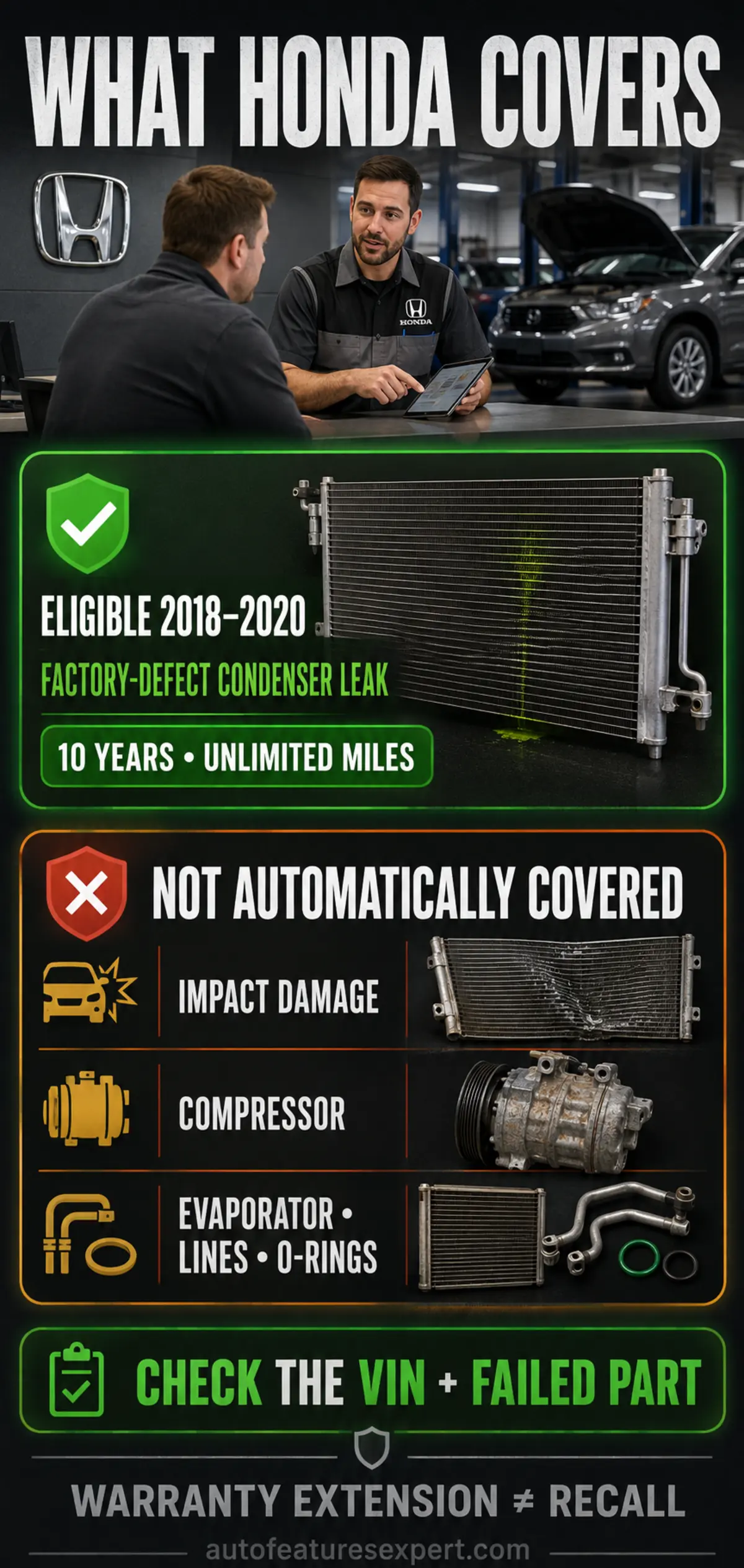
American Honda Service Bulletin 21-018 covers eligible 2018–2020 non-hybrid Accord trims. Bulletin 21-015 addresses eligible 2018–2020 Accord Hybrid vehicles. Both programs extend the A/C condenser warranty to 10 years from the original purchase date with unlimited miles.
The bulletin language matters. Coverage applies when the original condenser was not manufactured to specification and a qualifying corrosion or manufacturing-condition leak is confirmed. It does not cover a condenser punctured by road debris. Honda also instructs dealers to check the vehicle’s iN VIN status; the year and model are not a substitute for that inquiry.
Does the extension transfer to a used owner?
Honda’s owner communication for the Accord Hybrid states that the extension provides coverage to the original owner and subsequent owners. A used buyer should still verify the exact VIN, original in-service date, title history and current campaign status with an authorized Honda dealer.
Is the Accord A/C compressor covered for 10 years?
Not by the condenser extension. Bulletin 21-018 and the parallel Hybrid program cover the specified condenser defect. A compressor, compressor seal, evaporator, hose, O-ring, control module or collision-damaged condenser requires its own warranty basis. Depending on age and repair history, normal new-vehicle, replacement-part, service-contract or goodwill coverage may apply, but it must be verified separately.
What about refrigerant coverage?
Honda’s 2020 U.S. warranty booklet says A/C refrigerant is covered for the first 2 years or 24,000 miles unless it is required as part of another warranty repair. Under the qualifying condenser extension, the bulletin’s repair procedure includes evacuation and recharge. An out-of-warranty recharge by itself is not a promise that Honda will pay for a leak elsewhere.
Recall vs Warranty Extension vs Technical Service Bulletin
| Program | Purpose | How it applies here |
|---|---|---|
| Safety recall | Corrects a safety defect or noncompliance; open recalls can be checked through NHTSA by VIN. | The reviewed Accord condenser program is not a safety recall. |
| Warranty extension | Extends time or mileage coverage for a defined condition and component. | Eligible 2018–2020 Accord condensers: 10 years, unlimited miles, qualifying defect only. |
| Technical service bulletin | Gives technicians diagnostic, repair or campaign instructions. | Bulletins 21-018 and 21-015 explain inspection, eligibility and condenser replacement. |
A TSB does not automatically mean free work, and a warranty extension is not an open-ended A/C warranty. NHTSA’s public recall lookup is essential for safety campaigns, but Honda dealer VIN inquiry is the more relevant eligibility check for this condenser warranty extension.
How to Reduce Future A/C Repair Risk
- Run the A/C periodically, including during cooler months, so seals receive normal lubrication.
- Replace a clogged cabin air filter when inspection or the Maintenance Minder calls for it.
- Keep leaves and debris away from the cowl and visible condenser area without bending fins.
- Investigate declining cooling early instead of repeatedly adding refrigerant.
- After front-end impact or grille damage, inspect the condenser before assuming a factory defect.
- Use the refrigerant and oil specification shown on the under-hood label; do not mix products or use stop-leak.
- Keep every invoice, including vent temperatures, recovered charge, leak location and installed part number.
Owner Experience: What Reports Can and Cannot Tell Us
Owners commonly describe warm air, uneven left-right cooling, a temporary improvement after recharge and uncertainty over whether a dealer diagnosis qualifies for extended coverage. Those patterns are useful for building inspection questions. They are not a denominator-based failure study and cannot establish the percentage of Accords affected.
The strongest conclusion comes from Honda’s own action: eligible 2018–2020 condensers received extended coverage for a defined manufacturing condition. Individual stories remain secondary. An owner whose condenser was replaced free and another whose compressor was denied can both be accurate because the diagnosed components and warranty bases are different.
Expert Analysis
The Accord A/C search results have a component-identification problem. Many pages treat “condenser,” “compressor” and “recharge” as interchangeable answers. They are not. The warranty creates an additional trap: because a 2018–2020 Accord may be eligible, owners can assume any warm-air complaint is free. Honda’s procedure requires the opposite—first establish VIN eligibility, then prove that the condenser has the covered type of leak.
For used-car evaluation, this makes 2018–2020 neither an automatic avoid nor an automatic bargain. A vehicle with a documented Honda condenser repair, consistently cold vent temperatures and no remaining leak can be preferable to an apparently untouched car that was recharged before sale. Repair quality and evidence matter more than a checkbox saying “A/C works today.”
Before You Buy a Used Honda Accord
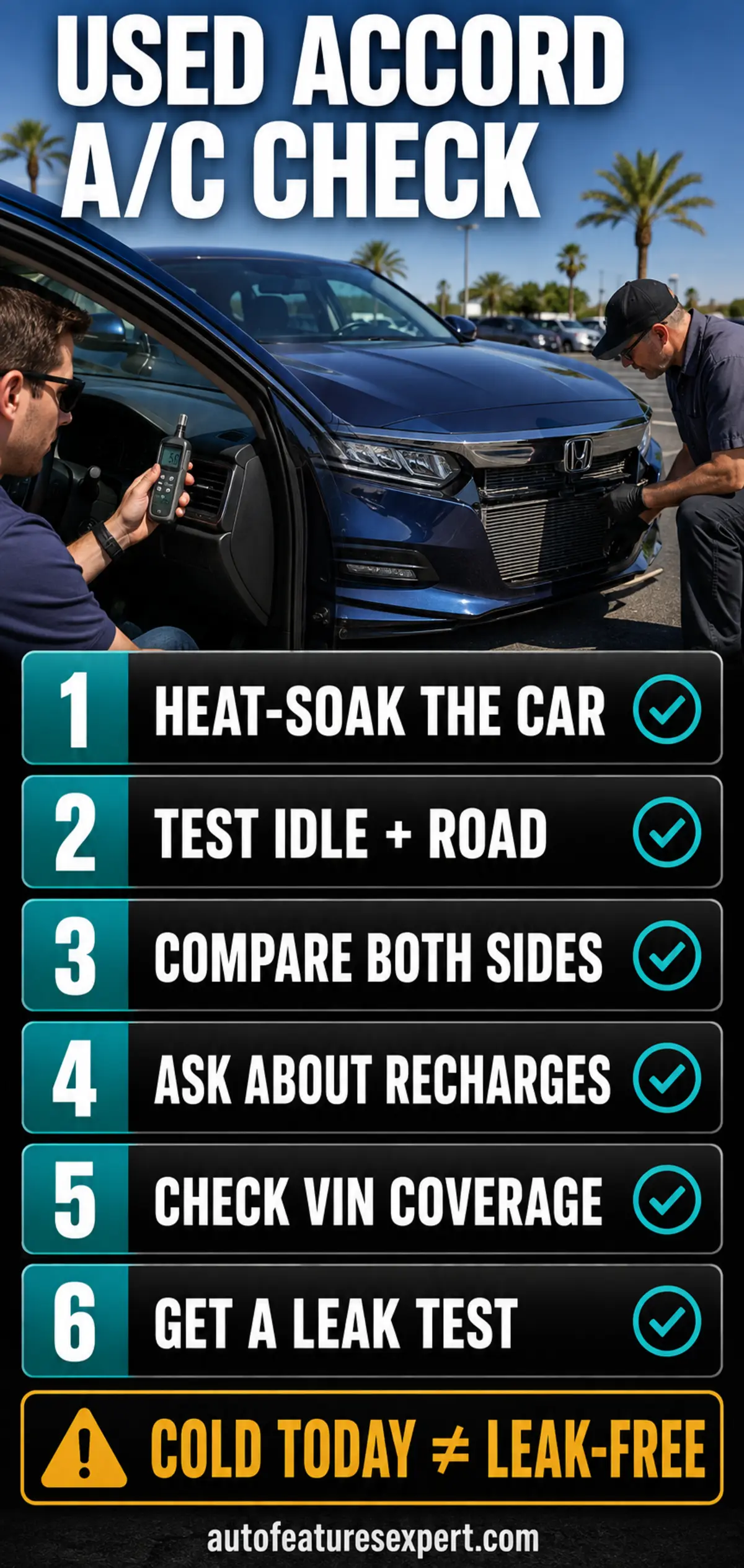
- Start the test after the car has heat-soaked, not first thing in a cool morning.
- Measure center-vent temperature with MAX A/C and recirculation selected.
- Test at idle and during a road drive; note whether cooling changes with speed.
- Compare driver and passenger vent temperatures on dual-zone cars.
- Confirm strong airflow at every blower speed and listen for actuator clicking.
- Inspect the visible condenser face for impact damage, oily residue or bent fins.
- Ask whether refrigerant was recently added and demand the leak diagnosis.
- For 2018–2020, have a Honda dealer run the VIN for the condenser extension.
- Review invoices for condenser, compressor, evaporator or line replacement.
- Make the purchase contingent on a professional inspection if cooling is marginal.
Buying Advice by Situation
2018–2020 with cold A/C and no repair record
Verify VIN eligibility and test thoroughly. Lack of a repair invoice is not proof of a pending failure, but it means the buyer should understand the remaining time from the original purchase date and the narrow coverage terms.
2018–2020 with a documented condenser replacement
Confirm that the work was completed by Honda or with a traceable part number, then test the complete system. A condenser repair does not prove that the compressor, evaporator and controls are healthy, but a clean invoice removes an important unknown.
Any year with a recent recharge
Treat “recently recharged” as an unresolved question unless the invoice identifies and repairs the leak. Refrigerant is not normally consumed like engine oil. A sealed system that repeatedly becomes low needs diagnosis.
Any year with warm air or compressor noise
Do not accept a seller’s estimate or deduct only the price of refrigerant. Make the deal conditional on a qualified inspection, or price for the credible worst case—including compressor contamination or labor-intensive evaporator work.
Related Honda Accord Guides
- Honda Accord Years to Avoid
- Honda Accord CVT Problems
- Honda Accord Oil Dilution
- Honda Accord 1.5T Head Gasket Failure
- Honda Accord Hybrid Battery Life
Frequently Asked Questions
Which Honda Accord years have the A/C condenser warranty extension?
Honda’s U.S. bulletins cover eligible 2018–2020 Accord and Accord Hybrid vehicles. The condenser warranty is extended to 10 years from the original purchase date with unlimited miles. A Honda dealer must confirm VIN eligibility and verify that the leak results from the covered manufacturing condition.
Is the Honda Accord A/C problem a recall?
The 2018–2020 condenser program is a warranty extension, not a safety recall. It covers a defined component and condition within the extended term. Use NHTSA’s VIN tool for open safety recalls and ask a Honda dealer to check iN VIN status for the condenser campaign.
Does Honda’s 10-year A/C warranty cover the compressor?
Not under the Accord condenser extension. Bulletins 21-018 and 21-015 cover a qualifying factory-defective condenser leak. Compressor, evaporator, line, O-ring, control and impact-damage repairs need their own warranty basis. Ask the dealer to identify the failed component and coverage decision in writing.
How much does a Honda Accord A/C compressor cost?
RepairPal’s July 2026 national estimate is $1,032–$1,549 before taxes and location adjustments. Estimates for many 2018–2022 Accords are about $1,291–$1,706. Contamination, refrigerant service and related component replacement can increase the total, so obtain a VIN-specific, itemized quote.
Why is one side of my Accord cold and the other side warm?
Uneven temperatures can result from low refrigerant causing uneven evaporator cooling, or from an air-mix door, actuator, sensor or control problem. The temperature split alone cannot identify the cause. Compare vent temperatures and request refrigerant and climate-control testing before replacing an actuator or major A/C component.
Can I keep driving when the Accord A/C blows warm?
Warm cabin air alone usually does not prevent driving, but abnormal compressor noise, belt smoke, overheating or an electrical burning smell requires prompt attention. Continued compressor operation during a mechanical failure can spread debris or affect the drive belt on some configurations. Turn the A/C off and obtain diagnosis.
Will adding refrigerant fix an Accord A/C leak?
A correct recharge may temporarily restore cooling, but it does not seal the leak that allowed refrigerant to escape. The system should be recovered, measured, leak-tested, repaired and recharged to the under-hood specification. Avoid stop-leak products because they can contaminate service equipment and complicate repair.
Sources
- American Honda Service Bulletin 21-018: 2018–2020 Accord A/C Condenser Warranty Extension
- American Honda Owner Notice: 2018–2020 Accord Hybrid A/C Condenser
- American Honda Multi-Model Condenser Warranty Extension Announcement
- Honda 2020 U.S. Warranty Basebook
- NHTSA Recall Lookup
- U.S. EPA Section 609 Motor Vehicle A/C Certification
- RepairPal Honda Accord A/C Diagnosis Cost
- RepairPal Honda Accord A/C Condenser Replacement Cost
- RepairPal Honda Accord A/C Compressor Replacement Cost
- RepairPal Honda Accord A/C Evaporator Replacement Cost
How We Evaluated This Accord A/C Guide
Auto Features Expert reviewed Honda’s model-specific service bulletin, owner communication and warranty booklet; NHTSA-hosted manufacturer records; EPA refrigerant-service requirements; and July 2026 repair-cost estimates. We separated confirmed coverage from ordinary age-related possibilities and used owner discussions only to identify questions worth testing—not to calculate failure rates.
The year guidance ranks inspection priority by the strength of official documentation, calendar age and potential repair exposure. It does not label every car in a model year defective. Warranty eligibility, repair cost and the correct failed component remain VIN- and diagnosis-specific.







