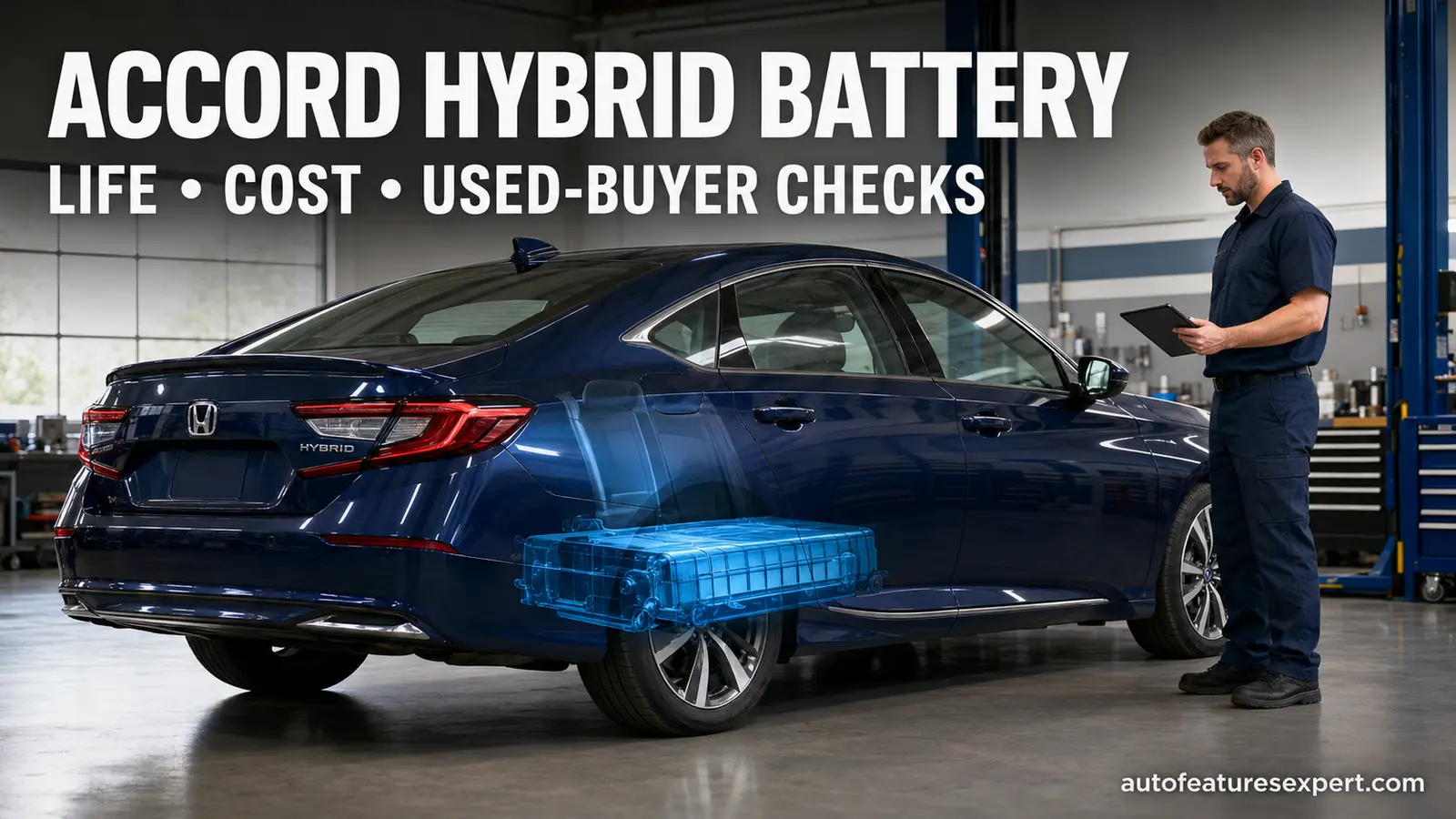
Use this guide for
Evaluate Accord hybrid-battery life, warranty context, failure signs and used-car evidence by generation.
Boundary: A dashboard state-of-charge display is not a remaining-capacity test, and generations should not be treated as one battery system.
Honda Accord hybrid battery life is not governed by a fixed replacement interval. Honda covers greater-than-normal high-voltage battery degradation for 8 years/100,000 miles on recent U.S. models, with 10 years/150,000 miles for certain California-emissions vehicles. A healthy pack can remain serviceable beyond warranty, but Honda publishes no Accord-specific survival curve. For used buyers, battery age, diagnostic codes, temperature behavior, service history and an HDS-capable inspection matter more than mileage alone.
Key Takeaways
- Warranty is not a replacement schedule. Reaching eight years or 100,000 miles does not mean the traction battery is due for automatic replacement.
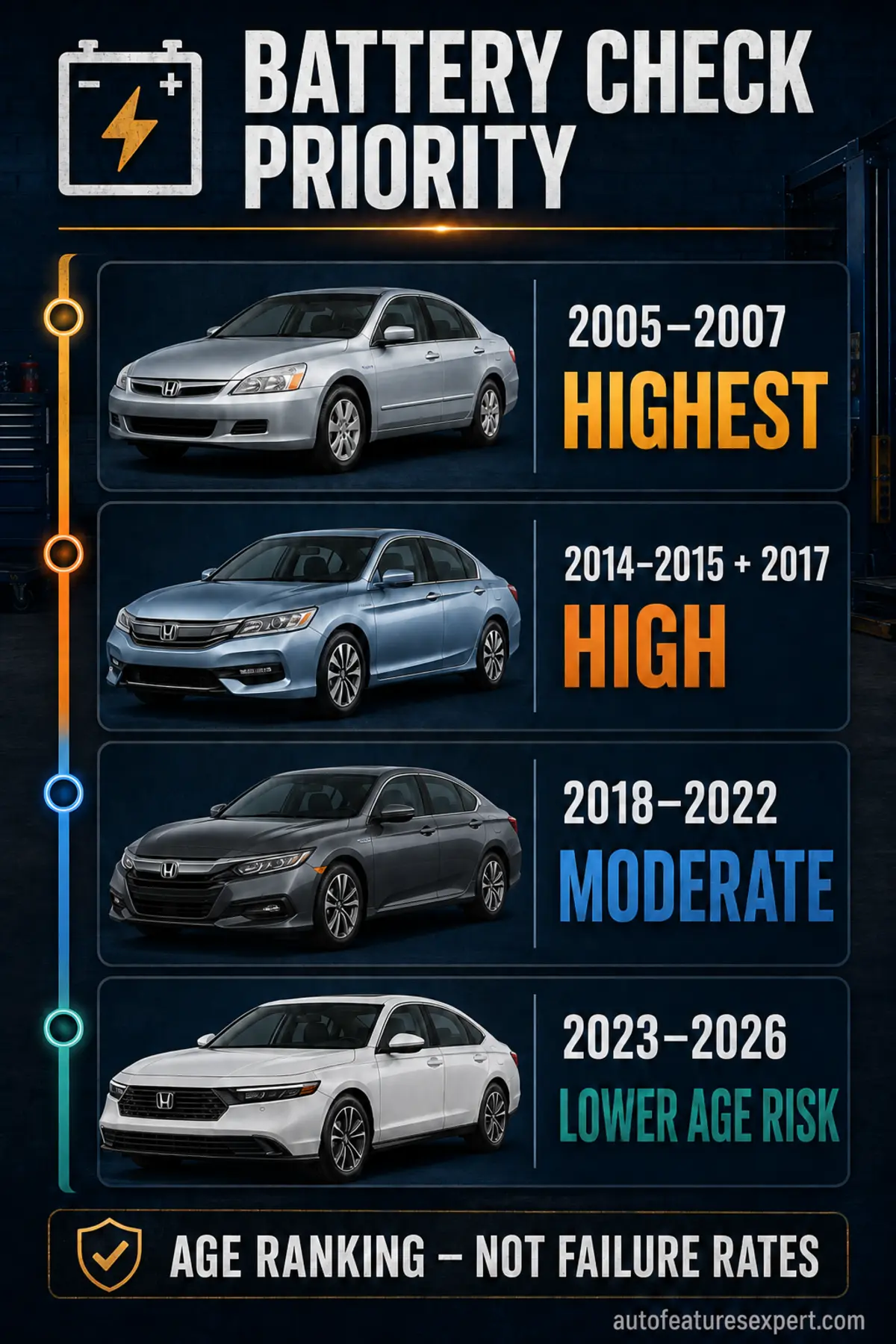
- Age changes the inspection priority. The 2005–2007, 2014–2015 and 2017 Accord Hybrids deserve the closest battery checks because their packs are now the oldest, not because Honda publishes a higher failure rate for those years.
- Budget with current quotes. RepairPal’s July 2026 estimate is about $4,184–$4,412 for an Accord high-voltage battery replacement, while remanufactured alternatives may cost less but carry different cell, core and warranty terms.
- Do not diagnose from fuel economy alone. Weather, tires, trip length, cabin heat or air conditioning, engine maintenance and driving speed can all change MPG.
- Separate the batteries. A dead 12-volt battery can leave an Accord Hybrid unresponsive even when the high-voltage pack is healthy.
- Check by VIN. Warranty coverage, California-emissions eligibility, recalls and campaigns vary by model year, state and individual vehicle.
Honda Accord Hybrid Battery Reliability and Cost Snapshot
| Question | Practical answer for a U.S. used buyer |
|---|---|
| Published replacement interval | None. Honda does not instruct owners to replace a healthy high-voltage pack at a fixed age or mileage. |
| Base capacity coverage on recent models | 8 years/100,000 miles for greater-than-normal degradation; gradual capacity loss is expected and excluded. |
| Possible California-emissions coverage | 10 years/150,000 miles for the hybrid battery on eligible vehicles; confirm the exact vehicle, registration history and warranty booklet. |
| Current planning cost | About $4,184–$4,412 in RepairPal’s national estimate; actual OEM, remanufactured and used-pack quotes vary. |
| Highest inspection priority | 2005–2007, 2014–2015 and 2017 because of calendar age and reduced remaining warranty, not a verified failure-rate ranking. |
| Buyer recommendation | Buy on documented battery condition, VIN coverage and a hybrid-capable inspection—not a dashboard charge gauge or seller promise. |
Risk label: Low to moderate for a properly operating recent Accord Hybrid still under applicable coverage; moderate to high financial exposure for an older car that has no diagnostic report and is priced without a battery reserve. This is a cost-risk assessment, not a prediction that a particular pack will fail.
First Identify the Battery: 12-Volt vs. High-Voltage Pack
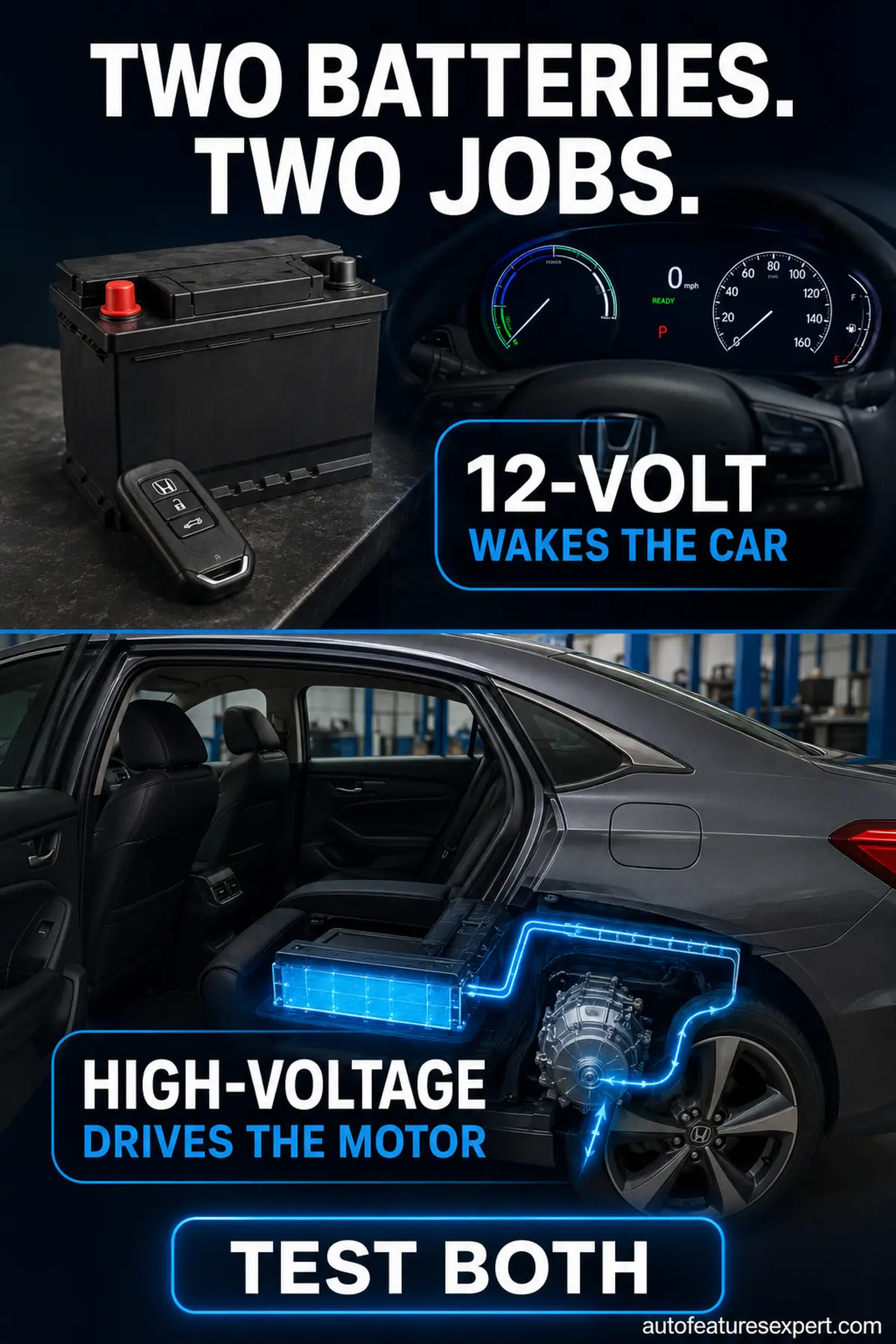
The Accord Hybrid has two battery systems with different jobs. The small 12-volt battery wakes the vehicle’s computers, closes the high-voltage contactors and powers ordinary electronics. The high-voltage traction battery stores regenerative-braking energy and supplies the electric drive motor. A no-start, dark dashboard or inoperative key fob can therefore originate with the 12-volt system rather than an expensive traction pack.
| Clue | More consistent with 12-volt trouble | More consistent with high-voltage system trouble |
|---|---|---|
| Vehicle response | Dark or flickering displays, locks or accessories inoperative | Vehicle powers on but shows a POWER SYSTEM or hybrid-system warning |
| Diagnostic evidence | Low-voltage and communication codes across several modules | Battery-specific codes such as P0A7F or P0A80 after full-system diagnosis |
| Driving behavior | Usually normal after the correct 12-volt fault is repaired | Reduced assist, rapid state-of-charge movement, limited power or engine running more often |
| Typical cost class | Hundreds of dollars | Potentially several thousand dollars |
Do not approve a traction-battery replacement from symptoms alone. A failing 12-volt battery, cooling fan, temperature sensor, control module, inverter or wiring fault can produce overlapping warnings. The stored diagnostic codes and Honda service procedure should identify the failed system.
How the Accord Hybrid Battery Changed by Generation
“Accord Hybrid” covers several substantially different systems. The first U.S. version used Honda’s Integrated Motor Assist system with a nickel-metal hydride pack. Later cars use lithium-ion batteries and Honda’s two-motor hybrid architecture. Parts, scan data and replacement options are not interchangeable across these groups.
| U.S. model years | System | 2026 inspection priority | What matters most |
|---|---|---|---|
| 2005–2007 Accord Hybrid | V6 IMA, nickel-metal hydride | Highest | Pack age, IMA codes, previous rebuild quality, cooling path and availability of a warranted replacement |
| 2014–2015 Accord Hybrid | Two-motor hybrid, lithium-ion | High | Battery data, cooling, service history and an exact installed quote before purchase |
| 2014 Accord Plug-In Hybrid | Plug-in system with a larger 6.7-kWh lithium-ion pack | Separate case | VIN eligibility for the battery campaign and 12-year/200,000-mile extension; do not apply regular-Hybrid prices |
| 2017 Accord Hybrid | Updated two-motor hybrid, lithium-ion | High | Age, code history, state-of-charge behavior and replacement availability |
| 2018–2022 Accord Hybrid | Third-generation two-motor system, lithium-ion | Moderate | Remaining warranty, recall completion, scan data and collision or water history near hybrid components |
| 2023–2026 Accord Hybrid | Fourth-generation two-motor system, lithium-ion | Lower age risk | Factory coverage and open VIN recalls, including the 2023–2025 ICM software campaign |
Honda’s 2004 technical release identifies the 2005 model’s nickel-metal hydride pack, while the company’s later press materials document lithium-ion batteries in the 2014 and 2018 systems. Honda’s current two-motor design uses a compact lithium-ion Intelligent Power Unit. The important buying lesson is simple: obtain a quote for the exact VIN and pack, not merely “an Accord Hybrid battery.”
How Long Does a Honda Accord Hybrid Battery Last?
There is no defensible single expiration mileage. Honda’s warranty documents acknowledge gradual capacity loss, but they do not publish a mandatory replacement age or an Accord-specific table showing what percentage of packs survive to 100,000, 150,000 or 200,000 miles. The widely repeated “8–10 years” estimate is a planning shorthand, not a factory deadline.
Calendar age deserves at least as much attention as odometer mileage. A 2014 car with 55,000 miles still has a battery that has experienced more than a decade of time, temperature exposure and storage cycles. Conversely, a later high-mileage highway car may have accumulated mileage quickly without spending as many years in heat. Neither example can be approved without diagnostic evidence.
Factors that can shorten useful battery life
- Heat exposure: sustained high battery temperatures accelerate chemical aging. Honda warns that extreme high temperatures can affect the high-voltage battery.
- Blocked cooling airflow: luggage, covers, pet hair, dust or liquid near an intake can restrict cooling. Honda owner guidance says not to obstruct the battery air intake.
- Long storage: Honda’s 2025 manual advises driving more than 30 minutes at least once every three months to maintain charge during infrequent use.
- Water or collision damage: repairs near the rear seat, trunk, underbody or orange high-voltage cabling require careful inspection.
- Poor prior repair quality: a weak-module replacement may temporarily clear a code without restoring balance across an aged pack.
What does not prove a failing battery
Lower winter MPG, the gasoline engine running for cabin heat, a full charge gauge after a downhill section, reduced regeneration when the pack is full, or a charge display that moves during normal driving can all be normal. Treat these as context. A battery diagnosis needs codes, data under load, temperature information and a repeatable symptom.
Honda Accord Hybrid Battery Failure Symptoms
No single symptom proves the pack needs replacement. The following pattern becomes more meaningful when several signs occur together and the diagnostic system stores relevant faults:
- POWER SYSTEM, IMA, check-engine or “stop driving when safe” messages
- P0A7F, P0A80 or other battery-system codes confirmed with an appropriate scanner
- State of charge repeatedly moving from high to low unusually quickly under similar conditions
- Noticeably reduced electric assist or power limitation
- The engine running more often after weather, route and accessory use are controlled
- A battery cooling fan that runs loudly or persistently
- A repeatable fuel-economy decline that remains after tire, brake, engine and climate-control causes are excluded
If the vehicle reports loss of drive power, a red warning or an instruction to stop, move to a safe location and follow the owner’s manual. Continuing to drive a high-voltage fault can leave the car unable to move. Never open the battery enclosure or touch orange high-voltage components without the required training and protective equipment.
How to Test a Used Accord Hybrid Battery
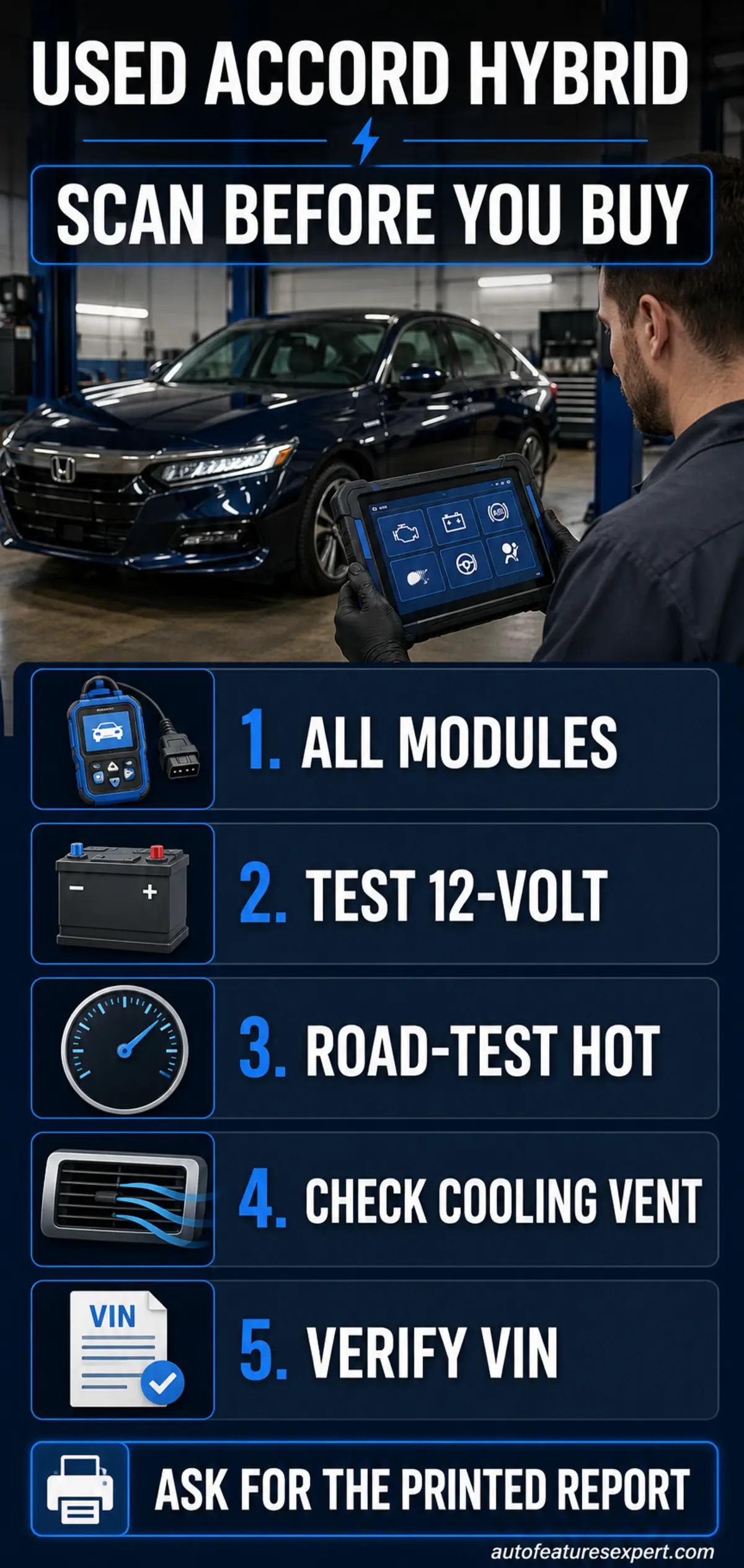
A dashboard charge meter is not a battery-health certificate. It shows managed state of charge, not total remaining capacity. Likewise, a generic code reader may see engine codes while missing hybrid-control modules. Ask a Honda dealer or qualified hybrid specialist for a written inspection that identifies the scan platform and findings.
- Scan every relevant module before clearing anything. Preserve diagnostic trouble codes, pending codes, freeze-frame data and readiness status. Recently reset monitors are a reason to delay the purchase until the car has completed normal drive cycles.
- Test the 12-volt battery first. Low system voltage can create misleading communication faults and warning lights.
- Review battery data during charge and discharge. A technician should evaluate voltage consistency, temperature sensors, state-of-charge behavior and the applicable Honda diagnostic procedure. Consumer apps that display a generic “health percentage” are not automatically equivalent to Honda’s warranty determination.
- Road-test from cold to full operating temperature. Include city acceleration, steady cruising and regenerative deceleration. Watch for warnings, abrupt power changes and abnormal fan operation.
- Inspect the cooling path. Confirm that the intake is unobstructed and that there is no evidence of liquid, debris or improper trim installation.
- Check repair and campaign history. Ask for Honda dealer records, battery invoices, part numbers and the transferable warranty on any replacement pack.
- Run the VIN through Honda and NHTSA. Open recalls should be corrected at no charge, but recall completion does not certify battery capacity.
Expert Tip: Ask the shop to state in writing whether it tested the high-voltage battery, the 12-volt battery or both. “Battery tested good” is too vague for a hybrid purchase.
Honda Accord Hybrid Battery Replacement Cost
RepairPal’s national estimate, updated July 25, 2026, places an Accord high-voltage battery replacement at $4,184–$4,412, including an estimated $488–$716 in labor and about $3,696 in parts. Taxes, location and related repairs are excluded. Current specialist listings show that remanufactured or alternative packs can be cheaper, but the advertised price may depend on a refundable core, local installation and a shorter warranty.
| Option | Cost position | Main advantage | Main risk to verify |
|---|---|---|---|
| New OEM or Honda-authorized assembly | Usually highest | Known fit, factory procedure and dealer support | Exact part availability, labor, programming and replacement-part warranty |
| Honda remanufactured part | Model- and supply-dependent | Factory-channel documentation may be easier | Whether the quote is truly remanufactured and what the warranty covers |
| Independent remanufactured pack | Often below dealer replacement | Can make an older car economical to keep | Cell age, balancing process, core charge, installer coverage and nationwide warranty terms |
| Used salvage pack | Potentially lowest | Lower upfront cost | Unknown age, storage, donor mileage, water/collision history and limited warranty |
| Module-level repair | Low initial invoice | May address an isolated fault | Remaining modules are the same age; repeat imbalance and repeat labor are possible |
A proper quote should specify the battery type, new/remanufactured/used condition, part number, labor, diagnostic fee, software or initialization work, taxes, core deposit, shipping, old-pack return and warranty. For a used car, obtain the quote before negotiating. A seller’s estimate may omit the most expensive line items.
Repair or sell the car?
Compare the installed repair price with the vehicle’s value after repair—not just its current trade-in offer. An otherwise sound 2018–2022 Accord may justify a warranted replacement more easily than a rusty 2005 car with transmission, air-conditioning and suspension needs. On an older vehicle, price the whole deferred-maintenance list before treating the battery as the only decision.
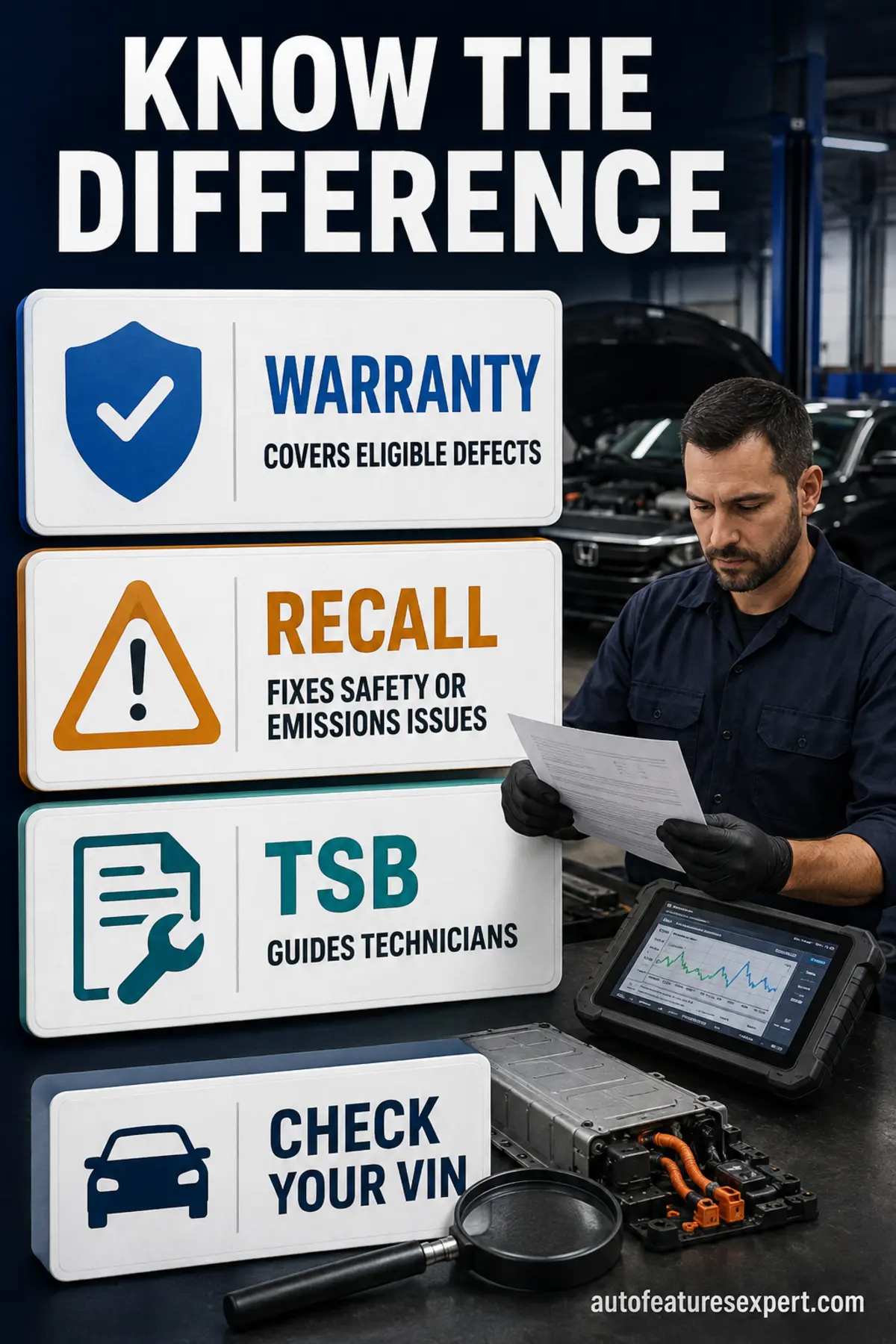
Battery Warranty, Recall and Service Bulletin: Not the Same Thing
| Program | What it means | Accord Hybrid example |
|---|---|---|
| Warranty | Contractual coverage for a defect or greater-than-normal degradation within stated time, mileage and eligibility rules | Recent Honda coverage is generally 8 years/100,000 miles; eligible California-emissions vehicles may receive 10 years/150,000 miles |
| Warranty extension | Honda lengthens coverage for a defined condition and VIN population | Service Bulletin 21-038 extends eligible 2014 Accord Plug-In Hybrid battery coverage to 12 years/200,000 miles |
| Safety recall | A safety defect is repaired without charge for affected VINs, regardless of ordinary warranty expiration | Recall 25V785 addresses ICM software on certain 2023–2025 Accord Hybrids; it is not a general battery-degradation recall |
| Emissions recall | Corrects an emissions-compliance issue for affected vehicles | Certain 2018 Accord Hybrids received software that allows P0A80 to clear after the correct battery is installed |
| Technical service bulletin | Repair guidance for technicians; it does not automatically provide free repairs | A bulletin can describe diagnosis or software without creating universal coverage |
Important Accord Hybrid campaigns to recognize
- 2014 Accord Plug-In Hybrid: Honda documented potential early deterioration and a 12-year/200,000-mile high-voltage battery warranty extension for eligible VINs. This PHEV campaign should not be generalized to the regular 2014 Accord Hybrid.
- Certain 2018 Accord Hybrids: the emissions campaign corrected software behavior involving DTC P0A80 after an incorrect pack had been installed. It was not a statement that every 2018 battery required replacement.
- Certain 2020 Accord Hybrids: NHTSA recall 20V798 concerned a DC-DC converter in the power control unit that could stop charging the 12-volt battery. The traction battery’s cell capacity was not the recall cause.
- Certain 2023–2025 Accord Hybrids: NHTSA recall 25V785 addresses integrated control module software that can reset and cause loss of drive power. The remedy is software reprogramming, not routine traction-pack replacement.
Coverage changes by year and jurisdiction. Use the vehicle’s original warranty booklet, Honda’s dealer VIN inquiry and the NHTSA recall lookup. Do not rely on a generic dealership blog or a warranty term copied from another manufacturer.
How to Help the Battery Last
- Keep the high-voltage battery intake and surrounding trim clear. Do not cover it or spray water into it.
- Follow Honda’s storage guidance. For a current Accord Hybrid used infrequently, Honda advises driving more than 30 minutes at least once every three months.
- Respond promptly to POWER SYSTEM, charging-system and check-engine warnings. Preserve codes before disconnecting batteries or clearing faults.
- Maintain the gasoline engine, cooling systems, tires and brakes. A mechanical problem can reduce MPG and be mistaken for battery degradation.
- Where practical, reduce prolonged extreme-heat exposure. Shade helps cabin and battery thermal load but cannot reverse existing degradation.
- Do not try to force the state-of-charge gauge to stay full. Honda’s control system deliberately cycles the usable portion of the battery.
- Keep invoices for battery work. Record the part number, installer, core return and warranty transfer terms.
Owner Experience: What Reports Can and Cannot Tell Us
Accord owners report both high-mileage cars on their original packs and occasional early failures. Those reports are valuable for identifying questions—warning messages, fan noise, fuel-economy changes and repair availability—but they do not establish a failure percentage. Online discussions also frequently mix 12-volt battery symptoms with traction-battery symptoms.
A single owner whose pack lasted 180,000 miles cannot guarantee another pack will do the same. Likewise, an early replacement under warranty does not prove a generation-wide defect. Use owner experience to build the inspection checklist, then make the buying decision from the VIN, records, scan data and condition of the individual car.
Expert Analysis: Age Matters, but Evidence Wins
The most common buying error is treating the warranty limit as engineered battery death. Honda’s 8-year/100,000-mile term defines coverage, not an automatic expiration. The second error is approving an older pack simply because the car still returns acceptable MPG. The hybrid control system can mask some capacity loss, and MPG contains too many outside variables to serve as a capacity test.
For the oldest Accords, parts strategy matters almost as much as present condition. A 2005–2007 IMA car may drive normally today, but the buyer should know who can service it and what a warranted replacement costs locally. For 2014–2017 cars, an HDS-capable inspection and exact VIN quote convert an undefined fear into a manageable number. For 2018 and newer models, remaining federal or state-specific coverage can materially change the risk.
The best value is not automatically the newest car. It is the car whose purchase price, battery evidence, warranty position and overall condition leave room for a realistic repair reserve.
Before You Buy: Accord Hybrid Battery Checklist
- □ Confirm it is a regular Hybrid or the separate 2014 Plug-In Hybrid.
- □ Obtain the VIN and check both Honda and NHTSA recall records.
- □ Confirm the original sale state, current registration state and applicable warranty booklet.
- □ Scan all modules before codes or readiness monitors are cleared.
- □ Load-test the 12-volt battery separately.
- □ Request battery voltage, temperature and state-of-charge findings—not only “passed.”
- □ Test-drive from cold through normal operating temperature.
- □ Inspect the battery air intake for blockage, liquid and damaged trim.
- □ Look for collision, flood or water evidence around hybrid components and wiring.
- □ Verify any replacement battery’s part number, date, installer and transferable warranty.
- □ Obtain an installed local replacement quote using the exact VIN.
- □ Price the engine, brakes, tires, A/C and suspension along with the battery risk.
Buying Advice by Model-Year Group
2005–2007: specialist or enthusiast purchase
These cars have the greatest age exposure and a different IMA architecture. Buy only when the vehicle is unusually well documented, a specialist has scanned it and a local replacement path is available. A low purchase price is not enough if the battery, transmission and other age-related repairs are all deferred.
2014–2015 and 2017: condition matters more than reputation
These can still be rational used buys, but their calendar age puts battery evidence near the top of the inspection. Do not confuse the regular Hybrid with the 2014 Plug-In Hybrid warranty extension. Require a written scan result and leave a repair reserve if the applicable coverage has expired.
2018–2022: often the practical value range
These cars combine a newer lithium-ion system with enough road history to evaluate individual condition. Some examples may retain federal or California-emissions battery coverage. Verify recall completion, avoid recently cleared codes and compare the hybrid inspection with the car’s total maintenance history.
2023–2026: lowest age exposure, but still check recalls
The newest group normally carries the strongest remaining warranty position. That does not remove the need for a VIN check: certain 2023–2025 cars are covered by the ICM software recall. A completed recall is positive documentation, but it is not the same as a battery-capacity certificate.
Related Honda Accord Guides
- Honda Accord Years to Avoid: Problem Patterns Used Buyers Should Know
- Honda Accord CVT Problems: Shudder, Fluid Service and Failure Signs — including why the Hybrid’s two-motor drive is not a conventional belt CVT.
- Honda Accord Oil Dilution: Which 1.5 Turbo Years Are Most at Risk? — relevant when comparing a Hybrid with a non-hybrid 1.5T.
- Honda Accord 1.5T Head Gasket Failure: Years, Symptoms and Repair Cost — another non-hybrid powertrain cost to consider when cross-shopping.
- Honda Accord A/C Problems: Condenser, Compressor and Warranty Coverage — a separate system-level guide for warm-air symptoms, leak diagnosis and 2018–2020 condenser coverage.
Frequently Asked Questions
How long does a Honda Accord Hybrid battery last?
Honda does not publish a fixed replacement age or an Accord-specific survival curve. Many buyers use the 8-year/100,000-mile warranty as a planning reference, but it is coverage—not an expiration date. Calendar age, heat exposure, codes, cooling, repair history and battery data matter more than a universal mileage claim.
How much does a Honda Accord Hybrid battery cost to replace?
RepairPal’s July 2026 national estimate is $4,184–$4,412, including $488–$716 in labor and about $3,696 in parts, before taxes and location adjustments. Remanufactured or used packs may cost less. Get a VIN-specific installed quote that includes diagnostics, software work, shipping, core charges and warranty.
What is the Honda Accord Hybrid battery warranty?
Recent U.S. Honda warranty documents cover greater-than-normal high-voltage battery degradation for 8 years/100,000 miles. Eligible California-emissions vehicles may receive 10 years/150,000 miles. The separate 2014 Accord Plug-In Hybrid campaign can extend eligible battery coverage to 12 years/200,000 miles. Confirm every term by VIN and warranty booklet.
Which Accord Hybrid years need the closest battery inspection?
Prioritize 2005–2007, 2014–2015 and 2017 because those batteries have the greatest calendar age and are more likely to be outside ordinary coverage. That is an inspection ranking, not a published failure-rate ranking. A documented older pack can be a better purchase than a newer car with codes or an unexplained repair.
Can I drive with a failing Accord Hybrid battery?
Do not continue if the car reports loss of drive power, a red warning or an instruction to stop. Some battery faults allow limited operation, while others can disable propulsion. Follow the owner’s manual, preserve diagnostic codes and arrange professional diagnosis or towing rather than assuming the gasoline engine will carry the car.
How do I check the battery before buying a used Accord Hybrid?
Use a Honda dealer or qualified hybrid specialist to scan all modules, test the 12-volt battery separately and evaluate high-voltage battery data under charge and discharge. Check the cooling intake, repair records, readiness monitors, VIN recalls and warranty eligibility. The dashboard charge gauge alone cannot measure remaining capacity.
How can I tell whether the 12-volt or hybrid battery is bad?
A dark, unresponsive vehicle or failed accessories often points first to the 12-volt system. A vehicle that powers on with POWER SYSTEM warnings, battery-specific codes, reduced assist or abnormal state-of-charge behavior may have a high-voltage fault. Symptoms overlap, so test both systems before authorizing an expensive pack.
Sources
- Honda 2025 Hybrid Warranty Basebook
- Honda 2023 Accord Hybrid Federal and California Emissions Warranty Parts List
- Honda 2025 Accord Hybrid Owner’s Manual: High Voltage Battery
- Honda 2005 Accord Hybrid Technical Release
- Honda 2014 Accord Hybrid Specifications
- Honda 2018 Accord Hybrid Powertrain Press Kit
- NHTSA Recall 25V785: 2023–2025 Accord Hybrid ICM Software
- NHTSA Recall 20V798: 2020 Accord Hybrid Power Control Unit
- Honda Service Bulletin 21-038: 2014 Accord Plug-In Hybrid Battery Warranty Extension
- Honda 2018 Accord Hybrid P0A80 Emissions Recall Notice
- RepairPal Accord Hybrid High-Voltage Battery Replacement Estimate
How We Evaluated Honda Accord Hybrid Battery Life
This guide was prepared for U.S. owners and used-car shoppers by comparing Honda warranty booklets, emissions-parts lists, owner-manual instructions and generation-specific technical releases with NHTSA recall and service-bulletin records. Current repair estimates and specialist replacement listings were used to establish a planning range, not a guaranteed invoice. Owner discussions were reviewed for recurring inspection questions but were not counted as failure statistics.
Honda does not publish an Accord-specific battery survival curve, so this article does not assign invented failure percentages or promise a fixed lifespan. Model-year groups are ranked by inspection priority based on calendar age, system differences, remaining coverage and documented campaigns. The decisive evidence for any vehicle remains its VIN, full diagnostic scan, service history and a qualified pre-purchase inspection.







