Use this guide for
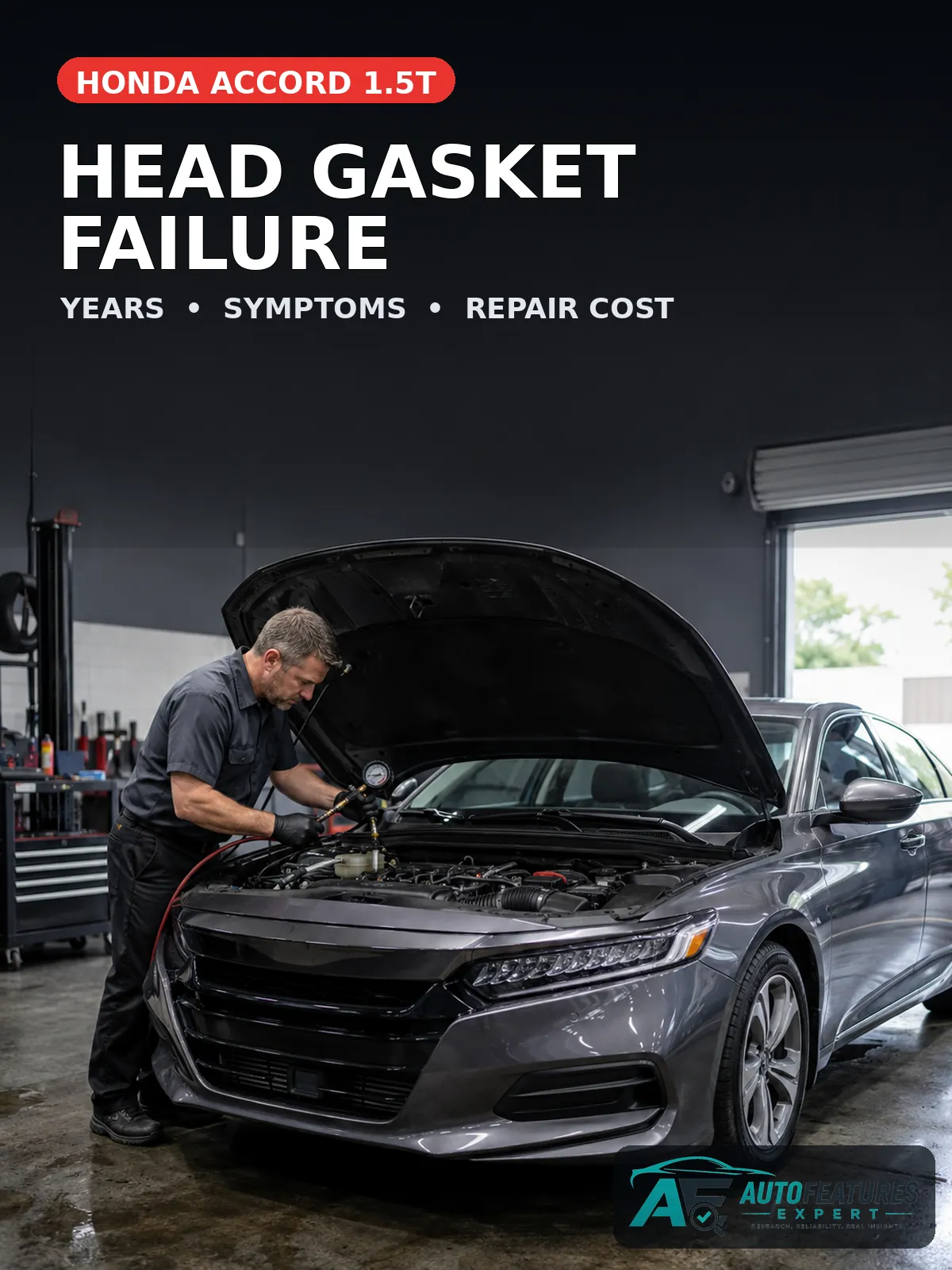
Evaluate Accord 1.5T head-gasket warning signs and repair evidence.
Boundary: Keep oil dilution and ordinary coolant leaks as separate diagnostic possibilities.
Honda Accord 1.5T head gasket failure is a documented coolant-intrusion concern, especially worth investigating on 2018 and 2019 cars that develop a cold-start misfire, unexplained coolant loss or P0300–P0304 codes. It is not proof that every 1.5T Accord will fail, and a misfire alone does not diagnose the gasket. A cooling-system pressure test and borescope inspection are the most useful confirmation steps.
That distinction matters because internet discussions often mix three different things: individual owner experiences, Honda dealer communications and safety recalls. The evidence supports taking the symptom pattern seriously, but it does not support a universal failure-rate claim. This guide separates what Honda has documented from what owners have reported, explains which years deserve the closest inspection and shows how to evaluate a repair estimate without authorizing thousands of dollars of work on a guess.
Key Takeaways
- 2018–2019 have the clearest manufacturer documentation. An American Honda dealer communication archived by NHTSA asked dealers to identify certain 2018–2019 Accord 1.5L vehicles with P0300–P0304 codes and a head-gasket coolant leak confirmed by borescope or pressure testing.
- 2018–2022 are the main used-buyer watch years. Owner complaints extend beyond 2019, but Honda has not published a failure rate that lets shoppers rank every year with statistical precision.
- A cold-start misfire is a clue, not a verdict. Spark plugs, coils, injectors, wiring and fuel delivery can cause similar codes. Coolant intrusion needs to be demonstrated.
- There is no blanket U.S. head-gasket safety recall or widely published Accord 1.5T warranty extension as of July 31, 2026. VIN-specific recall and warranty eligibility should still be checked with Honda.
- Budget from roughly $2,700 to $3,600 for a straightforward professional replacement estimate. Dealer quotes and repairs involving a warped head, damaged catalyst, turbo or complete engine can be substantially higher.
- Stop driving if the engine overheats, loses power or flashes the check-engine light. Continuing can turn a sealing repair into cylinder-head, bearing, catalyst or engine damage.
Which Honda Accord 1.5T Years Have Head Gasket Reports?
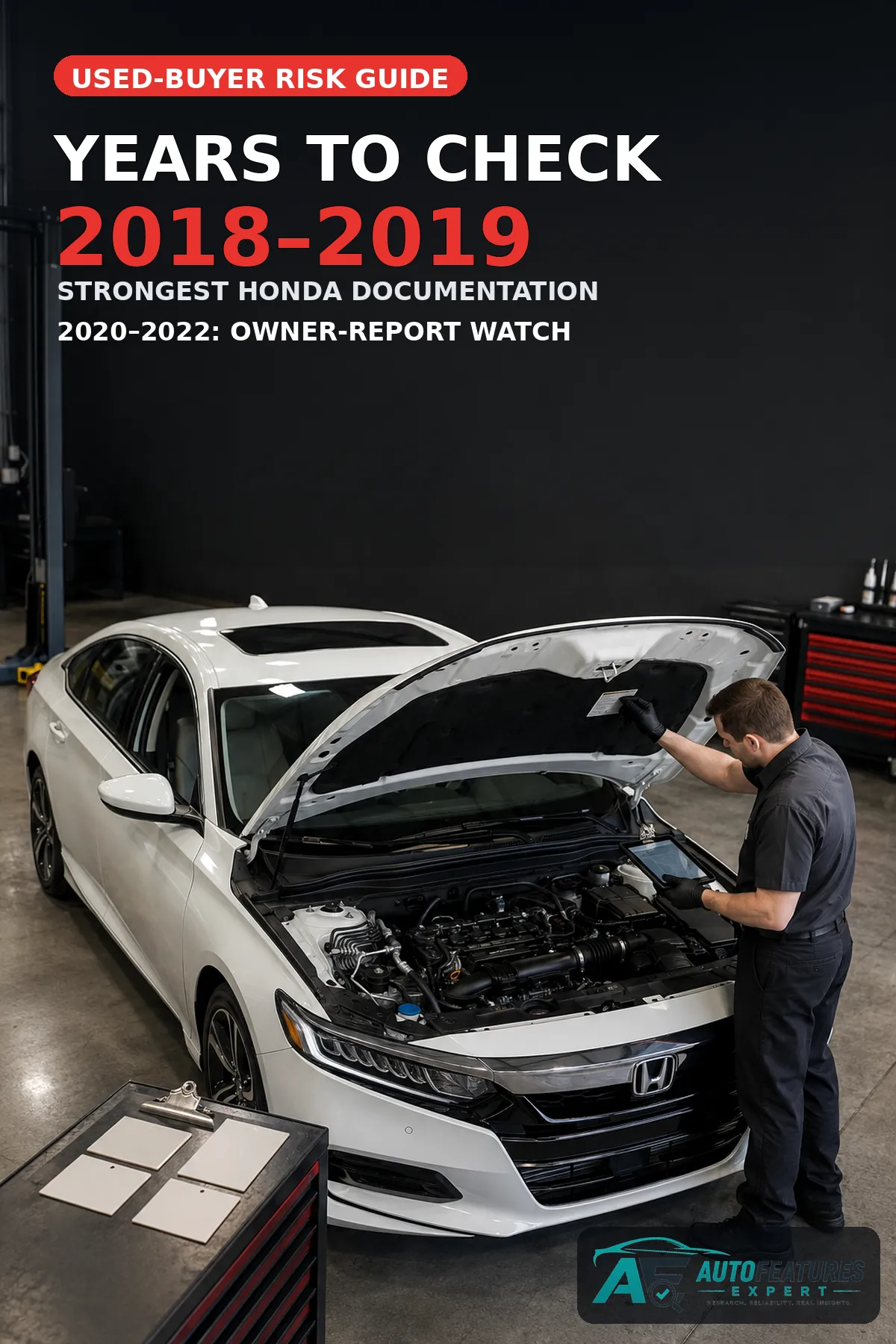
For a U.S. used-car shopper, 2018 through 2022 is the sensible inspection range because those are the tenth-generation Accord years that offered the 1.5-liter turbo and dominate the owner discussion. The evidence is not equally strong for every year, however. The most precise ranking is based on the type of evidence available—not on an invented failure percentage.
| Model years | What the evidence supports | Used-buyer response |
|---|---|---|
| 2018–2019 Accord 1.5T | Strongest official signal. Honda’s April 2023 dealer request specifically covered certain 2018–2019 Accord 1.5L cars with P0300–P0304, rough running and a coolant leak into a cylinder confirmed by borescope or pressure test. | Require a true cold start, complete coolant history, scan report and cooling-system pressure test before purchase if symptoms or unexplained coolant service appear. |
| 2020–2022 Accord 1.5T | Owner complaints and repair discussions report similar symptoms, but the 2023 Honda communication above did not name these years. There is no published Honda failure percentage proving they share the same risk level. | Inspect carefully, but do not automatically reject a clean car with stable coolant, no recurring misfire and strong records. |
| 2023–2026 Accord 1.5T | The 1.5-liter turbo continued in the eleventh-generation Accord. Current public evidence is not mature enough to assign these newer years the same owner-report pattern as 2018–2022. | Check warranty start date, VIN history and symptoms. Treat claims that the newer generation is either “completely fixed” or “certain to fail” as unproven. |
| Accord 2.0T and hybrids | Different powertrains. Reports involving them should not be counted as proof about the 1.5T. Honda’s later parts requests for Accord FHEV models concern the hybrid engine, not the Accord 1.5T. | Research the installed powertrain by VIN and trim rather than applying a 1.5T conclusion to every Accord. |
Honda introduced the 1.5T to the U.S. Accord for 2018, producing 192 horsepower and 192 lb-ft in the redesigned car. The company continued a revised 192-hp 1.5T in lower eleventh-generation trims beginning in 2023. Shared displacement does not by itself prove identical failure behavior across generations, calibrations or production revisions. Age also biases owner-report data: 2018 cars have had far more time and miles to develop a problem than 2025 or 2026 cars.
Why there is no honest “failure mileage”
Many public complaints describe failures somewhere around the 70,000-to-120,000-mile range, and some fall outside it. That range is useful for inspection planning, not probability. NHTSA complaints and owner forums are self-selected: they reveal symptom patterns and possible safety consequences, but they do not tell us how many problem-free Accords exist in the denominator. A 90,000-mile car is not automatically doomed, and a 50,000-mile example is not automatically protected.
The better question is: does this specific car show a repeatable combination of coolant loss and combustion symptoms? A well-documented 110,000-mile Accord with stable coolant and clean cold starts may be a better purchase than a 65,000-mile car whose reservoir was just topped off and whose diagnostic monitors were recently reset.
Honda Accord 1.5T Head Gasket Symptoms
The most persuasive pattern is not one dashboard light. It is a recurring cold-start misfire or rough run combined with coolant that disappears without an obvious external leak. Honda’s own dealer request used the same logic: qualifying cars needed a P0300-series code and a confirmed head-gasket coolant leak into a cylinder.
1. Rough start after the car sits overnight
A small internal leak can allow coolant to enter a cylinder while the engine is parked. At the next cold start, that cylinder may stumble until the liquid clears and combustion stabilizes. The driver may feel shaking for several seconds, see multiple driver-assistance warnings or notice the check-engine light. A smooth warm restart does not erase the cold-start evidence.
Record a video of the first start of the day and note ambient temperature, warning lights and duration. Do not repeatedly clear codes before a technician sees the freeze-frame data; that information can show engine temperature, load and operating conditions when the misfire was detected.
2. P0300, P0301, P0302, P0303 or P0304 codes
P0300 means a random or multiple-cylinder misfire. P0301 through P0304 identify the cylinder in which the control module detected a misfire. These codes tell a technician where combustion was irregular; they do not identify the failed part. Ignition, fueling, compression and coolant intrusion remain possible until testing narrows the cause.
3. Coolant level drops with no visible puddle
Check the translucent reservoir only when the car is parked level and fully cold, then photograph the level against the same reference point. A single low reading can follow prior service, an external hose or radiator leak, or incomplete air bleeding. A repeatable drop with no external leak is more concerning—especially when it accompanies a same-cylinder cold-start misfire.
Never remove a hot radiator cap. The pressurized system can release boiling coolant and steam. If the temperature warning appears, switch off the engine as soon as it is safe and arrange a tow.
4. White exhaust or a sweet coolant smell after warm-up
Visible vapor on a cold morning can be normal condensation. Persistent white exhaust after the engine and exhaust are warm, particularly with a sweet odor and falling coolant level, deserves immediate testing. Do not rely on exhaust color alone; oil burning, rich fueling and condensation can be misidentified by eye.
5. Overheating, loss of power or a flashing check-engine light
These are stop-driving symptoms. A severe misfire can overheat the catalytic converter, while low coolant or combustion pressure entering the cooling system can push engine temperature beyond a safe range. Continuing to drive may warp the aluminum cylinder head, damage bearings if fluids mix, harm the turbocharger or convert a repairable engine into a replacement candidate.
6. Bubbles or rapid pressure in the cooling system
Combustion gas entering a coolant passage can create abnormal pressure, bubbling or coolant displacement. Air left after cooling-system service can also bubble, so observation must be interpreted with service history and proper test equipment. A technician should evaluate pressure from a cold start rather than inviting an owner to open a hot system.
A Misfire Does Not Prove the Head Gasket Failed
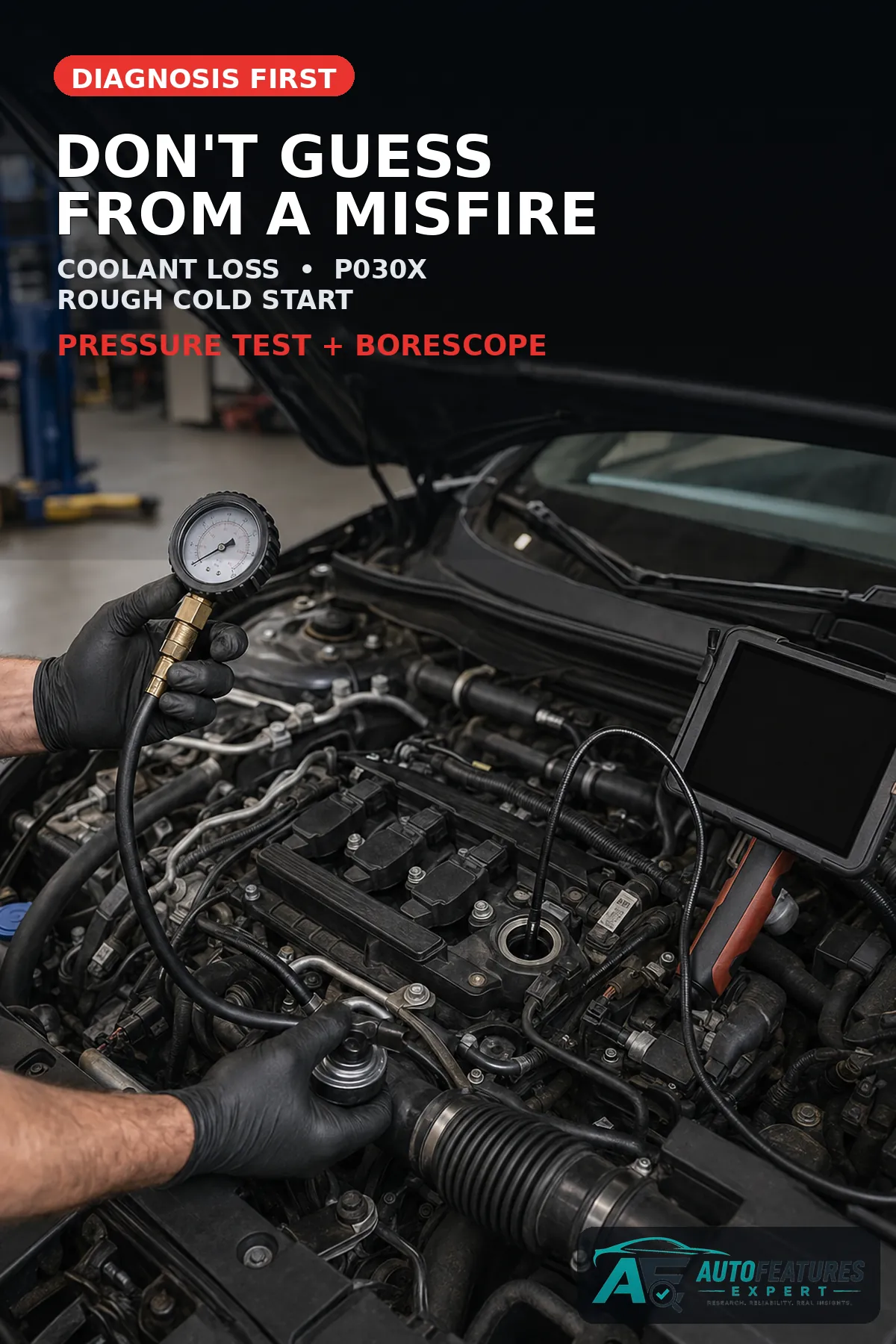
This is the most important money-saving section in the guide. The Accord 1.5T can misfire because of worn or fouled plugs, a failed coil, injector trouble, wiring, fuel quality, low compression, valve issues or coolant intrusion. Replacing the gasket based only on P0301 is poor diagnosis. Replacing plugs and coils repeatedly while ignoring coolant loss is equally poor diagnosis.
| Finding | What else can cause it? | Evidence that raises head-gasket confidence |
|---|---|---|
| Cold-start roughness or P030X | Spark plug, coil, injector, wiring, fuel pressure or mechanical compression fault | Same-cylinder recurrence plus unexplained coolant loss and evidence of coolant in that cylinder |
| Low coolant | Reservoir, cap, hose, radiator, water pump, heater core or prior incomplete fill | No external leak during inspection, pressure loss and coolant traces visible in a cylinder |
| White exhaust | Normal condensation, oil consumption or rich fueling | Persists when fully warm, smells like coolant and coincides with a falling coolant level |
| Overheating | Fan, thermostat, water pump, radiator obstruction, low coolant or trapped air | Combustion gas in coolant, rapid system pressurization or verified cylinder-to-coolant leakage |
A defensible diagnostic sequence
- Preserve the evidence. Read all stored, pending and permanent codes plus freeze-frame data before clearing anything.
- Verify the coolant level cold. Inspect the reservoir, radiator, cap, hoses, water pump area, thermostat housing and underbody for an external leak.
- Inspect plugs and cylinders. A plug that looks unusually steam-cleaned, deposits that differ from neighboring cylinders or visible droplets after an overnight sit can guide the next test.
- Pressure-test the cooling system. Honda’s archived dealer communication explicitly accepts pressure testing or borescope inspection as confirmation of a head-gasket coolant leak into a cylinder.
- Borescope the suspected cylinder. Ideally the vehicle sits long enough for a small leak to become visible. Compare all four cylinders instead of interpreting one image in isolation.
- Use supporting tests when needed. A combustion-gas test, compression test and cylinder leak-down test can add context, but a small intermittent coolant leak may not fail every test on demand.
- Rule out injector and ignition faults. More than one problem can exist. A confirmed coolant leak does not make an injector test unnecessary, and a bad injector does not prove the cooling system is healthy.
- Document the repair scope. Before teardown, the estimate should state how the shop will check cylinder-head flatness, surface condition and related damage.
Ask for test results in writing: codes and freeze-frame data, cold and hot pressure readings, borescope photographs, external-leak findings and the reason the shop concluded the gasket—not merely a plug, coil or injector—is responsible. This record also helps if you request warranty or goodwill review from Honda.
What Causes the 1.5T Head Gasket Problem?
The confirmed mechanism in the Honda dealer document is narrow: coolant leaking past the head-gasket seal into a cylinder. The document does not publish a root-cause conclusion, a defect rate or a permanent redesign. That is why claims about one universal cause should be labeled as hypotheses unless Honda or an engineering analysis supports them.
Online explanations frequently point to high cylinder pressure from turbocharging, the spacing between cylinders and coolant passages, head-bolt clamping force, heat cycling, detonation, tuning or gasket construction. Some may be mechanically plausible. Plausible is not the same as proven for every failed Accord. A prior overheating event can also damage a gasket that was not the original problem.
Factors a shop should record
- Whether the engine is stock or has an ECU tune, boost controller, intake or exhaust modification.
- Any history of overheating, low coolant, collision damage or cooling-system repair.
- Oil and coolant service records and whether the correct Honda-specified coolant was used.
- Which cylinder shows intrusion and whether the cylinder head or block is flat and undamaged.
- Fuel quality, abnormal combustion evidence and stored knock or fueling data where available.
- Whether injectors, plugs or coils have already been replaced and whether the same misfire returned.
Running premium fuel is often promoted online as a guaranteed preventive fix. Honda’s 2023 Accord material says the production 1.5T makes its rated output on regular unleaded. Fuel that meets the owner’s-manual requirement, avoiding an aggressive tune, promptly correcting overheating and following fluid service are sensible practices, but no public Honda document says premium fuel guarantees that an Accord head gasket will not leak.
Is There a Honda Accord 1.5T Head Gasket Recall?
No blanket U.S. safety recall for the Accord 1.5T head gasket was listed in Honda and NHTSA recall resources reviewed on July 31, 2026. Honda’s April 2023 “request for parts” is a dealer investigation communication, not a recall, customer repair bulletin or promise to pay every claim. Lawsuits and owner petitions are allegations, not recall remedies.
Do not confuse this issue with the separate 2018–2022 Accord 1.5T fuel-pump motor safety recall. That campaign addresses a defective fuel-pump impeller that may cause the pump to stop working. A completed fuel-pump recall does not repair a head gasket, and a head-gasket diagnosis does not mean the fuel-pump recall was performed. Enter the vehicle’s 17-character VIN in the official Honda recall lookup and keep the result with the inspection records.
Standard warranty and goodwill questions
Honda’s U.S. warranty booklet lists a five-year/60,000-mile powertrain limited warranty, beginning with the original in-service date, subject to its terms and exclusions. Many tenth-generation cars are now outside that window. An extended service contract, state-law right or prior repair warranty may create different coverage, so the service adviser should run a VIN-specific eligibility inquiry rather than relying on a forum answer.
If the car is just outside coverage, ask the dealer to open a case with American Honda before authorizing teardown. Provide ownership history, maintenance records, the written diagnosis and any history of Honda-dealer service. Goodwill assistance is discretionary—not an entitlement—and may cover none, part or all of a repair. Get every contribution and remaining customer charge in writing.
Honda Accord 1.5T Head Gasket Repair Cost
RepairPal’s estimate updated July 25, 2026 places a 2018–2022 Accord head-gasket replacement at approximately $2,688 to $3,591 before taxes, location adjustments and related repairs. That is a useful baseline, not a guaranteed invoice. Owner-submitted NHTSA complaints include dealer estimates around $4,000 to more than $5,000, illustrating how labor rate, teardown findings and replacement scope can move the total.
| Repair path | Planning range | What changes the price |
|---|---|---|
| Diagnosis before teardown | Shop-specific; ask for a capped diagnostic authorization | Cold-soak time, pressure testing, borescope, scan data and leak-down work |
| Straightforward head-gasket replacement | $2,688–$3,591 national estimate | Labor rate, parts choice, fluids, single-use fasteners and local taxes |
| Dealer or expanded repair | Often $4,000–$6,000+ in owner-reported quotes | Cylinder-head machining or replacement, injectors, plugs, damaged catalyst, turbo concerns and dealer labor |
| Replacement engine | Can exceed the car’s economic repair threshold | New, remanufactured or used engine; installation; turbo and accessories; warranty length; shipping and core charges |
A low quote is not automatically a bargain if it excludes machine-shop measurement, new one-time-use fasteners, required gaskets, oil, filter, coolant, spark plugs or post-repair verification. A high quote is not automatically justified if it bundles injectors, a turbo or a complete cylinder head without test evidence.
What a complete written estimate should answer
- Is the quote for diagnosis only, teardown authorization or the completed repair?
- Will the cylinder head be checked for flatness, cracks and surface finish? Who decides whether it can be machined?
- Which gasket, head bolts or studs, seals, fluids and one-time-use parts are included?
- Are spark plugs, injectors, turbocharger or catalytic converter included because testing found a fault—or merely as preventive add-ons?
- What happens to the price if the head or block fails inspection after disassembly?
- What parts-and-labor warranty covers coolant loss, repeat misfire and a second gasket failure?
- Will the shop provide before-and-after test results and verify no external or internal coolant loss remains?
Compare estimates on equal scope. An independent Honda specialist may have lower labor rates and deeper familiarity than a general shop, while a dealer has direct access to Honda case handling and VIN campaign information. The right choice is the facility that can prove the diagnosis, explain its machining standards and stand behind the complete repair.
Can You Drive With a Suspected Head Gasket Leak?
If there is only an occasional rough cold start and no overheating, owners are often tempted to keep driving while watching the coolant. That can be a costly gamble because the leak can worsen and liquid coolant does not compress like air. The safer default after a repeat misfire-plus-coolant-loss pattern is to minimize operation and schedule diagnosis.
Tow the car immediately if any of the following occurs:
- The temperature warning appears or the gauge moves into the hot range.
- The check-engine light flashes, the engine shakes continuously or power drops sharply.
- Dense white exhaust persists after warm-up.
- The reservoir empties again after a recent correct fill.
- Oil looks milky, its level rises unexpectedly or the engine develops abnormal mechanical noise.
- The car enters limp mode or cannot maintain a safe traffic speed.
Do not pour stop-leak into the system as a substitute for diagnosis. Sealant may restrict small cooling passages, contaminate equipment and complicate a proper repair. Do not keep refilling coolant and treating the temperature warning as a reminder; every overheat event can change the repair economics.
Used-Buyer Inspection for a 2018–2022 Accord 1.5T
A standard 20-minute test drive is poorly designed to find a small internal coolant leak. The seller may warm the car before arrival, clear codes or top off the reservoir. Ask in advance that the engine remain completely cold, and confirm by carefully checking that the hood and surrounding engine components are at ambient temperature before start-up.
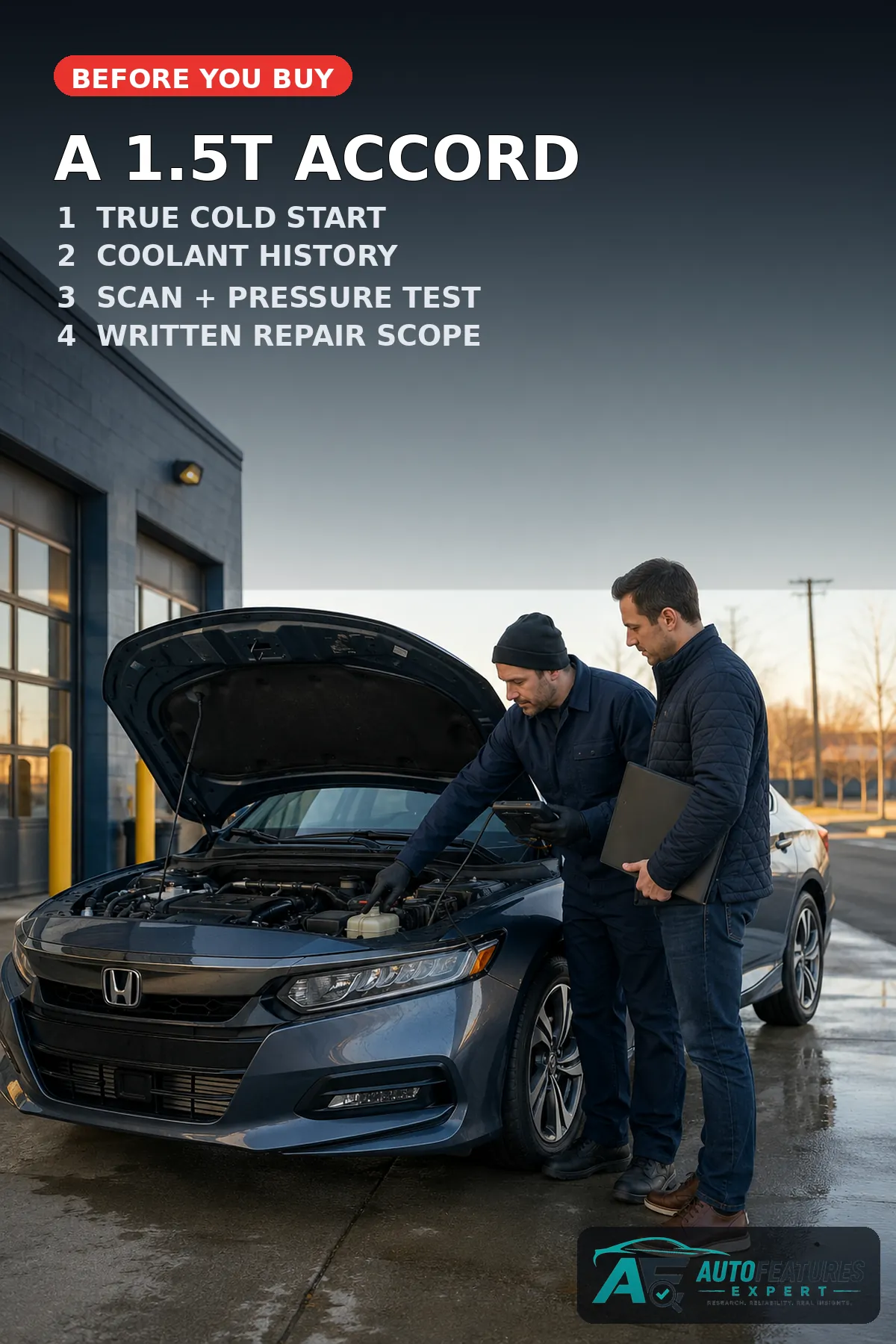
- Verify the engine. Decode the VIN and inspect the under-hood emissions label. Do not assume every Sport, EX or Touring has the same powertrain.
- Inspect cold fluid levels. Photograph the coolant reservoir and inspect the oil cap and dipstick. Freshly detailed engine bays and recently replaced reservoirs deserve questions, not automatic rejection.
- Watch the first start. Look for shaking, delayed stabilization, persistent white exhaust and a cluster of warning messages. Record the event if the seller permits.
- Scan before and after the drive. Read stored, pending and permanent codes. Check emissions-monitor readiness; several “not ready” monitors can indicate a recent battery disconnect or code clear.
- Drive long enough to reach full temperature. Include idle, moderate acceleration and a restart. Watch temperature behavior without aggressive testing.
- Review service invoices. Repeated plugs, coils, injectors or coolant top-offs can reveal a symptom trail. Ask why any cylinder-head or cooling-system work was done.
- Order an independent pressure test and borescope inspection. This is especially important when the car has a recurring P030X code, unexplained coolant loss or a suspiciously clean cylinder.
- Check recall completion by VIN. The fuel-pump campaign is separate but still important to safe ownership.
If a gasket was already replaced, the invoice is more valuable than the seller’s verbal assurance. It should identify the shop, mileage, parts, head inspection or machining, related repairs and warranty. Confirm that coolant remains stable after the repair and that the same-cylinder misfire has not returned.
Should You Repair the Car or Sell It?
Use the car’s value after a successful repair, not the amount already spent, as the starting point. Then compare the complete repair quote with the cost and risk of replacing the car. A well-kept Accord with no transmission, collision or corrosion problems may justify a $3,000 repair. A high-mileage car that also needs a turbo, catalyst, tires, brakes and suspension may not justify an open-ended teardown.
Repair is easier to justify when:
- The leak was caught before overheating and the head and block pass inspection.
- The quote has a clear ceiling, complete scope and meaningful parts-and-labor warranty.
- The CVT, turbo, body and safety systems are otherwise healthy.
- The car has strong records, manageable mileage and no major accident or rust history.
- Its post-repair value comfortably exceeds the repair plus a contingency reserve.
Selling or replacing may be more rational when:
- The engine overheated severely, coolant contaminated the oil or the head/block is damaged.
- The estimate remains open-ended after teardown or approaches the car’s repaired retail value.
- Turbocharger, catalyst, injector, CVT or other expensive work is also confirmed.
- A used engine is proposed without verifiable mileage, leak testing and a strong labor warranty.
- The owner cannot absorb the cost of a repeat failure outside the repair warranty.
Do not conceal a known coolant-intrusion diagnosis from a buyer. If selling as-is, provide the written findings and price the vehicle as a repair project. Disclosure requirements vary by state, and clear documentation reduces both ethical and legal risk.
How to Reduce Risk After Repair
No maintenance routine can guarantee that a head gasket will last forever, and Honda does not list head-gasket replacement as scheduled maintenance. Risk reduction is about limiting heat and abnormal combustion, then catching coolant loss before it creates secondary damage.
- Check the coolant level only when fully cold and investigate any recurring drop rather than repeatedly topping it off.
- Use the coolant specification in the owner’s manual and make sure the system is correctly bled after service.
- Address a rough cold start, P030X or temperature warning promptly. Preserve scan data before clearing codes.
- Keep oil changes current and monitor for an unexpectedly rising level or coolant contamination.
- Avoid unverified high-boost tuning on a daily driver whose long-term durability matters.
- Use fuel that meets Honda’s octane and quality requirement; do not treat premium as a documented cure.
- Retain the repair invoice, machine-shop report, photos and warranty terms for future claims or resale.
Fuel dilution is a separate 1.5T topic with overlapping drivability concerns. Our Honda 1.5T oil-dilution guide explains why a rising oil level or gasoline odor should not automatically be labeled a head-gasket failure. For broader brand research, use the Honda vehicle research hub.
Frequently Asked Questions
Which Honda Accord years have the most 1.5T head gasket concerns?
2018–2022 are the main used-buyer watch years, with 2018 and 2019 having the clearest manufacturer documentation. Honda’s 2023 dealer communication specifically covered certain 2018–2019 Accord 1.5L cars with P0300–P0304 codes and confirmed coolant leakage into a cylinder. Owner reports extend into later tenth-generation years, but Honda has not published a model-year failure rate.
What is the first sign of an Accord 1.5T head gasket leak?
A brief rough cold start or repeat single-cylinder misfire combined with unexplained coolant loss is the most useful early pattern. Either symptom by itself has other possible causes. Record the cold start, preserve scan data and have the cooling system checked for both external leakage and coolant intrusion into a cylinder.
Does a P0301, P0302, P0303 or P0304 code mean the head gasket is bad?
No. A P030X code identifies a detected misfire, not its cause. Spark plugs, coils, injectors, wiring, fuel pressure, valve or compression problems can produce the same code. Confidence rises when the same cylinder shows coolant after an overnight pressure test or borescope inspection and the coolant level drops without an external leak.
Is there a recall for the Honda Accord 1.5T head gasket?
No blanket U.S. head-gasket recall was listed in the Honda and NHTSA recall resources reviewed on July 31, 2026. The Honda dealer parts request is an investigation communication, not a recall. The separate 2018–2022 Accord 1.5T fuel-pump recall does not cover the head gasket. Check every vehicle’s VIN because recall status is vehicle-specific.
How much does a Honda Accord 1.5T head gasket replacement cost?
RepairPal’s July 2026 estimate for a 2018–2022 Accord is about $2,688–$3,591 before taxes, location differences and related repairs. Dealer and owner-reported quotes can exceed $4,000–$6,000 when labor rates, cylinder-head work, injectors, turbo or catalyst damage are added. Obtain a written scope and a post-teardown price ceiling.
Can I keep driving an Accord with a suspected head gasket leak?
Continued driving risks turning a small leak into overheating, cylinder-head, catalyst, bearing or engine damage. Tow the car if the temperature warning appears, the check-engine light flashes, power drops, dense white exhaust persists or coolant rapidly disappears. Even a mild repeat cold-start misfire with coolant loss deserves prompt diagnosis.
Will premium gas prevent the 1.5T head gasket from failing?
There is no public Honda guidance saying premium fuel prevents this failure. Use fuel that meets the owner’s-manual requirement, avoid questionable tuning, maintain the cooling system and investigate overheating or coolant loss immediately. Premium may be appropriate for some modified or operating conditions, but it is not a documented head-gasket cure.
Sources and Research Notes
- American Honda Technical Information & Support request, April 13, 2023 — 2018–2019 Accord 1.5L, P0300–P0304 and coolant leakage confirmed by borescope or pressure test.
- 2020 Honda U.S. Warranty Booklet — standard three-year/36,000-mile new-vehicle and five-year/60,000-mile powertrain coverage.
- Honda official VIN recall lookup — current vehicle-specific campaign status.
- Honda Service Bulletin 24-009 / NHTSA recall 23V-858 — separate 2018–2022 Accord 1.5T fuel-pump motor recall.
- Honda 2018 Accord powertrain press kit and 2023 Accord press kit — U.S. 1.5T introduction, output and continued use.
- RepairPal 2019 Accord head-gasket cost estimate — estimate updated July 25, 2026 and year-by-year Accord ranges.
- NHTSA complaint reporting — owner reports were used to identify recurring symptom and safety narratives, not to calculate a failure rate.
Research cutoff: July 31, 2026. Recall, warranty, lawsuit and repair-cost information can change. Verify the VIN, current Honda campaign status, local labor rates and written diagnostic results before making a repair or purchase decision.
About This Article
This guide was built for U.S. Accord owners and used-car shoppers who need to decide whether a rough-running 1.5T has an ignition or fuel problem, a coolant-intrusion problem or insufficient evidence for either conclusion. We reviewed Honda powertrain documentation, the manufacturer communication preserved in NHTSA’s technical-service archive, Honda’s warranty terms, current recall resources, current national repair estimates and owner complaint narratives.
Evidence was weighted by source type. Honda and NHTSA documents establish what vehicles and diagnostic qualifiers the manufacturer actually named. Repair-cost services provide a planning baseline. Owner complaints help reveal repeat symptom sequences and real-world quote ranges, but they cannot establish incidence because the number of unaffected vehicles is unknown. Lawsuit allegations and forum explanations were not treated as engineering findings. The result is intentionally more cautious than a viral “all 1.5Ts fail” claim and more actionable than a generic list of blown-head-gasket symptoms.
2026-07-31T05:15:59-04:00







