Use this guide for
Screen Honda Accord years and configurations that deserve extra caution before purchase.
Boundary: This page ranks used-year risk; detailed 1.5T, CVT, A/C and hybrid questions stay separate.
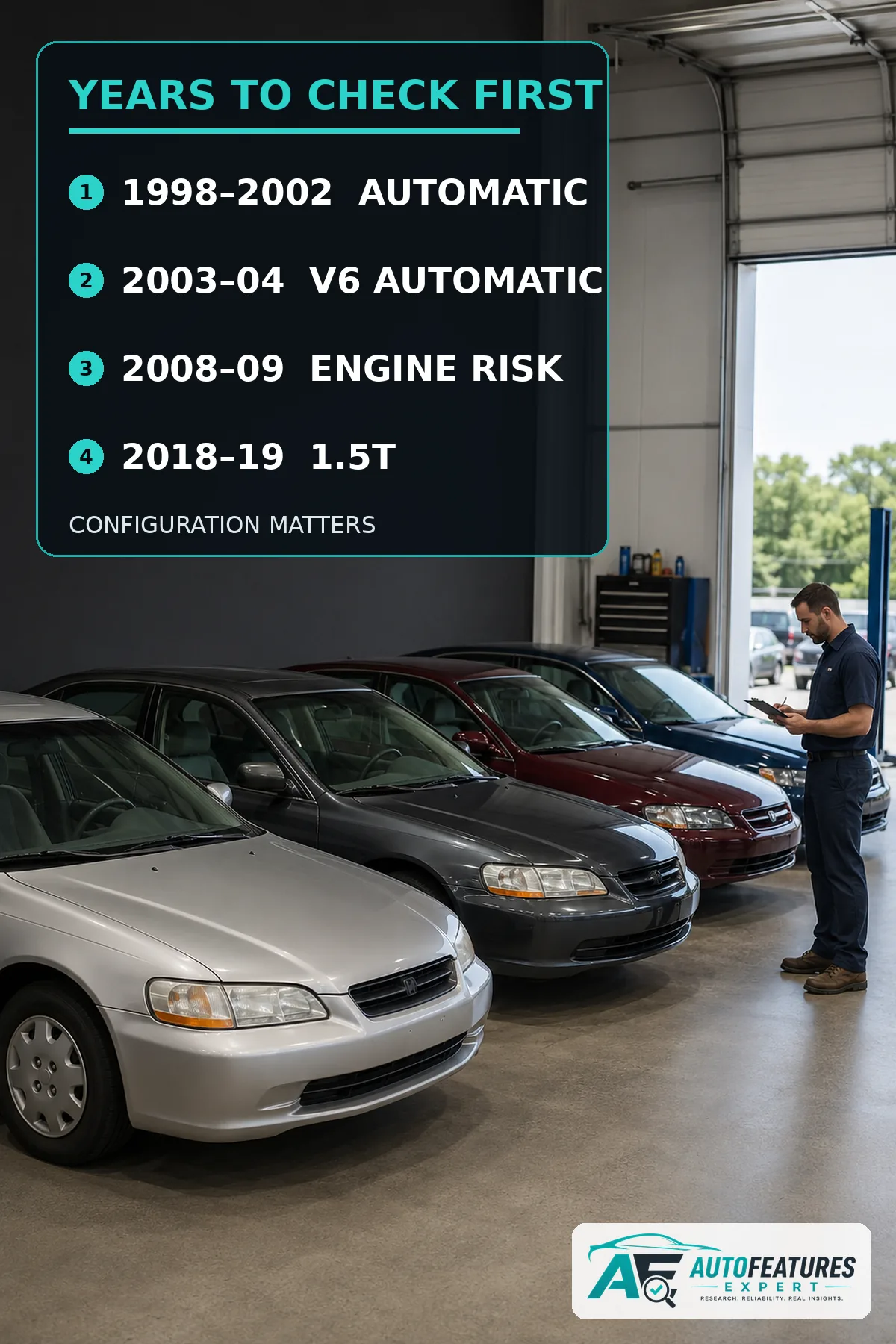
Honda Accord years to avoid for a U.S. used-car shopper are best narrowed to 1998–2002 automatics, 2003–2004 V6 automatics, 2008–2009 cars with engine-specific warning signs, and 2018–2019 models equipped with the 1.5-liter turbo. Those are not automatic rejects: the engine, transmission, VIN history, recall completion and inspection results matter more than the badge year alone.
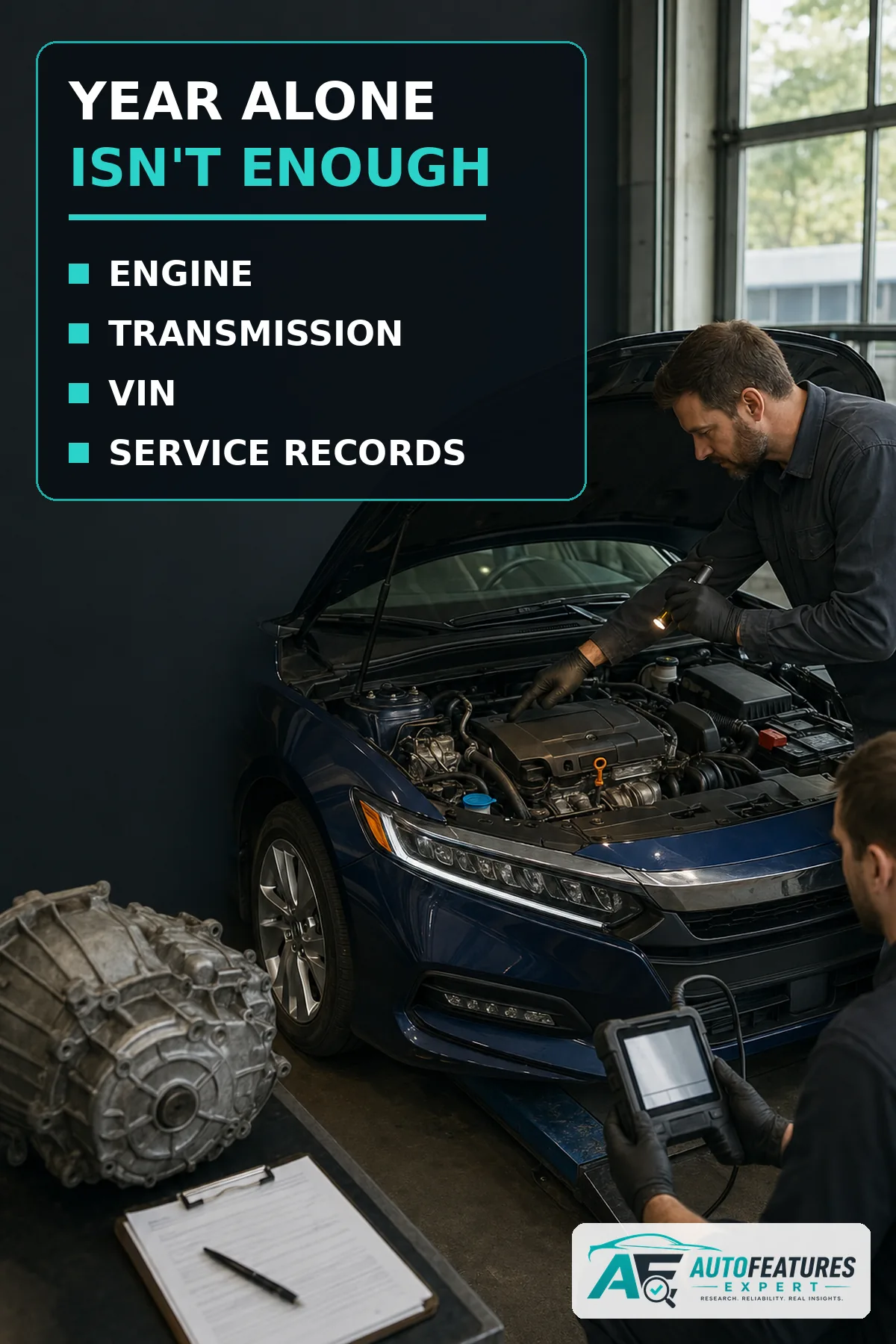
A clean-looking Accord can still conceal an expensive transmission, oil-consumption or coolant-intrusion problem. The reverse is also true: a documented repair, a clean cold start and a strong pre-purchase inspection can make a supposedly “bad year” a better purchase than a neglected favorite. This guide separates manufacturer documentation from owner-report patterns so you can decide what to reject, what to inspect closely and what evidence justifies buying.
Key Takeaways
- Highest transmission scrutiny: 1998–2002 four-speed automatics and certain 2003–2004 V6 automatics deserve the most caution. A 2003 Accord is the clearest single-year risk signal in owner-submitted transmission data, while Honda’s 2004 recall documented a separate second-gear overheating risk in certain 2003 and early-2004 V6 cars.
- Highest engine scrutiny: 2008–2009 needs powertrain-specific analysis. Honda documented oil-consumption conditions in certain four-cylinders and piston-ring/misfire trouble in 2008–2012 V6 automatics.
- Turbo-era watch list: Honda asked dealers to submit parts from certain 2018–2019 Accord 1.5L cars with confirmed coolant leakage into a cylinder. That communication supports close inspection, but it is not a recall and does not publish a failure rate.
- Do not condemn an entire generation: a 2018 1.5T, 2018 2.0T and 2018 Hybrid have materially different powertrains. Likewise, ninth-generation four-cylinder/CVT cars should not be judged by a V6 six-speed automatic bulletin.
- Verify the exact VIN: recall completion, build date and equipment can change the decision. Use NHTSA and Honda VIN lookups, then ask a Honda dealer to check campaign history when older completed recalls no longer appear in the public lookup.
- Inspection beats reputation: insist on a stone-cold start, a long mixed-speed test drive, scan data and an independent inspection. A warmed-up car waiting when you arrive is a reason to slow down.
Honda Accord Years to Avoid: The Short List
The table below is a risk triage tool, not a prediction that every listed car will fail. “Avoid unless proven” means the repair exposure is high enough that incomplete records, an unresolved symptom or a seller who refuses an inspection should end the deal.
| Model years and configuration | Priority | What the evidence points to | Used-buyer decision |
|---|---|---|---|
| 1998–2002 automatic, especially V6 | Avoid unless proven | Concentrated owner reports of automatic-transmission failure; age adds fluid-leak, mount and parts-history uncertainty | Buy only with convincing replacement/rebuild documentation, correct operation hot and cold, and a specialist inspection |
| 2001–2002 Accord | Urgent VIN check | Certain cars received a Takata Alpha “Do Not Drive” warning for unrepaired driver inflators | Do not drive an affected, unrepaired VIN; arrange the free recall remedy |
| 2003–2004 V6 automatic | Avoid unless proven | Severe owner-reported transmission concentration for 2003; recall 04V176 covered certain 2003 and early-2004 V6 cars for second-gear heat buildup | Require recall/campaign history and flawless operation; reject slipping, flare, harsh engagement or unexplained warning lights |
| 2008–2009 four-cylinder | High scrutiny | Honda bulletin 12-087 documented a specific high-oil-consumption condition involving stuck rings | Check oil level before startup, service records, cold-start rattle, smoke and consumption history |
| 2008–2012 V6 automatic | High scrutiny | Honda bulletin 13-078 linked rotating/aligned piston rings with fouled plugs, misfire codes and an eight-year warranty extension | Verify misfire and piston/ring repair history; reject active P0301–P0304 codes without a credible diagnosis |
| 2013–2017 V6 six-speed automatic | Conditional watch | Honda bulletins 17-017/17-018 addressed torque-converter judder at approximately 20–60 mph | Test at light throttle through the full speed range; confirm software and fluid-service history |
| 2018–2019 1.5T | High scrutiny | Honda’s 2023 dealer communication covered certain cars with random/cylinder misfires and coolant leakage into a cylinder confirmed by borescope or pressure testing | Require an overnight cold start, stable coolant level and diagnostic proof if there is any repeat misfire |
| 2020–2022 1.5T | Owner-report watch | Similar owner concerns exist, but the Honda parts-collection document reviewed here names 2018–2019 | Apply the same coolant/misfire inspection without claiming the same official model-year scope |
| 2023–2025 Accord Hybrid | Recall-remedy check | NHTSA recall 25V785 covers improper ICM software that can reset and cause loss of drive power | Not a blanket avoid; verify the free software remedy on the VIN before purchase |
Direct answer: if you want one model year to approach most cautiously, 2003 has the strongest combination of severe owner-reported transmission trouble and an official safety-recall context for certain V6 automatics. If you are shopping a newer car, the 2018–2019 1.5T is the configuration that most needs a cold-start and coolant-intrusion inspection. Neither answer makes every other Accord from those years unsafe or unreliable.
Why a Powertrain-Specific List Is More Accurate
Most “best and worst years” lists flatten several distinct cars into one row. Honda sold four-cylinder and V6 Accords, manuals and automatics, conventional gas models and hybrids, then turbocharged 1.5-liter and 2.0-liter versions. A technical bulletin can apply to one engine and transmission while an adjacent trim has neither component.
That distinction changes purchase advice. Honda bulletin 13-078 applies to 2008–2012 Accord V6 models with an automatic transmission. It does not prove that the four-cylinder Accord from the same years has the same piston-ring mechanism. Bulletin 12-087 covers a different oil-consumption condition in four-cylinder cars and identifies affected years and VIN ranges. A generic statement that “all 2008–2012 Accords have bad engines” discards the most useful information in both documents.
Evidence strength matters too. We give the most weight to NHTSA recall reports and Honda service communications because they define an affected component, symptom or VIN population. Owner complaint aggregators are valuable for discovering patterns and understanding how a fault feels in daily use, but their totals are not failure rates. Owners self-select into reporting, vehicles have different mileages and sales volume varies by year. A large complaint count can identify what to inspect; it cannot tell you the probability that the next car will fail.
Finally, a recall is not automatically a reliability verdict. A completed software update or replaced component may remove the recall defect. Conversely, the absence of a recall does not prove that a car has no expensive pattern. The right question is: what exact component is in this VIN, what symptom should appear, and what evidence shows that this individual car is healthy or repaired?
1998–2002: Aging Four-Speed Automatics Need Proof, Not Promises
Sixth-generation Accords are inexpensive, simple by modern standards and often still running at high mileage. Their low purchase price is also what makes transmission risk financially decisive. A major automatic-transmission repair can exceed the value of the entire car, and the oldest examples are now more than a quarter-century old.
Owner-submitted databases show a pronounced automatic-transmission problem pattern in this era, particularly among V6 cars. Treat that as a screening signal rather than a population statistic. During the test drive, evaluate the car completely cold and again after at least 25–30 minutes. Watch for delayed engagement from Park to Drive or Reverse, engine speed rising without matching acceleration, a flare between shifts, shudder under light throttle, harsh downshifts and a flashing D indicator. Fresh-looking fluid is not proof of mechanical health, and dark or burnt-smelling fluid is a strong reason to stop.
Documentation must be specific. “Transmission done” on a marketplace listing is not enough. Ask for the date, mileage, shop name, invoice, warranty and whether the unit was rebuilt, remanufactured or used. Confirm that the installed transmission matches the car and that related mounts, cooling lines and leaks were addressed. A replacement performed long ago with no recent service history does not eliminate current risk.
2001–2002 Takata Alpha warning
Certain 2001–2002 Accords are subject to NHTSA’s urgent Takata Alpha “Do Not Drive” warning when the driver-airbag inflator remains unrepaired. NHTSA says affected owners should not drive the vehicle until the free repair is completed. This is a safety gate, not a negotiating point: run the 17-character VIN through the official recall lookup before traveling to inspect the car. If the VIN is affected and open, coordinate the remedy rather than driving it home.
NHTSA’s public VIN tool generally shows unrepaired safety recalls, but completed recalls and some campaigns older than 15 years may not appear. For an older Accord, save the lookup result and ask a Honda dealer to review the VIN’s campaign history. Do not accept “no dashboard light” or an owner’s memory as recall proof.
2003–2004 V6 Automatic: The Clearest High-Risk Cluster
The 2003 model year stands out because owner reports heavily concentrate around transmission failure. CarComplaints identifies transmission trouble as the Accord’s worst problem category and 2003 as its worst model year; its transmission-failure page shows hundreds of owner submissions, commonly near 100,000 miles. Those reports are not an incidence rate, yet the severity and repair exposure make them impossible to ignore in a used-car inspection.
There is also a separate official record. Honda recall 04V176 covered certain 2003 and early-2004 Accord V6 sedans and coupes. Honda explained that insufficient lubrication could allow excessive heat to build between second gears, potentially leading to gear tooth chipping and, in the worst case, transmission lockup. The prescribed remedy depended on inspection: dealers installed an oil-jet kit in many vehicles and repaired or replaced transmissions showing heat discoloration.
Do not merge those two facts into an unsupported claim that every 2003 transmission has the recall defect. Instead, use them together to raise the burden of proof. A candidate V6 automatic should have:
- a VIN-specific record showing recall 04V176 status, where applicable;
- clear invoices for any transmission repair or replacement;
- no delayed engagement, slipping, flare, shudder or abnormal shift behavior hot or cold;
- no stored or pending powertrain codes after a complete scan;
- an inspection by a shop that is not selling the vehicle.
A 2003–2004 four-cylinder manual is not the same risk proposition as a V6 automatic. Age-related rust, air-conditioning, suspension and airbag-recall concerns still matter, but the V6 automatic evidence should not be copied indiscriminately to every configuration. If a seller cannot identify the engine or transmission, assume the listing is incomplete and verify from the VIN and under-hood labels.
2008–2012: Separate Four-Cylinder Oil Use From V6 Misfires
Eighth-generation Accord criticism is often too broad. The useful split is between a documented four-cylinder oil-consumption condition and a different V6 piston-ring/misfire condition. The 2008–2009 model years deserve the highest scrutiny because they sit in the strongest overlap of early-generation owner complaints and manufacturer documentation, but later cars are not automatically clear.
Four-cylinder: oil consumption and cold-start evidence
Honda service bulletin 12-087 says certain 2008–2011 four-cylinder Accords may consume engine oil because the oil-control rings can stick under specific conditions. The bulletin lists all 2008–2009 four-cylinder VINs and selected 2010–2011 configurations/VIN ranges, then provides an oil-consumption test and a piston-and-ring repair path when the test confirms excessive consumption.
For a buyer, a clean tailpipe or lack of visible blue smoke does not settle the question. Ask how much oil is added between changes and at what mileage interval. Check the dipstick before the seller starts the car. Review oil-change invoices for quantity and frequency, not just stamps in a booklet. Inspect for external leaks so an unexplained low level is not automatically blamed on rings. If the owner says “they all use a quart,” request measured records or price the car as unresolved.
Some 2008–2012 four-cylinder cars also have a documented cold-start VTC actuator rattle. A brief metallic rattle after an overnight soak has a different diagnostic path from oil consumption, but both reward a true cold start. Ask the seller not to start the vehicle before you arrive, touch the hood cautiously to confirm it is cold, and record the first start with clear audio.
V6 automatic: piston rings, plug fouling and misfires
Honda bulletin 13-078 covers 2008–2012 V6 Accords with automatic transmissions. It states that piston rings may rotate and align, contributing to spark-plug fouling and diagnostic codes P0301 through P0304. Honda extended coverage for the specified condition to eight years with unlimited mileage. That extension is now historical for most cars, so it is evidence of the mechanism—not a promise that today’s repair will be free.
Scan the car even if the check-engine light is off. Look for stored and pending misfires, cleared readiness monitors and cylinder-specific history. Fresh plugs can temporarily remove an obvious symptom without correcting oil intrusion. If an invoice shows ring work, verify which cylinders were repaired and whether the shop followed the applicable Honda procedure. If active misfires exist, do not assume a tune-up will solve them.
Rear brake wear is a cost clue, not an engine verdict
A class settlement involved rear-brake-pad wear on 2008–2009 Accords. It helps explain why shoppers repeatedly encounter brake complaints on these years, but brake-pad life is not proof of an engine defect. Inspect pad thickness, rotor condition, caliper movement and service invoices separately. Frequent rear brake work can add ownership cost without making an otherwise well-documented powertrain unbuyable.
2013–2017: V6 Torque-Converter Judder Is a Conditional Watch
The ninth-generation Accord is another place where configuration matters. Honda bulletins 17-017 and 17-018 address judder in certain 2013–2017 V6 cars with the six-speed automatic. Drivers may describe a vibration, rumble-strip sensation or shudder between roughly 20 and 60 mph. Honda’s repair sequence included updated transmission software and a multi-stage automatic-transmission-fluid flush, with a further diagnostic path if the symptom remained.
That bulletin does not justify labeling every 2013–2017 Accord transmission as defective. Four-cylinder cars use a CVT or manual rather than the V6 six-speed automatic. A four-cylinder/CVT candidate needs its own checks: smooth takeoff, consistent ratio change, no bearing whine, correct Honda CVT-fluid service and no warning codes. It should not be rejected simply because a V6 bulletin appears in a search result.
On a V6 test drive, use light throttle on level road and hold speeds through the affected range after the drivetrain is warm. Do not let a short dealer loop substitute for a proper drive. Ask whether the software update and fluid service were completed, then verify the invoice and fluid specification. If the judder persists, price the uncertainty as a torque-converter or transmission problem rather than assuming another fluid change will cure it.
2018–2022: The 1.5T Deserves More Scrutiny Than the Year Badge
The tenth-generation Accord can have a 1.5-liter turbo, a 2.0-liter turbo or a hybrid powertrain. The most important recent used-buyer distinction is therefore “which engine?” rather than “which year?”
In a 2023 dealer communication submitted to NHTSA, Honda requested specific parts from certain 2018–2019 Accord 1.5L vehicles showing P0300 through P0304 codes, rough running and coolant leakage into a cylinder confirmed by borescope inspection or cooling-system pressure testing. The purpose was parts collection and investigation. It was not a safety recall, warranty extension or published failure-rate study.
That limited scope changes how the evidence should be communicated. It directly supports elevated scrutiny for 2018–2019 1.5T cars. Similar owner reports for 2020–2022 justify applying the same inspection process, but they do not allow us to claim that Honda’s document includes those later years. For a symptom-by-symptom diagnostic workflow, see our Honda Accord 1.5T head gasket failure guide.
The strongest pre-purchase signal is not one isolated symptom. It is a cluster: unexplained coolant loss, repeat rough running at the first cold start, a consistent cylinder misfire and physical evidence of coolant intrusion. A P0301 code alone does not diagnose a head gasket. Ignition coils, plugs, injectors, wiring, compression and fuel pressure remain possible causes. Require testing before accepting either “needs a coil” or “needs an engine” from a seller.
Ask to inspect the reservoir level on a fully cold engine, check service records for repeated coolant top-offs and preserve scan data. If concern exists, an independent shop can hold cooling-system pressure during an overnight soak and inspect the cylinders with a borescope before first start. Overheating, persistent white exhaust, rapid coolant loss or a flashing check-engine light is a stop-driving condition, not a negotiating opportunity.
Other tenth-generation recall checks
Recall completion is still essential. Certain 2018–2020 Accord and Accord Hybrid vehicles received a body-control-module software recall. Certain 2020–2022 Accords were included in a seat-weight-sensor recall. Other campaigns, including fuel-pump recalls, are VIN-specific. None of those automatically proves a head-gasket failure, and a head-gasket concern should not be misrepresented as though it were covered by an unrelated recall.
2023–2025: Current Recalls Require Remedies, Not a Blanket Ban
Newer cars can appear on a “years to avoid” page simply because a recent recall generated headlines. That shortcut is poor buying advice. In November 2025, Honda filed NHTSA recall 25V785 for 2023–2025 Accord Hybrid vehicles. Improper Integrated Control Module software can cause a CPU reset while driving and loss of drive power. Honda’s remedy is dealer reprogramming with improved software.
The report lists 256,603 potentially involved vehicles and estimates that 0.3% contain the defect. As of Honda’s November 6, 2025 decision date, the filing recorded 832 warranty claims and no reported injuries or deaths related to the issue. Those figures describe the recall record; they do not predict the reliability of an individual used car. Before buying, enter the VIN, verify completion of the software update and retain the dealer repair order.
Certain 2023–2024 Accord Hybrids were also included in NHTSA recall 24V763 for a high-pressure fuel pump that could crack and leak fuel. Honda’s dealer bulletin directs a VIN check and inspection, with replacement where required. Again, an open safety recall must be remedied, but a completed, verifiable recall is different from an unresolved mechanical pattern that requires engine or transmission diagnosis.
One common online mistake is attaching recall 24V744—the large “sticky steering” campaign—to the Accord. NHTSA’s official model list includes Civic, CR-V, HR-V and several Acura Integra configurations, but not Accord. Search results that say “Honda recall” are not enough; read the model-year list in the Part 573 filing before transferring a campaign to a different model.
Accord Configurations We Would Prefer Instead
No model year is guaranteed, and age can erase the advantage of a good design. These are comparative shopping targets—not certificates of reliability:
- 2006–2007 four-cylinder: a conventional choice when rust, timing-related maintenance, air-conditioning, suspension wear and recall history check out. A manual avoids the automatic-transmission question but adds clutch condition to the inspection.
- 2015–2017 four-cylinder/CVT: worth prioritizing over a same-condition V6 six-speed automatic when the CVT has correct fluid records, no whine, judder or warning codes, and performs cleanly from cold to hot.
- 2021–2022 2.0T: avoids the 1.5T engine configuration at the center of coolant-intrusion concern, but it still needs recall verification, transmission service evidence and a modification/tune check.
- 2021–2022 Hybrid: a different powertrain path from the 1.5T. Inspect the high-voltage system, cooling, warning history and recall status; do not infer health from fuel economy alone.
- 2023 and newer after VIN remedies: newer safety equipment and remaining warranty can be valuable, but the generation has a shorter long-term record. Verify hybrid ICM and fuel-pump recall completion where applicable.
Condition can reverse the ranking. A one-owner 2009 V6 with documented piston-ring repair, stable compression and complete maintenance can be a better purchase than a neglected 2017 four-cylinder with wrong fluid, collision repairs and a rolled-back maintenance story. Use the preferred list to focus your search, then let evidence decide.
A 30-Minute Inspection That Filters Expensive Accords
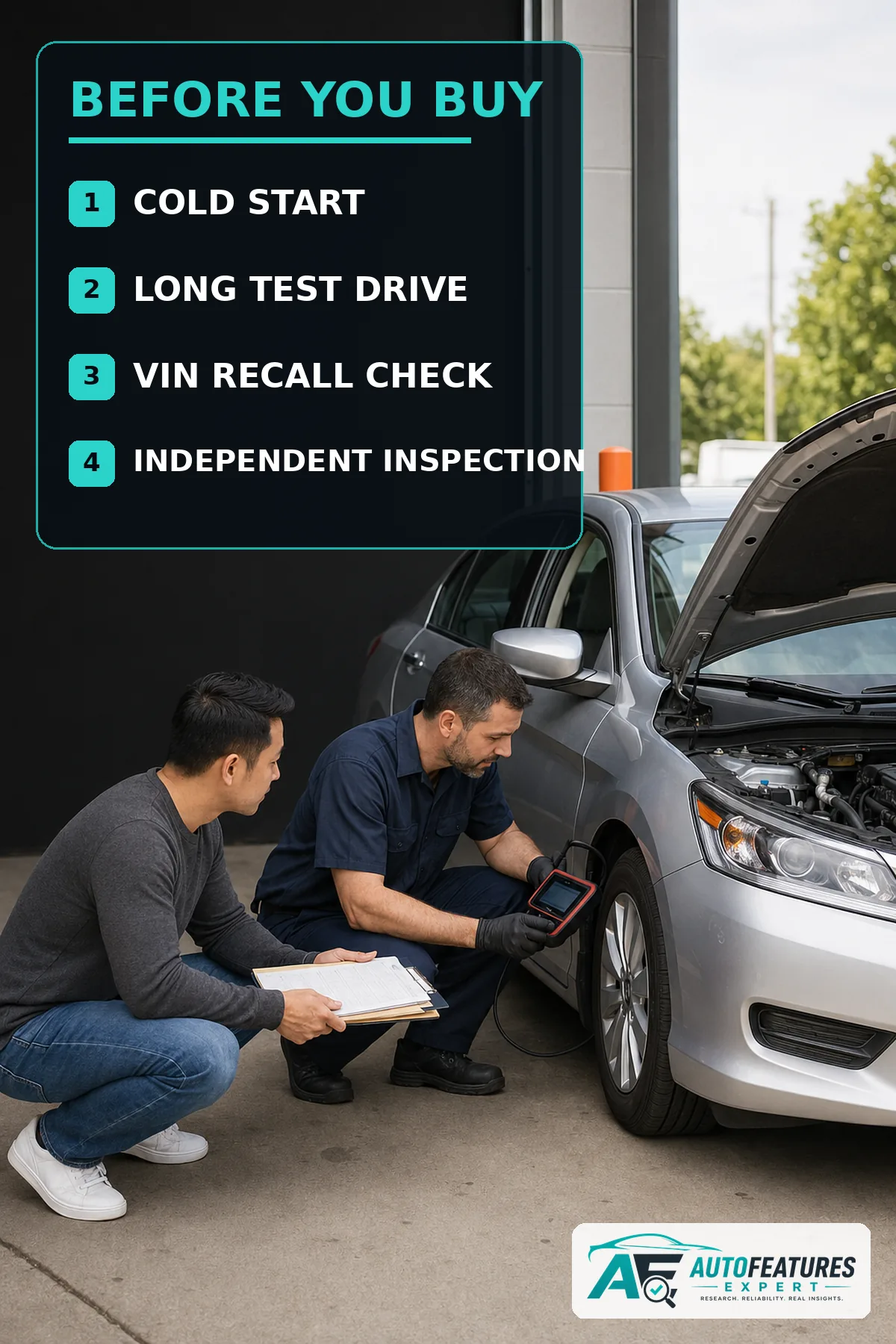
- Decode the VIN before the appointment. Confirm year, engine, transmission and trim. Run both NHTSA and Honda recall lookups, screenshot open campaigns and ask the seller for dealer repair orders.
- Request a true cold start. Tell the seller in writing not to start the car that day. On arrival, check that the engine is cold, inspect fluid levels safely and record the first 60 seconds for rattle, smoke and rough running.
- Scan every module. Read current, pending, permanent and history codes. Check readiness monitors; several “not ready” results can mean codes were recently cleared. A clear dashboard is not the same as a clean scan.
- Drive long enough to heat the drivetrain. Include parking maneuvers, gentle takeoff, light-throttle cruising, moderate acceleration, hills and deceleration. For older automatics, repeat Reverse-to-Drive engagement hot. For 2013–2017 V6 cars, hold 20–60 mph where judder can appear.
- Recheck fluids and leaks. Look for fresh spray-cleaning, coolant residue, oil seepage and transmission-fluid leaks. Never open a hot cooling system. Compare the cold coolant level with documented history rather than relying on one glance.
- Buy an independent pre-purchase inspection. Ask the shop to address the configuration-specific risk, not just perform a generic safety check. A 2019 1.5T may need an overnight pressure/borescope plan; a 2003 V6 automatic may need specialist shift evaluation.
| Finding | What it may mean | Decision threshold |
|---|---|---|
| Delayed Drive/Reverse, shift flare or slipping | Automatic transmission wear, hydraulic or control problem | Walk away unless a transmission specialist documents a limited, priced repair |
| V6 rumble-strip judder at 20–60 mph | Torque-converter judder covered by Honda diagnostic bulletins on certain 2013–2017 cars | Require documented software/fluid procedure and a symptom-free retest |
| Repeat cold misfire plus falling coolant | Possible 1.5T coolant intrusion; other causes still require exclusion | Pause purchase for overnight pressure test, borescope and written diagnosis |
| Low oil with vague top-off history | Leak, burning or neglected maintenance | Do not accept “normal”; require consumption testing or price as unresolved engine risk |
| Recently cleared monitors | Battery service or an attempt to hide a fault | Extend the drive and rescanning period; postpone the deal if monitors cannot run |
| Open safety recall | Known VIN-specific defect awaiting remedy | Arrange free dealer remedy before normal use; follow any Do Not Drive instruction |
Repair-Cost Risk: Why the Inspection Budget Matters
Purchase price alone can make a high-risk Accord look attractive. Compare it with the size of the plausible repair. RepairPal’s current generic estimate places a Honda Accord transmission replacement around $6,003–$6,525, excluding taxes, location differences and related work. Its 2019 Accord head-gasket estimate is about $2,688–$3,591 under the same limitations. Actual quotes can be higher when diagnosis reveals cylinder-head machining, engine damage, injectors, a torque converter, mounts or cooling-system parts.
Those figures are planning anchors, not quotes for a specific VIN. An older transmission may be repaired, rebuilt or replaced with a used/remanufactured unit at very different prices and warranty terms. A misfire may be an inexpensive ignition fault or evidence of internal engine work. Demand a written diagnosis and scope before subtracting a guessed amount from the asking price.
A rational inspection budget is small beside those exposures. Paying a qualified shop to scan modules, inspect on a lift and perform model-specific testing can save several thousand dollars. If the seller refuses an independent inspection, the information you lose is worth more than the apparent bargain.
How to Decide at a Given Price
Use three price bands. First, compare the candidate with clean examples of the same engine, transmission, trim and region—not merely the same model year. Second, subtract immediate known maintenance such as tires, brakes, timing service, fluids and unresolved recalls that affect logistics. Third, decide whether the remaining discount truly compensates for unresolved high-cost risk.
A $1,500 discount is not adequate protection against a $6,000 transmission possibility when the car already slips. A documented $3,000 repair completed recently by a reputable shop may be worth more than a similar discount with no invoice. The correct offer depends on evidence, warranty and how long you plan to own the car.
Do not let rarity or urgency compress the inspection. “Another buyer is coming” does not change the mechanical facts. Walk away from title inconsistencies, unexplained overheating, active slipping, a flashing check-engine light, coolant in a cylinder, oil-pressure warnings or a seller who blocks VIN verification. There will be another Accord.
Frequently Asked Questions
Which Honda Accord year is the worst?
2003 is the strongest single-year caution because owner-submitted data heavily concentrates around costly transmission failure and certain 2003 V6 automatics were included in recall 04V176 for second-gear heat buildup. That does not mean every 2003 Accord is defective. A four-cylinder manual and a V6 automatic have different risk, and VIN-specific repair history still controls the decision.
Should I avoid all 1998–2002 Accords?
No, but automatic cars—especially V6 examples—need unusually strong transmission evidence because a major repair can exceed the vehicle’s value. Test the car cold and fully warm and demand specific invoices for any replacement. For 2001–2002, run the VIN before driving because certain unrepaired Takata Alpha cars carry an urgent Do Not Drive warning.
Is a 2003 Accord four-cylinder safer than the V6?
From a transmission-risk perspective, a four-cylinder manual is a different and generally more attractive proposition than the V6 automatic highlighted by recall and owner-report evidence. A four-cylinder automatic still needs a complete shift test. Age-related airbag, rust, suspension, air-conditioning, fluid-leak and maintenance issues can outweigh the engine choice on an individual car.
Are 2008–2012 four-cylinders or V6 models worse?
They have different documented concerns. Honda bulletin 12-087 covers a high-oil-consumption condition in certain 2008–2011 four-cylinders, while bulletin 13-078 covers plug-fouling misfires tied to piston-ring behavior in 2008–2012 V6 automatics. The V6 bulletin’s eight-year extension is now historical for most cars. Inspect and price the exact powertrain rather than declaring one universal loser.
Should I avoid every 2018–2022 Accord?
No. The 1.5T, 2.0T and Hybrid are materially different. Honda’s 2023 parts-collection communication specifically identifies certain 2018–2019 1.5L cars with confirmed coolant intrusion and misfires. Similar reports justify inspecting later 1.5T cars, but that document does not include every 2020–2022 car or publish a failure rate. A cold-start, coolant and scan-data check is essential.
Are 2013–2017 Accord CVTs bad?
Honda’s widely cited judder bulletins for these years concern the V6 six-speed automatic, not the four-cylinder CVT. A CVT candidate still needs correct Honda fluid history, a long test drive, scan and checks for whine, judder or hesitation. Do not transfer a V6 torque-converter bulletin to the CVT, and do not buy any CVT with unresolved symptoms based only on the year’s reputation.
What are the safest alternative Accord years or configurations?
Comparatively attractive search targets include a well-documented 2006–2007 four-cylinder, a 2015–2017 four-cylinder/CVT with correct fluid service, or a 2021–2022 2.0T or Hybrid that passes inspection and VIN-recall checks. These are not guarantees. A neglected “good year” can be worse than a carefully repaired and maintained car from a higher-risk group.
Sources and Research Notes
- NHTSA/Honda recall 04V176 repair criteria and Honda’s transmission-recall announcement.
- Honda service bulletin 12-087 for specific four-cylinder oil-consumption conditions.
- Honda service bulletin 13-078 for V6 automatic misfires, plug fouling and piston-ring coverage.
- Honda bulletin 17-017 and 17-018 for V6 six-speed automatic torque-converter judder.
- Honda’s 2018–2019 Accord 1.5L dealer parts-collection request for confirmed coolant intrusion/misfire cases.
- NHTSA recall 25V785 Part 573 report for 2023–2025 Accord Hybrid ICM software and loss-of-drive-power risk.
- Honda bulletin for recall 24V763 covering certain 2023–2024 Accord Hybrid high-pressure fuel pumps.
- NHTSA VIN recall lookup and its older/completed-recall limitations; NHTSA Takata Alpha Do Not Drive alert.
- RepairPal Accord transmission-replacement estimate and 2019 Accord head-gasket estimate, accessed July 31, 2026.
- Owner-complaint aggregators were used to identify recurring inspection targets, not to calculate failure rates. Manufacturer bulletins were read for exact year, engine, transmission and symptom scope before a pattern was assigned.
About This Article
This guide was researched and fact-checked by the Auto Features Expert Editorial Team for U.S. used-car shoppers. We reviewed Honda service bulletins and dealer communications filed with NHTSA, Part 573 safety-recall reports, NHTSA consumer guidance, current repair-cost estimators and owner-submitted problem patterns. Research was completed July 31, 2026.
Our evidence hierarchy places official recall filings and manufacturer technical documents above complaint totals. Complaint data helps locate patterns but is not treated as a population failure rate. We distinguish a recall from a service bulletin, a warranty extension from current free coverage, and a documented model-year scope from later owner reports. Recommendations are configuration-specific wherever the source identifies an engine or transmission.
Vehicle condition, mileage, climate, collision history, maintenance and prior repairs can change the outcome. Prices are planning estimates rather than quotes and may exclude tax, diagnostic time, local labor differences and related damage. Always verify the VIN and obtain an independent pre-purchase inspection before buying.







