Use this guide for
Map Civic maintenance to mileage, time and operating conditions.
Boundary: Scheduled maintenance timing is different from repair-cost budgeting or fault diagnosis.
Honda Civic maintenance does not follow one universal mileage package. The exact year, engine, transmission, Maintenance Minder code and operating conditions determine the scheduled work. Tires, brakes, battery, suspension, leaks and A/C are separate condition-based items that should be measured rather than automatically bundled into a service package.
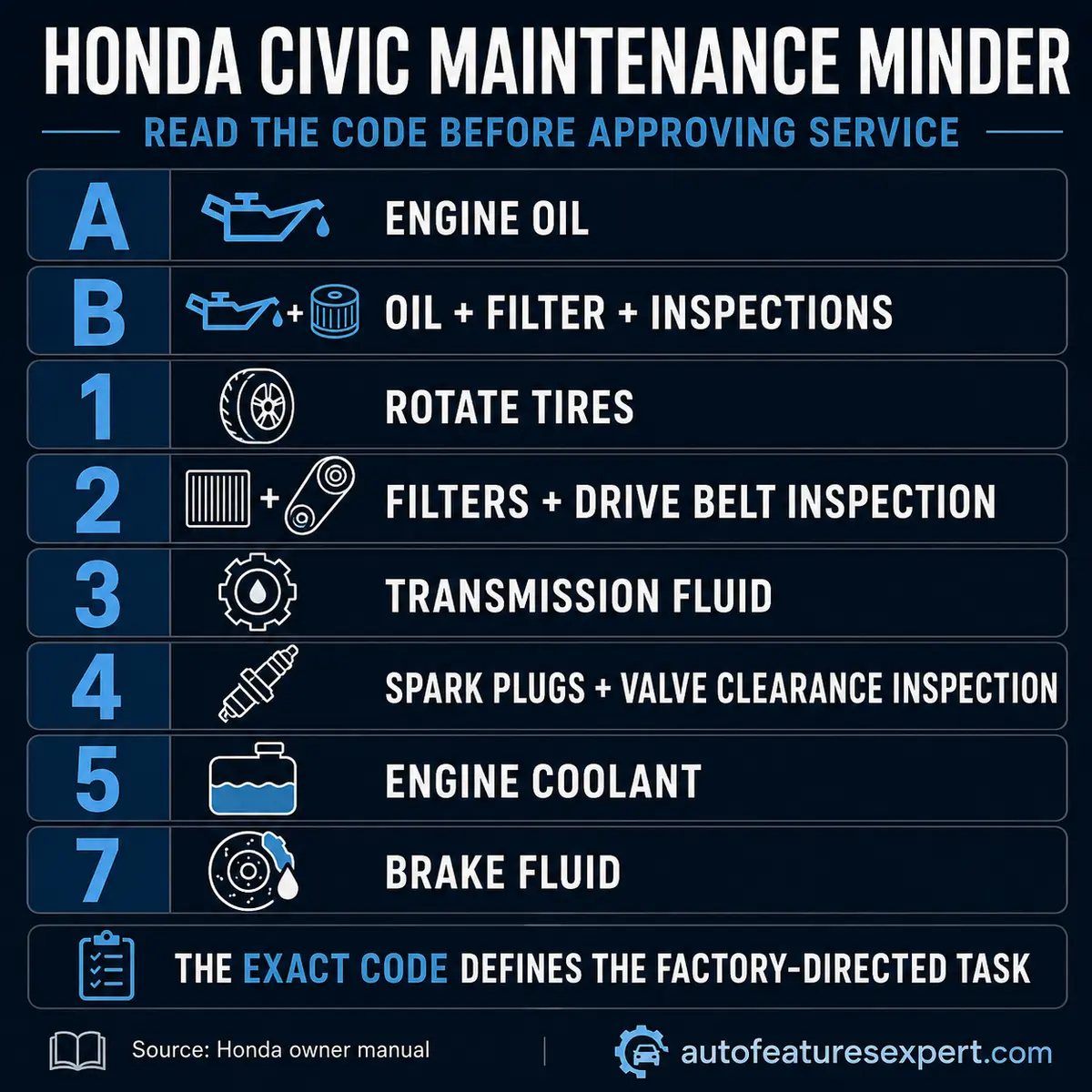
Translate the Maintenance Minder into actual work
| Code | Service category | Do not confuse it with |
|---|---|---|
| A | Engine oil | A universal oil viscosity/capacity for every Civic engine |
| B | Oil/filter plus listed inspections | Automatic replacement of everything inspected |
| 1 | Tire rotation | Automatic tire replacement without tread/age evidence |
| 2 | Filters and drive-belt inspection where specified | Automatic belt replacement |
| 3 | Transmission fluid | One fluid/procedure for conventional automatic, CVT, manual and hybrid drive |
| 4 | Spark plugs and valve-clearance work where specified | A generic “100K tune-up” |
| 5 | Engine coolant | Diagnosis of unexplained coolant loss |
| 7 | Brake fluid | Pad, rotor or caliper replacement without measurement |
This page owns scheduled maintenance requirements and record interpretation. Repair costs belong to Civic Maintenance Cost; existing symptoms belong to Troubleshooting.
Start with the exact configuration
Before interpreting a service record, identify the model year, engine and transmission. A 2001 timing-belt Civic, a later gasoline CVT and a current two-motor hybrid do not use the same maintenance logic. The Civic powertrain map resolves that configuration first.
Use mileage bands as an audit, not as a replacement for the manual
At lower mileage, oil service, tire rotation, inspections and code-driven work dominate. As mileage and age rise, the audit should verify whether transmission fluid, coolant, brake fluid, filters, plugs and other configuration-specific items were actually completed. Past 100,000 miles, deferred service and wear often matter more than the next routine oil change.
Service-record audit
| Evidence | Good record | Weak record |
|---|---|---|
| Oil service | Dated invoices with mileage and correct specification | Dashboard reset or “done regularly” |
| Transmission service | Correct fluid and procedure for installed unit | Generic “transmission flush” with no fluid detail |
| Coolant/brake fluid | Documented service at applicable interval | No record or repair mixed with routine maintenance |
| Wear items | Tread, brake and battery measurements | Replacement recommended only because of mileage |
| Major age/mileage service | Itemized invoice and date/mileage | Sticker or seller memory only |
Maintenance and repair are different costs
Brake-fluid replacement is maintenance; a leaking caliper is a repair. Coolant replacement is maintenance; diagnosing repeated coolant loss is repair. Transmission-fluid service is maintenance; internal slip or loss of drive is a fault. Keeping those categories separate prevents an inflated “maintenance cost” number and helps identify neglected vehicles.
For a used Civic, reconstruct what is due next
- Record current mileage and Maintenance Minder status.
- Collect invoices and sort them by date and mileage.
- Identify the exact engine and transmission.
- Compare documented service with the correct owner information.
- Measure tires, brakes and battery rather than guessing from age alone.
- Separate overdue scheduled work from existing faults.
- Price the next likely service window before buying.
Evidence boundary
The exact owner’s manual and applicable Honda service information control the schedule for a particular Civic. Mileage bands on this page are an audit framework, not a substitute for year- and powertrain-specific requirements.







