Use this guide for
Evaluate Accord 1.5T oil dilution through use pattern, oil level and service history.
Boundary: Do not merge oil dilution with coolant loss or head-gasket diagnosis.
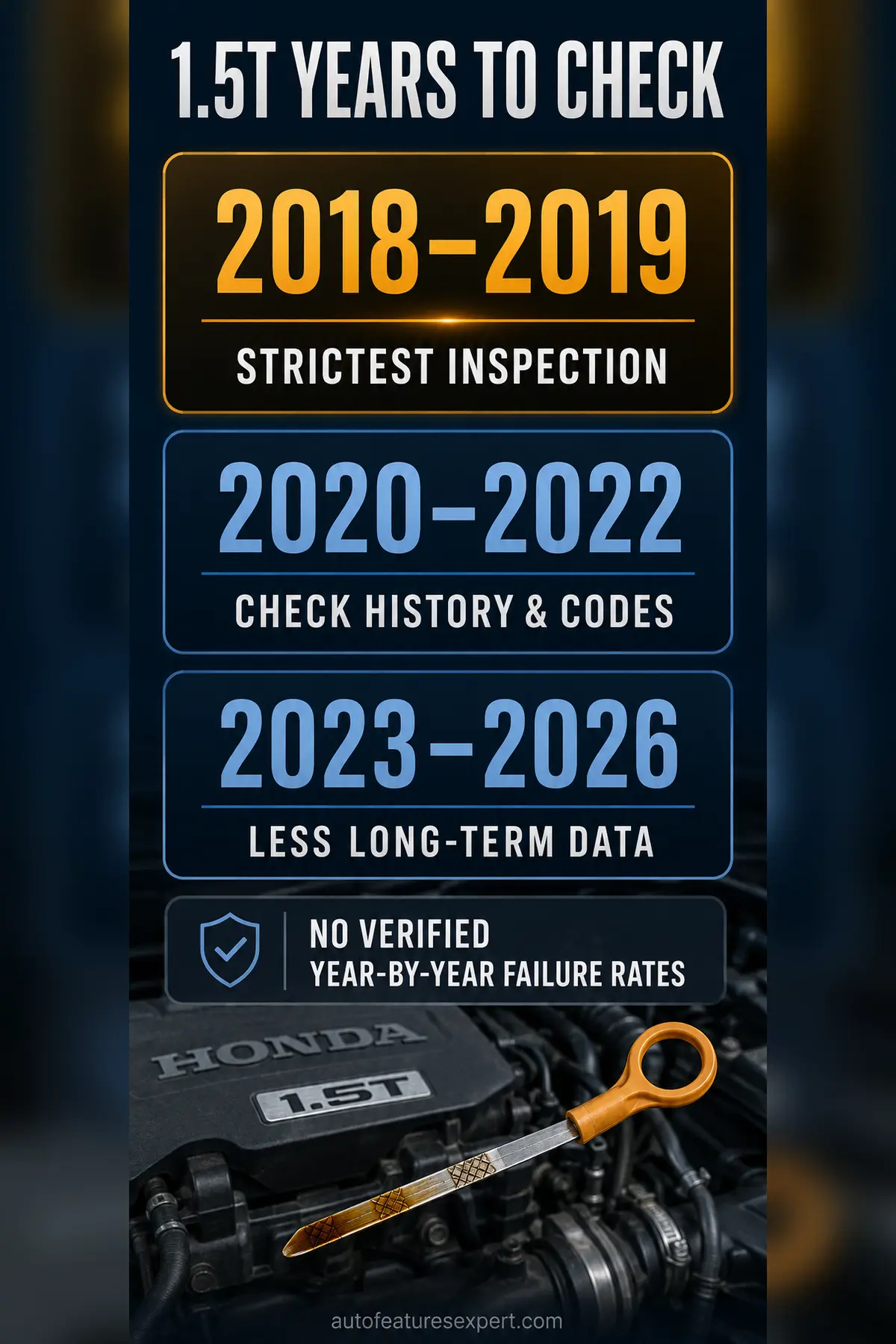
Honda Accord oil dilution is most worth checking on 2018–2022 Accords with the 1.5-liter turbo, especially early 2018–2019 cars used for repeated short trips in cold weather. However, Honda has not published an Accord-specific oil-dilution recall or failure-rate table. Treat a rising dipstick level, strong gasoline odor, P0172 or misfire codes as diagnostic clues—not proof—and separate fuel dilution from injector, head-gasket and fuel-pump faults.
Key Takeaways
- The relevant powertrain is the direct-injected 1.5T. The 2.0T and Accord Hybrid use different engines and should not be grouped into this diagnosis.
- 2018–2022 deserves the closest used-car check. Those years combine the earliest Accord application, the longest exposure and Honda dealer messages concerning P0300–P0304/P0172 conditions on 1.5T cars.
- 2018–2019 is an inspection priority, not a proven failure-rate winner. Honda’s later parts-collection request specifically sought certain 2018–2019 Accord 1.5L cars with misfires, but it addressed confirmed head-gasket leakage—not oil dilution.
- Honda’s well-known oil-dilution product updates and warranty extensions were written for selected Civic and CR-V applications. They should not be represented as an Accord recall or automatic Accord coverage.
- A gasoline smell alone is not a diagnosis. Confirm a repeatable rise in oil level, obtain scan data, inspect the cooling and fuel systems and consider laboratory oil analysis before approving major repairs.
Honda Accord Oil Dilution Risk Snapshot
| Question | Evidence-based answer | Buyer or owner action |
|---|---|---|
| Which Accord engine is relevant? | The 1.5-liter direct-injected turbo used in non-hybrid Accords. The 2.0T and hybrid powertrains are different. | Decode the VIN and confirm the engine before applying 1.5T advice. |
| Which years need the closest check? | 2018–2022 has the strongest reason for targeted inspection because it is the first Accord 1.5T generation and has the longest service history. Evidence does not establish a year-by-year failure rate. | Prioritize cold-start behavior, dipstick history, scan results and service records. |
| Are 2018–2019 the “worst”? | They are the earliest and most mature used-car cohort. Honda also investigated certain misfire conditions on these years, but that document does not prove oil-dilution prevalence. | Use a stricter pre-purchase inspection; do not reject a clean car by year alone. |
| What about 2023–2026? | Honda retained an updated 1.5T, including an upgraded direct-injection system for the eleventh-generation Accord. These cars have less long-term exposure. | Treat them as lower-confidence, not guaranteed problem-free. |
| Is there an Accord oil-dilution recall? | No Accord-specific oil-dilution safety recall was found in the Honda/NHTSA records reviewed on August 1, 2026. | Check the VIN anyway because unrelated recalls, including a fuel-pump recall, may apply. |
| Overall buyer recommendation | Inspect, do not automatically avoid. Risk depends heavily on operating pattern, maintenance, diagnosis and the individual car. | Prefer complete records, stable oil level, clean codes and a satisfactory cold-and-hot road test. |
What Oil Dilution Means in a Direct-Injected Turbo Engine
Oil dilution occurs when gasoline reaches the crankcase and mixes with engine oil. A small amount of fuel can enter the oil during normal cold operation, but the engine must become warm enough for much of that fuel to evaporate and leave through the crankcase-ventilation system. Repeated short trips can interrupt that process.
The Accord 1.5T combines direct injection, turbocharging and a relatively small oil capacity. Direct injection sprays fuel into the combustion chamber at high pressure. During a cold start, the engine uses a richer mixture while the cylinder walls and oil are cold. Some unburned fuel can pass the piston rings. If the car is shut off before the oil reaches sustained operating temperature, fuel can accumulate faster than it evaporates.
That mechanism does not mean every 1.5T develops harmful dilution. Climate, trip length, idle time, fuel-system condition, calibration, ring sealing, oil-change interval and measurement technique all affect the result. A dipstick reading also changes with parking angle, drain-back time and whether the oil was recently changed. The useful question is not “does this engine ever put fuel in the oil?” but “is fuel accumulating enough to raise the level, reduce viscosity or accompany a driveability fault?”
Affected Engines, Accord Models and Years
2018–2022 Accord 1.5T: The Main Used-Car Inspection Group
Honda introduced the tenth-generation U.S. Accord for 2018 with a 192-horsepower, direct-injected 1.5-liter turbo. The engine continued through the 2022 model year in non-hybrid trims. This is the group most people mean when they search for Honda Accord oil dilution, and it is the most sensible group to inspect closely because the earliest cars now have the longest combination of age, mileage and real-world use.
Honda dealer communications add context without proving an oil-dilution rate. A September 2021 parts-collection message sought certain 2018–2021 Accord 1.5Ts built after May 2018 when P0300–P0304 misfire codes or P0172 “system too rich” were stored and diagnosis pointed to the fuel injectors. A July 2022 message broadened similar parts collection to certain 2019–2022 Accord 1.5Ts. These were research requests to dealer personnel, not recalls, not warranty extensions and not declarations that every listed car had oil dilution.
The distinction matters because leaking, restricted or poorly performing injectors can create rich operation and misfires, and fuel-system faults may increase the opportunity for fuel to reach the oil. But P0172 can have several causes, while P030x codes can also result from ignition faults, compression loss or coolant intrusion. The scan code directs the investigation; it does not identify fuel in the crankcase by itself.
Why 2018–2019 Accords Deserve the Strictest Inspection
For a used buyer, 2018 and 2019 are reasonable inspection priorities because they are the earliest 1.5T Accords and therefore have the longest exposure to short-trip use, cold starts, deferred maintenance and prior repairs. They also appear in a 2023 Honda parts request involving confirmed head-gasket coolant leakage on certain 2018–2019 Accord 1.5L engines with misfire codes.
That head-gasket document must not be used as proof of oil dilution. Coolant intrusion can create rough running, misfires, coolant loss and steam-cleaned combustion chambers; fuel dilution is gasoline contaminating the crankcase oil. They can produce overlapping symptoms, but the tests and repairs are different. An article that combines them into one “1.5T defect” can send an owner toward the wrong repair.
There is no reliable public Honda table showing that a 2018 fails at a specific rate or that a 2019 is a fixed percentage safer. The defensible conclusion is narrower: inspect early cars more carefully, especially when their history includes winter short trips, rising oil level, repeat misfire work or unexplained frequent oil changes.
2020–2022 Accord 1.5T: Still Relevant, With No Automatic All-Clear
The same general operating mechanism can apply to 2020–2022 1.5T cars, and Honda’s 2021 and 2022 dealer messages included these later years in investigations of injector-traced P030x/P0172 complaints. Later production therefore should not be advertised as immune. At the same time, those messages do not establish a defect rate and were not Accord oil-dilution campaigns.
Condition and use should outweigh a simple model-year ranking. A 2021 Accord driven 2 miles at a time through cold winters may deserve more scrutiny than a well-documented 2018 that regularly completed long, fully warmed trips and shows stable oil level, clean scan data and normal compression/cooling-system checks.
2023–2026 Accord 1.5T: Updated, but Too New for the Same Long-Term Confidence
The eleventh-generation Accord continued with a 1.5-liter direct-injected turbo in LX/EX or later LX/SE non-hybrid trims. Honda described the 2023 system as updated and refined, including an upgraded direct-injection system and a new cold-active catalyst. That is meaningful design context, but it is not proof that fuel dilution is impossible.
As of August 1, 2026, these cars have less long-term exposure than the 2018–2022 generation. They should be labeled “less history” rather than “proven safe.” Owners should follow the correct oil specification and Maintenance Minder, monitor any abnormal rise in oil level and investigate warning lights instead of assuming a newer model year eliminates every 1.5T concern.
Accord Powertrains That Do Not Belong in This Group
- 2018–2022 Accord 2.0T: a different 2.0-liter turbo engine with different service information and fault patterns.
- Accord Hybrid: an Atkinson-cycle engine paired with Honda’s two-motor hybrid system, not the 1.5T.
- Earlier naturally aspirated Accords: they can develop fuel-system or oil issues, but they are outside this 1.5T-specific analysis.
Symptoms That Justify an Oil-Dilution Check
| Observation | Why it matters | What it does not prove |
|---|---|---|
| Oil level repeatedly rises above the full mark | Added volume can indicate fuel or coolant entering the crankcase. | One reading may be distorted by parking angle, drain-back time or overfilling. |
| Strong gasoline odor on the dipstick or drained oil | Fuel contamination is plausible when the smell is persistent and accompanied by a rising level. | Odor is subjective and does not measure the fuel percentage or viscosity. |
| P0172 fuel-system-too-rich code | A rich-running condition can increase fuel delivery and deserves fuel-system diagnosis. | The code does not prove crankcase dilution or identify the failed part. |
| P0300–P0304 misfire codes or rough running | Honda investigated injector-related misfires on some 1.5T Accords. | Ignition, injector, compression and coolant-intrusion faults can overlap. |
| Oil-pressure warning, new valvetrain noise or bearing noise | Loss of oil pressure or lubrication is urgent regardless of the cause. | These symptoms can result from low oil, mechanical wear, a sensor or other faults. |
| Poor fuel economy or harder cold starts | These can accompany rich operation or driveability problems. | Weather, tires, battery condition and many engine faults can cause the same change. |
Stop driving and arrange diagnosis if the oil-pressure warning remains on, the oil level is far above the maximum mark, the engine knocks, the vehicle stalls or there is severe misfiring. Fuel-contaminated oil can provide less protection, but continuing to run an engine with coolant intrusion, loss of oil pressure or an active severe misfire can also cause expensive damage.
How to Check and Diagnose Oil Dilution Correctly
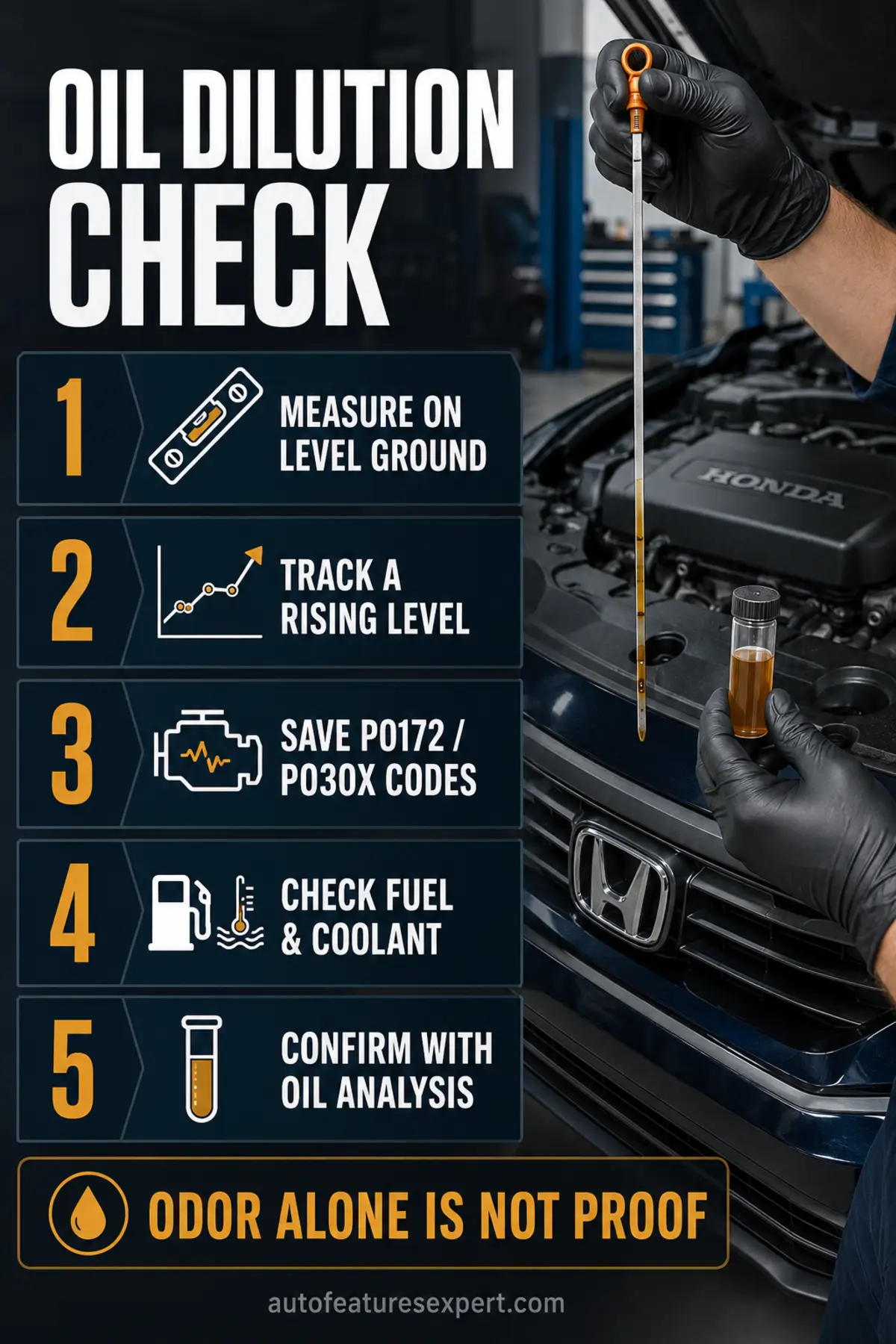
- Confirm the engine and baseline. Verify that the car is a non-hybrid Accord 1.5T. Review the last oil-change invoice for viscosity, quantity and date.
- Measure consistently. Park on the same level surface, follow the owner’s manual procedure and allow a consistent drain-back period. Photograph the dipstick with the date and mileage rather than relying on memory.
- Repeat the reading. A single high reading may be overfill. A repeatable upward trend over comparable checks is more useful.
- Preserve scan evidence. Scan the PCM for current, pending and history codes before clearing them or disconnecting the battery. Save freeze-frame data for P0172 or P030x.
- Check for coolant intrusion. Record coolant level cold, pressure-test when appropriate and use a borescope or leak-down/compression procedure if misfires and coolant loss point toward a head-gasket problem.
- Evaluate the fuel system. A technician may use fuel trims, injector balance, rail-pressure data, spark-plug appearance and Honda’s iN troubleshooting information. Replacing injectors solely because the oil smells like fuel skips essential diagnosis.
- Use laboratory oil analysis when the answer remains unclear. A used-oil lab can measure fuel dilution and viscosity. The sample should include oil mileage, engine mileage, oil brand/grade, top-off amount, trip pattern and ambient conditions.
- Recheck after the repair or oil change. Fresh oil resets the baseline; it does not identify why fuel accumulated. Continue consistent monitoring until the level and symptoms remain stable.
Expert Tip
Do not use an immediate post-oil-change dipstick reading as evidence that dilution is fixed. First verify that the shop filled the correct amount, then establish a repeatable level after normal operation. If the level climbs again, preserve the scan data and obtain a sample before another drain removes the best diagnostic evidence.
Repair Options and Possible U.S. Costs
“Fixing oil dilution” is not one line-item repair. The cost depends on what caused the abnormal fuel accumulation and whether wear has occurred. Current U.S. benchmarks are useful for comparison, but ZIP code, labor rate, model year and related damage can change a quote.
| Service or repair | Current benchmark | How to use the number |
|---|---|---|
| Oil change and new baseline | RepairPal lists about $119–$152 for a 2020 Accord; KBB’s displayed 2018 example varies by shop type and ZIP. | This removes contaminated oil but does not correct an injector, calibration, compression or coolant-leak fault. |
| Oil-warning/engine-oil diagnosis | RepairPal lists about $122–$179 for Accord engine-oil-light diagnosis. | A full rich/misfire investigation or oil analysis may add cost. |
| 2018 Accord fuel-injector replacement | RepairPal currently estimates about $1,257–$1,451. | Authorize only after diagnosis identifies the injectors; the estimate excludes taxes, location effects and related repairs. |
| Head-gasket or internal-engine work | No single national figure is reliable enough for this article because machine work, head condition, parts availability and collateral damage vary widely. | Require test results, itemized labor/parts, warranty terms and a second opinion before major work. |
If abnormal dilution is caught early and no mechanical fault is present, the practical response may be a correct oil service, an operating-pattern change and monitoring. If a rich condition, leaking injector, compression loss or coolant intrusion is confirmed, repair the cause first. An engine that already has low oil pressure, bearing noise or metal in the oil needs a different decision than one with only a mildly elevated laboratory fuel reading.
Recall, Warranty Extension and TSB: What Actually Applies?
No Verified Accord-Specific Oil-Dilution Recall
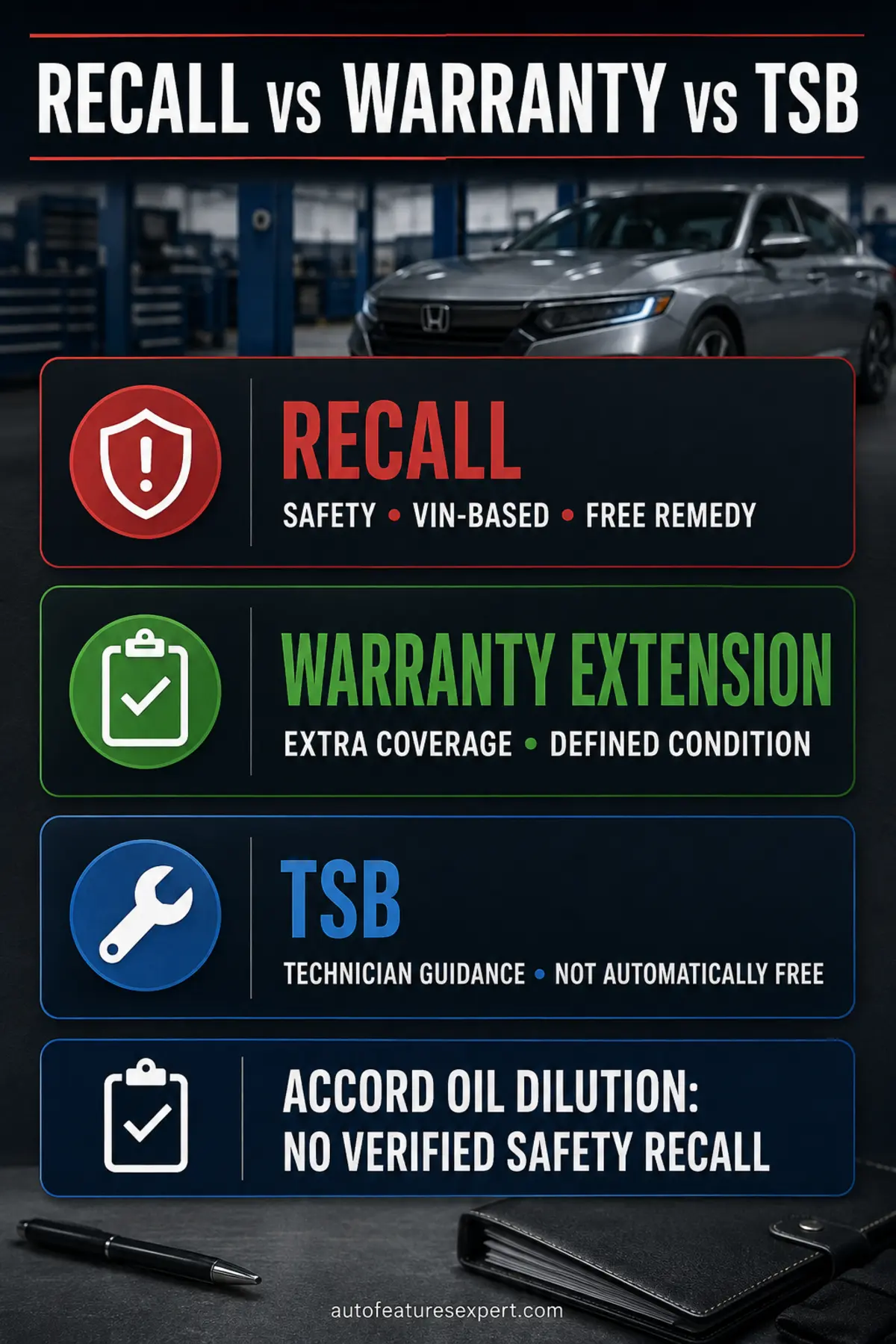
A safety recall addresses a safety-related defect or regulatory noncompliance in a defined VIN population. The Honda and NHTSA documents reviewed for this page did not show an Accord-specific oil-dilution safety recall. Search results often point to Honda’s 2018–2019 oil-dilution product updates and warranty extensions for selected CR-V and Civic applications; those documents do not list the Accord and should not be presented as Accord coverage.
The 2018–2022 Accord Fuel-Pump Recall Is Separate
Honda Service Bulletin 24-009 covers certain 2018–2022 Accord 1.5T vehicles by VIN for a fuel-pump motor impeller that can swell and cause the pump to stop working. The remedy is fuel-pump motor replacement. This is a real safety recall, but it concerns loss of fuel-pump operation—not a recall remedy for gasoline in the engine oil. Buyers should complete the free VIN check because an open recall still matters, while keeping the two conditions separate.
Honda Parts-Collection Requests Are Not Warranty Extensions
Honda’s 2021 and 2022 dealer messages asked for parts from qualifying 1.5T Accords with stored P030x/P0172 codes after normal troubleshooting traced the issue to fuel injectors. A 2023 request concerned qualifying 2018–2019 Accord 1.5L cars with a confirmed head-gasket coolant leak. These messages document Honda’s investigation criteria at those moments; they do not promise free repair, establish a prevalence rate or convert every similar complaint into the same diagnosis.
A technical service bulletin is service information for technicians. A warranty extension changes coverage for a defined condition and population. A recall creates a safety campaign tied to VIN eligibility. Ask a dealer to run the VIN in Honda’s iN system and identify the exact campaign or bulletin number instead of accepting the phrase “Honda has a bulletin for it” as proof of coverage.
Prevention and Maintenance That Actually Helps
- Use the viscosity and specification in the owner’s manual; do not “solve” fuel dilution by choosing a thicker oil without qualified guidance.
- Follow the Maintenance Minder, but shorten the decision cycle with a Honda specialist when repeated short trips, severe cold or documented dilution create a severe-service pattern.
- Avoid unnecessary extended idling. When practical, combine very short errands so the engine and oil reach full operating temperature.
- Do not accelerate hard when the engine is cold. Gentle driving warms the whole powertrain more usefully than prolonged stationary idling.
- Investigate P0172, P030x, hard starting and rough running promptly; do not repeatedly clear codes.
- Track oil and coolant levels using the same measurement method. A simple dated log is more valuable than an isolated smell test.
- Check open recalls by VIN through both Honda and NHTSA.
No fuel additive, catch can or oil brand can substitute for diagnosing an actual rich condition, leaking injector or coolant intrusion. Modifications can also complicate warranty discussions and introduce new variables. Keep the engine stock unless a qualified professional has a specific, evidence-based reason for a change.
Owner Experience: Useful Patterns Without Invented Statistics
Owner discussions commonly focus on three observations: a dipstick that appears higher than before, oil that smells of gasoline and concern about winter short-trip use. Those reports are useful for identifying questions and inspection steps, but they are not a denominator-based failure study. Forum members rarely use the same oil, sampling method, climate, trip pattern or diagnostic standard.
The most actionable owner pattern is documentation. A driver who records oil level and mileage, saves scan codes and obtains an oil-analysis result gives a technician something testable. A post that says “my oil smelled like gas, so the engine is defective” does not distinguish normal cold-start contamination from abnormal accumulation or identify whether injectors, compression, coolant or overfilling contributed.
Expert Analysis: Which Years Are Most at Risk?
For buying decisions, 2018–2019 should receive the strictest inspection, followed by 2020–2022. This ranking reflects exposure and evidence density—not a claimed failure rate. The early cars have been in service longest; Honda’s later communications document 1.5T misfire/rich-condition investigations across the tenth-generation years; and operating pattern can materially change the likelihood of fuel accumulating in oil.
2023–2026 should be treated as “less history,” not “no risk.” Honda updated the direct-injection system for the eleventh-generation Accord, and newer cars have fewer years of accumulated data. It would be premature to use that shorter history as proof that the condition cannot occur.
The best individual car is therefore not automatically the newest one. Prefer a car with stable oil and coolant levels, no stored or recently cleared codes, correct maintenance records, satisfactory cold and fully warm operation and a clean independent inspection. Avoid a seller who dismisses a rising oil level, cannot explain repeated injector/head-gasket work or will not allow diagnostic testing.
Buying Advice by Use Case
Frequent cold, short trips: A hybrid or a vehicle with a different powertrain may better fit the use pattern, but any recommendation should consider purchase price, climate and charging/driving needs. If choosing the 1.5T, plan consistent level checks and discuss severe-service maintenance with a Honda specialist.
Regular highway commute: A documented 1.5T that reaches full operating temperature, has clean scan results and passes inspection can be a reasonable purchase. Highway use does not erase a prior fault, so records still matter.
Unknown history or recently cleared codes: Walk away or price the uncertainty into the deal only after professional testing. A fresh oil change immediately before sale can be ordinary preparation, but it also removes the previous oil sample and level trend.
Existing owner with rising oil: Document the change, preserve codes and request diagnosis before repeatedly changing the oil. If the shop says the condition is normal, ask it to record the measured level, scan results and recommended monitoring interval on the repair order.
Related Honda Accord Guides
- Honda Accord 1.5T Head Gasket Failure: Years, Symptoms and Repair Cost
- Honda Accord Years to Avoid: Problem Patterns Used Buyers Should Know
- Honda Accord CVT Problems: Shudder, Fluid Service and Failure Signs
Honda Accord Oil Dilution FAQ
Which Honda Accord years have oil dilution problems?
The relevant U.S. group is the 2018–2026 Accord equipped with the 1.5-liter direct-injected turbo, but public records do not establish that every year has a defect or provide year-by-year failure rates. For used-car inspection, prioritize 2018–2022 because those cars have the longest exposure and Honda investigated related 1.5T P030x/P0172 conditions during that generation. Treat 2023–2026 as having less long-term evidence, not as guaranteed immune.
Is the 2018 Honda Accord the worst year for oil dilution?
There is not enough verified data to label 2018 the worst by failure rate. It deserves the strictest inspection because it was the first Accord 1.5T model year and now has the most time for mileage, short-trip use and maintenance history to accumulate. A clean, well-documented 2018 may be a better purchase than a later car with rising oil, stored codes or an unexplained repair history.
Does Honda have an oil-dilution recall for the Accord?
No Accord-specific oil-dilution safety recall was found in the Honda and NHTSA records reviewed on August 1, 2026. Selected Civic and CR-V 1.5T vehicles received separate product updates and warranty extensions, but those documents should not be applied automatically to the Accord. Certain 2018–2022 Accord 1.5Ts do have a VIN-based fuel-pump motor recall, which addresses pump impeller failure rather than fuel in engine oil.
How can I tell if gasoline is getting into my Accord’s oil?
Look for a repeatable rise in dipstick level using the same level surface and procedure, then preserve any P0172 or P030x scan data. A strong gasoline odor can support the concern but cannot quantify dilution. A laboratory used-oil analysis can measure fuel and viscosity. Diagnosis should also check for injector faults, overfilling and coolant intrusion because these conditions can create overlapping symptoms or change the oil level.
Will a long drive fix Honda Accord oil dilution?
Reaching sustained operating temperature may help normal cold-start fuel contamination evaporate, especially after repeated short trips. It will not repair a leaking injector, rich-running fault, compression problem or coolant leak, and it cannot reverse existing mechanical wear. Do not prescribe a highway drive when the oil is far overfull, the oil-pressure warning is on, the engine knocks or a severe misfire is active.
Should I change the oil more often on a Honda Accord 1.5T?
Follow the owner’s manual and Maintenance Minder unless a documented condition or severe operating pattern justifies a different interval. For repeated cold short trips or confirmed dilution, ask a Honda specialist to set an evidence-based interval and consider oil analysis. Extra oil changes can reduce exposure to contaminated oil, but they do not diagnose or repair the cause of abnormal fuel accumulation.
Is a used Honda Accord 1.5T safe to buy?
A used Accord 1.5T can be a reasonable purchase when it has stable oil and coolant levels, clean scan results, correct maintenance records, normal cold-and-hot operation and a satisfactory independent inspection. Give 2018–2019 cars the closest scrutiny, but do not reject or approve any car on model year alone. Check the VIN for recalls and investigate recent injector, head-gasket or repeated misfire work before buying.
Sources
- American Honda: 2018 Accord Specifications & Features
- American Honda: 2018 Accord Press Kit—Powertrain
- American Honda: 2023 Accord Press Kit
- American Honda: 2026 Accord Specifications & Features
- American Honda Dealer Message: 2018–2021 Accord 1.5T P030x/P0172 Parts Request
- American Honda Dealer Message: 2019–2022 Accord 1.5T P030x/P0172 Parts Request
- American Honda Dealer Message: 2018–2019 Accord 1.5L Misfire/Confirmed Head-Gasket Leak Parts Request
- American Honda Service Bulletin 24-009: 2018–2022 Accord 1.5L Fuel Pump Motor Safety Recall
- Honda Owners: VIN Recall Lookup
- NHTSA: VIN Recall Lookup
- RepairPal: 2020 Honda Accord Oil Change Cost
- RepairPal: 2018 Honda Accord Fuel Injector Replacement Cost
- RepairPal: Honda Accord Engine Oil Light Diagnosis Cost
How We Evaluated This Article
Scope: This guide addresses U.S.-market Honda Accord 1.5T vehicles, with emphasis on 2018–2026 model years, fuel-in-oil search intent and used-car decisions. It separates oil dilution from fuel-injector faults, coolant intrusion, fuel-pump recalls and unrelated powertrains.
Method: Alex Fric reviewed American Honda specifications, press materials, dealer communications filed in NHTSA’s manufacturer-communications database, the current Accord fuel-pump recall remedy and current U.S. repair-cost benchmarks. Search-result and owner-discussion patterns were used to identify questions, not to calculate failure rates.
Evidence limits: Honda has not published an Accord oil-dilution failure-rate table, and owner complaints do not provide a controlled denominator. This article therefore uses inspection-priority language rather than invented percentages. A VIN lookup, scan, consistent oil-level measurements and physical diagnosis remain necessary for an individual vehicle.
Review date: Sources and recall context were checked on August 1, 2026. Recall eligibility, technical information and repair prices can change; recheck the VIN and current service information before purchase or repair.







