Use this guide for
Separate Accord CVT shudder, fluid-service history, abnormal noise and failure signs.
Boundary: A drivability symptom does not prove CVT failure without configuration and diagnostic evidence.
Honda Accord CVT problems are most credibly concentrated in three documented groups: 2013 and certain early 2014 four-cylinder cars that surge, hesitate or judder from a stop; certain 2015–2016 four-cylinder CVTs that can stall when shifted into Reverse after a cold start; and a small VIN-specific group of 2021 Accord Sport models covered by a CVT replacement product update. Persistent shudder, slipping, abnormal whine, warning lights or loss of movement needs diagnosis—not another generic fluid recommendation.
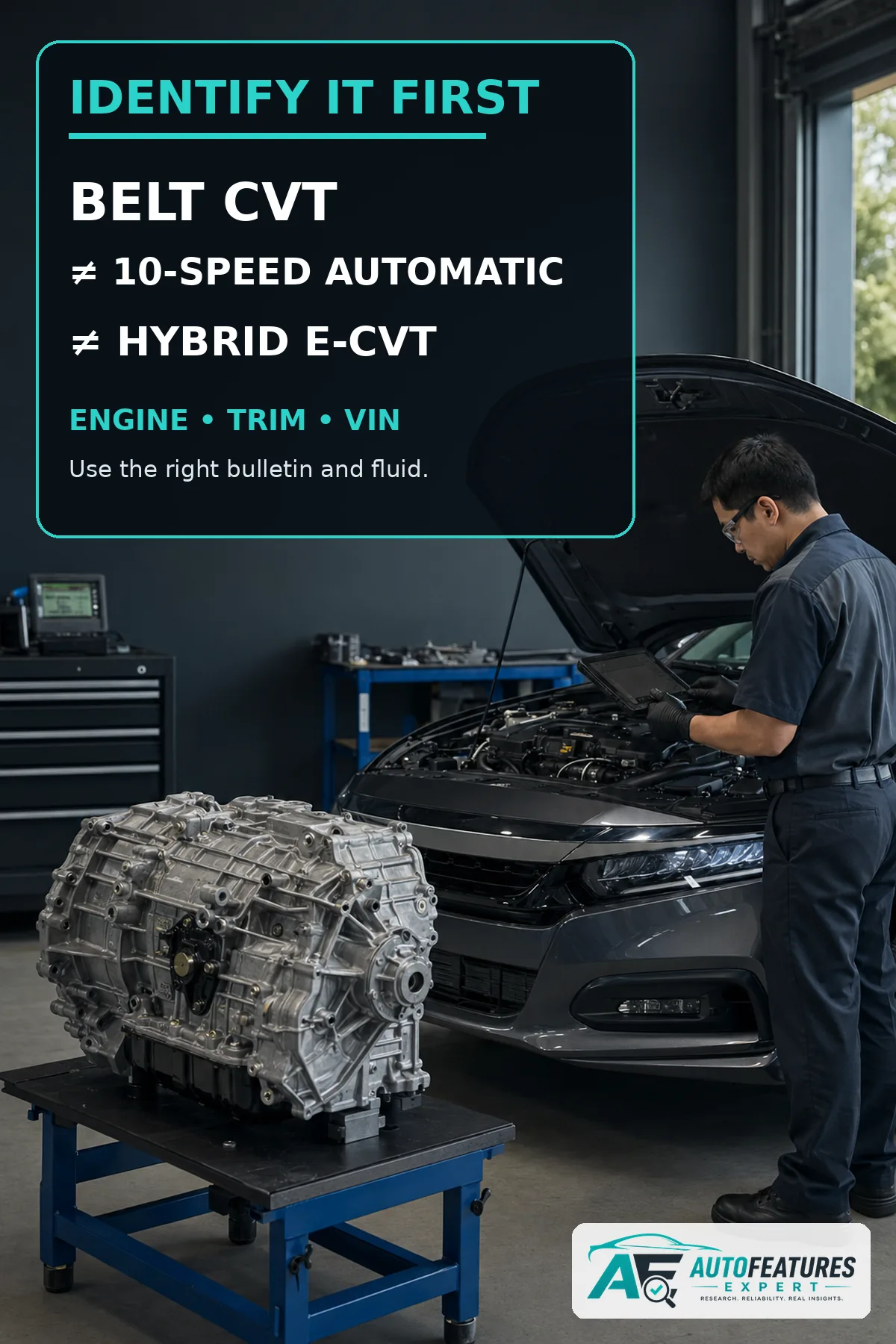
The Accord has used more than one transmission architecture since 2013. A four-cylinder gasoline model may have a belt-and-pulley CVT, a 2.0T uses a conventional 10-speed automatic, and an Accord Hybrid uses Honda’s two-motor electronic drive system. Calling all three “the Accord CVT” leads to the wrong service fluid, the wrong bulletin and often the wrong repair estimate. This guide identifies the unit first, then separates normal CVT behavior from a repairable control problem and a likely internal failure.
Key Takeaways
- 2013 and selected early 2014 cars have the clearest judder bulletin. Honda service bulletin 13-053 describes surge, hesitation or judder during light acceleration from a stop, especially before warm-up. The specified repair is an updated lower valve body plus PGM-FI software—not an automatic whole-transmission replacement.
- Cold Reverse stalling is a separate problem. Bulletin 18-072 covers certain 2015–2016 Accord L4 CVTs that stall 10–14 seconds after a cold start when shifted into Reverse. Honda’s diagnostic procedure uses an on-board snapshot; a matching case can require CVT replacement.
- Certain 2021 Sport VINs received a product update. Honda bulletin 22-052 says improper driven-pulley heat treatment may cause wear, belt damage, slipping, noise, warning lights or inability to move forward after stopping. It directs dealers to replace an included transmission.
- There is no evidence that every Accord CVT is defective. The official documents define years, builds, symptoms and VIN ranges. A bulletin or product update is not a model-wide failure-rate study.
- Use the correct fluid. Honda specifies HCF-2 for the belt-type Accord CVT and warns that incorrect fluid can damage the transmission. Follow the Maintenance Minder and the exact owner’s manual for the VIN.
- A fluid change cannot repair damaged hardware. Fresh correct fluid may improve behavior caused by degraded or incorrect fluid, but it cannot harden a defective pulley, remove belt damage or reverse internal metal wear.
Honda Accord CVT Problems: The Fast Diagnostic Answer
A shudder from a stop is not enough to condemn the transmission. On a 2013 or affected 2014 four-cylinder CVT, it can match Honda’s valve-body/software bulletin. A 2015–2016 car that actually stalls in Reverse during the first 10–14 seconds after a cold start fits a different and more serious diagnostic path. On an affected 2021 Sport VIN, slip with abnormal noise and multiple warnings can trigger a replacement campaign. On other years, normal troubleshooting must rule out engine misfire, mounts, axles, tires, incorrect fluid, low fluid and software before the CVT assembly is blamed.
| Symptom | Most useful first check | Urgency | Do not assume |
|---|---|---|---|
| Surge, hesitation or judder from a stop, worse cold | Confirm 2013/affected 2014 L4 CVT eligibility for bulletin 13-053; scan and reproduce cold | Schedule diagnosis promptly | That every judder needs a replacement CVT |
| Engine stalls after cold start when Reverse is selected | Preserve Honda on-board snapshot; compare year/VIN with 18-072 | High—loss of propulsion/control during maneuver | That it is normal cold behavior or merely a weak battery |
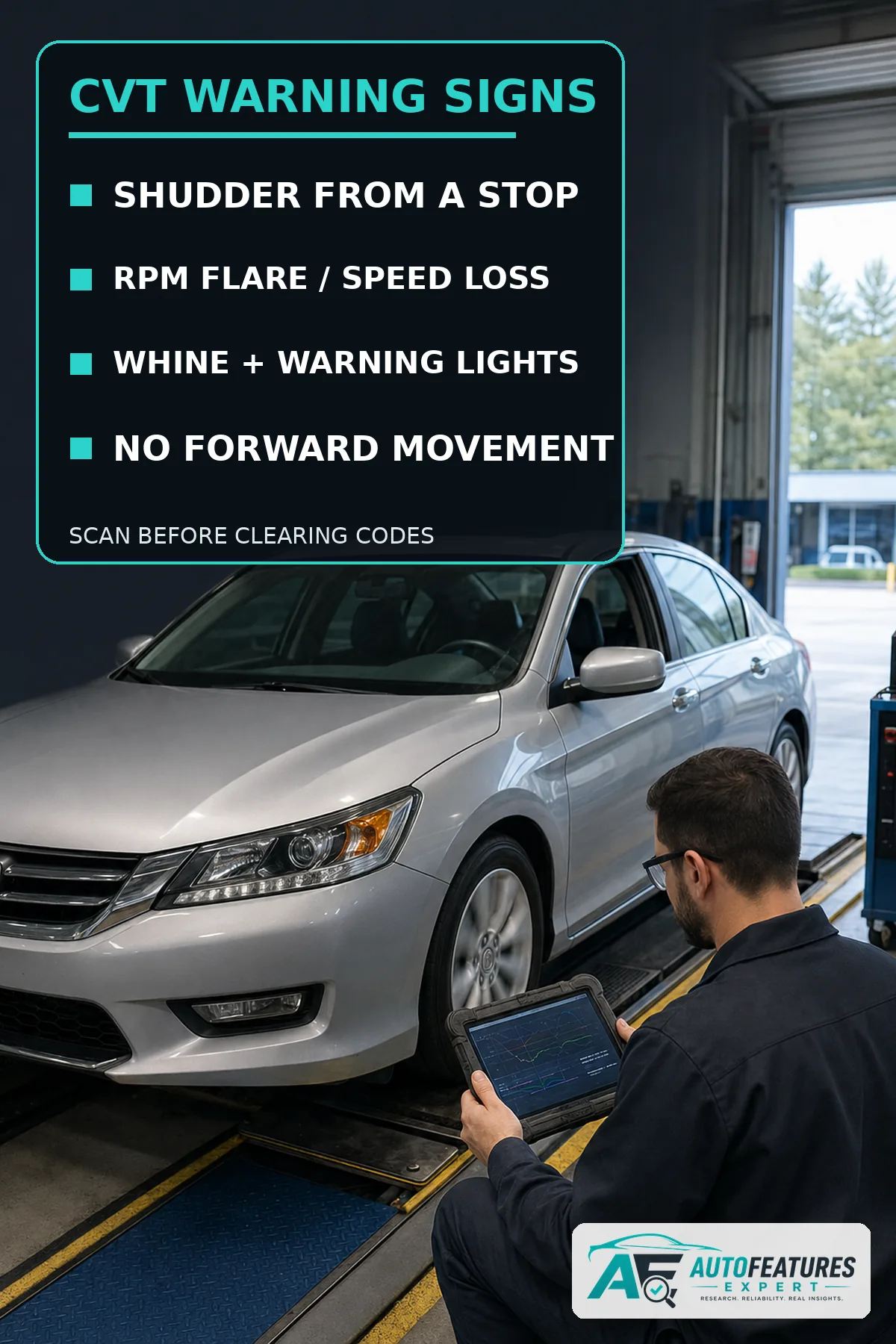
| Engine rpm rises but road speed does not follow | Scan CVT/engine modules; inspect fluid level, leaks and debris; road-test with data | High—limit driving | That all CVT rpm rise is “slipping” |
| Abnormal whine, metal noise, warnings and no forward movement | Stop driving; tow; check VIN for 2021 product update and inspect for internal damage | Immediate | That a drain-and-fill will restore damaged pulleys or belt |
| Vibration only at a particular vehicle speed | Inspect tires, wheels, axles and engine mounts before internal CVT conclusions | Moderate unless worsening | That every speed-related vibration comes from the transmission |
| Flashing transmission indicator or multiple warnings | Record every DTC and freeze-frame before clearing anything | High | That disconnecting the battery repaired the cause |
Which Honda Accord Models Actually Use a Belt-Type CVT?
The U.S.-market Accord introduced a conventional metal-belt CVT with the ninth-generation four-cylinder gasoline model for 2013. The V6 from that generation did not use it. For 2018–2022, the 1.5-liter turbo paired with a CVT, while the 2.0-liter turbo used a 10-speed conventional automatic. In the current generation, non-hybrid 1.5T trims use a CVT; hybrid trims use Honda’s two-motor system marketed with an electronic CVT or direct-drive description.
| U.S. Accord configuration | Transmission type | Is this article’s belt-CVT diagnosis relevant? |
|---|---|---|
| 2013–2017 2.4L four-cylinder gasoline | Belt-and-pulley CVT on CVT-equipped cars; manual also existed | Yes—especially the exact 2013/2014 bulletin scope |
| 2013–2017 V6 | Six-speed automatic or manual depending on body/trim | No—use the V6 automatic/manual diagnostic path |
| 2018–2022 1.5T gasoline | CVT, with manual offered on limited earlier configurations | Yes, after confirming the transmission from the VIN/build label |
| 2018–2022 2.0T gasoline | 10-speed automatic or limited manual | No—do not apply HCF-2 or CVT bulletins |
| Accord Hybrid | Honda two-motor hybrid electronic drive/e-CVT terminology | No—the architecture and diagnostic path differ from the metal-belt CVT |
| 2023–2026 non-hybrid 1.5T | Conventional belt-type CVT | Yes for general operation, fluid and symptom diagnosis; older bulletins do not automatically apply |
This distinction is more than vocabulary. Honda’s conventional CVT uses hydraulically controlled drive and driven pulleys connected by a metal belt. Honda’s two-motor hybrid system primarily uses a traction motor and generator, with the engine able to connect directly in an efficient cruising mode. The hybrid may be advertised as “e-CVT,” but it does not share the same belt-and-pulley failure mechanism as the gasoline CVT.
Before authorizing service, decode the VIN and verify the powertrain. Do not rely on the seller’s phrase “automatic.” A shop quoting HCF-2 fluid for a 2.0T 10-speed or diagnosing a hybrid with a belt-CVT bulletin is working from the wrong unit.
2013–2014 Accord CVT Judder: What Bulletin 13-053 Actually Says
Honda service bulletin 13-053 is the strongest primary source for the early Accord CVT’s best-known drivability complaint. The symptom is precise: surge, hesitation or judder as the car accelerates from a stop, more noticeable before the vehicle is fully warmed. Honda attributes the condition to a need for CVT hardware and software updates.
The November 2015 version covers all 2013 Accord L4 CVTs, including Japan-built cars with JHM VINs and U.S.-built cars with 1HG VINs. It also lists specific U.S.-built 2014 coupe and sedan VIN ranges. Because the 2014 scope ends at defined serial numbers, “2014 Accord” alone is not a diagnosis; the VIN must be compared with the bulletin or checked by a Honda dealer.
The corrective action is an updated lower valve-body kit and a PGM-FI software update. The procedure includes draining HCF-2, inspecting and cleaning the pan and magnets, checking the strainer inlet, installing the revised valve body and confirming fluid level. Honda states that normal warranty applies in the bulletin; that wording does not create free coverage for an out-of-warranty vehicle today.
This official repair path corrects two common internet errors. First, bulletin 13-053 does not prescribe a simple “three drain-and-fills” as the complete fix. Second, it does not say every affected car needs a whole CVT. A seller’s invoice should show the valve-body part, software work and date—not merely “transmission serviced.”
How to test an early Accord for the bulletin symptom
Arrange the inspection before the first start of the day. With the engine and CVT cold, use light, steady accelerator input from a complete stop on level pavement. Repeat several normal takeoffs without brake-torquing or aggressive launches. Note whether the car pauses, surges or vibrates as drive is applied, then repeat after full warm-up. A symptom that is strongest cold and fades warm deserves a bulletin/VIN review.
Do not clear codes or disconnect the battery before diagnosis. Scan all modules, not only generic engine data. Check whether readiness monitors are incomplete, which can suggest recent clearing. Inspect engine and transmission mounts because a collapsed mount can magnify otherwise mild powertrain movement. Confirm that an engine misfire is not creating a shudder that feels like transmission trouble.
2015–2016 Cold Reverse Stall: A Different Failure Pattern
Honda bulletin 18-072 covers all 2015 Accord L4 CVTs and specified 2016 Accord four-door and two-door VIN ranges. Its symptom is unusually specific: after a cold start, the engine stalls when Reverse is selected within approximately 10–14 seconds.
Honda explains that excessive oil clearance between the input and stator shafts can let fluid drain from the torque converter during a long off period. When the converter refills after startup, trapped air can apply the lock-up clutch and stall the engine. The bulletin does not instruct a technician to guess from the customer description. It requires retrieving an on-board PGM-FI snapshot and comparing engine speed, vehicle speed, selector position, temperatures, run time and lock-up-solenoid data with Honda’s example.
If the snapshot matches, the repair procedure calls for CVT replacement. If there is no matching snapshot, the bulletin says to continue normal troubleshooting. This is why a buyer should not let a seller clear data after a cold-stall event. The stored snapshot can be the evidence that separates an intermittent ignition or idle problem from the documented transmission condition.
A 2015–2016 Accord that starts normally and never stalls in Reverse is not proven defective simply because its year appears in the bulletin. Conversely, a car that has been warmed before every viewing has not passed the cold test. Ask the seller in writing to leave it untouched overnight.
2021 Accord Sport CVT Product Update: Small Population, Serious Symptom
Honda’s 2022 service bulletin 22-052 is a product update for certain 2021 Accord Sport VINs. The companion dealer notice says the campaign covered 75 total 2021 Accord and CR-V units—not 75 Accords alone. This is a narrowly defined manufacturing population, not a finding that all 2021 Accord Sport CVTs are weak.
The documented cause is improper heat treatment of the driven pulley. Honda says abnormal pulley wear or CVT-belt damage can produce slipping, abnormal noise and multiple warning lights; in some cases, the vehicle may not move forward after stopping. The corrective action is replacement of the transmission when the VIN is included.
For a used 2021 Sport, ask a Honda dealer to run an iN VIN-status inquiry. Public recall tools are essential for safety recalls, but a manufacturer product update may require the dealer campaign system for definitive status. Obtain the completed repair order if the campaign was performed. If the seller reports slip or loss of forward motion and the VIN is not included, the car still needs normal CVT diagnosis—the absence of campaign eligibility does not make the symptom harmless.
Normal Accord CVT Behavior vs. a Real Failure Sign
A CVT does not have to step through fixed gears. During firm acceleration, it can raise engine rpm to an efficient power point and hold it while vehicle speed increases. Some Accords simulate stepped shifts under certain conditions to make the response feel more familiar. Neither behavior alone proves belt slip.
The key is whether acceleration matches command. A healthy CVT can hold rpm, but the car should gain speed smoothly and repeatably. In true slip, engine speed may flare without corresponding acceleration, sometimes with a warning indicator, heat-related deterioration or abnormal noise. The difference is easier to identify when a technician records engine rpm, vehicle speed, commanded ratio, pulley pressures and temperatures rather than relying on sensation alone.
Shudder
A low-speed judder can come from CVT hydraulic control, torque-converter lock-up behavior, degraded or incorrect fluid, mounts, inner CV joints or an engine misfire. Frequency helps: an engine-related shudder follows engine rpm, a tire/wheel vibration follows road speed, and a launch-only event follows load application. Bulletin 13-053 provides a configuration-specific path for early cars, but later models require their own diagnosis.
Whine or hum
Some hydraulic and gear noise is normal, especially when load changes. A new or rapidly increasing whine that rises with road speed, becomes louder hot, accompanies metal debris or appears with ratio codes is not normal. Compare the noise in Park/Neutral and in motion, on and off throttle. Wheel bearings can closely imitate transmission hum, so lift inspection and chassis-ear testing may prevent a false CVT replacement.
Hesitation
Turbo lag, throttle mapping, idle-stop restart, traction control and CVT ratio selection can all affect response. A repeat delay entering Drive or Reverse, a long pause before the vehicle moves or hesitation with warning codes needs diagnosis. A 1.5T engine misfire or fuel-delivery problem can also feel like transmission hesitation; our Accord 1.5T head-gasket diagnostic guide explains why misfire and coolant evidence must be separated from CVT behavior.
Warning lights or limp behavior
A flashing transmission indicator, reduced-power mode or a cluster of warnings is a data-preservation event. Photograph the dashboard, record the circumstances and scan before clearing. Low 12-volt voltage can generate multiple alerts, but that possibility does not justify erasing transmission codes without saving them.
A Diagnosis Ladder That Avoids an Unnecessary CVT Replacement
- Identify the exact unit. Decode the VIN and verify engine, trim and transmission. Separate 2.4L CVT, 1.5T CVT, 2.0T 10-speed and Hybrid electronic-drive cars.
- Record when the symptom occurs. Cold or hot, from a stop or at cruise, Reverse or Drive, uphill or level, light or heavy throttle. A repeatable condition is far more useful than “it shifts weird.”
- Scan before service. Save engine, transmission and body-module DTCs, pending/permanent codes, freeze-frame data and readiness status. On a 2015–2016 cold Reverse stall, preserve the on-board snapshot required by Honda’s bulletin.
- Check external causes. Inspect fluid leaks, mounts, axles, wheel/tire condition, charging voltage and engine performance. A vibration is not automatically an internal CVT failure.
- Verify fluid identity and level. Ask for invoices showing HCF-2, quantity and date. The wrong product or incorrect level can cause poor operation. A red generic “universal CVT” receipt needs product verification.
- Road-test with data cold and hot. Compare vehicle speed with engine rpm and commanded operation. Reproduce the exact start, cruise or Reverse condition safely.
- Check bulletin and campaign eligibility. Match 13-053 by VIN, 18-072 by year/VIN and symptom, and 22-052 through Honda’s VIN system.
- Inspect the evidence in drained fluid. A small paste on a magnetic plug differs from flakes, chips or heavy metallic material. Have the shop photograph the pan, magnets and fluid before cleaning.
- Demand a repair boundary. A quote should say whether the plan is fluid correction, software, valve body, external component or complete CVT—and what test justifies that step.

Honda Accord CVT Fluid: Interval, HCF-2 and Service Method
Honda’s Maintenance Minder uses sub-item 3 for transmission-fluid replacement. It calculates service timing from operating conditions rather than publishing one universal normal-use mileage for every owner. The relevant owner’s manual also adds a severe-use instruction: regular low-speed driving in mountainous areas raises transmission temperature and requires more frequent fluid replacement, commonly every 25,000 miles (40,000 km) in the referenced Accord manuals.
That does not make an arbitrary 30,000-mile schedule a Honda rule for every car. A conservative owner may choose a mileage cap based on use, age and service history, but the article should distinguish personal preventive strategy from manufacturer wording. Follow the Maintenance Minder, the exact model-year manual and any severe-use note that applies to the vehicle.
For the conventional Accord CVT, Honda specifies HCF-2. Bulletin 13-053 explicitly warns that incorrect fluid will damage the transmission. Bulletin 18-072 says wrong fluid or an incorrect fill level can make the CVT work poorly and may cause a replacement unit to fail again. Modern Accord CVTs generally use a check-bolt procedure rather than a casual dipstick check, so temperature, selector cycling and vehicle level matter.
Current Accord specifications list approximately 3.9 U.S. quarts (3.7 liters) for a routine HCF-2 change, but complete replacement capacity is substantially higher. The 2021 replacement bulletin, for example, specifies 8.0 quarts during installation. Never use one web number for every service operation; “drain-and-fill quantity” and “dry/replacement fill” are different.
Drain-and-fill or machine flush?
Honda’s owner information describes fluid replacement, and the factory procedures reviewed here drain and refill with HCF-2 while controlling level. They do not establish a generic high-pressure machine flush as the default Accord CVT service. If a shop proposes a machine exchange, ask for the Honda procedure it will follow, the exact fluid, how adapters are isolated from other products and how final level will be verified.
Do not use an aggressive service to hide a failing unit before sale. If the fluid contains heavy metal or the car already slips, changing fluid is not a diagnosis. Preserve a sample and document debris before deciding whether limited repair remains rational.
Will a CVT Fluid Change Fix Shudder?
It can fix or reduce a shudder caused by degraded, contaminated, incorrect or improperly leveled fluid. It may also change torque-converter engagement feel. But improvement after a service does not prove the hardware is healthy, and lack of improvement does not by itself prove the whole CVT is destroyed.
Use the bulletin scope as the decision point. A 2013 or affected 2014 car matching 13-053 needs evaluation for the updated valve body and software; fluid alone omits the documented corrective action. A 2015–2016 cold Reverse stall matching 18-072 follows Honda’s snapshot and replacement path. An affected 2021 pulley campaign is not repairable with fluid because the underlying issue is material hardness and possible wear.
If service is attempted on a car without metal debris or severe slip, agree on a post-service test: same cold start, same road, similar temperature and logged data. If the symptom returns after a few hundred miles, do not repeat drains indefinitely without deeper diagnosis.
Honda Accord CVT Repair Costs and Decision Thresholds
RepairPal’s July 2026 estimate puts an average Honda Accord transmission-fluid change around $191–$221, before tax, location and related work. Its year-specific estimates are higher for some models: about $259–$288 for a 2014 Accord and $237–$266 for a 2023. A correct quote must identify the transmission and fluid; a cheap service using an unspecified universal product is not equivalent.
RepairPal’s current generic transmission-replacement estimate is approximately $6,003–$6,525, with location and related repairs excluded. That is a budgeting reference, not an Accord-CVT quote. Used, remanufactured and new assemblies can have radically different prices, availability, programming requirements and warranties.
Match repair depth to evidence. A correct HCF-2 drain-and-fill or level correction is rational when fluid is wrong, old or low and there is no severe slip or heavy metal. Software or lower-valve-body work needs a VIN/bulletin match or a separately proven hydraulic-control fault. Mount, axle, wheel or engine repair is appropriate only after the vibration source is physically isolated outside the CVT. Complete replacement needs stronger evidence: a matching 18-072 snapshot, an affected 22-052 VIN, internal belt/pulley damage, loss of movement or an unrecoverable internal fault.
Before approving replacement, ask whether the quote includes cooler/line inspection, mounts, fluid, programming or learning procedures, alignment, tax and core charge. Get the remanufacturer or supplier name and warranty terms in writing. A short labor-only warranty on an unknown salvage unit is not comparable with a remanufactured assembly supported by the installer.
Used Accord CVT Checklist
- Confirm the powertrain: do not shop by year alone. Verify 2.4L CVT, 1.5T CVT, 2.0T 10-speed or Hybrid.
- Run the VIN: check NHTSA safety recalls and ask Honda to review product updates and service campaigns, particularly 22-052.
- Demand a cold appointment: test light acceleration from rest and Reverse engagement before the drivetrain warms.
- Drive at least 30 minutes: include low-speed takeoffs, steady cruising, hills, deceleration and hot restart.
- Scan all modules: preserve pending/permanent codes and readiness status. Do not accept a recently cleared dashboard as proof.
- Audit fluid invoices: look for HCF-2, date, mileage and a credible service provider. “Transmission flush” without fluid identity is incomplete evidence.
- Inspect under the car: check the CVT case, cooler hoses/lines and axle-seal areas for leaks; evaluate mounts and axles.
- Pay for an independent inspection: tell the shop the exact year-specific symptom and bulletin you want evaluated.
For a broader view of engine and transmission combinations, pair this checklist with our Honda Accord years-to-avoid guide. The Honda Accord research hub organizes the related reliability, repair and buying guides.
When to Stop Driving
Tow the car when it will not move normally, loses forward drive after a stop, produces a harsh new metal noise, displays a flashing transmission indicator with poor operation, leaks fluid rapidly or repeatedly stalls during selection of a drive range. Continued operation can spread metal through the hydraulic system and cooler circuit or leave the vehicle unable to move in traffic.
A mild repeat judder without warning lights still deserves prompt diagnosis, but it is a different risk from loss of propulsion. Record symptoms before they disappear, avoid high-load driving and do not authorize parts based solely on a phone description.
Frequently Asked Questions
Which Honda Accord years have the most documented CVT problems?
2013 and specific early 2014 four-cylinder CVTs have Honda bulletin 13-053 for surge, hesitation or judder from a stop. Certain 2015–2016 L4 CVTs have bulletin 18-072 for a cold-start Reverse stall. A small VIN-defined group of 2021 Accord Sport vehicles received product update 22-052 for an improperly hardened driven pulley. These documents define inspection priorities, not model-wide failure rates.
Is the 2013 Honda Accord CVT reliable?
Many remain in service, but 2013 deserves the closest early-generation scrutiny because every 2013 Accord L4 CVT falls within Honda bulletin 13-053’s affected-vehicle description. Test it completely cold for launch surge, hesitation or judder and verify whether the updated lower valve body and software were installed. A symptom-free road test, correct HCF-2 records and an independent inspection matter more than a seller’s reliability claim.
Does the Honda Accord Hybrid have the same CVT?
No. The gasoline Accord CVT uses hydraulically controlled pulleys and a metal belt. The Accord Hybrid uses Honda’s two-motor electronic drive system, with a traction motor, generator and direct engine-drive capability at suitable speeds. Honda may use e-CVT terminology, but the hybrid does not share the conventional CVT belt-and-pulley mechanism, fluid service or failure path discussed in this guide.
How often should Honda Accord CVT fluid be changed?
Follow Maintenance Minder sub-item 3 and the exact owner’s manual for the model year. Honda does not give one universal normal-use mileage for every Accord. Referenced manuals call for more frequent changes—typically every 25,000 miles or 40,000 km—when the car is regularly driven at very low speeds in mountainous conditions because transmission temperature rises. Document every service and use the specified HCF-2 fluid.
Should I use only Honda HCF-2 in an Accord CVT?
Honda specifies HCF-2 for the conventional Accord CVT, and its service bulletins warn that incorrect fluid can damage the unit or make it operate poorly. If a shop proposes another product, require written proof that it meets the exact Honda specification and will not be mixed through shared equipment. Never put HCF-2 in a 2.0T 10-speed automatic or assume the Hybrid uses the same service procedure.
Will changing the CVT fluid fix an Accord shudder?
It may help when the cause is degraded, incorrect or improperly leveled fluid, but it cannot repair damaged pulleys, belt wear or excessive internal clearance. For a 2013 or eligible 2014 car matching bulletin 13-053, Honda’s corrective action includes an updated valve body and software. Preserve codes and inspect drained fluid before assuming a routine service is either a cure or a reason to replace the entire transmission.
What signs suggest an Accord CVT is failing?
Serious signs include engine rpm flaring without matching acceleration, persistent hot shudder, increasing whine or metal noise, heavy debris in the fluid, a flashing transmission indicator, multiple warnings, delayed engagement or loss of forward movement. A vibration alone is not proof because mounts, axles, tires and engine misfires can imitate CVT trouble. Tow the car if it cannot move normally or produces severe noise.
Sources and Research Notes
- Honda service bulletin 13-053: final 2015 revision covering 2013 and specified 2014 Accord L4 CVTs with surge, hesitation or judder from a stop.
- Honda service bulletin 18-072: cold-start Reverse stall diagnosis for certain 2015–2016 Accord L4 CVTs.
- Honda service bulletin 22-052 and dealer campaign message: certain 2021 Accord Sport/CR-V CVTs with improper driven-pulley heat treatment.
- Honda CVT technology explanation: pulley and metal-belt operation.
- Honda two-motor hybrid system explanation: traction motor, generator and direct engine-drive mode.
- 2024 Accord Maintenance Minder guidance and 2025 Accord fluid specification.
- RepairPal Accord transmission-fluid service estimate and generic transmission-replacement estimate, accessed July 31, 2026.
About This Article
This guide was researched and fact-checked by the Auto Features Expert Editorial Team for U.S. and global English-speaking Accord owners and used-car buyers. Research was completed July 31, 2026. We reviewed Honda service bulletins filed with NHTSA, Honda owner and maintenance information, Honda’s technical explanations of conventional CVT and two-motor hybrid architecture, current repair-cost estimates and owner-reported symptoms used only as leads for inspection priorities.
Our evidence hierarchy gives the greatest weight to VIN-defined manufacturer campaigns, official service procedures and owner’s manuals. A technical service bulletin describes a condition and repair path; it is not a recall, a failure-rate study or automatic free coverage. A product update is also distinguished from a federal safety recall. Owner reports can reveal how a symptom presents, but their totals are not treated as the probability that an individual transmission will fail.
Every diagnosis in this article is configuration-specific. A belt-type CVT, 10-speed automatic and two-motor Hybrid drive are not interchangeable. Fluid quantities and procedures vary between a routine drain-and-fill and complete unit replacement. Repair prices are planning references and can change with location, parts source, tax and related damage. Verify the VIN, current campaign status and exact service information before authorizing work.







