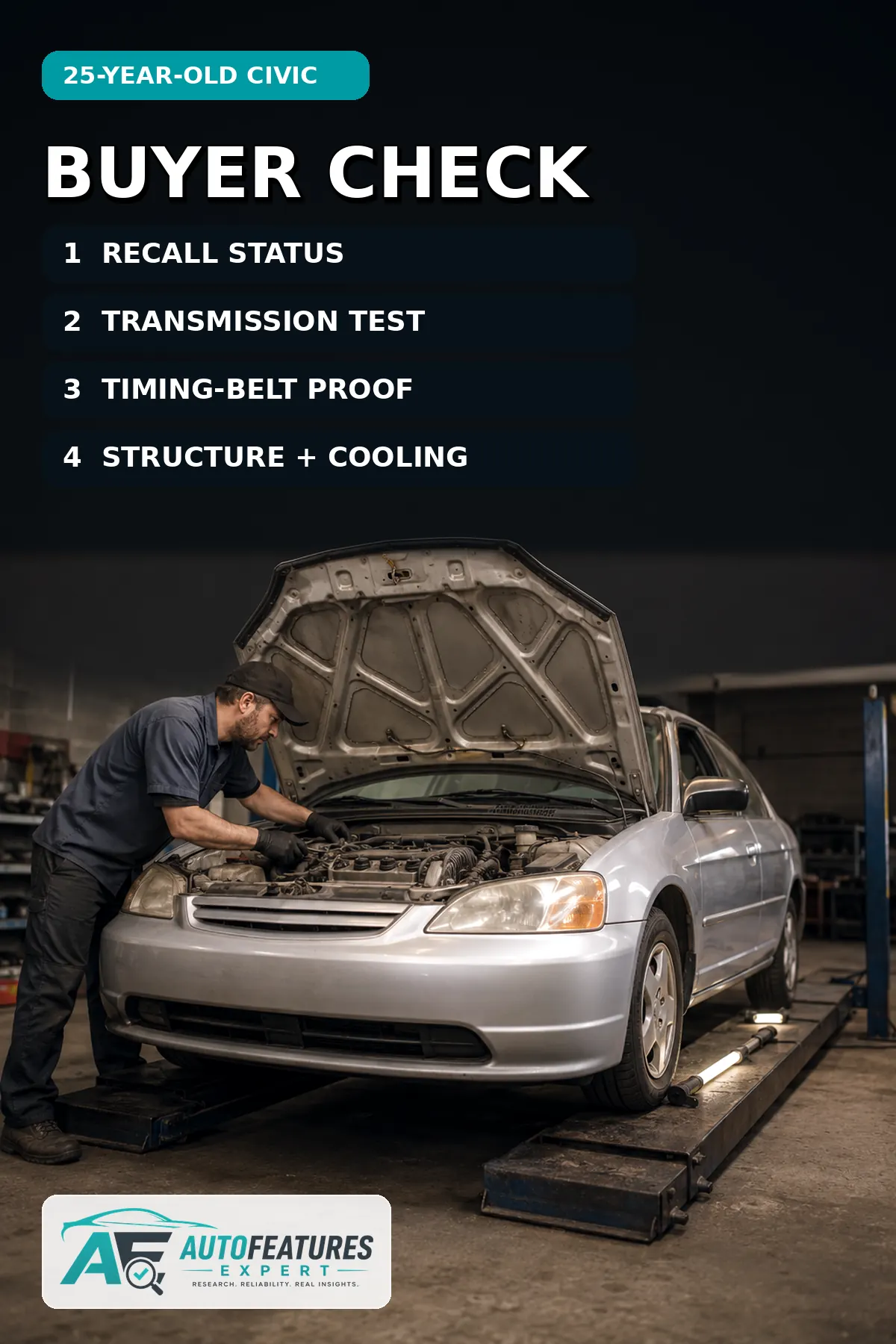
Use this guide for
Inspect a 2001 Civic in the order that exposes expensive transmission, service, cooling and age-related risk.
Boundary: This checklist routes failures to focused pages; it should not duplicate each diagnosis.
2001 Honda Civic used-buyer checklist priorities are VIN recall status, transmission behavior, timing-belt documentation and structural condition. A low asking price or clean interior cannot offset an open Takata Do Not Drive warning, a slipping automatic, overheating evidence or rust at suspension mounting points.
Quick Answer
Before buying a 2001 Civic, check the VIN before driving, require a true cold start, test the transmission until fully warm, verify the timing-belt invoice, scan codes and readiness monitors, inspect cooling and oil leaks, and put the car on a lift. Walk away when the seller blocks inspection or high-consequence risks remain unknown.
2001 Honda Civic Buyer Checklist at a Glance
| Check | Pass evidence | Walk-away warning |
|---|---|---|
| Recall status | Current Honda/NHTSA VIN result and completed repair orders | Open Takata Alpha Do Not Drive instruction |
| Automatic transmission | Clean cold-to-hot operation and scan results | Slip, flare, delayed engagement or lost drive |
| Timing belt | Invoice with VIN/date/mileage and correct service scope | No evidence on a car priced without service allowance |
| Cooling system | Stable level, pressure-test evidence, no overheating history | Repeated loss, combustion evidence or seller minimizing overheating |
| Structure/suspension | Sound mounting points and measured wear only | Structural rust, broken mount, unsafe ball joint or hidden crash repair |
| Electronic history | Normal warning-lamp self-test and completed readiness monitors | Missing lamps, recently cleared codes or altered wiring |
1. Check the VIN Before the Test Drive
Certain 2001–2002 Civics with an unrepaired Takata Alpha driver inflator remain under a federal Do Not Drive warning. Enter the 17-character VIN at both NHTSA and Honda. If the result says not to drive, stop the normal inspection process and contact Honda about the free remedy and transport support.
Also verify the low-beam headlight wiring campaign and any airbag campaigns affected by replacement-inflator history. A receipt from years ago is useful but does not replace a current lookup.
2. Confirm the Car Is Truly Cold
Arrange the appointment so the engine and transmission have not been warmed. Touching the exhaust is unsafe; compare coolant temperature scan data with ambient conditions and observe cold-start behavior. Pre-warming can hide delayed transmission engagement, smoke, noise, weak battery performance and cooling-system pressure.
3. Identify the Engine and Transmission
Verify the trim, VIN, engine stamp and transmission. DX/LX commonly use the D17A1, EX the D17A2 and HX the D17A6 with either a manual or CVT. Swaps are common, and an unidentified replacement affects parts, emissions legality and resale.
Use our 2001 Honda Civic engine specs guide for identification.
4. Test the Automatic Transmission Cold and Hot
With the brake applied, select Reverse and Drive and note delay or impact. Drive gently, then moderately, including stop-and-go, hills and steady cruise. Repeat engagement after full warm-up. Watch for rpm flare, slipping, harsh shifts, shudder, flashing D indicator, abnormal noise or loss of movement.
Scan stored, pending and permanent codes before and after the drive. A fluid change is maintenance, not a promised cure for internal failure. See the focused transmission guide.
5. Verify Timing-Belt Service
Honda’s normal schedule calls for the gasoline-engine timing belt at 110,000 miles or seven years. Require a paid invoice identifying the vehicle, date, mileage and parts. A sticker or seller statement is weaker evidence. If documentation is missing, price a complete correctly scoped service immediately.
6. Inspect Engine Oil and Cooling
- Check oil level before starting and after the drive.
- Look for active leaks, burnt odor and contaminated fluids.
- Confirm coolant level stone cold.
- Inspect radiator, hoses, thermostat area, water-pump region and fans.
- Monitor temperature and heater consistency during the drive.
- Pressure-test unexplained loss; do not assume “just a hose.”
The correct oil is 5W-20, with trim-specific capacity explained in the oil guide.
7. Scan Codes and Readiness Monitors
Confirm that the check-engine, SRS, ABS and charging lamps illuminate during self-test and then behave normally. Save codes and freeze-frame data. Incomplete monitors can indicate a recently disconnected battery or cleared codes. That is not proof of fraud, but it reduces the value of a clean dashboard.
8. Inspect Suspension, Steering and Structure on a Lift
Check ball joints, tie rods, control-arm bushings, struts, springs, wheel bearings, CV boots, engine mounts and steering-rack boots. Inspect rocker panels, floor, subframe areas, suspension mounts, brake/fuel lines and lift points for corrosion. Compare tire wear and look for bent components, overspray, disturbed fasteners and non-factory welds.
Use the suspension guide to interpret clunks, leaks and uneven wear.
9. Test Brakes, Tires and Every Electrical Function
Measure tire tread and record date codes. Check braking pull, pulsation and pedal feel. Test all exterior lights, windows, locks, mirrors, horn, wipers, blower speeds, A/C, rear defroster, gauges and charging system. A weak battery may be simple, but repeated discharge can indicate an electrical fault; see the battery-size and test guide.
10. Audit the Records
Give credit only to invoices that identify the work, date, mileage and preferably VIN. Separate:
- Confirmed: documented work and measured condition.
- Required: diagnosed repairs with written estimates.
- Unknown: seller claims, missing belt history, reset monitors or an already-warm drivetrain.
11. Calculate the All-In Cost
Add purchase price, tax, registration, immediate safety work, overdue maintenance, diagnosed repairs and a contingency. Compare that total with a better-documented car. A $2,000 Civic needing tires, brakes, timing belt and transmission work is not a $2,000 car.
12. Walk-Away Rules
- Open Do Not Drive recall before remedy.
- Transmission slip, delayed engagement or hot loss of drive without acceptable diagnosis.
- Overheating or unexplained coolant loss.
- Structural corrosion or unsafe suspension mounting points.
- Altered VIN, blocked inspection or missing warning-lamp self-tests.
- Seller refuses a cold start, scan, long drive or independent lift inspection.
Frequently Asked Questions
Is a manual 2001 Civic safer to buy?
It avoids the automatic-specific complaint pattern, but clutch, synchro, timing-belt, cooling, recall and structural checks still apply.
Is low mileage more important than maintenance?
No. Time-aged belts, tires, seals, fluids and corrosion can make a low-mileage car risky.
How long should the test drive be?
Long enough to reach full operating temperature and repeat transmission engagement, braking and cooling checks. A five-minute loop is inadequate.
Should I buy one with no service records?
Only when inspection and price fully account for the unknowns. High-consequence missing evidence should be treated as work due.
Sources
- NHTSA — Takata Alpha Do Not Drive alert
- American Honda — 2001 Civic Owner’s Manual
- Auto Features Expert — 2001 Civic problems research hub
About This Article
Author: Alex Fric, Automotive Research Editor
Last verified: August 5, 2026
Scope: U.S.-market 2001 Civic used-vehicle inspection and buying decisions. It cannot diagnose an individual vehicle or replace a qualified pre-purchase inspection.







