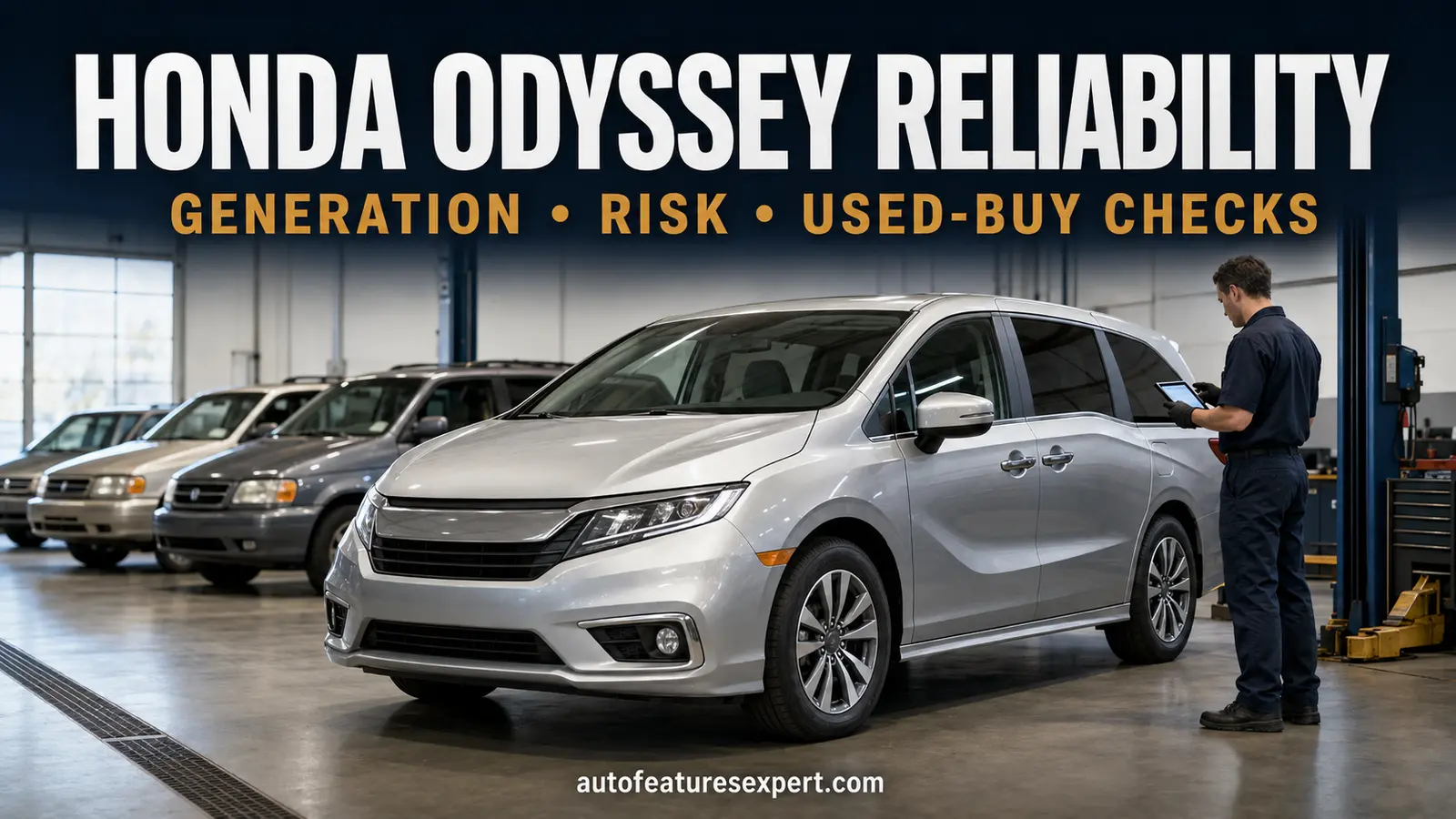
Use this guide for
Compare Honda Odyssey reliability by generation and identify the ownership risks worth verifying on a used minivan.
Boundary: This is currently the Odyssey cluster's broad owner page; new subpages should exist only when a distinct query earns them.
Honda Odyssey reliability by generation: The fourth generation (2011–2017), especially a well-documented 2014–2017 example, is usually the smartest value buy. For newer safety technology and lower age, target a carefully inspected 2021–2024 fifth-generation van. Approach 1999–2004 and 2018–2020 models with more caution, but judge every Odyssey by VIN-specific recalls, service records, condition, and a professional pre-purchase inspection—not model year alone.
Key Takeaways
- Best value starting point: 2014–2017 vans combine useful modern features with a mature fourth-generation design, but timing-belt history, oil use, misfires, mounts, and sliding doors still need inspection.
- Best modern starting point: 2021–2024 vans avoid the earliest years of the fifth generation, while offering stronger current safety and convenience technology. Their shorter time on the road means long-term durability is less proven.
- Highest inspection burden: 1999–2004 models because of age and historical automatic-transmission concerns; 2018–2020 models because of several VIN-specific campaigns and first-years-of-a-generation complexity.
- A recall is not a failure rate: A recall population identifies vehicles that may contain a safety defect. It does not mean every van failed, and an open recall can normally be repaired free by a Honda dealer.
- Records beat reputation: A maintained “caution” year can be a better purchase than a neglected “recommended” year. Verify the VIN, cold start, scan data, timing-belt service, transmission behavior, doors, electronics, and underbody.
Editorial scope: This is a generation-level reliability comparison for U.S.-market Honda Odysseys. It is not a list of every complaint or a substitute for a VIN lookup and hands-on inspection. Individual trims, production dates, repair history, climate, mileage, and prior use can change the risk materially.
Honda Odyssey Reliability and Risk Snapshot
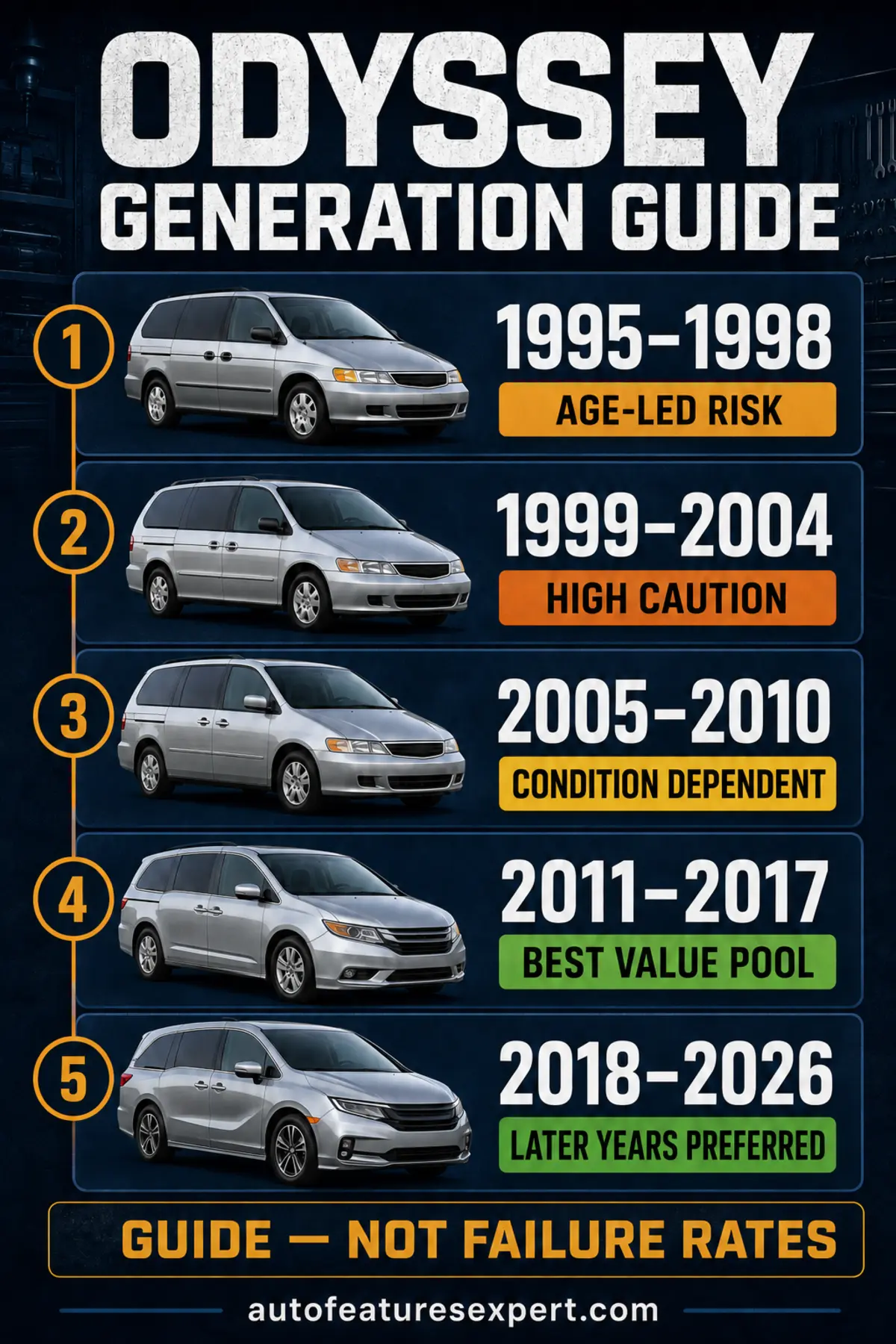
| U.S. generation | Model years | Used-buy view | What matters most now |
|---|---|---|---|
| First | 1995–1998 | Age-led risk | Rust, rubber, parts availability, crash protection, maintenance evidence |
| Second | 1999–2004 | High caution | Automatic transmission, recall completion, age, doors, rust |
| Third | 2005–2010 | Condition dependent | Transmission behavior, VCM-related symptoms on equipped trims, mounts, timing belt, doors |
| Fourth | 2011–2017 | Best value pool | 2011–2013 misfire history, oil level, timing belt, mounts, doors, maintenance records |
| Fifth | 2018–2026 | Later years preferred | VIN recalls, camera/infotainment, doors, transmission operation, engine noise and records |
These labels are purchase-screening priorities, not measured failure probabilities. Older generations have had more time and mileage to develop faults; newer generations may look better partly because they have had less exposure. Complaint totals also rise with sales volume and vehicle age, so raw counts cannot fairly rank generations without a denominator and comparable observation period.
What “Reliable” Should Mean for a Used Minivan
A family minivan has a harder job than a lightly used commuter. It may idle in school lines, make repeated short trips, carry eight people and luggage, tow within its rating, operate power sliding doors dozens of times a day, and accumulate highway miles on vacations. A useful reliability judgment therefore needs more than an engine reputation.
We evaluate an Odyssey across five systems:
- Powertrain durability: engine oil control, misfires, timing-belt service, cooling, transmission shift quality, and evidence of correct fluids.
- Family-use hardware: power doors, latches, seat mechanisms, air conditioning, rear camera, infotainment, and charging ports.
- Safety and campaign status: open recalls by VIN, evidence that earlier repairs were completed, warning lamps, tires, brakes, and corrosion.
- Age-related condition: leaks, hardened rubber, worn suspension, motor mounts, rust, degraded wiring, and unavailable trim pieces.
- Ownership economics: purchase price plus the maintenance backlog due soon. A cheap van that immediately needs a timing-belt package, tires, brakes, mounts, and door work is not necessarily the value choice.
Model-wide data can add context but cannot choose a generation for you. RepairPal currently rates the Odyssey 3.5 out of 5 and third among eight minivans, with a reported average annual repair cost of $547. Those figures aggregate multiple ages and generations. They are useful as a broad ownership baseline, not evidence that a specific 2004 or 2022 van will match the average.
Reliability by Honda Odyssey Generation
First Generation (1995–1998): Simple, but Age Is the Main Problem
The first U.S. Odyssey was smaller and mechanically simpler than the minivans that followed. That simplicity can appeal to an enthusiast who finds a preserved example, yet even the newest is now nearly three decades old. At this age, the generation’s original design reputation matters less than the individual van’s storage, corrosion exposure, cooling-system care, previous repairs, and parts availability.
Inspect the lower body, subframes, brake and fuel lines, steering and suspension joints, engine and transmission seals, hoses, and every electrical accessory. A clean cold start and smooth test drive are necessary but not sufficient; dried seals or a weak cooling system can become expensive after regular use begins. Older crash structure and safety equipment are also materially different from a recent Odyssey. For regular family transportation, this is an age-led specialty purchase rather than our default reliability recommendation.
Second Generation (1999–2004): The Highest-Caution Generation
The 1999 redesign delivered the larger layout many buyers associate with the Odyssey, but this generation is tied to well-documented automatic-transmission concerns. A 2004 safety campaign addressed insufficient transmission lubrication in certain 2002–2004 vehicles; the remedy depended on inspection and vehicle condition. That official campaign is not proof that every second-generation transmission will fail, but it reinforces the need to verify the VIN and scrutinize shift behavior and repair history.
Do not rely on “transmission replaced” as a complete answer. Ask for the date, mileage, invoice, part source, warranty, cooler-line or related work, and subsequent fluid-service records. During a long test drive, check engagement into Drive and Reverse, shifts under light and moderate throttle, hot behavior after at least 20 minutes, flaring RPM, shudder, harsh downshifts, leaks, and warning lights. A generic code scan can miss mechanical deterioration, so a Honda-experienced technician should evaluate any serious candidate.
Age compounds the powertrain question. Power doors, window regulators, air conditioning, mounts, suspension bushings, catalytic converters, rust, and interior hardware may all require work. Buy only when condition, documentation, and price leave a large repair reserve. For a primary family vehicle, a later generation usually offers a better balance.
Third Generation (2005–2010): Better Package, Increasing Maintenance Burden
The third generation improved space, refinement, and safety compared with the older vans, and many remain useful. Reliability varies more by equipment and care than a one-line rating suggests. Transmission condition still deserves attention. On VCM-equipped versions, investigate oil consumption, spark-plug fouling, cylinder-specific misfire codes, vibration, and engine-mount wear rather than assuming all J-series V6 engines behave identically.
Honda service information for certain 2008–2010 Odyssey trims describes a diagnostic and repair path for P0301–P0304 misfires associated with spark-plug fouling and piston-ring behavior. A bulletin documents a known service condition; it does not say that every eligible van developed it. Eligibility and any previous repair should be checked using the VIN and dealer records.
By now, routine age and mileage items are equally decisive. Confirm the timing-belt package, water pump, tensioner, valve-clearance work where indicated, spark plugs, transmission fluid, brakes, tires, shocks, control-arm bushings, motor mounts, and both sliding doors. If a seller cannot document a major service, price the van as though it is due. A clean third-generation van can be an affordable choice, but it demands a deeper inspection and larger reserve than most 2014–2017 examples.
Fourth Generation (2011–2017): The Best Value Pool—with an Early-Year Caveat
The fourth generation is our strongest value starting point because it is newer than the aging 2005–2010 group, has a mature family-friendly design, and usually costs much less than a late fifth-generation van. The recommendation is not uniform across all seven years.
Honda Service Bulletin 13-081 covers eligible 2011–2013 Odysseys with P0301–P0304 misfires. It states that piston rings on certain cylinders may rotate and align, contributing to spark-plug fouling. Honda extended relevant powertrain coverage to eight years with unlimited mileage from the original purchase date for eligible vehicles and set out diagnosis, software, spark-plug, piston-cleaning, and ring-replacement procedures. That historical coverage is generally expired now because of vehicle age, but the bulletin remains important when evaluating records and unexplained misfires.
For a 2011–2013 candidate, ask whether the van had repeated misfires, fouled plugs, ring work, unusual oil consumption, or engine-mount replacement. Scan for stored and pending codes; a recently cleared monitor can be a warning sign. Check the oil level before the test drive and look for a consistent service history rather than a freshly cleaned engine bay.
Well-kept 2014–2017 vans are the fourth generation’s smartest shopping zone. They are later in the design cycle and avoid the exact 2011–2013 population in Bulletin 13-081. That does not make them immune to oil use, VCM-related symptoms, mounts, doors, air-conditioning, suspension, or transmission issues. It simply gives a buyer a more favorable starting point when records and condition are comparable.
A timing belt is central to the budget. RepairPal’s current estimate places Odyssey timing-belt replacement at approximately $1,013–$1,523 before taxes, fees, location differences, or additional repairs. Many shops sensibly quote a package that also addresses the water pump and tensioning components. If proof is missing, treat the service as a near-term cost, not a verbal promise.
Fifth Generation (2018–2026): Choose Later Years and Verify the VIN
The fifth-generation Odyssey adds modern driver assistance, cabin technology, improved seating flexibility, and stronger contemporary crash performance. It is also more electronically complex. The first three model years carry a higher inspection burden because multiple official campaigns have touched cameras, displays, network connections, door components, or a limited engine population.
The most serious engine campaign is NHTSA recall 23V-751. Honda’s filing includes certain 2018–2019 Odysseys built within a specified production range, not every 2018 or 2019 van. The report says an improperly manufactured crankshaft could cause connecting-rod-bearing wear and seizure, potentially leading to abnormal noise, reduced output, stalling, no-start, engine damage, or increased fire/crash risk. The dealer remedy is inspection and repair or engine replacement when necessary. Only a VIN lookup can determine inclusion.
August 2026 update: NHTSA campaign 26V-423 covers certain 2018–2020 Odysseys because water may enter the rearview-camera assembly and prevent the image from displaying. The July 2026 campaign expands an earlier camera recall, and some previously repaired vans may require the newer remedy. Honda plans owner notification beginning August 24, 2026, but affected VINs can be checked now. Test the camera and verify the VIN even if the seller has not received a letter.
Earlier fifth-generation vans may also require checks for power sliding-door operation and infotainment or MOST-network symptoms. A completed free recall can remove a defined safety defect from the purchase equation, but a stack of campaign receipts does not prove the rest of the vehicle is healthy. Conversely, an open recall is not automatic evidence that the van has suffered the defect. Separate recall status from the mechanical inspection.
For most buyers, 2021–2024 is the better fifth-generation starting range. It moves beyond the earliest production years while retaining current family technology and lower age. We especially like clean 2022–2024 examples when the budget permits. However, newer vans have accumulated fewer years and miles, so their apparent advantage partly reflects shorter exposure. Verify campaigns, software updates, maintenance, battery health, camera, audio, doors, HVAC, warning systems, and road behavior just as carefully.
The 2024 Odyssey earned an IIHS Top Safety Pick designation. IIHS applies several crash-test results across the 2018–2026 generation, while also identifying limitations in its updated moderate-overlap evaluation. That is valuable safety context—not proof of mechanical reliability. Reliability, recall status, and crashworthiness answer different questions.
Which Honda Odyssey Generations Are the Smartest Used Buys?
Best Value: 2014–2017
Start here if you want the most van for the money and can accept normal high-mileage maintenance. Favor one-owner or long-term-owner examples with continuous records, a documented timing-belt package, clean oil history, smooth transmission operation, quiet mounts, fully functioning doors, and no diagnostic-monitor anomalies. A lower trim with fewer powered accessories may be attractive when simplicity matters, but condition is more important than trim mythology.
Best Modern Choice: 2021–2024
Choose this group if current driver-assistance features, cabin technology, lower age, and improved crash protection justify the higher price. Later does not mean maintenance-free: inspect all electronic functions, both power doors, rear camera, HVAC zones, battery state, tires, brakes, and service records. Use the VIN at both NHTSA and Honda because campaign databases can update.
Budget Alternative: Exceptional 2009–2010 or 2011–2013 Examples
These years can work when the price reflects risk and documentation is unusually strong. For 2009–2010, verify the applicable misfire/VCM service history and age-related work. For 2011–2013, investigate Bulletin 13-081 symptoms and repairs. Do not buy solely because a seller says “Honda engines last forever.” The whole van—not only the engine block—must be ready for family duty.
Highest-Caution Shopping Zones: 1999–2004 and 2018–2020
The reasoning differs. The second generation combines documented historical transmission concern with two decades of aging. The 2018–2020 group is much newer, safer, and more sophisticated, but sits at the beginning of the fifth generation and has several VIN-specific campaign and electronics checks. Neither range is a universal “never buy.” Both need stronger evidence and price discipline than the recommended starting points.
Symptoms That Should Change Your Buying Decision
Walk away or pause the deal for professional diagnosis when you find any of the following:
- Transmission: delayed Drive/Reverse engagement, RPM flare between shifts, shudder, harsh hot shifts, slipping, burnt-smelling fluid, leaks, or a transmission warning.
- Engine: persistent knock, repeated misfire, flashing check-engine light, low oil with no credible explanation, blue exhaust smoke, coolant/oil mixing, overheating evidence, or cold-start rattle that does not settle promptly.
- VCM/mount behavior: excessive vibration when cylinders transition, torn active mounts, repeated plug fouling, cylinder codes, or a repair history that treats symptoms without diagnosing the cause.
- Doors: reversing, stopping, grinding, unlatching, warning chimes, intermittent outer handles, damaged cables, water intrusion, or a door that works only with assistance.
- Electronics: blank rear camera, popping audio, rebooting display, dead USB ports, driver-assistance warnings, multiple unrelated faults, or evidence of water intrusion.
- Structure: uneven panel gaps, overspray, poorly repaired collision damage, severe corrosion near mounts or brake lines, flood odor, or mismatched safety-system parts.
A flashing malfunction indicator lamp can indicate a catalyst-damaging misfire. Do not continue a hard test drive. Likewise, abnormal bearing noise, low oil pressure, overheating, or repeated stalling warrants stopping the engine and arranging diagnosis.
How to Diagnose an Odyssey Before Buying
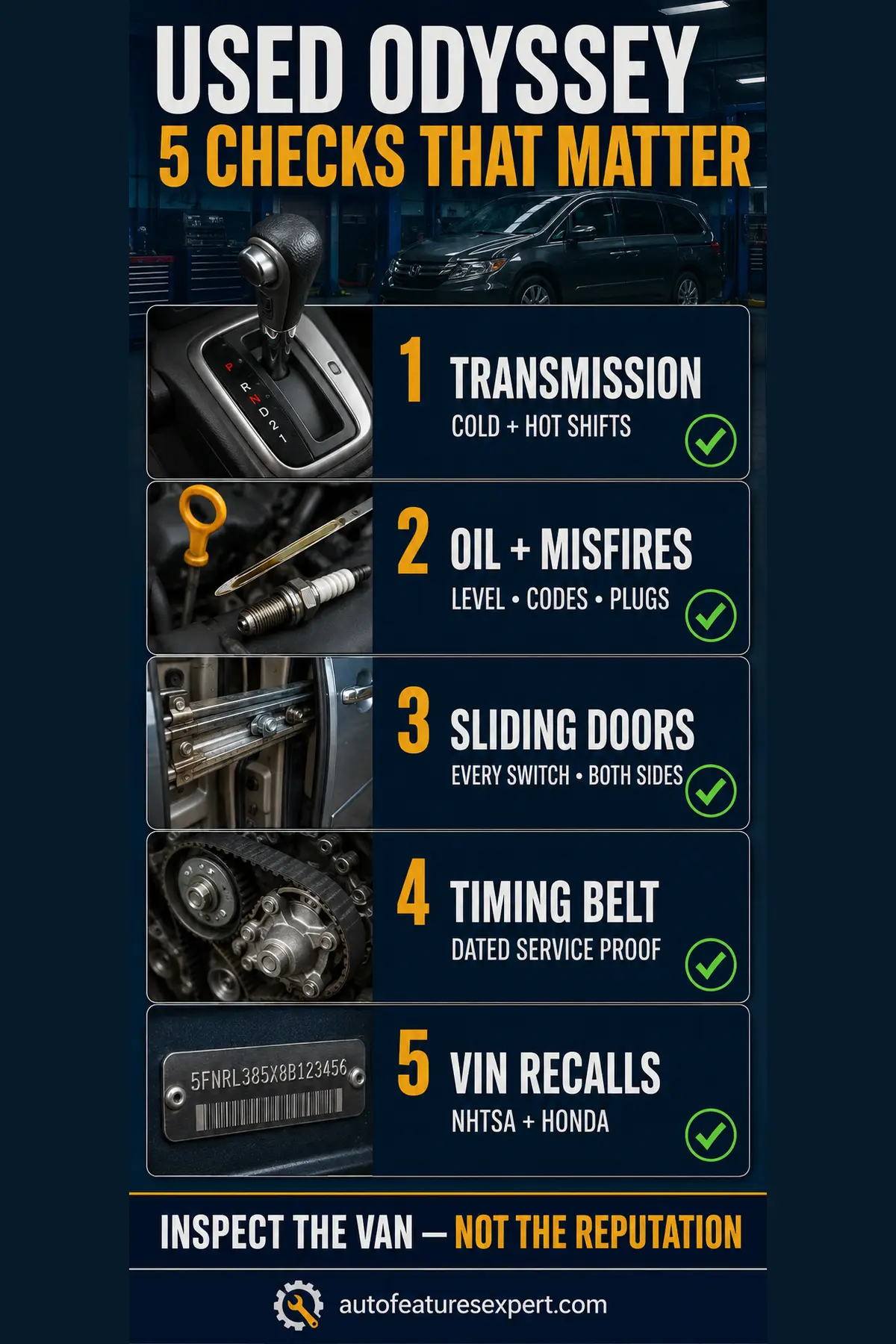
1. Begin with the VIN, Not the Advertisement
Run the 17-character VIN through the NHTSA recall lookup and Honda’s recall lookup. Confirm that the VIN on the dashboard, driver-door label, title, and service records matches. Save the results and ask a Honda dealer to check completed campaigns and relevant product updates. NHTSA notes that VIN results may omit already repaired, very old, very recent, non-safety, or international campaigns, so “zero unrepaired recalls” is not the entire history.
2. Insist on a True Cold Start
Ask the seller not to start the van before arrival. Check fluid levels and the ground first, then listen for extended cranking, chain/belt-area noise, bearing knock, exhaust smoke, uneven idle, and warning lamps. Verify that every warning lamp illuminates during the bulb check and then goes out appropriately. A warmed engine can conceal start-up noise, weak battery behavior, smoke, and rough idle.
3. Scan More Than Current Trouble Codes
Use a capable scan tool to inspect current, pending, permanent, and history codes; misfire counters; fuel trims; temperature; charging voltage; and emissions-monitor readiness. Several “not ready” monitors can mean the battery was disconnected or codes were recently cleared. That is not proof of deception, but it requires an explanation and a repeat test after a complete drive cycle.
4. Test the Van Like a Family Will Use It
Operate both sliding doors from the handles, dashboard, key fob, and interior switches. Try them parked level and, where safe, on a slight incline. Fold and move every seat. Run front and rear air conditioning through all zones. Pair a phone, play audio, use every camera view, test charging ports, and let the infotainment remain on long enough to expose resets or connection dropouts.
5. Drive It Cold and Fully Warm
Include stop-and-go traffic, steady 40–60 mph operation, moderate acceleration, parking maneuvers, and a restart after heat soak. Listen during cylinder-deactivation transitions and over rough pavement. Brake from several speeds without pulling or pulsation. A five-minute drive around the block is not a meaningful transmission or cooling-system test.
6. Pay for an Independent Pre-Purchase Inspection
Ask for a lift inspection, diagnostic scan, battery/charging test, fluid and leak evaluation, tire/brake measurement, underbody corrosion check, cooling-system review, timing-belt evidence assessment, and road test. On a questionable transmission or engine, a specialist’s diagnosis is cheaper than buying first and investigating later. The inspection should be independent of the seller.
Likely Repairs and Realistic Cost Planning
Online cost ranges are planning tools, not quotes. Labor rates, trim, model year, region, part quality, related damage, and dealer versus independent-shop pricing can move totals considerably.
| Item | Budget meaning | Buying implication |
|---|---|---|
| Timing belt package | RepairPal currently estimates belt replacement around $1,013–$1,523; a complete package or related work can cost more. | No dated invoice means budget for service. |
| Transmission fluid service | RepairPal currently estimates roughly $156–$184 for a fluid change. | Correct service history matters; fluid service cannot cure mechanical failure. |
| Sliding-door repair | Could be adjustment or a switch, cable, latch, roller, closer, motor, wiring, or control issue. | Diagnose before agreeing to a seller’s “easy fix” discount. |
| Misfire/oil-use repair | Ranges from plugs or coil diagnosis to mount work or internal engine repair. | Codes and oil level need cause-based diagnosis. |
| Transmission repair/replacement | Potentially several thousand dollars, depending on unit, damage, and warranty. | Independent specialist assessment is essential when symptoms appear. |
Build a first-year reserve based on the inspection, not a generic percentage. Tires, brakes, battery, overdue fluids, timing-belt work, and a single door repair can arrive together even on a fundamentally sound van. Negotiate from written estimates and service evidence.
Recall vs. Warranty Extension vs. TSB vs. Investigation
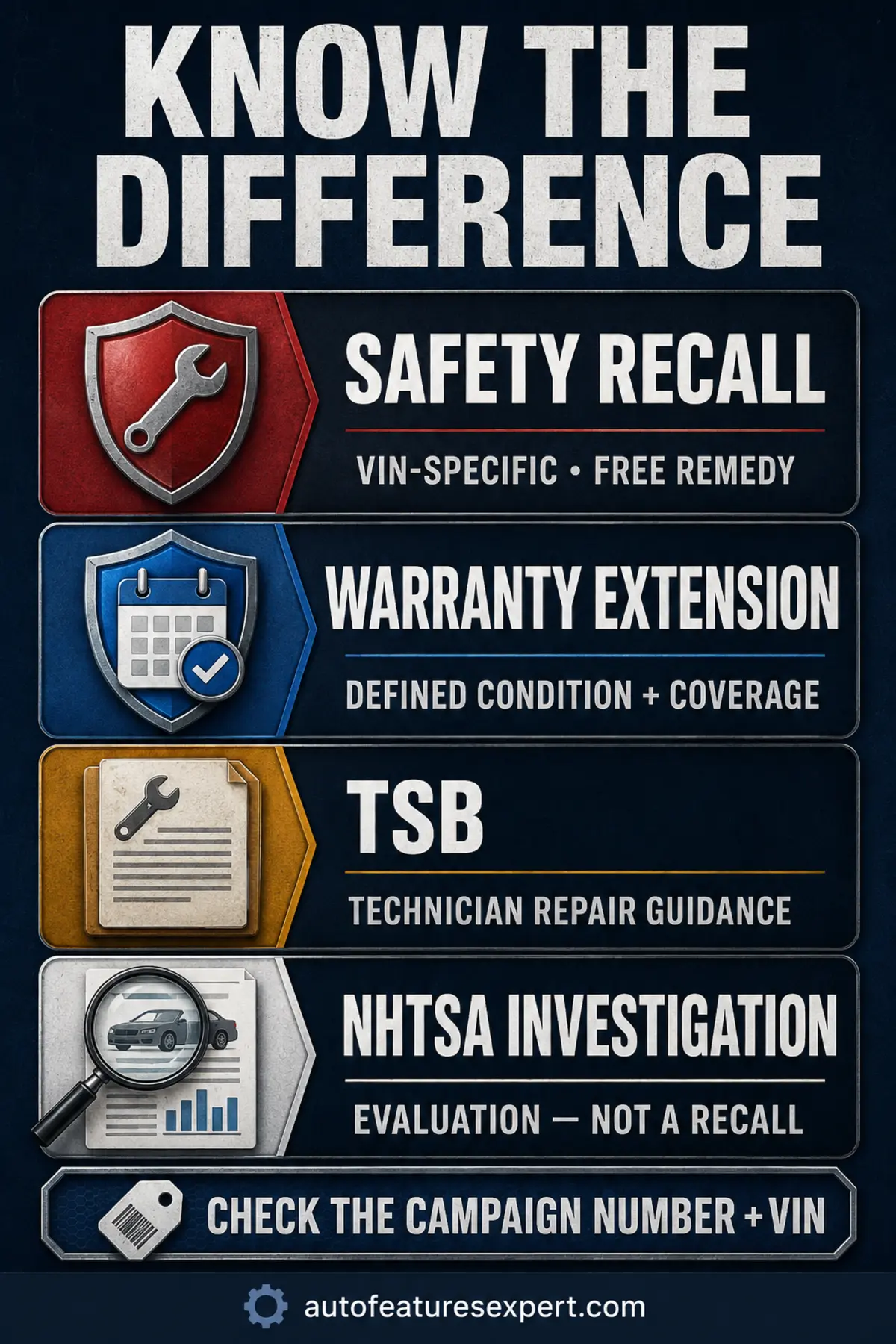
- Safety recall: Addresses a safety-related defect or noncompliance for an identified population. The specified remedy is normally free, regardless of ordinary warranty status. Check the VIN.
- Warranty extension: Extends coverage for a defined condition, time, mileage, and eligible population. It is not automatically a safety recall. Bulletin 13-081’s historical eight-year/unlimited-mileage coverage for eligible 2011–2013 vans is the key Odyssey example.
- Technical service bulletin (TSB): Provides technicians with diagnostic or repair guidance for a known condition. A TSB does not establish a failure rate, prove a defect exists in every listed vehicle, or guarantee free repair outside applicable coverage.
- NHTSA investigation: An agency evaluation of an alleged safety problem. An investigation may close without a recall or may contribute to later action. It is not itself a recall and should never be described as one.
This distinction prevents two common buying mistakes: assuming a TSB guarantees free repairs, and assuming every vehicle named in a broad investigation has been recalled. Ask for the campaign number, VIN eligibility, remedy status, and written dealer confirmation.
Prevention and Maintenance That Matter Most
- Follow the Maintenance Minder and owner’s manual. Severe conditions, towing, short trips, heat, and heavy family use may justify closer attention. Keep invoices, dates, mileage, fluid specifications, and part details.
- Check the oil level between services. Establish a baseline on level ground and investigate a change rather than waiting for the warning lamp.
- Use the correct transmission fluid and service method. Avoid universal-fluid shortcuts and do not treat a flush or additive as a repair for slipping or internal wear.
- Document the timing-belt package. Follow the applicable Honda schedule and Maintenance Minder. Include related components as recommended by the servicing professional.
- Keep door tracks clean and observe behavior. Do not force a binding door. Intermittent faults become easier to diagnose when you record the switch used, slope, temperature, and warning shown.
- Maintain battery voltage. Weak batteries and poor connections can produce confusing electronic symptoms. Test the charging system rather than repeatedly replacing parts.
- Check recalls at least twice a year. NHTSA specifically recommends recurring checks because campaigns and VIN populations can change.
Owner Experience: What Anecdotes Can and Cannot Tell You
Owner communities are valuable for recognizing symptom language: the exact door sound, when an infotainment reboot happens, how a misfire feels, or what documentation a dealer requested. They can also help a buyer prepare focused questions. They cannot supply a population-level failure rate unless the sample, exposure, verification, and denominator are known.
Online discussions overrepresent vehicles with problems because owners of uneventful vans have less reason to post. At the same time, a repeated pattern should not be dismissed simply because it is anecdotal. Use owner reports as leads, then verify them against recalls, manufacturer communications, service records, diagnostic evidence, and an inspection. We do not convert forum post counts into invented percentages.
Expert Analysis: Why Later-Cycle Years Usually Win
The strongest Odyssey buys tend to sit after the first years of a redesign but before age and deferred maintenance dominate. That explains the appeal of 2014–2017 and 2021–2024. Later-cycle vehicles may benefit from production learning, updated parts or software, and a repair industry familiar with the platform. They also have fewer unknowns than a brand-new redesign.
However, “later is better” is a screening rule, not a law. A 2017 with 170,000 hard miles, no timing-belt proof, low oil, and broken doors is a weaker purchase than a fully documented 2013 whose relevant repairs were completed. A 2022 with collision damage and unresolved warnings is not saved by its model year. The ranking narrows the search; evidence decides the vehicle.
Our practical hierarchy is therefore:
- Correct VIN/title and no unacceptable structural or flood history.
- Professional inspection with no major unexplained symptoms.
- Complete recall status and credible maintenance/repair evidence.
- Generation and model-year preference.
- Trim, color, and convenience features.
Before You Buy: 15-Point Honda Odyssey Checklist
- Match the VIN on the van, title, and records.
- Run both NHTSA and Honda recall checks; save the results.
- Ask a Honda dealer for completed campaign and relevant service-bulletin history.
- Require a cold start and verify the warning-lamp bulb check.
- Check oil and coolant before driving.
- Scan current, pending, permanent, and history codes plus readiness monitors.
- Test Drive and Reverse engagement cold and hot.
- Drive long enough to evaluate every shift and heat-soak restart.
- Operate both sliding doors from every control method.
- Test the rear camera, audio, display, driver-assistance warnings, and charging ports.
- Run front and rear HVAC through all zones.
- Verify timing-belt, water-pump, transmission-fluid, brake, and tire records.
- Inspect mounts, leaks, suspension, underbody rust, and collision repair on a lift.
- Price every overdue item using written local estimates.
- Make the purchase conditional on an independent pre-purchase inspection.
Expert Tip
Do not let a zero-code scan end the inspection. Check emissions readiness and permanent codes. If most monitors are “not ready,” the battery may have been disconnected or codes cleared shortly before your visit. Ask why, complete a proper drive cycle, and scan again before money changes hands.
Buying Advice: The Short Version
For maximum value, shop 2014–2017 first and reserve funds for age/mileage maintenance. For modern safety and convenience, shop 2021–2024, with 2022–2024 a particularly sensible starting pool when priced fairly. Treat 1999–2004 as enthusiast/bargain territory requiring strong transmission evidence and a large reserve. Treat 2018–2020 as a VIN-and-systems verification exercise rather than a blanket rejection.
Never pay a “Honda reliability” premium without documentation. Compare the asking price with the timing-belt status, tires, brakes, battery, doors, open recalls, fluid history, and inspection findings. The best Odyssey is the one whose remaining useful life and known upcoming costs fit your family—not simply the year with the best online reputation.
Related Honda Odyssey Guides
- Honda Odyssey years to avoid and the reasons behind the risk
- Used Honda Odyssey buying guide: inspection and hidden-cost checks
- High-mileage Honda Odyssey maintenance costs after 100,000 miles
- Honda Odyssey transmission problems by generation
- Honda Odyssey VCM symptoms, oil use, misfires, and mounts
- Honda Odyssey sliding-door problems and diagnostic checks
Frequently Asked Questions
What is the most reliable Honda Odyssey generation?
The fourth-generation 2011–2017 Odyssey is the best value pool overall, but we prefer well-maintained 2014–2017 examples because they sit later in the cycle and fall outside the 2011–2013 vehicle range named in Honda Bulletin 13-081. Condition, timing-belt history, oil use, transmission behavior, doors, and inspection results still matter more than the label.
What are the smartest Honda Odyssey years to buy used?
Start with 2014–2017 for value or 2021–2024 for newer safety and family technology. A documented 2022–2024 is an appealing modern choice, while a clean 2014–2017 can deliver lower purchase cost. These are shopping ranges, not guarantees; compare VIN recalls, service records, mileage, condition, and upcoming maintenance.
Should I avoid every 2018–2020 Honda Odyssey?
No. Those early fifth-generation years require extra diligence because several VIN-specific campaigns and electronic or door checks may apply. Verify recall completion, including the latest rearview-camera campaign where applicable, test every system, and inspect engine and transmission behavior. A properly repaired, well-maintained van can still be a reasonable purchase.
Is Honda Service Bulletin 13-081 a recall?
No. Bulletin 13-081 documents a warranty extension and repair procedure for eligible 2011–2013 Odysseys with specific misfire codes and spark-plug fouling. It is not a safety recall. The extension was eight years with unlimited mileage from original purchase, so ordinary coverage has generally expired, but the service and repair history remains relevant.
How do I check Honda Odyssey recalls before buying?
Enter the exact 17-character VIN at NHTSA.gov/recalls and Honda’s owner recall site, then ask a Honda dealer to confirm completed and open campaigns. Match the VIN on the dashboard, door label, title, and records. Recheck periodically because newly announced campaigns or updated VIN populations may appear later.
Does a completed recall make an Odyssey reliable?
A completed recall confirms that the specified safety remedy was recorded; it does not certify the engine, transmission, doors, electronics, maintenance, collision history, or overall condition. Treat recall verification and the pre-purchase inspection as separate requirements.
How much should I budget for a used Honda Odyssey after purchase?
Use the inspection to build a first-year list for overdue fluids, tires, brakes, battery, timing-belt work, mounts, doors, and diagnosed faults. RepairPal currently estimates timing-belt replacement at roughly $1,013–$1,523 and transmission-fluid service at about $156–$184, but local quotes and related work can change the total.
Sources
- National Highway Traffic Safety Administration — VIN recall lookup and recall process
- American Honda — VIN recall lookup
- American Honda Service Bulletin 13-081 — 2011–2013 Odyssey misfire warranty extension
- NHTSA Recall 23V-751 — connecting-rod-bearing campaign filing
- Reuters — July 2026 Honda Odyssey rearview-camera recall
- Insurance Institute for Highway Safety — 2024 Honda Odyssey rating
- RepairPal — Honda Odyssey model-wide reliability and repair-cost context
- RepairPal — Honda Odyssey timing-belt replacement estimate
- RepairPal — Honda Odyssey transmission-fluid service estimate
How We Evaluated Honda Odyssey Reliability
We separated U.S.-market Odysseys by generation, then compared documented powertrain and family-use concerns, vehicle age, campaign scope, repair complexity, and the evidence a buyer can verify. Official NHTSA and Honda materials were prioritized for recalls, warranty extensions, and service procedures; IIHS was used only for safety context; current repair estimators were used only as planning ranges.
We did not turn complaint totals or forum posts into failure rates. Generation recommendations reflect inspection burden and used-buy value, not a promise that every vehicle in a preferred range is reliable. This article was reviewed for the July 2026 camera-recall update and is intended to be used with a VIN lookup, maintenance records, and an independent inspection.
About This Article
This guide was prepared for Auto Features Expert by Alex Fric for U.S. used-minivan shoppers. It distinguishes safety recalls, warranty extensions, TSBs, and investigations; preserves uncertainty where population-level failure data is unavailable; and focuses on decisions a buyer can verify. Campaign populations, remedies, pricing, and database status can change, so confirm current information with NHTSA, Honda, and a qualified repair professional before purchase.







