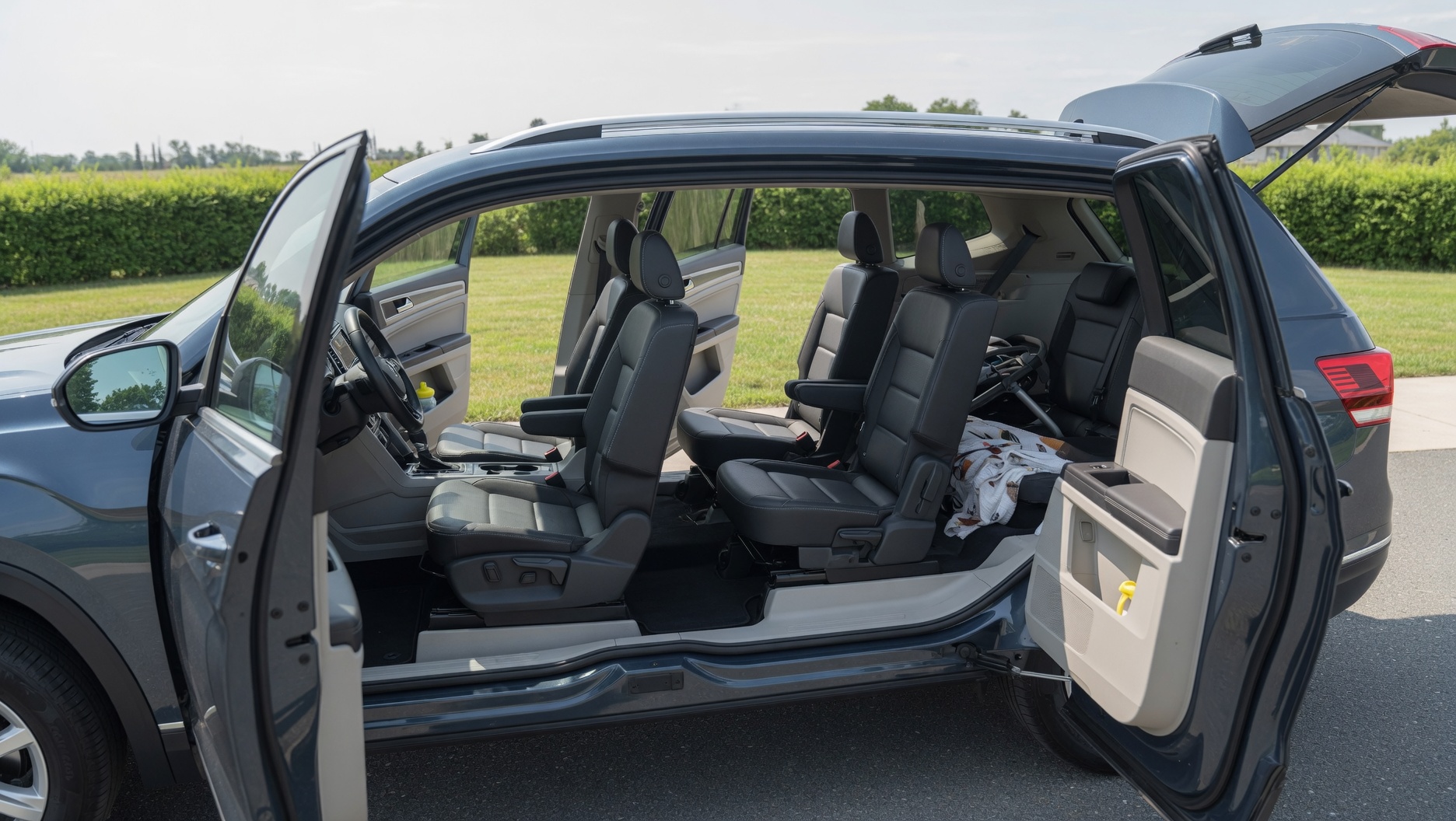
If you need a Volkswagen with three rows of seats, your options are more limited than you might expect. Volkswagen sells thousands of SUVs every year, but only a handful of models actually offer seating for seven passengers. Some are true seven seaters with a usable third row. Others technically have seven seats but cram the back row into a space better suited for grocery bags.
The difference matters more than most buyers realize. A family of five shopping for weekend road trip space has very different needs than a family of seven that uses every seat on the school run. Legroom, cargo space behind the third row, ease of access, and child seat compatibility all change dramatically depending on which Volkswagen seven seater you choose.
I have spent considerable time comparing Volkswagen’s three-row lineup across multiple model years, measuring real cargo space, testing third-row access with car seats installed, and tracking how these vehicles hold up in daily family use. The gap between the best and worst seven seater in the Volkswagen range is significant enough that choosing the wrong one can turn every family trip into a compromise.
This guide covers every current Volkswagen model available with seven seats globally, with a focus on the U.S. and European markets. For each model, you will find real-world seating analysis, cargo figures, powertrain options, pricing context, and a honest assessment of who each vehicle actually suits.
The Complete Volkswagen 7 Seater Lineup for 2024-2025
Volkswagen currently offers three models with seven-seat capability across global markets. The availability varies by region, which creates confusion for buyers researching online and finding models that are not sold in their country.
| Model | Seats | Third Row Standard? | U.S. Available | Europe Available | Starting Price (USD) | Starting Price (EUR) |
|---|---|---|---|---|---|---|
| Volkswagen Atlas | 7 (6 optional) | Yes, standard on most trims | Yes | No | ~$36,000 | N/A |
| Volkswagen Atlas Cross Sport | 5 only | No third row | Yes | No | ~$34,000 | N/A |
| Volkswagen Tiguan (2024+) | 7 (U.S. spec) / 5 (EU spec) | Yes on U.S. long-wheelbase | Yes | Varies by market | ~$30,000 | ~EUR 37,000 |
| Volkswagen Touran | 7 | Yes, standard | No | Yes | N/A | ~EUR 32,000 |
One important clarification: the Atlas Cross Sport is frequently confused with the Atlas in online searches, but it is a five-seat-only vehicle with no third row option. If you need seven seats in a Volkswagen in the United States, your choices are the Atlas or the new long-wheelbase Tiguan.
European buyers have the Touran as a compact MPV option, plus some regional Tiguan variants with optional third-row seating depending on the specific market and configuration.
Volkswagen Atlas: The Dedicated Seven Seater
The Atlas is Volkswagen’s largest SUV and the only model in the lineup designed from the ground up as a seven seater for the North American market. It rides on the MQB platform stretched to its maximum wheelbase, and the interior space reflects that engineering priority. This is the Volkswagen where seven adults can actually sit without someone volunteering to stay home.
Third Row That Adults Can Actually Use
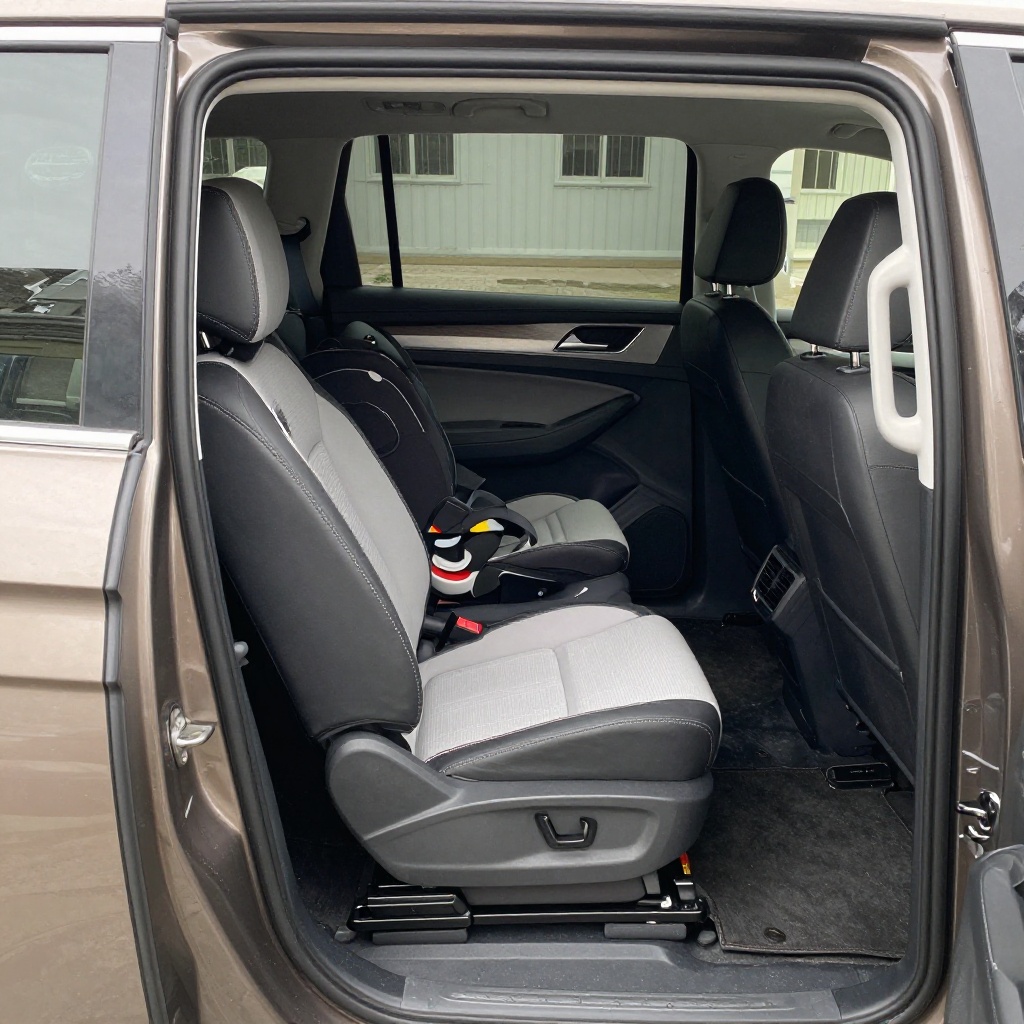
The Atlas third row is one of the most usable in the midsize SUV segment. Legroom in the third row measures approximately 33.7 inches, which is competitive with the Chevrolet Traverse and noticeably more generous than the Hyundai Palisade or Toyota Highlander.
What makes the Atlas third row genuinely livable is not just legroom but the combination of headroom (37.5 inches), hip room, and seat cushion height. Many SUV third rows mount the seat low to the floor, forcing passengers into a knees-up position that becomes uncomfortable after 20 minutes. The Atlas positions the third-row seat cushion high enough that adults can sit with a natural leg angle, which is a meaningful difference on trips longer than a quick drive across town.
Access to the third row uses a tilt-and-slide mechanism on the second-row seats. The pathway is wide enough to get a rear-facing child seat through without removing it from its base, which is a practical detail that parents will appreciate. Many competitors require removing the child seat entirely to access the third row, which turns every school pickup into a logistics exercise.
Cargo Space With All Rows in Use
This is where the Atlas earns its position as the default Volkswagen seven seater. With all three rows upright and occupied, the Atlas still provides approximately 20.6 cubic feet of cargo space behind the third row. That is enough for a double stroller, several grocery bags, and a couple of backpacks. It is not cavernous, but it is functional, and that distinction separates the Atlas from smaller seven seaters where the third row essentially eliminates the cargo area.
Fold the third row flat and cargo space jumps to approximately 55.5 cubic feet. Fold everything down and you get roughly 96.8 cubic feet, which is large enough for furniture, building materials, or a family’s worth of luggage for a two-week trip.
| Configuration | Cargo Space (cu ft) | Real-World Equivalent |
|---|---|---|
| All 3 rows upright | 20.6 | Double stroller + grocery bags |
| Third row folded | 55.5 | Full family luggage for a week |
| Second and third rows folded | 96.8 | Small apartment move |
Atlas Powertrain and Weight Considerations
The 2024-2025 Atlas is powered by a 2.0-liter turbocharged four-cylinder engine producing 269 horsepower, paired with an 8-speed automatic transmission. Front-wheel drive is standard, with 4MOTION all-wheel drive available as an option.
Curb weight ranges from approximately 4,300 pounds (FWD) to 4,500 pounds (AWD), which is lighter than some competitors despite the Atlas being one of the physically largest vehicles in the class. The lighter weight helps fuel economy slightly, with EPA estimates around 21 mpg city / 27 mpg highway for the FWD model and 20/25 for the AWD version.
Previous model years offered a 3.6-liter VR6 engine, but Volkswagen dropped it from the lineup during the 2024 refresh. Some buyers miss the VR6’s smoother power delivery, and used Atlas models with the VR6 remain popular on the secondary market for that reason.
Who the Atlas Actually Suits
The Atlas is the right Volkswagen seven seater if you regularly use all seven seats. Families with three or more children, households that frequently carpool, or buyers who need the cargo space behind a full third row will find the Atlas genuinely practical. It is not sporty, it is not luxurious, and it does not pretend to be either. It is a spacious, straightforward family hauler that does the seven-seat job better than most vehicles in its price range.
Where the Atlas falls short: driving dynamics feel soft and disconnected compared to a Mazda CX-90 or Kia Telluride. Interior materials on lower trims feel basic for the price. And fuel economy with the 2.0T engine, while adequate, does not match the hybrid options available from Toyota and Hyundai.
The 2024+ Volkswagen Tiguan: A New Seven Seater Enters the Game
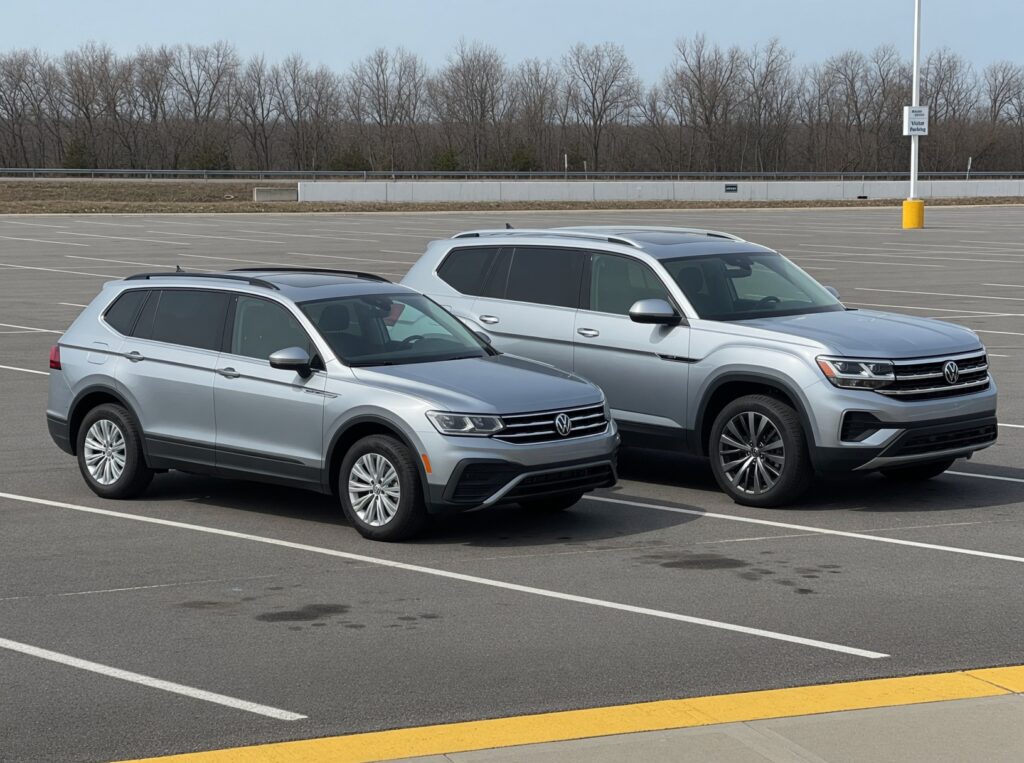
The redesigned 2024 Volkswagen Tiguan introduced something the previous generation lacked in most markets: an available third row. The new Tiguan rides on an updated MQB Evo platform with a longer wheelbase than its predecessor, and Volkswagen used that extra length to package a third-row seat into what was previously a five-seat-only compact SUV.
This is significant because the Tiguan sits at a much lower price point than the Atlas, starting around $30,000 compared to the Atlas at $36,000. For buyers who occasionally need seven seats but do not want to buy and park a full-size SUV, the Tiguan offers a compelling middle ground.
The Honest Truth About Tiguan Third-Row Space
The Tiguan’s third row is usable, but it is not an Atlas. Legroom measures approximately 28.5 inches, which is about five inches less than the Atlas and roughly comparable to the Toyota Highlander’s third row. Adults can sit there for short trips, but anything over 30 minutes becomes uncomfortable for anyone taller than about 5’8″.
Children, however, fit well. For families with younger kids who need an occasional third row for carpools or grandparent visits, the Tiguan’s back row is perfectly adequate. The seats fold flat to create a level cargo floor when not in use, so you are not sacrificing daily practicality for a row you only use occasionally.
One honest caveat: cargo space behind the Tiguan’s third row is very limited, approximately 8-10 cubic feet depending on the measurement method. That is enough for a couple of small bags but not much else. If you need to carry seven people and their luggage at the same time, the Tiguan will struggle. The Atlas or a minivan is the better choice for that scenario.
How the Tiguan Compares to the Atlas as a Seven Seater
| Feature | 2024+ Tiguan (7-seat) | 2024+ Atlas (7-seat) |
|---|---|---|
| Starting price (USD) | ~$30,000 | ~$36,000 |
| Third-row legroom | ~28.5 in | ~33.7 in |
| Cargo behind third row | ~8-10 cu ft | ~20.6 cu ft |
| Max cargo (all rows folded) | ~73 cu ft | ~96.8 cu ft |
| Engine | 2.0T 4-cylinder | 2.0T 4-cylinder |
| Horsepower | 184 hp | 269 hp |
| Curb weight (AWD) | ~3,900 lb | ~4,500 lb |
| Combined MPG (AWD) | ~28 mpg | ~23 mpg |
| Towing capacity | ~2,200 lb | ~5,000 lb |
The table tells a clear story. The Tiguan is smaller, lighter, more fuel efficient, and significantly cheaper. But its third row is a compromise, its cargo space with all seats up is minimal, and its towing capacity is a fraction of the Atlas. If the third row is a daily necessity, the Atlas is the better vehicle. If the third row is an occasional convenience, the Tiguan is smarter money.
Tiguan Third Row Availability by Market
This is where regional differences create real confusion for online shoppers:
United States: The 2024+ Tiguan offers a third row on most trims. It is the long-wheelbase version specifically designed for the North American market.
Europe: The European Tiguan typically uses a shorter wheelbase and does not offer a third row. European buyers looking for a Volkswagen seven seater in this size class are generally directed to the Touran instead.
Other markets: Availability varies. Some Asian and South American markets receive the long-wheelbase Tiguan with third-row seating, while others get the shorter European version. Always check local Volkswagen configurators for your specific market.
Volkswagen Touran: Europe’s Compact Seven Seater
The Touran does not exist in the American market, but it is one of the most popular compact MPVs in Europe and deserves inclusion in any global discussion of Volkswagen seven seaters. It occupies a space that no other Volkswagen fills: a compact, fuel-efficient, city-friendly vehicle with genuine seven-seat capability and a sliding rear door (in some configurations).
Why the Touran Still Makes Sense in 2024
In an era when every manufacturer is pushing SUVs and crossovers, the Touran’s MPV body style might seem outdated. In practice, it offers advantages that no SUV in the Volkswagen range can match.
The lower floor height makes entry and exit easier for children and elderly passengers. The boxy roofline creates more headroom across all three rows than any comparably sized crossover. The cargo area is deeper and more regularly shaped than an SUV’s sloping rear end, which means real-world luggage capacity often exceeds what the cubic footage numbers suggest.
The Touran’s third row is genuinely usable for children and small adults, with access through a tilt-forward second row that creates a wider opening than most SUVs. Two ISOFIX mounting points in the second row and the flat folding mechanism for the third row make it exceptionally flexible for families with changing seating needs.
Touran Powertrain Options
European Touran buyers have access to Volkswagen’s full range of efficient powertrains:
| Engine | Power | Fuel Type | Combined Consumption | Best For |
|---|---|---|---|---|
| 1.5 TSI | 150 hp | Gasoline | ~6.5 L/100km | General family use |
| 2.0 TDI | 150 hp | Diesel | ~5.2 L/100km | High-mileage commuters |
| 1.5 TSI DSG | 150 hp | Gasoline (auto) | ~6.8 L/100km | Urban convenience |
| 2.0 TDI DSG | 150 hp | Diesel (auto) | ~5.5 L/100km | Long-distance touring |
The diesel options remain popular in Europe for families covering high annual mileage, where the fuel cost savings over gasoline are still meaningful. Volkswagen has not introduced a hybrid or plug-in hybrid version of the Touran, which is increasingly seen as a gap in the lineup given the direction of European emissions regulations.
Who Should Consider the Touran Over a Tiguan or Atlas
The Touran makes the most sense for European families who prioritize interior flexibility over road presence. If you want a seven seater that is easy to park in tight European city centers, returns good fuel economy, and offers genuinely versatile interior packaging, the Touran delivers in ways that taller, heavier crossovers cannot.
Where it falls short: the Touran does not look or feel premium. It rides on an older platform than the current Tiguan, and the interior technology, while functional, lacks the polish of Volkswagen’s newer SUV interiors. Resale values have also softened in some markets as the broader shift toward SUVs continues.
Choosing the Right Volkswagen 7 Seater: A Practical Decision Framework
Picking the right model is not just about seat count. It is about how you actually use those seats and what trade-offs you are willing to accept.
Use Pattern 1: All Seven Seats Used Regularly (3+ Times Per Week)
If every seat gets used most days, the Atlas is the only Volkswagen seven seater that makes sense. The Tiguan’s third row is too compromised for daily use, and the Touran (if available in your market) works for children but not for adult passengers on a regular basis.
The Atlas provides enough third-row space, enough cargo behind it, and enough powertrain capability to function as a genuine seven-passenger vehicle without constant compromise.
Use Pattern 2: Third Row Used Occasionally (Weekend Carpools, Visiting Family)
This is where the Tiguan becomes the smarter choice. You get a smaller, more fuel-efficient, more affordable vehicle that drives better in daily five-passenger use, with a third row available when you need the extra capacity. The key is accepting that the third row is supplementary, not primary seating.
Use Pattern 3: European City Family With Young Children
The Touran wins here. Its lower ride height, efficient packaging, tight turning circle, and excellent child seat compatibility make it the most practical choice for urban European families. The lack of SUV styling is a trade-off that this buyer profile generally does not mind.
Use Pattern 4: Towing Plus Seven Seats
Only the Atlas offers meaningful towing capacity at 5,000 pounds. The Tiguan’s 2,200-pound limit handles a small utility trailer or a lightweight boat but nothing more. The Touran’s towing capacity varies by powertrain but maxes out around 1,600-1,800 kg (approximately 3,500-4,000 pounds) in European specification, which covers small camping trailers.
Common Misconceptions About Volkswagen Seven Seaters
Several persistent myths circulate online about Volkswagen’s three-row vehicles. Clearing these up can save buyers from making decisions based on outdated or inaccurate information.
“The Tiguan has always had a third row.”
False. The first-generation Tiguan (2007-2016) and the second-generation European Tiguan (2016-2023) were five-seat vehicles only. The long-wheelbase version sold in the U.S. from 2018 onward offered a third row on some trims, but it was not standard across all markets. The 2024 redesign made the third row more widely available, but it still depends on which market and wheelbase version you are buying.
“The Atlas is just a bigger Tiguan.”
Not exactly. While both use versions of the MQB platform, the Atlas is engineered specifically for the North American market with dimensions, suspension tuning, and feature priorities that differ significantly from the Tiguan. The Atlas is about 10 inches longer, 3 inches wider, and sits on a wheelbase that is roughly 7 inches longer than even the extended-wheelbase Tiguan. They drive very differently.
“Volkswagen offers a seven-seat ID.4 or ID.6.”
The ID.4 is a five-seat electric crossover with no third-row option in any market. The ID.6, which does offer six or seven seats, is sold exclusively in China as of 2024-2025 and is not available in North America or Europe. If you are looking for a Volkswagen electric seven seater outside of China, there is currently no option.
“The Touran is outdated and being discontinued.”
While the Touran rides on an older platform and rumors of discontinuation have circulated for years, Volkswagen has continued to sell and update it in European markets. Production plans vary, so check with local Volkswagen dealerships for current availability and any upcoming model changes.
What Owners Report After Living With These Vehicles
Ownership feedback across forums, owner review platforms, and long-term reliability data reveals consistent patterns for each model.
Atlas owners frequently praise the interior space and third-row usability, but commonly report that fuel economy falls 1-2 mpg below EPA estimates in real-world mixed driving. Several long-term owners note that the 2.0T engine, while adequate, feels underpowered when the vehicle is fully loaded with seven passengers and cargo, particularly on highway grades and during merging. Infotainment responsiveness has improved with recent model year updates, but earlier 2018-2021 models drew criticism for laggy touchscreen behavior.
Tiguan owners with the third row generally describe it as “good enough for kids, tight for adults,” which aligns with the measurement data. Fuel economy reports tend to be closer to EPA figures than the Atlas, with many owners reporting 27-29 mpg in highway-heavy driving. The smaller footprint makes the Tiguan noticeably easier to park and maneuver than the Atlas, which multiple owners cite as a significant advantage in urban and suburban environments.
Touran owners in European markets consistently highlight the vehicle’s practicality and flexibility, particularly for families with young children. The most common criticism is road noise at highway speeds, which is more noticeable than in the Tiguan or Atlas due to the MPV body style and less sound insulation compared to Volkswagen’s newer SUV platforms. Diesel Touran variants receive particularly strong praise from high-mileage owners for their fuel efficiency and low-end torque.
A Few Important Cautions
The seating capacity, cargo measurements, and specifications in this article reflect manufacturer-published data and may vary by trim level, optional equipment, and market-specific configurations. Always verify exact specifications on the Volkswagen configurator for your country or at your local Volkswagen dealership.
Third-row dimensions and usability can vary based on second-row seat position. Most manufacturer legroom measurements assume the second row is in its default or mid-track position. Sliding the second row forward to create more third-row legroom reduces second-row passenger comfort, so real-world flexibility depends on who is sitting where.
Pricing information is approximate and reflects base MSRP without destination charges, taxes, or dealer-installed accessories. Actual transaction prices may be higher or lower depending on market conditions, incentives, and dealer inventory.
This article is for general informational purposes and does not constitute professional purchasing or financial advice.
Frequently Asked Questions
Which Volkswagen has the most third-row legroom?
The Atlas, with approximately 33.7 inches of third-row legroom. This is the most spacious third row in the Volkswagen lineup and one of the more generous third rows in the midsize SUV segment overall. The Tiguan’s third row offers roughly 28.5 inches, which is adequate for children but tight for most adults.
Is the Volkswagen Tiguan third row big enough for adults?
For short trips under 30 minutes, most adults under 5’8″ can sit in the Tiguan’s third row without major discomfort. For longer trips or taller passengers, the space becomes noticeably cramped. If adult third-row passengers are a regular requirement, the Atlas is the better choice.
Does Volkswagen make a seven-seat electric SUV?
Volkswagen sells the ID.6 with six or seven seats, but only in the Chinese market. There is currently no seven-seat electric Volkswagen available in North America or Europe. The ID.4 is a five-seat electric crossover with no third-row option.
Can you fit three child seats across the second row of a Volkswagen Atlas?
Yes, in most cases. The Atlas second row is wide enough to accommodate three child seats across, though the fit depends on the specific car seat models being used. Narrow-profile car seats (such as the Diono Radian series) make three-across installations significantly easier than full-width seats.
How does the Volkswagen Atlas compare to the Hyundai Palisade for seven-seat use?
The Atlas offers slightly more third-row legroom (33.7 vs. approximately 31.4 inches) and more cargo space behind the third row. The Palisade generally has a more refined interior, smoother ride quality, and better standard feature content for the price. Both are strong seven-seat SUVs, with the Atlas winning on raw space and the Palisade winning on overall refinement and perceived value.
Is the Volkswagen Touran available in the United States?
No. The Touran has never been sold in the United States. It is available in European and select other markets. U.S. buyers looking for a compact Volkswagen seven seater should consider the 2024+ Tiguan with the third-row option.
What is the towing capacity of a seven-seat Volkswagen?
The Atlas offers the highest towing capacity at 5,000 pounds when properly equipped. The Tiguan is rated for approximately 2,200 pounds. The Touran varies by powertrain but generally falls between 3,500 and 4,000 pounds in European specifications. Only the Atlas is suitable for towing mid-size trailers or boats.
Should I buy a Volkswagen Atlas or a minivan for seven passengers?
If maximizing passenger space and interior flexibility is the top priority, a minivan (such as the Volkswagen Multivan in Europe or competitors like the Honda Odyssey or Toyota Sienna in the U.S.) will generally offer more usable space per dollar than any three-row SUV. The Atlas makes sense if you prefer the SUV body style, need available all-wheel drive, or want moderate towing capability that most minivans do not offer.
References
- Volkswagen USA official Atlas and Tiguan specifications: volkswagen.com
- Volkswagen Germany official Touran and Tiguan specifications: volkswagen.de
- EPA fuel economy data: fueleconomy.gov
- NHTSA vehicle safety ratings and complaints: nhtsa.gov
- Euro NCAP safety ratings: euroncap.com